elocation-id: elocation-id: e4117
The use of a suitable substrate is decisive for the success of protected agriculture. This study aimed to evaluate the physical properties of various substrates and determine which offer greater water efficiency for application in protected agricultural systems. The research was conducted in 2025 at the Soil Physics Laboratory of the College of Postgraduates, Montecillo Campus. Seven substrates were analyzed: tezontle, coconut fiber, bovine compost and their mixtures. Total porosity, aeration porosity, water retention porosity, bulk density, granulometry and water retention capacity were determined. Likewise, readily available water, reserve water and total available water were quantified. The results indicated that coconut fiber and its combinations exhibited the most favorable values for total porosity, water retention porosity and total available water, consistent with reports in the specialized literature. Tezontle showed the lowest water retention porosity (17.5%), whereas coconut fiber stood out for its high water retention capacity (58.7%) and low bulk density (0.06 Mg m-3). The mixtures presented a balanced granulometry, unlike the pure substrates, which showed an excess of fine particles. Total available water showed positive correlations with water retention porosity (r2= 0.91) and the fine fraction (r2= 0.75), and negative correlations with coarse particles (r2= -0.76) and aeration porosity (r2= -0.6). In general, the combinations with coconut fiber offered adequate physical conditions that promote efficient water management in soilless cultivation systems.
coconut fiber, compost, granulometry, tezontle, total available water, tezontle.
Currently, the characteristics of substrates used in agricultural practices, such as hydroponics, are decisive in plant development and in obtaining good yields ( Velázquez-González et al ., 2022 ; Flores-Sánchez et al ., 2025 ). According to Lazcano-Bello et al . (2021) , these substrates offer a controlled environment for root development and guarantee physical support, good aeration, adequate distribution of water and nutrients.
In this context, various studies study the properties of organic and inorganic materials used in protected agricultural production ( Gayosso-Rodríguez et al ., 2021 ; Shafer et al ., 2022 ). To choose the right substrate, a thorough characterization of its physical properties must be made, as they express the relationship between the availability of water, oxygen and nutrients, an essential condition to achieve a better use of the crop’s productive potential ( Montoya-Jasso et al ., 2021 ; Mixquititla et al ., 2022 ).
Numerous studies report that particle size, shape and nature determine the water-to-air ratio of a substrate. Mixquititla et al . (2022) , when studying the influence of the granulometry of different substrates on water retention and porosity, found that as particle size increases, aeration capacity also increases, and water retention capacity decreases.
Gayosso-Rodríguez et al . (2021) analyzed pine sawdust, henequen bagasse, coconut fiber, shavings and sargassum and found that with particles ≤ 5 mm, an aeration porosity close to 30% and water retention of more than 50% were achieved, physical characteristics that define a good substrate. In forest nurseries, Boudreault et al . (2023) reported aeration porosity values close to 10% and water retention porosity values of 30 to 45% as suitable for cultivating silver fir ( Abies alba ).
In this context, the study aimed to evaluate and compare the physical properties of organic and inorganic substrates and their mixtures in order to identify those with greater water retention capacity for use in protected agriculture systems.
The work was conducted in the Soil Physics Laboratory of the Postgraduate Program in Edaphology of the College of Postgraduates, Montecillo Campus. The substrates used were red tezontle, coconut fiber and bovine compost, as well as their combinations ( Table 1 ). The physical properties that were determined were total porosity (TP), bulk density (BD), aeration porosity (AP), water retention porosity (WRP), granulometry, readily available water (RAW), reserve water (RW) and total available water (TAW).
The porosity of the substrates was determined according to the method described by Landis et al . (1990) . The substrates were saturated and then left to stand for 24 h. Plastic permeameters were used; their volumes were determined, and the permeameters were tared and labeled. After the resting period, the permeameters were filled with the previously saturated substrates and weighed using a precision balance (Mettler 2000).
Subsequently, the water from the samples contained in the containers was allowed to drain, and the weight of the drained substrate was recorded. The samples were then dried in an oven at 105 °C until a constant weight was obtained. For each substrate, three replications were performed. The data obtained were used to calculate total porosity (TP), aeration porosity (AP), and water retention porosity (WRP).
The expressions used were the following:
Where: Vtp= total pore volume= saturated substrate weight-dry substrate weight; Vp= permeameter volume; Vpa= aeration pore volume= saturated substrate weight-drained substrate weight.
Before the statistical analysis, the assumptions of normality (Shapiro-Wilk) and homogeneity of variances (Levene) (α= 0.05) were verified. Subsequently an Anova was conducted, and the means were compared using Tukey’s HSD test (α= 0.05). The analyses were carried out in R version 4.3.2 (R Core Team, 2025).
To determine the particle diameter of the substrates, the methodology described by Bunt (1988) was used. Seven sieves were used, with mesh diameters (mm) as follows: 6.36, 4.76, 3.36, 2, 1, 0.5, 0.25, and the base. They were placed in a descending order after weighing each sieve. Samples of 500 g were placed in the sieve column and subjected to oscillation for three minutes on a shaker.
The sieves were then weighed with the substrate samples contained within each. The percentages corresponding to fine particles (<0.5 mm), coarse particles (>1 mm), and the optimal range (0.5-4 mm) recommended by Bunt (1988) ; Cabrera (1995) were determined.
For this test, the method proposed by De Boodt et al . (1974) was used, with three replications for each substrate. A set of suction funnels with a porous glass plate connected to a hose leading to a porous filter was also used. Suction was carried out at 10, 50 and 100 cm of water column. The funnels were filled with the saturated samples to prevent evaporation.
Samples were taken at 0 cm of water column tension and placed in metal cylinders. The wet weight of the samples was determined, and they were dried in an oven at 105 °C until a constant weight was obtained. The process was repeated for water-column tensions of 10, 50 and 100 cm. The data obtained enabled us to calculate the moisture content by the gravimetric method and the bulk density.
The following equations were used:
Where: Mg= moisture content (%); BD= bulk density (Mg m-3); Wws= wet substrate weight (g); Wds= dry substrate weight (g); and Vp= permeameter volume.
The corresponding curves were obtained, and the following moisture ranges were identified: unavailable water (UAW), from 0 to 10 cm of water column; readily available water (RAW), from 10 to 50 cm of water column; reserve water (RW), from 50 to 100 cm of water column, and hardly available water (HAW), more than 100 cm of water column.
After verifying normality (Shapiro-Wilk) and homogeneity of variances (Levene) (α= 0.05), an Anova was performed, and the means were compared with Tukey’s HSD test (α= 0.05), using R version 4.3.2 (R Core Team, 2025).
In order to analyze the relationship between granulometry, porosity, and water retention capacity, the following physical properties were evaluated in the seven substrates analyzed: proportion of fine particles (<0.5 mm) and coarse particles (>1 mm), aeration porosity (AP), water retention porosity (WRP), and percentage of usable water or total available water (TAW). Pearson’s correlation test was applied to determine the strength and direction of the relationships between the physical properties of the substrates. The analysis was carried out using R version 4.3.2 (R Core Team, 2025).
Porosity refers to the void spaces within the substrate; it is essential for both air circulation and water movement; therefore, it includes aeration porosity and water retention porosity ( Wright et al ., 2025 ).
The evaluated substrates exhibited a total porosity (TP) ranging from 61 to 86% ( Figure 1 ). The lowest value corresponded to S5 (100% tezontle) and the highest to S6 (100% coconut fiber), with significant differences from the others, except S4 (76%). According to Abad et al . (1993) ; Caron and Michel (2021) , adequate TP ranges between 70 and 85%, so S2 (50% tezontle-compost), with a value of 64%, and S5 (61%) do not meet this criterion.
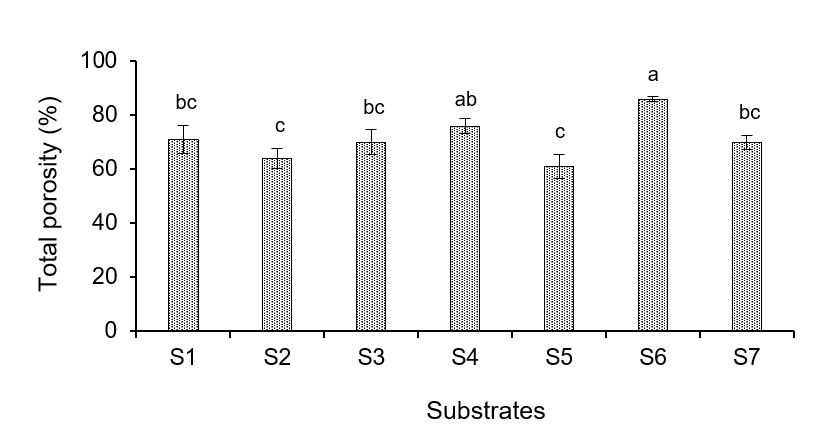
Coconut fiber and its mixtures showed the highest TP values, consistent with Soto-Bravo and Betancourt-Flores (2022) , who recorded values above 90% for this substrate in greenhouse tomato cultivation. Thiessen et al . (2024) also found TP values ranging from 83 to 92% in greenhouse petunia cultivation.
Aeration porosity (AP) varied among substrates ( Figure 2 ), with the highest value in S5 (100% tezontle, 43%), which presented statistically significant differences compared to the other treatments, and the lowest in S7 (100% compost, 17%). Substrate S1 also showed a high value (32%), exceeding the optimal range of 10-30% ( Cabrera, 1995 ; Caron and Michel, 2021 ), along with S5. In contrast, S2, S3, S4 and S6 showed values within the recommended range and no statistically significant differences among them. In general, coconut fiber, compost and their mixtures presented the most adequate AP levels.
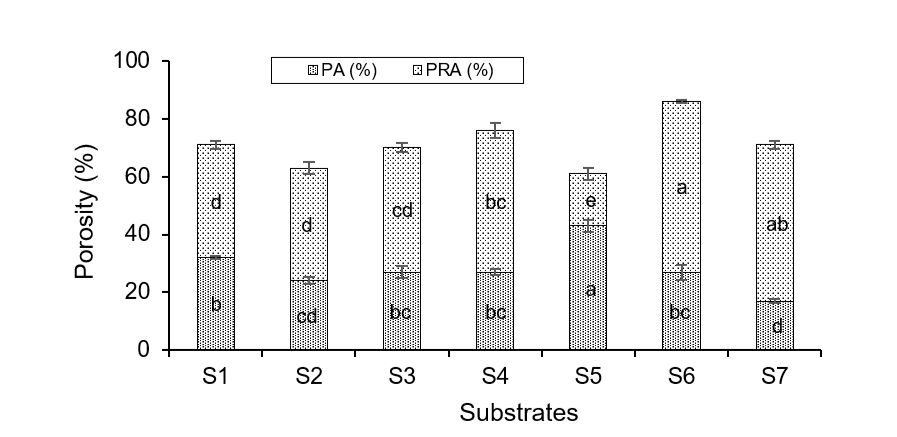
As can be seen in Figure 2 , water retention porosity (WRP) was higher in S6 (100% coconut fiber, 59%), exceeding the minimum value (55%) according to the criteria proposed by Caron and Michel (2021) , and showed significant differences compared to the other substrates, except S7 (100% compost). The lowest value (18%) corresponded to S5 (100% tezontle). The values of compost (53%) and compost-coconut fiber mixture (49%) were close to the minimum threshold suggested by the aforementioned authors.
Gomes et al . (2023) ; Fen et al . (2026) align with those who point out that a higher proportion of coconut fiber increases water retention due to its fibrous texture, which reduces aeration porosity and improves water retention capacity.
Usable water or total available water, consists of two fractions: readily available water (RAW) and reserve water (RW). This fraction represents the volume of water that a plant can absorb and use for its physiological functions ( De Jong et al ., 2024 ). The values of readily available water (RAW) ranged from 7% to 37%, with S6 (100% coconut fiber) having the highest capacity, showing significant differences compared to the other treatments ( Table 2 ).
[i] 1= Abad et al . (1993) . Values that do not share a letter have statistically significant differences (Tukey, p≤ 0.05). RAW= readily available water; RW= reserve water; TAW= total available water; BD= bulk density; S1= tezontle-coconut fiber (50-50%); S2= tezontle-compost (50-50%); S3= tezontle-coconut fiber-compost (34-33-33%); S4= coconut fiber-compost (50-50%); S5= tezontle (100%); S6= coconut fiber (100%); S7= compost (100%).
The mixtures with coconut fiber (S1, S3 and S4) did not differ among themselves; however, only S4 (coconut fiber-compost 50-50%) was within the optimal range (20-30%) recommended by Abad et al . (1993) . Regarding reserve water (RW), substrates S1, S6, and S7 were within the ideal range (4-10%), whereas S4 (11%) was close to the upper limit. Substrates S3 and S4 showed the most adequate total available water (TAW) values (25 and 31%), aligning with the ideal range (24-40%) proposed by Abad et al . (1993) . The tezontle-coconut fiber mixture (50-50%) also presented a value close to the lower limit suggested by these authors (21%).
The bulk density (BD) values were within a range of 0.06 to 0.9 Mg m-3( Table 2 ). The lowest value corresponded to substrate S6 (100% coconut fiber), whereas the highest was recorded by S5 (100% tezontle), with no significant differences compared to S2 (50-50% tezontle-compost), but with significant differences compared to the rest of the substrates. Substrate S4 (50-50% coconut fiber-compost) with 0.32 Mg m-3was within the optimal range (0.2-0.4 Mg m-3) ( Abad et al ., 2005 ).
In this sense, Flores-Sánchez et al . (2025) consider values less than 0.8 Mg m-3as adequate, a criterion that S1, S3 and S7 meet. On the other hand, S6 (100% coconut fiber) with 0.06 Mg m-3was outside the recommended range, indicating excessive porosity and low stability, which favors the gradual physical decomposition of the substrate ( Zhao et al ., 2024 ). Mixtures with coconut fiber and compost showed the most balanced bulk density values.
The particle size of a substrate determines its porosity and, consequently, its ability to retain water and promote aeration ( Durand et al ., 2025 ). To evaluate the granulometry of substrates, Bunt (1988) ; Cabrera (1995) recommend that at least 60% of the particles be between 0.5 and 4 mm and that fine particles (<0.5 mm) should not exceed 20%.
The results shown in Table 3 indicate that all substrates, except S4, exceed the recommended percentage of particles between 0.5 and 4 mm. Nonetheless, only S1, S2, and S3 meet the fine particle limit (<0.5 mm), so they have the best composition. On the other hand, pure substrates of tezontle, coconut fiber, and compost do not guarantee an adequate particle composition because they contain a high percentage of particles smaller than 0.5 mm ( Table 3 ).
[i] 1= Bunt (1988) ; Cabrera (1995) . S1= tezontle-coconut fiber (50-50%); S2= tezontle-compost (50-50%); S3= tezontle-coconut fiber-compost (34-33-33%); S4= coconut fiber-compost (50-50%); S5= tezontle (100%); S6= coconut fiber (100%); S7= compost (100%).
Table 4 presents the results of Pearson’s correlation matrix between the variables analyzed. A high positive correlation was observed between water retention porosity (WRP) and total available water (TAW) (r2= 0.91).
| Variables | FP | CP | AP | WRP | TAW |
|---|---|---|---|---|---|
| FP | 1 | -0.94 | -0.1 | 0.65 | 0.75 |
| CP | -0.94 | 1 | 0.15 | -0.71 | -0.76 |
| AP | -0.1 | 0.15 | 1 | -0.35 | -0.6 |
| WRP | 0.65 | -0.71 | -0.35 | 1 | 0.91 |
| TAW | 0.75 | -0.76 | -0.6 | 0.91 | 1 |
As reported by Fields et al . (2020) ; Durand et al . (2023) , a higher proportion of functional pores significantly enhances the substrate’s ability to retain useful water, thereby improving its water efficiency. This relationship is confirmed in Table 5 , where substrate S6, which had the highest WRP value (58.7%), also had the highest TAW content (44%). Similarly, the lower WRP value (17.5%) coincided with the lower TAW record (9%).
[i] FP= fine particles; CP= coarse particles; AP= aeration porosity; WRP= water retention porosity; TAW= total available water; S1= tezontle-coconut fiber (50-50%); S2= tezontle-compost (50-50%); S3= tezontle-coconut fiber-compost (34-33-33%); S4= coconut fiber-compost (50-50%); S5= tezontle (100%); S6= coconut fiber (100%); S7= compost (100%).
Likewise, Table 4 showed a positive correlation between fine-particle content and TAW (r2= 0.75), consistent with reports by Abad et al . (2005) , who demonstrated that coconut fiber significantly improves the water retention capacity of substrates. This relationship is also expressed in Table 5 , where the highest FP records (S4 and S6) coincide with the higher TAW values.
Regarding the CP-TAW and AP-TAW correlations, both were negative ( Table 4 ). The first showed a correlation coefficient of -0.76 and the second of -0.6, suggesting that increases in coarse particles and aeration pores reduce the fraction of water available in the substrates studied.
These results confirm the importance of water retention porosity (WRP) and fine particle content in the water retention capacity of horticultural substrates. Therefore, it is important to take these physical characteristics into account when combining substrates in order to optimize water use and promote adequate productive performance ( Fields et al ., 2020 ; Durand et al ., 2023 ; Abad et al ., 2005 ).
The substrate with 100% coconut fiber, as well as its combinations, presented the best total porosity values. The best aeration porosity and water retention porosity results corresponded to substrates with 100% coconut fiber, 100% compost and their combinations.
The mixtures composed of tezontle-coconut fiber (50-50%), tezontle-compost (50-50%), and tezontle-coconut fiber-compost (34-33-33%) presented a granulometric composition within the optimal ranges established in the literature; in contrast, the substrates composed exclusively of coconut fiber, tezontle or compost showed a content of fine particles higher than recommended.
A direct correlation was identified between water retention porosity and the percentage of fine particles, with respect to the total available water content of the evaluated substrates.
In contrast, a higher percentage of aeration pores and coarse particles was associated with a decrease in usable water. The substrates composed of mixtures of coconut fiber with tezontle and compost in different proportions (S1, S3 and S4) exhibited the best total available water contents (usable water), a characteristic that ensures efficient water use in protected agricultural production systems.
Durand, S.; Jackson, B. E.; Fonteno, W. C. and Michel, J. C. 2023. Advances in substrate particle characterization using dynamic image analysis compared to sieving procedure for predicting water retention properties. Acta Horticulturae. 1377:537-544. https://doi.org/10.17660/ActaHortic.2023.1377.66.
Landis, T. D. 1990. Containers: types and functions. In: The container tree nursery manual. Landis, T. D.; Tinus, R. W.; McDonald, S. E. y Barnett, J. P. (eds.). Volume 2. Department of Agriculture, Forest Service. Washington, DC, USA. 41-85 pp. https://es.scribd.com/document/594534513/container-tree-nursery-manual-chap-2?utm.
Lazcano-Bello, M. I.; Sandoval-Castro, E.; Tornero-Campante, M. A.; Hernández Hernández, B. N.; Ocampo-Fletes, I. y Díaz-Ruíz, R. 2021. Evaluación de sustratos, solución nutritiva y enraizador en producción de plántulas de jitomate. Revista Mexicana de Ciencias Agrícolas. 12(1):101-113. https://doi.org/10.29312/remexca.v12i1.2450.
Velázquez-González, R. S.; García-García, A. L.; Ventura-Zapata, E.; Barceinas- Sánchez, J. D. O. y Sosa-Saavedra, J. C. 2022. Una revisión sobre la hidroponía y las tecnologías asociadas para operaciones de mediana y pequeña escala. Agriculture. 12(5):646. https://doi.org/10.3390/agriculture12050646.
Zhao, R.; Sofkova- Bobcheva, S.; Cartmill, D. L.; Hardy, D. y Zernack, A. 2024. Evaluación comparativa de la piedra pómez como sustrato sin suelo para el cultivo en interiores de Rubus idaeus L. New Zealand Journal of Crop and Horticultural Science. 52(3):280-297. https://doi.org/10.1080/01140671.2024.2358885.