elocation-id: elocation-id: e4109
Increasing irrigation water productivity (WP) is essential to address water scarcity and ensure agrifood sustainability, especially in arid and semi-arid regions. To this end, a bibliometric analysis of the scientific literature on WP in agriculture was conducted. This research aimed to characterize global scientific output, global trends, the most influential actors, and the main lines of research in this field. A total of 3 833 documents published in Scopus between 1983 and 2024 were analyzed using bibliometric indicators. The results show exponential growth in scientific output since 2009. China, India and the United States of America account for 55% of global production. The most influential journal was Agricultural Water Management, with 776 publications, whereas China Agricultural University stood out as the institution with 181 publications and 7 058 citations. Thematic mapping identified five main clusters: agronomic strategies, sustainability and climate change, strategic crop management, agricultural modeling and ecophysiological bases. In short, water productivity has consolidated itself as a strategic axis of global agricultural research. This study offers a comprehensive view that can guide future research, drive agronomic innovation and strengthen policies for more efficient water management in agriculture.
agricultural efficiency, global trends, water resources.
Rapid global population growth and pressure on agrifood systems make it necessary to improve agricultural productivity to ensure food security ( Tripathi et al ., 2024 ). It is estimated that food production will need to increase by at least 50% ( Simatele et al ., 2023 ).
Agriculture uses more than 70% of available freshwater ( Ma et al ., 2024 ), so it is essential to reduce irrigation water consumption while maintaining or increasing production with the same volume of water ( Kang et al ., 2017 ).
One of the most widely used metrics for assessing water use efficiency in agricultural systems is water productivity (WP) ( Ma et al ., 2024 ). Molden et al . (2010) define WP as the ratio of the net benefits of crop, forestry, fisheries and livestock farming systems to the amount of water used to produce those benefits.
According to Heydari (2014) , this term was introduced by Molden in 1997 to analyze water use at different levels of aggregation, emphasizing the value of water used in agriculture and distinguishing it from concepts such as irrigation efficiency and water use efficiency.
Various studies have tried to identify effective solutions to increase WP in agriculture. For example, Abera et al . (2025) developed a methodology to model corn production and WP under deficit irrigation (DI) and mulching conditions.
Authors such as Fernández et al . (2020) have shown that the combined use of water-efficiency indicators and economic analyses favors informed decision-making to optimize WP across different cropping systems. Patanè et al . (2011) found that DI can reduce water consumption while maintaining or increasing yield in semi-arid environments.
For their part, Li et al . (2024) proposed a climate-smart irrigation strategy aimed at strengthening food security and water sustainability in the face of climate change (CC) scenarios.
Improving WP through management strategies and irrigation technologies is essential to ensure food and water security, especially in the face of CC scenarios ( Abera et al ., 2025 ). In water-scarce regions, where irrigation is essential for livelihoods and income generation, it is vital to develop socioeconomic approaches that reduce water consumption without compromising agricultural production ( Molden et al ., 2010 ).
Nonetheless, despite the progress of experimental and applied research, there is still no systematic analysis to assess the evolution and dynamics of research on WP in agriculture. This deficiency limits understanding of the field’s scientific development and hinders the formulation of effective water management policies and strategies.
From this perspective, this study aimed to characterize global scientific production on WP in agriculture using bibliometric techniques, in order to identify the main drivers of knowledge and the most influential countries and institutions, and to map the trends shaping the global scientific agenda on the efficient use of water in agriculture.
The bibliometric analysis was conducted using the Scopus database because of its broader thematic coverage and a larger number of indexed journals compared with Web of Science (WoS) ( Martín et al ., 2021 ). The search was carried out in September 2025; documents published between 1983 and 2024 were considered, using the criterion: ‘water productivity’ and ‘crop’.
The equation applied was: title-abs-key ‘water productivity’ and ‘crop’ and pubyear >1983 and pubyear <2025 and limit-to doctype, ‘ar’ or limit-to doctype, ‘ch’ or limit-to doctype, ‘bk’ and exclude subjarea, ‘psyc’. A total of 3 833 documents were obtained, of which 95.6% were scientific papers, 3.9% were book chapters, and 0.5% were books. The documents were exported to a tab-delimited text format (TXT) file for Windows.
The following variables were identified: total scientific productivity, total number of publications, number of citations, average citations per year, H-index and the impact factor of SCImago Journal Rank (SJR) journals. The H-index is a metric for evaluating the impact of scientific publications by balancing the number of publications with the number of citations received ( Ortega et al ., 2021 ). The SJR measures the prestige and scientific impact of academic journals based on the citations received and the relevance of the sources that cite them ( Ochoa et al ., 2020 ).
The text file downloaded from Scopus was imported into VOSviewer software (version 1.6.20, Leiden University, Leiden, Netherlands) ( Narong and Hallinger, 2023 ) and the institutions involved in the publications were identified using the ‘organizations’ metric. Countries were verified using VOSviewer analysis by examining the co-authorship of documents restricted to countries. Finally, bibliometric maps were generated showing the main institutional co-authorships and keyword co-occurrence.
A minimum threshold of 40 occurrences was applied to a total of 12 210 keywords, unifying synonyms, excluding country names, and using the association normalization method and clustering algorithm proposed by van Eck and Waltman (2010) .
The evolution of scientific production on WP between 1983 and 2024 shows sustained, accelerated growth starting in 2009, when a turning point in interest in the subject is observed. Since then, the number of publications has increased exponentially, reaching 432 papers in 2024, reflecting growing attention to water scarcity, global food demand, and the need for efficient water resources management ( Tolimir et al ., 2024 ).
The first formal publication on the concept of WP was by Droogers and Cometa (1999) , entitled ‘water productivity from integrated basin modeling’. This pioneering study developed a simulation model of Turkey’s water balance to assess water use efficiency at different levels of agricultural management, laying the methodological basis for further studies.
The analysis of scientific productivity in WP shows a high geographical concentration of knowledge, with a predominance of Asia ( Figure 1 ). The three leading countries (China, India and the United States of America) account for more than 2 100 publications (55% of the world total).
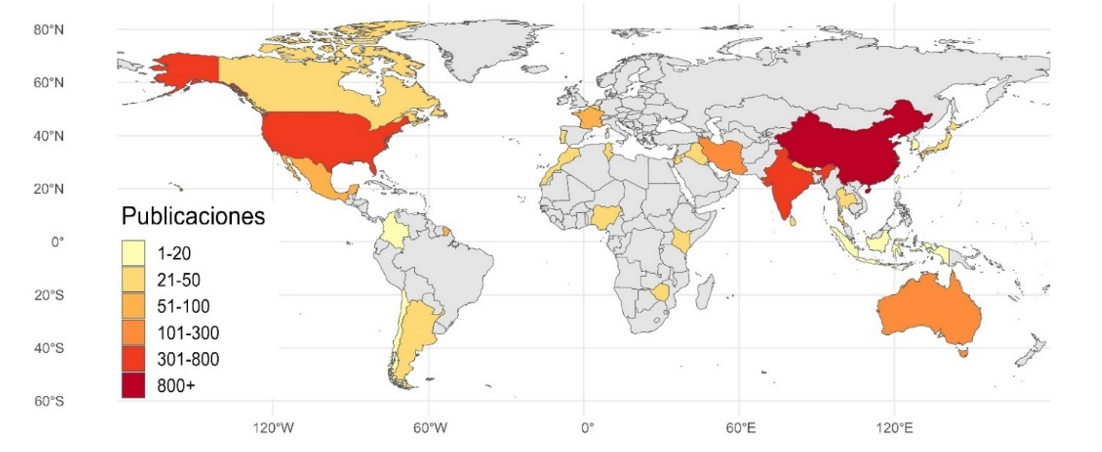
China leads the ranking with 839 publications, surpassing the United States of America by 18.3%. Nevertheless, a large part of its recent publications has fewer than 50 citations, reflecting its rapid expansion and scientific consolidation. According to Hu et al . (2025) , China’s scientific growth results from a long-term national strategy based on massive investment in research, innovation policies, and international openness.
The research by Kalashnikova et al . (2024) points out that this progress has also been favored by government support and continued investments in research and development (R+D), which exceed those of the United States of America and the European Union. Together, these actions have consolidated China’s comparative advantage in generating scientific knowledge globally ( Xie and Freeman, 2019 ).
Mexico ranks twentieth with 56 publications (98.2% papers and 1.8% book chapters), 1 131 citations and an H-index of 16. This limited production reflects a scarcity of comprehensive data and a restricted research focus, which makes it difficult to conduct comprehensive analyses and develop effective water management strategies ( Velázquez and Valdez, 2022 ). In addition, low national funding for R+D (less than 0.5% of GDP, below the average of OECD countries) is a structural factor that slows the progress of scientific research ( Estévez et al ., 2021 ).
Scientific production on WP is concentrated in a limited number of high-impact specialized journals, mainly in five countries ( Table 1 ). Agricultural water management tops the list, with the highest number of publications, an H-index of 90 and an SJR of 1.757, consolidating its position as the main platform for disseminating knowledge on the subject. It is followed by Field Crops Research, which focuses on crop physiology, ecology, and management.
Other prominent journals include Irrigation and Drainage, Irrigation Science and the Swiss journals Agronomy, Water and Sustainability, which have gained relevance by integrating approaches to water efficiency, climate change and agri-environmental sustainability. Collectively, most are in quartiles Q1 and Q2, reflecting the maturity and international visibility of WP research.
In summary, research on WP is mainly disseminated in journals of academic excellence and high impact factors, which confirms its consolidation as a mature and strategically relevant scientific area.
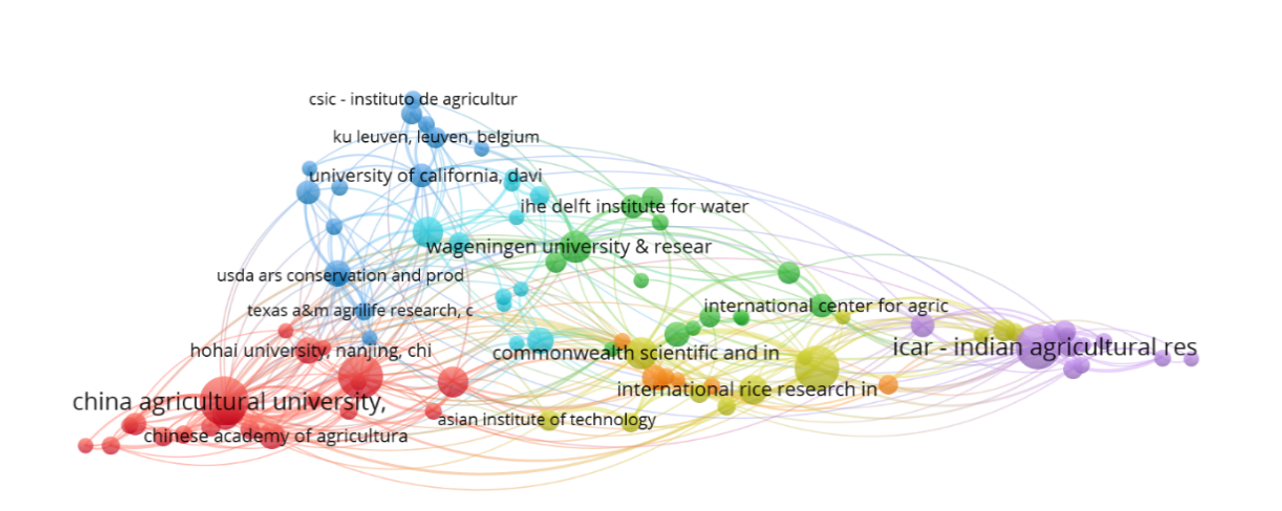
Figure 2 shows the most prolific institutions in WP research during the period 1983-2024. China Agricultural University leads the ranking with 181 publications, 7 058 citations and an H-index of 68, consolidating itself as the world’s leading center in this line of research. The network records relationships among institutions, and node size reflects the number of publications.
The second institution is Northwest A & F University, with 163 articles, 5 409 citations, and an H-index of 39. In third place are Punjab Agricultural University and the ICAR-Indian Agricultural Research Institute, with 146 publications, average citations per paper of 26.8 and 22.9, and H-indexes of 10 and 16, respectively.
The institutional co-authorship map shows an international collaboration structure comprising five main clusters. The red cluster, led by China Agricultural University, integrates Chinese universities with strong ties to the Asian Institute of Technology and CSIRO, forming the dominant Asian network. The intense green cluster, led by Wageningen University & Research and the IHE Delft Institute for Water Education, constitutes the European core focused on sustainable water management and water governance.
The blue cluster brings together North American institutions such as the University of California-Davis, the USDA and Texas A&M University, which maintain active cooperation with Europe. The green-yellow cluster links the International Rice Research Institute (IRRI) with the CSIRO, articulating a network of research applied to strategic crops and agricultural sustainability. Finally, the purple cluster, headed by the ICAR-Indian Agricultural Research Institute, represents the Indian network, with growing links to Asia and Europe.
Overall, this analysis shows that international collaboration around WP is concentrated in high-performing scientific institutions, located mainly in Asia, Europe and North America. In contrast, Latin America’s participation remains limited, evidencing the need to strengthen its integration into global research networks.
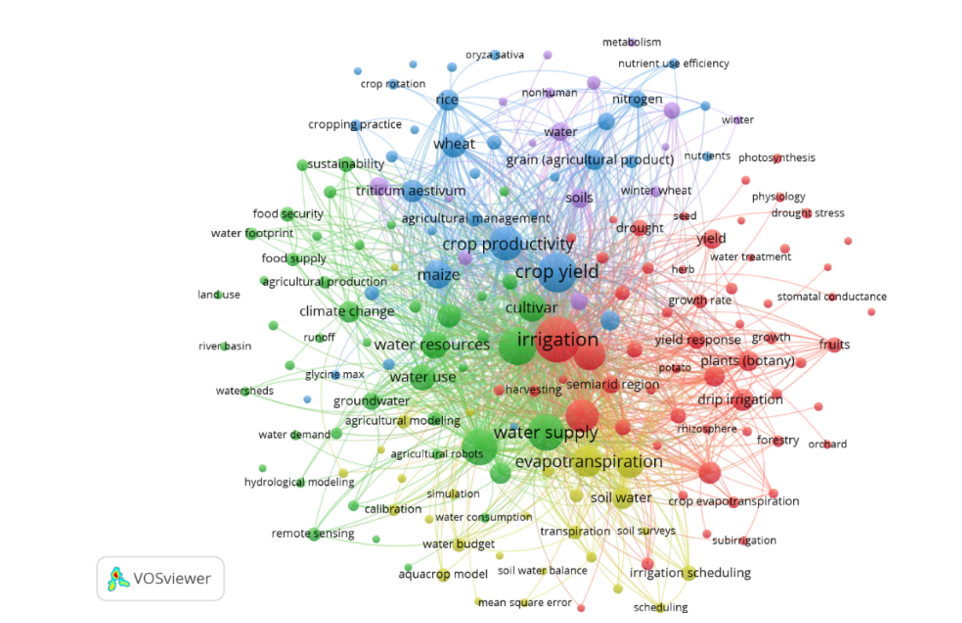
The analysis of keyword co-occurrence allowed us to identify the main thematic lines and research trends around WP, based on the frequency and association of relevant terms ( Figure 3 ). The size of the nodes reflects the frequency of term use and the colors distinguish five main clusters.
The red cluster brings together studies on agronomic and ecophysiological strategies aimed at optimizing water use under conditions of water scarcity. Water use efficiency depends on appropriate decisions about irrigation systems and scheduling ( Fernández et al ., 2020 ), as well as the adoption of validated agronomic practices ( Molden et al ., 2010 ).
Measures such as DI, irrigation scheduling, and crop selection have shown strong potential to increase yields with lower water consumption ( Patanè et al ., 2011 ). Under conditions of water scarcity, Tolimir et al . (2024) showed that applying DI at 80% of ETc, combined with high planting density (75 200 plants ha-1), saves up to 37% of water, with only a 10% reduction in corn grain yield.
Similarly, Patanè et al . (2011) reported that the use of DI in tomatoes reduced water consumption by 48%, while improving fruit quality. The green cluster brings together research aimed at integrated water management and agrifood sustainability in the context of CC. Efficient water management consolidates its position as a strategic axis for sustaining food production in the face of population growth and the intensification of climatic phenomena.
As Kang et al . (2017) point out, ‘there is no food security without water security’. Li et al . (2024) showed that climate-smart irrigation enables more timely and accurate applications, which increases the resilience of crops to adverse environmental conditions. This strategy is essential for strengthening hydro-agricultural sustainability in CC scenarios. Likewise, Abera et al . (2025) documented that the increase in ETo associated with rising temperatures causes a significant reduction in agricultural yields.
The blue cluster brings together research focused on agronomic management and the productive efficiency of strategic crops, with an emphasis on increasing WP. Wu et al . (2024) showed that using plastic mulch significantly improves the WP and yield of corn under rainfed conditions, especially in the Zhengdan 958 (ZD) cultivar, registering increases of 21.7% in yield and 26.9% in WP compared to the treatment without mulch.
This effect is attributed to a larger leaf area, higher chlorophyll content, and a higher photosynthetic rate, as well as a more efficient root-to-stem ratio that favors biomass accumulation. In a complementary manner, Lepcha et al . (2024) evaluated the effect of micro-sprinkler irrigation combined with nutritional management in cardamom, finding a positive linear correlation between yield and the volume of water applied.
These results confirm that integrating water and nutrient management, together with the selection of adapted crops, can optimize water use efficiency. The yellow cluster brings together research that uses agricultural simulation models as strategic tools to assess water efficiency.
These tools integrate agronomic, climatic, and soil information to generate productive scenarios useful in decision-making ( Abera et al ., 2025 ). Liu et al . (2007) applied the GEPIC (EPIC + GIS) model to estimate wheat yield and WP in Africa, demonstrating that optimal water and fertilizer supply significantly increases agricultural production.
The purple cluster brings together studies focused on the ecophysiological and productive bases of agricultural systems, providing experimental support for the other clusters. Tripathi et al . (2024) provide evidence on the ecophysiological responses of mung bean ( Vigna radiata L.) to different waste management strategies and irrigation schemes.
In a complementary manner, Al-Qthanin et al . (2024) showed that mulching with rice straw combined with DI in orange trees improves soil moisture retention, increases photosynthetic pigments (chlorophyll and carotenoids), reduces proline content (an indicator of water stress) and favors fruit retention. These results allow us to establish functional relationships between soil water status, plant physiology and crop yield.
The analysis of keyword co-occurrence reveals an interconnected and hierarchical thematic structure, in which terms such as irrigation, crop yield, water resources, evapotranspiration and climate change constitute the conceptual axes of the field.
The cluster network reflects strong integration among agronomic, hydrological and ecophysiological approaches, closely linked to emerging topics of sustainability and climate management. In addition, the presence of terms such as remote sensing, water footprint and agricultural modeling indicates an evolution towards technological and multidisciplinary approaches in the management of agricultural WP.
The bibliometric analysis of water productivity (WP) in agriculture shows continuous, accelerating growth in scientific output over the last two decades, driven by increasing pressure on water resources and by the need to ensure food security in the context of climate change. The thematic evolution reflects a diversification of knowledge, organized into five clusters that range from agronomic and ecophysiological strategies to modeling, sustainability and physiological foundations.
Geographically, China, India and the United States of America lead the scientific production on WP, with different levels of maturity and impact. Likewise, the journal Agricultural Water Management consolidates itself as the primary means of dissemination, whereas China Agricultural University stands out as the institution with the highest level of scientific output. In contrast, Mexico has limited participation; however, it has growth potential if its institutional capacities, international networks and research agenda focused on efficient water management are strengthened.
This study offers a comprehensive perspective on the scientific development around WP by identifying gaps, trends and key actors, and provides a solid basis to guide efficient strategies in water management, agronomic innovation and public policymaking. In summary, WP consolidates itself as a strategic and multidimensional indicator, essential to face the global challenges of water scarcity, agrifood sustainability and climate resilience.
Al-Qthanin, R. N.; AbdAlghafar, I. M.; Mahmoud, D. S.; Fikry, A. M.; AlEnezi, N. A.; Elesawi, I. E.; AbuQamar, S. F.; Gad, M. M. and El-Tarabily, K. A. 2024. Impact of rice straw mulching on water consumption and productivity of orange trees [Citrus sinensis (L.) Osbeck]. Agricultural Water Management. 298(1):1-15. https://doi.org/10.1016/j.agwat.2024.108862.
Estévez, E. H.; Valdés, A. A.; González, E. O.; Durand, J. P.; Lloyd, M.; Martínez, J. G. and Parra, L. G. 2021. Higher education, science, technology and academics in méxico: at a crossroads. Universities in the knowledge society: the nexus of national systems of innovation and higher education. Aarrevaara, T.; Finkelstein, M.; Jones, G. A. and Jung, J. 357-373 pp. https://doi.org/10.1007/978-3-030-76579-8-20.
Hu, A.; Zhou, S. and Xie, Y. 2025. The great leap development and Outlook of China’s scientific and technological strength (2000-2035). In study on the national conditions of modernization with Chinese characteristics. Hu, A.; Zhou, S. and Xie, Y. 243-272 pp. https://doi.org/10.1007/978-981-97-7447-0-8.
Kang, S.; Hao, X.; Du, T.; Tong, L.; Su, X.; Lu, H.; Li, X.; Huo, Z.; Li, S. and Ding, R. 2017. Improving agricultural water productivity to ensure food security in China under changing environment: from research to practice. Agricultural Water Management. 179(1):5-17. https://doi.org/10.1016/j.agwat.2016.05.007.
Lepcha, R.; Patra, S. K.; Poddar, R.; Sarkar, A.; Ray, R.; Alharbi, S. A.; Ansari, M. J. and Hossain, A. 2024. Microsprinkler irrigation in combination with nutrient management influences crop and water productivity and water-nutrient dynamics in large cardamom-growing soils in the hilly sub-Himalayan region of India. Journal of Water and Climate Change. 15(7):3074-3093. https://doi.org/10.2166/wcc.2024.683.
Li, M.; Zhou, S.; Shen, S.; Wang, J.; Yang, Y.; Wu, Y.; Chen, F. and Lei, Y. 2024. Climate-smart irrigation strategy can mitigate agricultural water consumption while ensuring food security under a changing climate. Agricultural Water Management. 292(1):1-11. https://doi.org/10.1016/j.agwat.2023.108663.
Tolimir, M.; Gajić, B.; Kresović, B.; Životić, L.; Gajić, K.; Brankov, M. and Todorovic, M. 2024. Impact of deficit irrigation and planting density on grain yield and water productivity of maize grown under temperate continental climatic conditions. Agricultural Water Management. 302(1):1-12. https://doi.org/10.1016/j.agwat.2024.109009.
Tripathi, S.; Kaur, A.; Brar, A. S.; Sekhon, K. S.; Singh, S.; Malik, A. and Kisi, O. 2024. Optimizing yield and water productivity in summer mung bean (Vigna radiata L.) through crop residue management and irrigation strategies. BMC Plant Biology. 24(1):2-17. https://doi.org/10.1186/s12870-024-05640-1.
Wu, L.; Quan, H.; Wu, L.; Zhang, X.; Ding, D.; Feng, H.; Siddique, K. H. M.; Liu, D. L. and Wang, B. 2024. Plastic mulching enhances maize yield and water productivity by improving root characteristics, green leaf area and photosynthesis for different cultivars in dryland regions. Agricultural Water Management. 305(1):2-11. https://doi.org/10.1016/j.agwat.2024.109105.