elocation-id: e4102
Haematoxylum campechianum L., known as palo de Campeche or palo de tinte and as éek, tooso boon che’ or palo among the Mayans, has high commercial value and grows as a wild plant in the Yucatan Peninsula; this species is a taxon distributed in the region, with historical, patrimonial and economic value due to its commercialization as a raw material to extract natural dyes. The objectives of this research were to determine the morphometry, viability and germination of palo de tinte seeds in Campeche as a function of temperature and storage period in order to increase their forest use potential. Seeds were collected in the municipality of Escárcega, Campeche, in March 2024. Germination and viability (tetrazolium test) tests were performed every 30 days for eight months at different temperatures (-18 °C, 3 °C, 23 °C, and room temperature ≈ 31 °C). Significant differences (p < 0.05) were found in the percentage of germination (% G) as a function of storage time, where the highest percentage of germination (90%) was at the temperature of 3 °C. Viability was maintained for 180 days, then gradually decreased; based on the characteristics found, it is inferred that H. campechianum seeds are classified as intermediate.
Haematoxylum campechianum L., forest, physiology, seed.
Mexico ranks seventh among countries with the highest deforestation rates worldwide, with the country’s tropical regions suffering the greatest environmental damage due to different human activities (FAO, 2025).
Tropical forests are better represented in the southeast of the country, where there are privileged sites, such as the states of Chiapas, Tabasco, and Campeche, which have multiple factors such as precipitation, light, temperature, soils, and topography, among others, which, when interacting, determine the distribution of vegetation (SEMARNAT, 2017).
H. campechianum is a wild tree of the Yucatan Peninsula belonging to the Fabaceae family; it is found in lowlands with clayey and deep soils with little drainage (Niembro, 2002), in which lowland floodable forest, known as Ak’alche in Mayan terminology, develops (Chable-Vega et al., 2019).
H. campechianum often forms dense clumps known as tíntales. Due to its wide ecological plasticity, it manages to adapt to different environments and grows in association with tall sub-evergreen forest, medium semideciduous and sub-evergreen forest, mangroves, shrublands, riverbanks or banks of other bodies of water, and secondary vegetation (Pennington and Sarukhán, 1998; Niembro, 2002).
This taxon has historical, patrimonial, and economic value due to its commercialization as a raw material to extract hematoxylin, a natural dye (Contreras, 2010) that is used in cytological applications to stain chromatin by binding to acidic components such as phosphate groups of nuclear DNA; it is also attributed with anti-inflammatory, antioxidant, antiseptic, and anticancer properties (Duke, 2008).
Likewise, it is still used as a natural dye for textile fibers and in handicrafts for dyeing clothing, hammocks, and jipijapa hats; due to the hardness of its wood, it is also used in fence posts and the production of charcoal (Peng et al., 2014; Plasencia et al., 2017).
Currently, many tíntales are suffering significant reductions associated with anthropogenic activities in their habitat, such as the destruction, degradation, and fragmentation of ecosystems, mainly due to agricultural expansion, urbanization, and illegal logging (Vester et al., 2007).
Deforestation in the sites where the tíntales are located points to an imminent risk to their populations, with the danger that this poses to all the diversity of associated flora and fauna (Plascencia-Vázquez et al., 2025).
For this reason, and the value that palo de tinte represents from an economic point of view and for diversity, it is decisive to implement reforestation and conservation programs. Although research on the germination processes of H. campechianum seeds is scarce, it is necessary to know their physical and physiological quality after harvest and how it changes over storage time in order to develop an adequate management plan for their conservation.
Based on responses to desiccation, seeds are mainly divided into two categories: orthodox (desiccation-tolerant) and recalcitrant (desiccation-sensitive) seeds (Roberts, 1973). Orthodox seeds can be stored after dehydration under a wide range of environmental conditions; on the other hand, recalcitrant seeds do not tolerate dehydration and therefore, it is very difficult to preserve them by traditional methods in germplasm banks (Ellis et al., 2007).
There is a third group of seeds that are recognized as intermediate; as their name indicates, their behavior is intermediate between recalcitrant and orthodox (Hong and Ellis, 1996), but they are tolerant to desiccation.
The physiological quality of a seed influences the sum of all the characteristics that determine its behavior and the possible level of crop development; the components of seed quality are influenced by genetic, physical, physiological and health aspects (Velázquez, 2014; ISTA, 2024).
Therefore, the objective of this research was to determine the viability and germination of H. campechianum seeds as a function of temperature and storage period, in order to determine the temperature and maximum storage time that guarantee high germination percentages.
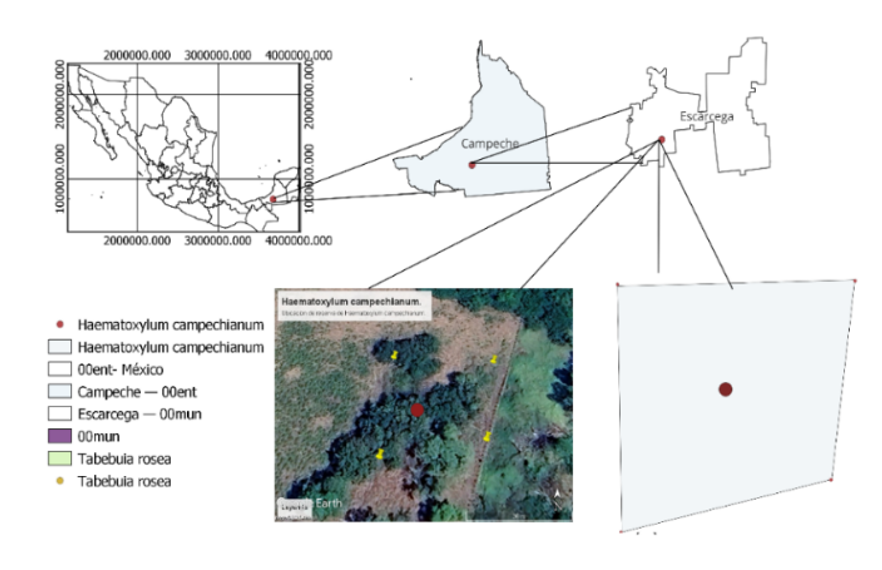
H. campechianum seeds were collected on March 21, 2024, in the municipality of Escárcega, Campeche, with coordinates: 18.4221259, -90.7944725; 18.4249464, -90. 7884012 (Figure 1); the climate is warm-subhumid with rainfall in summer, the average annual temperature is 26 °C and the annual rainfall is 1 100-1 200 mm (García, 2004).
The collection was carried out according to the methodology of Vallejos et al. (2010); the seeds were obtained directly from the crown of 20 trees and stored in henequen sacks; in order to avoid the accumulation of moisture and with it the presence of fungi, the seeds were immediately transported for processing to the Laboratory of Ecophysiology of Tropical Crops of the National Technological Institute of Mexico, Chiná Campus, located in the state of Campeche, Mexico (19° 45’ 37” north latitude; 90° 29’ 46” west longitude), with an altitude of 20 masl and a predominant warm sub-humid climate with rainfall in summer from June to October, average annual temperature of 26 °C, and precipitation varying between 1 100 mm and 2 000 mm (García, 2004).
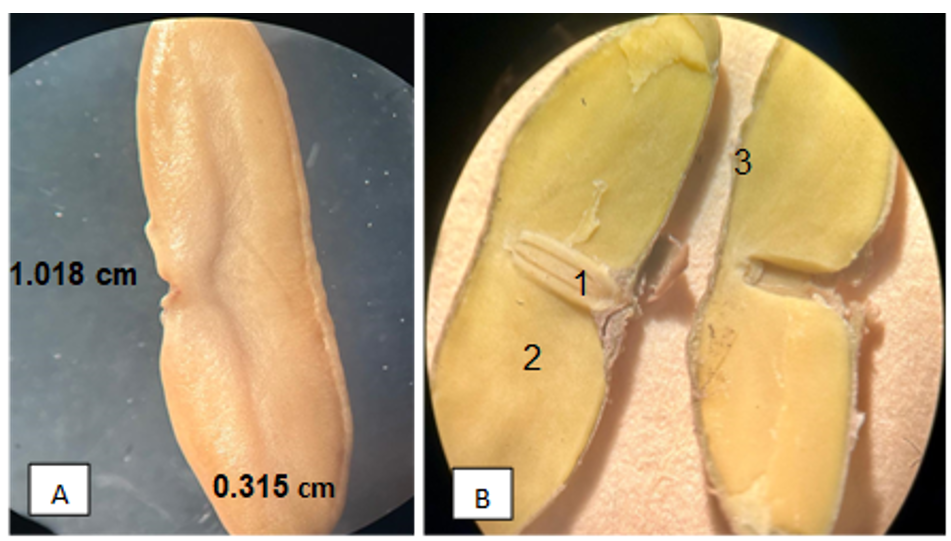
Healthy, whole and uniform seeds were used. Four groups of 20 seeds were randomly selected and the variables that were quantified were length (mm) and width (mm) of the seed using a digital caliper (Truper® CAL-6MP digital vernier) (Figure 2).
Physical and physiological parameters of seeds at the start of the study. The following physical parameters of seed quality were determined at the beginning of the study, one day after collection, prior to storage: weight of 100 seeds, purity, moisture content, percentage of seed viability by tetrazolium topographic test and percentage of germination by paper test. A homogeneous sample size was used as specified in the rules of the International Seed Testing Association (ISTA, 2024), 100 seeds for each test with three replications.
Weight of 100 seeds. One hundred seeds were weighed in triplicate using a 0.001 g precision digital balance (Ohaus Adventurer®). The data obtained were used to determine the number of seeds per kilogram (ISTA, 2024): Number of seeds per kg= (number of seeds in the sample/weight of the sample (g)*1 000).
Physical purity. The seed is considered pure if it appears normal in terms of its size, shape and overall external appearance. Conversely, a seed that is too small has been partially eaten by insects, or shows spots produced by fungi are considered impure. It was determined by separating a representative sample into three main components: pure seed, other seeds and inert matter. Next, the pure seeds were weighed. The percentage of purity was calculated using the following formula (ISTA, 2024): % purity= (weight of clean seeds/weight of the sample)*100.
Moisture content. The oven-drying method was employed, using three replications of 100 seeds. The seeds were placed in brown paper envelopes and then placed in the drying oven (Thermo Scientifics®) at 95 °C for 72 h; after the drying period, the weight of the dry matter was measured using the digital scale. To quantify the moisture content, the following formula was applied (ISTA, 2024): moisture content (%)= [(fresh weight - anhydrous weight)/ fresh weight]*100.
Initial viability test. Seed viability was determined using the tetrazolium technique in accordance with the international regulations of ISTA (2024), which consisted of immersing the seeds in a 1% 2,3,5-triphenyltetrazolium chloride solution for 8 h at room temperature in the absence of light. Previously, a transverse cut was made in the seed using a scalpel to facilitate the penetration of the solution. Subsequently, the excess solution was removed and viability was evaluated using a stereoscope (10 x).
Seed viability was determined according to the coloration of the embryo: fully stained seeds (viable and vigorous embryos), partially stained seeds (viable embryos with half vigor) and unstained seeds (non-viable embryos) (Rao et al., 2007). Three replications of 20 seeds were evaluated; it was determined at the beginning of the experiment, once the seeds were collected. Viability was determined with the following expression: % viability= number of seeds stained/total number of seeds.
Initial germination. A germination test is performed to determine what proportion of the seeds in an accession will germinate under favorable conditions and produce normal seedlings (seedlings with essential structures: roots, shoots and sufficient food reserve, capable of developing into reproductively mature plants) (Rao et al., 2007). Initial germination was determined in recently collected seeds according to the rules of seed analysis (ISTA, 2024) using four replications of 100 seeds and the paper germination method; it was expressed as a percentage of normal plants (%), with the following formula (ISTA, 2024): % germination= number of seeds germinated/number of seeds sown*100.
Four seed storage environments were evaluated, consisting of four temperatures: 31 °C at room temperature, 23 °C in an incubation room, 3 °C in a cold room and -18 °C in a freezer (Samsung®). Hobo H8-032-08 sensors (Onset Computer Corporation, USA) were used to record the temperature and relative humidity in the storage environments. Temperatures were defined based on studies on other tropical tree species (Santillán-Fernández et al., 2023).
To analyze the effect of temperature (31, 23, 3, -18 °C) over a storage period of 240 days (eight months), a completely randomized design was established with three replications of 20 seeds per storage temperature, and the evaluation was performed every 30 days.
Seed viability was determined using the tetrazolium technique in accordance with the international regulations of ISTA (2024), which consisted of immersing the seeds in a 1% 2,3,5-triphenyltetrazolium chloride solution for 8 h at room temperature in the absence of light. Subsequently, the excess solution was removed, and viability was assessed using a stereoscope (10 x).
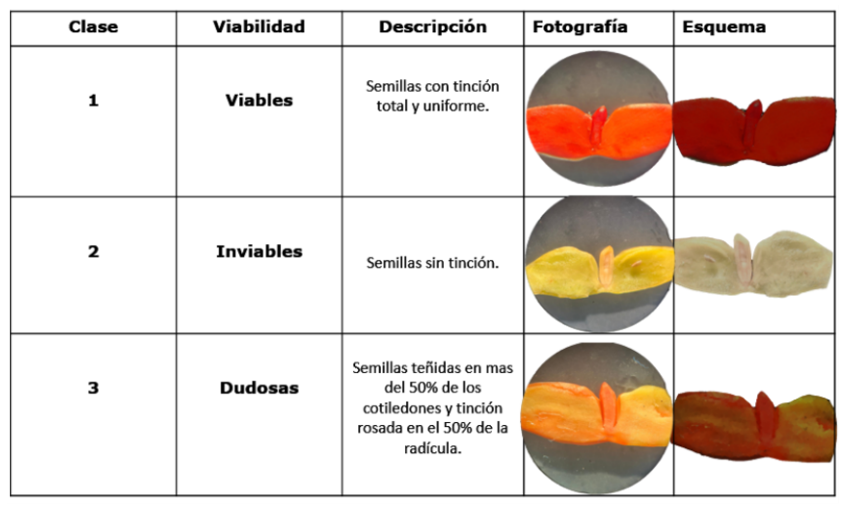
According to the classification system of Pérez-Mendoza (2018), three categories were considered: class 1= seeds stained completely and uniformly (viable and vigorous embryos); class 2= unstained seeds (non-viable embryos); and class 3= partially stained seeds (doubtful seeds, 50% staining, partially viable embryos).
Seed germination percentage was evaluated as a function of temperature and storage period using the paper germination test, with four replications of 100 seeds for each temperature. The seeds were evenly distributed on layers of previously moistened (brown) paper, which were placed in plastic boxes.
The first count was carried out five days after the sample was mounted in the trays to obtain the number of germinated seeds, and from this indicator, the count was done every seven days. The seed was considered germinated when the radicle reached approximately 0.5 mm in length (Vadillo et al., 2004).
Data were subjected to an analysis of variance with the PROC GLM procedure of SAS 9.2® (SAS Institute Inc., 2009) and comparison of means with Tukey’s test (p ≤ 0.05). In all cases, the assumption of normality and the homogeneity of variances were assessed using the Shapiro-Wilk and Levene tests, respectively (Contreras-Cruz, 2023).
The results of the morphometric analysis of seeds indicate that they are transversely oblong, laterally flat, 1 to 3 cm long, 1 to 2 cm wide and 0.7 to 1 mm thick (Figure 2). The description found here coincides with that reported by Niembro (2002), with a slightly brown, smooth, opaque, leathery seminal coat, marked on its lateral surface by a greenish-gray line or a sinuous, deep longitudinal depression.
Physical and physiological parameters of seeds at the start of the study. The initial quality tests were conducted, and the following results were found: a weight of 5.899 g in 100 seeds, purity of 98.6%, moisture content of 6.15%, viability of 95% seeds per kg of 16 952 and germination percentage of 97.7% (Table 1).
| Weight of 100 seeds (g) | Seed purity (%) | Moisture content (%) | Viability (%) | Seeds per kg | Germination (%) |
|---|---|---|---|---|---|
| 5.899 | 98.6 | 6.15 | 95 | 16 952 | 97.7 |
A purity of 98.6% was found because the seeds were collected directly from the tree canopy, so there were no garbage or other materials foreign to the seeds. Seed storage under adverse conditions causes aging, resulting in materials with a reduced germination capacity (Magdaleno-Hernández et al., 2020).
The moisture content of the seeds was 6.15%; this value indicates that the seeds can be stored for several months and guarantees their quality; on the contrary, a moisture content of 20% is not suitable for storage since the storage time of the seeds decreases as the moisture content of the seeds increases (Hay et al., 2023).
The highest-quality seeds were observed at the storage temperature of 3 °C. Seeds with total and uniform staining, seeds without staining, and seeds partially stained were observed (Figure 3). Red staining of embryos indicates seed viability, resulting from the respiratory activity of mitochondria, showing cell viability (Busso et al., 2015).
These patterns have been reported in other species such as Cedrela odorata L., Cariniana pyriformis Miers (Espitia-Camacho et al., 2017), Coffea arabica L. (Flechas-Bejarano and Medina-Rivera, 2021) and Roseodendron donnell-smithii (Agustín-Sandoval et al., 2017). For storage conditions (at different temperatures), at 30-day intervals, a gradual decrease in seed viability was observed for temperatures of 31 °C and -18 °C; after 60 days of storage, 65% viability was observed; on the contrary, the temperature of 3 °C was best for seed storage, maintaining a viability percentage of 85% after 180 days.
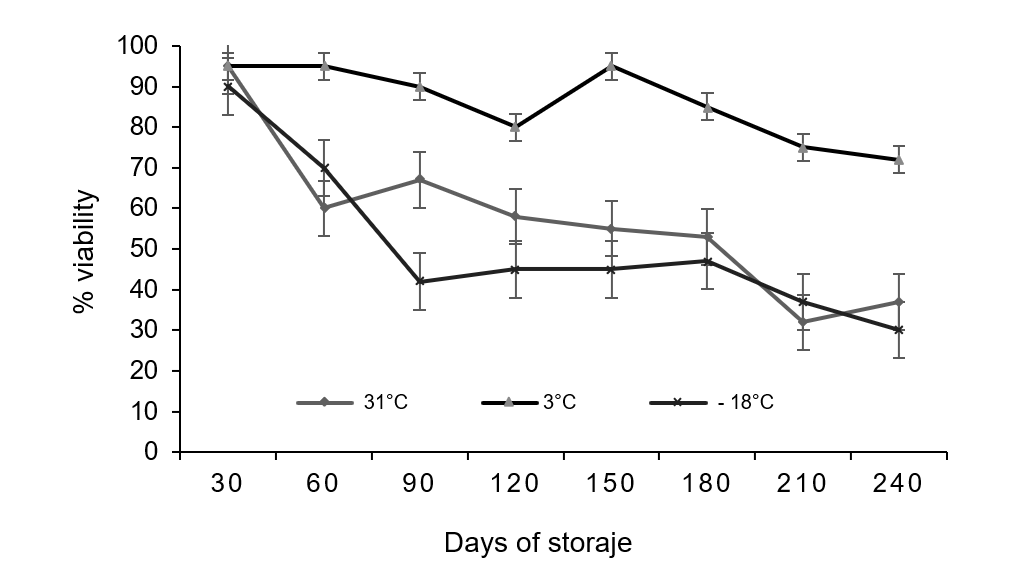
For the temperature of 23 °C, viability was perceived to decrease to 60% after 120 days of storage (Figure 4). In the Fabaceae family, few studies have been carried out to know the tolerance to desiccation; Galíndez et al. (2015) identified the effect of storage on two subtropical species of Fabaceae, Amburana cearensis (Allemao) AC Sm and Myroxylon peruiferum Lf, noting that seeds of A. cearensis stored at -18 °C for twelve months were classified as orthodox, while those of M. peruiferum were sensitive to desiccation and storage at -18 °C.
Statistical analyses indicated significant differences among storage conditions (31 °C, 23 °C, 3 °C, and -18 °C) in the different seed storage times (p < 0.001), between 30 and 240 days (Figure 5). The highest germination percentage, 90%, was observed at 3 °C at 150 days of storage; by contrast, the temperatures that most affected germination were 31 °C and -18 °C.
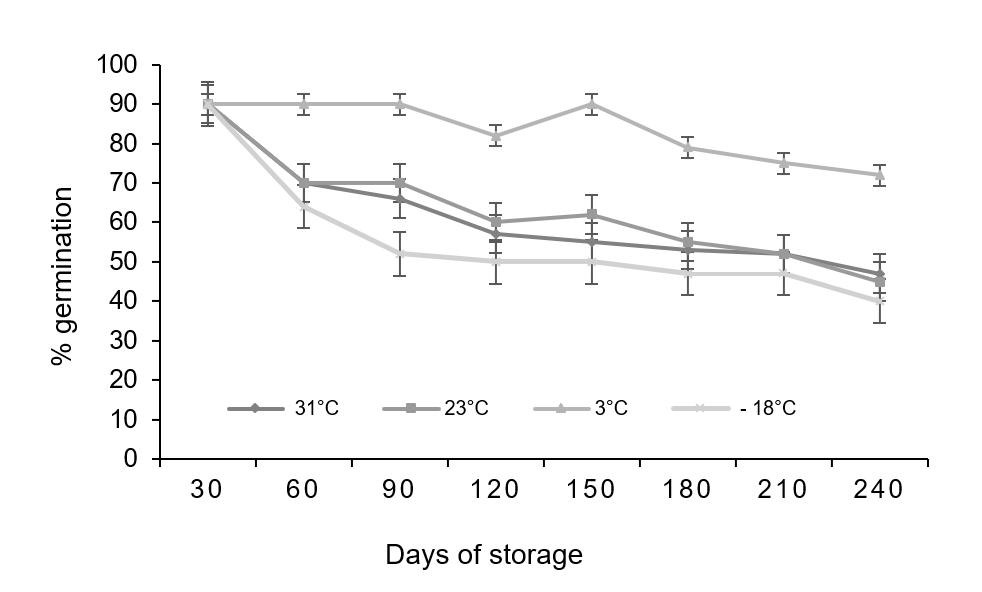
Euan-Tun et al. (2021) reported germination values of 55 and 54% after 10-month storage; however, unlike this study (controlled temperature), in said work, they only evaluated a storage temperature of 25 °C.
It has been reported that, at temperatures of -18 °C, seed germination in Fabaceae (legumes) is limited; this freezing temperature stops the metabolic and chemical activity necessary to initiate this process, which causes the seed to remain in a state of dormancy and, in extreme cases, the death of the embryo (Portuguez et al., 2020).
Likewise, extreme temperatures (greater than 30 °C) result in thermoinhibition of germination, which is closely linked to reduced protein synthesis in the embryo, inhibition of transcription, and increased abscisic acid synthesis related to latency (Ding et al., 2008). On the contrary, there was a positive response to the temperature 3 °C, which confirms that the lower the temperature, the greater the longevity of the palo de tinto seed; in contrast, warm temperatures accelerate its deterioration and loss of germinative capacity (Santillán-Fernández et al., 2023).
Temperature and storage time are factors affecting the viability and germination of palo de tinto seeds; derived from this study, these seeds were classified as intermediate. The information generated is valuable since there is little or no information on the physical and physiological quality of H. campechianum seeds as a function of temperature and storage period; likewise, it is valuable for developing conservation strategies for these species. It is necessary to enrich these results with other experiments, including different types of collection sites and other physical and physiological quality parameters.
Agustín-Sandoval, W. G.; Espinosa-Zaragoza, S.; Avendaño-Arrazate, C. H.; Reyes-Reyes, A. L.; Ramírez-González, S. I.; López-Báez, O.; Andrade-Rodríguez, M. y Rangel-Zaragoza, J. L. 2017. Calidad de semillas de primavera (Roseodendron donnell-smithii Miranda syn Tabebuia donnell-smithii Rose). Agroproductividad. 10(3):81-86. https://revista-agroproductividad.org/index.php/agroproductividad/article/view/974.
Chablé-Vega, M. A.; Plasencia-Vázquez, A. H.; García-González, A.; Ferrer-Sánchez, Y.; Riverón-Giró F. B. y Zamora-Crescencio P. 2019. Distribución, densidad y estructura dasométrica de Haematoxylum campechianum y Haematoxylum calakmulense en Campeche, México. Ecosistemas y Recursos Agropecuarios. 6(16):65-77. https://doi.org/10.19136/era.a6n16.1784.
Contreras, A. C. 2010. La biodiversidad perdida: el caso de los colorantes. In: Durán, R. y M. Méndez Ed. Biodiversidad y desarrollo humano en Yucatán. Centro de Investigación Científica de Yucatán, AC. Programa de Pequeñas Donaciones-Fondo para el Medio Ambiente Mundial, Comisión Nacional para el Conocimiento y Uso de la Biodiversidad. Secretaría de Desarrollo Urbano y Medio Ambiente. Mérida, México. 368-372 pp.
Euan-Tun, J. L.; González-Durán, E.; Ramírez-Benítez, J. E.; Zamora-Crescencio, P.; Vargas-Contreras, J. A.; Rodríguez-Robles, U.; Enríquez-Hernández, J. K.; Caamal-Velázquez, J. H. and Aragón-Gastélum, J. L. 2021. Storage time effect on the germination of Haematoxylum campechianum L. (Fabaceae), in Campeche, Mexico. Madera y Bosques. 27(3):1-13. doi: 10.21829/myb.2021.2732263.
Galíndez, G.; Malagrina, G. M.; Ceccato, D. V.; Ledesma, T. T.; Lindow, L. T. y Ortega, B. F. P. 2015. Dormición física y conservación ex situ de semillas de Amburana cearensis y Myroxylon peruiferum (Fabaceae). Boletín de la Sociedad Argentina de Botánica. 50(2):153-161. Doi: 10.31055/1851.2372.v50.n2.11660.
Magdaleno-Hernández, E.; Magdaleno-Hernández, A.; Mejía-Contreras, A.; Martínez-Saldaña, T.; Jiménez-Velázquez, M. A.; Sánchez-Escudero, J. y García-Cué, J. L. 2020. Evaluación de la calidad física y fisiológica de semilla de maíz nativo. Agricultura, Sociedad y Desarrollo. 17(3):569-581. https://doi.org/10.22231/asyd.v17i3.1372.
Plasencia-Vázquez, A. H.; Pascale-Villegas, M. C.; Ferrer-Sánchez, Y. y Zamora-Crescencio, P. 2017. Distribución histórica de las especies del género Haematoxylum (Leguminosae) en la Península de Yucatán, México, basada en ejemplares de herbario. Acta Botánica Mexicana. 119:51-68. https://doi.org/10.21829/abm119.2017.1231.
Santillán-Fernández, A.; Castañeda-Alonso, S. S.; Carrillo-Ávila, E.; Tadeo-Noble, A. E.; Bautista-Ortega, J.; Vera-López, J. E. y Alatorre-Cobos, F.; 2023. Morfometría y viabilidad de semillas de Brosimum alicastrum Sw. en Campeche. Revista Mexicana de Ciencias Forestales. 14(77):31-55. DOI: 10.29298/rmcf.v14i77.1345.
Velázquez, H. 2014. Estudio fisiológico en familias prolíficas de un lote de producción de semilla de la variedad de maíz. Tesis de maestría profesional, especialidad en granos y semillas. Universidad Autónoma Agraria Antonio Narro. Saltillo, Coahuila. 70 p. http://repositorio.uaaan.mx:8080/xmlui/handle/123456789/7476.
Vester, H. F. M.; Lawrence, D. J.; Eastman, J. R.; Turner, B. I.; Calme, S. Dickson, R.; Pozo, C. T. and Sangermano, F. 2007. Land change in the southern Yucatán and calakmul biosphere reserve: effects on habitat and biodiversity. Ecological Applications. 17(4):989-1003. https://doi.org/10.1890/05-1106.