elocation-id: elocation-id: e4086
In the Northeastern Sierra of Puebla, the ‘Criolla’ apple has remained in production; however, the cultivar cannot compete in markets with commercial cultivars, and its production has decreased due to climate change. With the aim of increasing the percentage of flower bud break and the production in apple trees of the ‘Golden Delicious’ and ‘Criolla’ cultivars, applications of the bud break promoter thidiazuron (TDZ) were carried out in Mexcalcuautla, Teziutlán, Puebla, during the 2022 and 2023 cycles. The trees received 400 and 600 ppm TDZ; a 2x3 split-strip arrangement was used, limited to six treatments in a randomized block experimental design; flower and vegetative bud break, inflorescence, fruit set, yield and physical and biochemical aspects of fruit were evaluated. Statistical analyses indicated that ‘Golden Delicious’ apples with 400 ppm TDZ presented higher flower bud break and yield. The physical quality of the fruits was better in ‘Golden Delicious’ with 400 ppm TDZ and ‘Criolla’ without TDZ since their fruits had a greater weight; in terms of the size and respiration rate of the apples, there were no differences between the treatments; nevertheless, firmness was higher in ‘Golden Delicious’ apples with 400 ppm TDZ than in the other treatments. The content of malic acid, ascorbic acid, pH, total soluble sugar content and starches were not affected by TDZ applications. It was concluded that applying TDZ at 400 ppm increased the percentage of flower bud break in ‘Golden Delicious’ apples and did not harm the physical and biochemical quality of the fruits.
bud break promoters, flower bud break, inflorescence, TDZ.
In Mexico, the area allocated to apple cultivation exceeds 55 000 ha, mainly concentrated in the northern region of the country. Chihuahua leads production, contributing 67.4% of the total volume, whereas Puebla contributes 6.4% (SIAP, 2023). However, in the municipalities of the northeastern sierra of Puebla, apple production has shown a downward trend. This decrease is due, in part, to the introduction in 1980 of commercial apples grafted on clonal rootstocks in the northern sierra of Puebla.
Despite this innovation, producers in the Northeastern Sierra continued to cultivate the ‘Criolla’ variety, which could not compete in the market with the new cultivars, limiting themselves to sales in local markets. This change has led to the elimination of much of the agroforestry flora, causing variations in temperatures and phases of the apple flowering season, resulting in damage and losses in production (Yepes and Silveira-Buckeridge, 2011).
There are several studies in the northern states of Mexico, where stimulators have been used together with agronomic practices to increase flower bud break and adjust the flowering period in fruit trees. For example, Zermeño et al. (2010) evaluated the effect of the bud break promoter thidiazuron (TDZ) and the partial whitewashing in ‘Golden Delicious’ apple plants, while Soto-Parra et al. (2020) compared TDZ, Erger, potassium nitrate, and emulsified oil as bud break promoters in the ‘Golden Glory’ variety.
The research used quality cultivars grafted onto clonal rootstocks, facilitating their adaptation to the local ecology. The objective was to increase the percentage of bud break and production in the ‘Golden Delicious’ and ‘Criolla’ apple varieties through TDZ applications, without compromising the physical and biochemical quality of the fruits.
The experiment was conducted in the locality of Mexcalcuautla, Teziutlán, Puebla, located at 19° 43’ 00’’ north latitude and the meridians 97° 38’ 42’’, at an altitude of 2 200 m, with annual rainfall of 1 539 mm, maximum temperature of 24 °C, minimum temperature of 2 °C, an average accumulation of 450 h chilling-recorded by the local meteorological station. The topography of the place consists of hillsides and slopes with a 60% inclination, sandy loam soil, and a pH of 6 due to the high amount of organic matter available in the place.
The materials used were ‘Golden Delicious’ and ‘Criolla’ apples on ‘EMLA7’ rootstocks; the plants were three years old when the research began and were established in a planting system of 1.5 m between rows and 1 m between trees in a square planting pattern. The management used for the crop was conventional.
A split-plot design was implemented, with four randomized complete blocks (RCBD), in 2x3 design. The factors considered were: A) with two levels, apple cultivars ‘Golden Delicious’ and ‘Criolla’; and B) which consisted of the doses of the bud break stimulant TDZ (0, 400 and 600 ppm), evaluating six treatments in total (Table 1). A group of five trees was considered as an experimental unit, with an experimental population of 120 trees.
A solution of thidiazuron of the Bucosa brand (0.4-0.6 g L-1, depending on the treatment), previously dissolved in 70% alcohol, was prepared, adding 2 ml of the sticking agent INEX-A (Cosmoagro) and 20 ml of emulsified citrulline per liter of solution. The mixture was sprayed on the leaves on February 2, 2023 and no subsequent applications were made. The application was carried out in the morning, before bud break, to maximize the response of the promoter doses and reduce heat stress.
Fifteen days after applying TDZ, biweekly counts of the flower and vegetative shoots that emerged over three months were made; the total number of buds of each tree was taken as 100%; the results were reported as percentages.
When the trees presented the highest percentage of flower opening, the flowers were counted per cluster; subsequently, the fruits from the flowers that began development and growth were quantified, where 100% was the total number of flowers sprouted per tree; finally, when the apples reached consumption maturity, they were harvested and weighed to report the yield in g tree-1.
Fruits without mechanical damage, pests, or diseases, with the typical maturity background color (index 3-4 on CTC scale) were selected. With a position of 1 fruit per quadrant + 1 central one. In total, 25 fruits were sampled per treatment. The fruits were weighed on an Adventurer Pro digital scale and their polar diameter (PD) and equatorial diameter (ED) were measured using a generic digital Vernier.
Fruit skin firmness: two different points on each apple were evaluated using a FORCE FIVE FDV universal texture meter with a 3 cm concave probe; the results were reported in newtons (N).
Ascorbic acid (vitamin C) and malic acid contents: the juice-sample titration methodology was used for both variables; for ascorbic acid, titration by Tillman’s method described by the AOAC (1984) was used, and for titratable acidity, the AOAC (1988) method was used. The content of ascorbic acid (vitamin C) was reported in mg 100 ml-1 of juice, and malic acid was reported as a percentage.
Potential of hydrogen (pH): pH was determined from the juice of apple samples obtained from the two cultivars using a Science MED digital pH meter.
Total soluble sugar content: 5 g of fresh apple pulp was taken for each treatment; then, soluble sugars were concentrated in a volume of 10 ml in 80% ethanol with the Soxhlet method; each sample was diluted to a 1:400 ratio and 600 μl were taken to quantify with anthrone (Dreywood, 1946); three replications were used per sample and the results were reported in mg g-1 fresh weight.
Starch content in fruit pulp: the starch was determined from the dried pulp obtained by Soxhlet extraction. The samples were dried at 75 °C for 24 h, pulverized, and treated with dimethyl sulfoxide. They were incubated with buffer with and without enzymes (β-glucosidase and α-amylase), and spectrophotometric readings were taken at 340 nm before and after enzymatic action. The difference between readings allowed us to calculate the starch content, expressed in μmol g-1 dry weight.
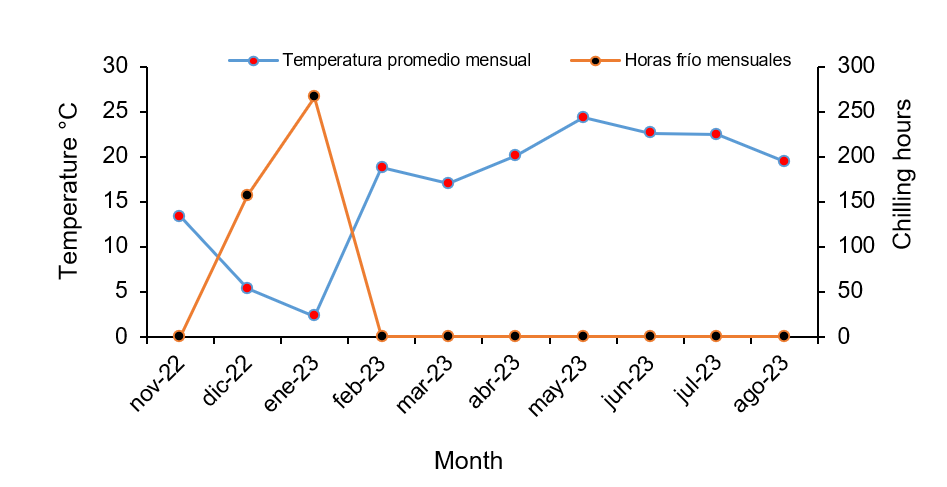
The records of average monthly temperatures obtained from the meteorological station of the municipality of Mexcalcuautla, Teziutlán, Puebla, were analyzed to determine the accumulation of cold during the phenological cycle of the apple tree Malus domestica Borkh (Figure 1). It was observed that the dormancy period extended from November 2022 to February 2023, with the greatest accumulation of cold concentrated in December 2022 and January 2023. A total of 157 h chilling (CH) were counted in December, whereas the highest value was recorded in January, at 266 CH; over the entire cycle, a total of 423 CH was reached, as determined by direct quantification.
The analysis of variance showed significant differences among treatments (p≤ 0.05). According to Figure 2A, the ‘Golden Delicious’ cultivar treated with 400 ppm TDZ presented the highest percentage of flower bud break (16.7%), higher than that observed in the same cultivar without application of TDZ (4%) and with 600 ppm (3.5%). These values were also higher than those recorded in the ‘Criolla’ cultivar, which reached only 4% with 400 ppm and 3% with 600 ppm TDZ.
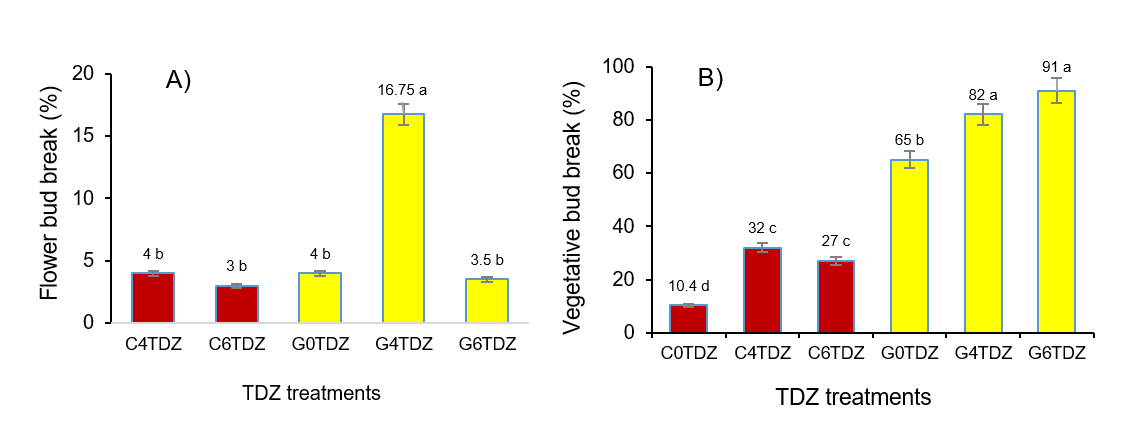
In contrast, the ‘Criolla’ apple without TDZ did not present flower bud break, and its vegetative bud break was low (10.4%). The percentages obtained are attributed to the use of the dwarf planting system. Zermeño et al. (2010) reported an 88.89% bud break rate in ‘Golden Delicious’ grafted onto ‘MM111’ rootstock in Saltillo, Coahuila, using a 15% lime solution combined with 300 ppm TDZ.
Similarly, Soto-Parra et al. (2020) reported a 92% bud break rate in ‘Golden Glory’ using the joint application of the mineral oil Tenco Oil 100 EW (3%) and 100 ppm TDZ (Revent®). One of the causes of the low percentage of flower bud break in this study was the insufficient accumulation of cold during dormancy, which reached 423 h, while the requirement for ‘Golden Delicious’ is 800 to 1 000 h (UNIFRUT, 1997).
The results obtained in the evaluation of vegetative bud break in the apple cultivars ‘Criolla’ and ‘Golden Delicious’ show a differentiated response to the application of TDZ, which shows the influence of genotype and dose on the physiological expression of the buds. Figure 2B shows that in ‘Criolla’, TDZ had a negative effect, reducing the percentage of vegetative bud break, while in ‘Golden Delicious’, there was a positive trend, where the higher the dose of TDZ, the higher the percentage of vegetative bud break.
This behavior contradicts the findings of Zermeño et al. (2010), who observed no significant effect of TDZ on vegetative emergence in ‘Golden Delicious’, suggesting that environmental conditions, agronomic management, and the physiological state of trees can modify the response to the growth regulator. Azcón-Bieto and Talón (2013) explain that cytokinins activate plant metabolism by stimulating cell division, thereby favoring the emergence of vegetative buds in fruit species.
TDZ, as a nitrogenous compound of the phenylurea group, has cytokinin activity and has been classified as a bud break promoter or cold compensator (Greene, 1995). Víctor et al. (2020) have shown that doses above 400 ppm TDZ in prickly pear cactus significantly increase the percentage of vegetative bud break and reduce flower bud break, which partially coincides with the results observed in ‘Golden Delicious’ in this study.
The results obtained in this study show a differential response of the apple cultivars ‘Criolla’ and ‘Golden Delicious’ to the application of thidiazuron (Table 2), particularly in terms of the number of flowers per inflorescence, fruit set and yield per tree. ‘Golden Delicious’ treated with 400 ppm TDZ showed a positive response, reaching up to five flowers per cluster, although below the potential reported by Hull et al. (1985), who mention up to eight flowers per cluster in this variety.
| Treatment | Flowers per cluster | Fruit set (%) | Yield (kg tree-1) |
|---|---|---|---|
| C4TDZ | 1 b | 100 a | 0.55 a |
| G4TDZ | 5 a | 73 b | 1.32 a |
| G6TDZ | 1 b | 75 b | 0.1 a |
On the other hand, neither ‘Criolla’ with 400 ppm nor ‘Golden Delicious’ with 600 ppm TDZ presented inflorescence, suggesting a possible floral inhibition at high doses or a varietal sensitivity to the growth regulator. Regarding fruit set, a remarkable efficiency was observed in ‘Criolla’ with 400 ppm TDZ, reaching 100% of fruit set, which can be attributed to the low number of flowers, reducing competition for resources. In ‘Golden Delicious’, the set was 73% at 400 ppm and 75% at 600 ppm, indicating that, although the higher dose did not favor flowering, it did maintain an acceptable fruit retention capacity.
These results partially coincide with those reported by Zermeño-González et al. (2009), who managed to increase fruit set through partial whitewashing to improve chilling-hour accumulation, in combination with TDZ. The yield per tree was low, with values significantly lower than those reported in the literature. ‘Golden Delicious’ with 400 ppm TDZ reached 1.3 kg tree-1, being statistically superior (p≤ 0.05) to treatments with 600 ppm and ‘Criolla’ with 400 ppm.
This yield is related to the reduced tree size (2 m in height) and unfavorable climatic conditions. In comparison, previous studies, such as those by Benincore et al. (2000); Milosevic and Milosevic (2009), report yields of 25 kg tree-1 and 20.81 kg tree-1, respectively, for larger trees with adequate nutritional management. Likewise, Zermeño-González et al. (2009); Soto-Parra et al. (2020) report yields greater than 49 kg tree-1 and 49.5 t ha-1, respectively, under intensive management conditions and specific applications of TDZ or its derivatives.
The results obtained in the evaluation of the physical quality of the ‘Golden Delicious’ and ‘Criolla’ apple fruits in Table 3 reveal important differences attributable both to the TDZ treatment and to the sampling and postharvest management conditions. Since the ‘Criolla’ control did not show flower bud break during the experiment, fruits from a local producer in Teziutlán, Puebla, were used to make the corresponding comparisons.
It was observed that the ‘Criolla’ apple without TDZ (90.9 g) and ‘Golden Delicious’ apple with 400 ppm TDZ (88.5 g) presented the highest weights among the treatments evaluated. These results, although superior in the present study, are inferior to those reported by Benincore et al. (2000), who obtained an average weight of 113 g in ‘Golden Delicious’ with the application of 50 ppm TDZ. This difference can be attributed to the dose used, tree size and the edaphoclimatic conditions of the experiment.
Regarding size, no significant differences were found between cultivars or between applied doses of TDZ. The values ranged from 43.6 to 51.9 mm in polar diameter and from 46.6 to 56.5 mm in equatorial diameter. These results are consistent with reports by Benincore et al. (2000), who obtained fruits with values of 55 mm in both diameters in ‘Golden Delicious’ with 50 ppm TDZ, suggesting that TDZ does not significantly affect the external morphology of the fruit under the conditions evaluated.
In firmness of fruit skin, ‘Golden Delicious’ with 400 ppm TDZ presented a value of 60 N, higher than that of ‘Criolla’ without TDZ (28 N). However, these values are below the physiological standards reported by Kader (2002), who states that an apple at physiological maturity must have a firmness of 80 N in the skin. Silveira et al. (2007) reported similar values in ‘Fuji’. In addition, Kupferman (2005) points out that the firmness range in the ‘Golden Delicious’ skin at consumption maturity is between 50 and 55 N.
The evaluation of the biochemical quality of the ‘Golden Delicious’ and ‘Criolla’ apple fruits treated with different doses of TDZ did not show significant differences between cultivars or between treatments (Table 4). The ascorbic acid content ranged from 4.1 to 5.6 mg 100 ml-1, values higher than those reported by Silveira et al. (2007) in ‘Fuji’ apple (2.6 mg 100 ml-1).
Regarding malic acid, the values obtained (0.24-0.62%) were lower than the 4.5% threshold established by Kader (2002) for classifying an apple as acidic. These results contrast with the reports of Corona-Leo et al. (2020), who found 0.42% in ‘Golden Delicious’; authors such as Dzanagov et al. (2021) reported 0.75% in ‘Aidored’ with nitrogen fertilization, indicating that malic acid content may vary depending on agronomic management.
The pH of the fruits remained in a range of 3.7 to 3.9, values similar to those reported by Corona-Leo et al. (2020) in ‘Golden Delicious’ (3.8). The total soluble sugar content ranged from 167 mg g-1 (16.7%) to 185 mg g-1 (18.5%), representing a high concentration compared to the findings of Benincore et al. (2000), who reported 13.2% in ‘Golden Delicious’ with 150 ppm TDZ, of Silveira et al. (2007), who reported 14.1% in ‘Fuji’, and of Zermeño et al. (2010), who reported 14.9% in ‘Golden Delicious’ with whitewashing and TDZ. The higher sugar concentration in this study may be related to the reduced size of the fruits, which favors the accumulation of solutes in smaller volumes, as Kader (2002) points out.
Finally, the starch content was low, with values between 2.6 (0.26%) and 3.9 (0.39%) μmol g-1 dry weight, which indicates that the fruits were at the stage of maturity for consumption, a stage in which the starch is broken down into simple sugars, such as glucose and maltose. This is consistent with what Musacchi and Serra (2018) describe, who explain that starch decreases as the fruit ripens. Tirado-Gallegos et al. (2016) reported 14.1 g 100 g-1 of dried pulp at physiological maturity and 11.9 g 100 g-1 at consumption maturity in ‘Golden Delicious’.
The application of 400 ppm TDZ in the ‘Golden Delicious’ cultivar promotes flower bud break, inflorescence development and increased yield. In contrast, in the ‘Criolla’ cultivar, this dose only improves fruit set.
On the other hand, the application of 600 ppm TDZ in ‘Golden Delicious’ induces excessive vegetative bud break and reduces yield, whereas ‘Criolla’ shows a limited response to this concentration. In both cultivars, TDZ improves the texture of the fruit skin, without affecting size and weight.
Likewise, applications of 400 and 600 ppm do not modify the fruit’s biochemical characteristics.
To the National Council of Humanities, Sciences and Technologies (CONAHCYT, by its acronym in Spanish) and the College of Postgraduates for resources and funding for research.
Tirado-Gallegos, J. M.; Zamudio-Flores, P. B.; Ornelas-Paz, J. de J.; Ríos-Velasco, C.; Acosta-Muñiz, C. H.; Gutiérrez-Meraz, F.; Islas-Hernández, J. J. y Salgado-Delgado, R. 2016. Efecto del método de aislamiento y el estado de madurez en las propiedades fisicoquímicas, estructurales y reológicas de almidón de manzana. Revista mexicana de Ingeniería Química. 15(2):391-408.
Zermeño-González, A.; Gill-Marín, J. A.; Jasso-Cantú, D.; Ramírez-Rodríguez, H.; Hernández-Herrera, A.; Rodríguez-García, R. y Benavidez-Mendoza, A. 2009. Efecto del encalado total del manzano en la temperatura interna, rendimiento de frutos y su relación con la aplicación de thidiazuron. Revista Chapingo Serie Horticultura. 15(3):289-296.