elocation-id: elocation-id: e4080
Corn is a crop of great importance in Mexico because it is used for both human and animal consumption, positioning itself as one of the three most important forage crops due to the energy value it contributes to the diets of dairy cattle. The study aimed to examine trends in forage corn production at the national level and in the state of Veracruz from 1980 to 2023 in order to forecast the availability and supply of feed for the livestock sector using predictive models (ARIMA). The information was obtained from the database of the Agrifood Information Consultation System, covering the historical series at the national level and for the state of Veracruz. The exploratory data analysis technique was used to identify trends and seasonalities; subsequently, predictive time series models were built using the ARIMA model, using the RStudio forecast library. The results showed an upward trend in forage corn production. At the national level, forage production under irrigated conditions will present a sustained growth trend; in contrast, under rainfed conditions, unstable variations will be observed over the next decade, with a projected decrease of 1.57%. In the state of Veracruz, projections indicate that corn forage production under irrigated and rainfed conditions will maintain a stable trend over the next decade. Yields per hectare are estimated at 19.57 and 23.87 tonnes, respectively, suggesting productive stability associated with relatively constant edaphoclimatic and management conditions in the region. It is concluded that the use of predictive models is a reliable tool for modeling corn forage production, providing the agricultural and livestock sectors with a planning instrument that contributes to reducing agricultural risks in the short and medium term.
Zea mays L., fresh forage, prediction, production, trend.
Worldwide, around 197 million hectares are used for corn cultivation, making this crop one of the most important compared to other cereals such as rice and wheat (Erenstein et al., 2022; FAO, 2023). Over the last five years, world consumption grew at an average annual rate of 1.5%, which meant a lower growth rate in production (FIRA, 2024).
The productive potential of this agricultural product is subject to inherent factors, such as temperature, precipitation, soil fertility and planting density (Álvarez-Flores et al., 2023). In 2024, global yellow corn production was mainly concentrated in five countries: the United States of America, China, Brazil, the European Union and Argentina. In this sense, the United States of America has the highest level of corn use in the world, which oscillates around 318.9 million tonnes for forage, industrial (ethanol production) and human consumption (tortilla) (FIRA, 2024).
In Mexico, the total consumption of corn for grain is 42.1 million tonnes, which is supplied with 38.3% of white corn and 61.7% of yellow corn; the white corn is destined for the food industry, whereas the yellow corn is for livestock and agro-industrial activities (López-García et al., 2021; FIRA, 2024). As it is not self-sufficient, Mexico imports about 18.4 million tonnes of yellow corn from the United States of America, which is destined for the industrial and livestock sectors: the latter for the production of beef, pork, chicken, eggs and milk.
On the other hand, the agricultural and livestock sectors are not proportional to population growth, since food demand in livestock production is usually higher than supply and the country needs to look for other alternatives to meet the demand for yellow corn (FIRA, 2024; Jaime-Vargas, 2024; Sánchez et al., 2024).
In addition, Mexico produces 12% of forage corn, which is an option for the use of yellow corn, allowing the incorporation of a balanced, more efficient system and maximizing the productivity of dairy cattle, since its use reports increases of 16.8 and 25% in milk production (Guevara-Viera et al., 2016; Zaragoza-Esparza et al., 2021).
In this regard, there are studies on the use of forage corn for silage as a base feed in the diet of cattle for fattening and breeding for the supply of meat and milk, which is a nutritional alternative in productive parameters; these studies report significant increases in milk production, feed efficiency, and body condition during dry seasons, allowing a reduction in dependence on external inputs and supplying up to 55% of the daily diet of the animals (Bravo et al., 2018; Bermúdez-Ramírez et al., 2025).
It is important to note that approximately 50% of national milk production is carried out under an intensive system, whose feed base is mainly composed of corn and alfalfa silage; this contrasts with the rest of the production, which is governed by extensive or grazing, semi-intensive, and family or backyard systems. It is worth mentioning that the intensive system uses grains on a smaller scale in the diet of dairy cattle; however, it has a high forage productivity, more than 90%, as there are no losses, and as it has a good nutritional content, with 30 to 40% dry matter, 13 to 38% fiber, 1 to 5% fat, and 0.67 to 0.75% for nitrogen-free extract (Jaime-Vargas, 2024; Lachi et al., 2024).
Faced with this scenario, Mexico allocates around 109 million hectares of land to the intensive system for livestock activity, mainly concentrated in the states of Veracruz, Jalisco, Chihuahua, Chiapas, Durango, Tabasco, Sonora and Michoacán, which represent 55.5% of the production units. Veracruz leads the way, with a production of 268 thousand tonnes of beef and 537 thousand tonnes of chicken meat (INEGI, 2025; SIAP, 2025). This dynamic keeps the country as the world’s sixth-largest producer of beef, chicken and pork (COMECARNE, 2025).
In this research, series of grain corn and forage corn production at the national level were used to build models that allow forecasting the trend of corn forage production, which will allow small, medium and large producers to carry out accurate planning of agricultural and livestock activities and will serve as a strategic instrument in decision-making. The objective of the study was to analyze trends in corn, beef, and bovine milk production at the national level and in the state of Veracruz in order to project their production volumes over a ten-year period under an increasingly challenging environment.
The present study was developed under a quantitative approach, with an exploratory, descriptive, correlational, and predictive scope. The data on the annual production of corn for grain and forage, beef, and bovine milk at the national level and in the state of Veracruz were obtained from the portal of the Agrifood Information Consultation System (SIACON).
The relationship between agricultural production variables at the national level was analyzed using a Pearson correlation matrix, considering the planted area, harvested area, production and yield of grain corn and forage corn under irrigated and rainfed conditions from 1980 to 2023. This analytical technique was applied to determine the productive dynamics of forage corn by assessing the strength of relationships among variables, providing statistical evidence on whether crop intensification is aligned with an improvement in technical efficiency or responds only to extensive growth.
A descriptive analysis was carried out with the data on planted area of forage corn at the national level, while a comparative analysis was carried out with the information on the production of corn for grain, forage corn, beef and milk production for Mexico and for the state of Veracruz under irrigated and rainfed conditions.
An autoregressive moving average model (ARIMA(p, d, q)) was applied to predict future national forage production and a quadratic linear regression was applied to predict the production of forage corn under rainfed and irrigated conditions for the state of Veracruz. These analyses were performed using RStudio 4.4.3 (R Core Team, 2020).
According to Box et al. (1994), the ARIMA model consists of three components: 1) autoregressive (AR); 2) integrated (I); and 3) moving average (MA), these allow the model to identify patterns such as trends and seasonality, which help predict future values based on historical data.
The AR component (p) AR(p) is where each current value yt in the observed series depends on a linear combination of the previously observed values, that is:
Where: yt = is the current observation; c, ϕ1, ϕ2, …, ϕp = are the parameters of the model to be estimated; p = denotes the number of past values (number of autoregressive terms) that are used to approximate the value yt; and εt = is the error term. The autoregressive part constructs a regression (trend) model based on past values of the time series for prediction.
As for the integrated part (I), differentiating the series involves transforming a non-stationary time series into a stationary series. This differentiation consists of subtracting one observation from another to eliminate trends and seasonality, allowing the series to be stationary. In other words, differentiation helps the data fit the model and not the noise. The formula for differentiating is:
Where: y't = is the series differentiated at time t; yt = is the value of the series at time t; and yt-1 = is the value of the series at the previous time. The differentiation process usually applied several times until stationarity is reached. The notation I(d) indicates the order of differentiation necessary to achieve stationarity.
Finally, the moving average (MA) component of an ARIMA model focuses on the relationship of a current value in the series with previous prediction errors. The MA model of order q MA(q) can be represented as:
The combination of the three components results in the non-seasonal ARIMA (p, d, q) model, which is expressed as follows:
Model fitting and value prediction were performed with the forecast library and the auto.arima() option in RStudio 4.4.3 (R Core Team, 2020).
In the 1980s, Mexico allocated 5 200 ha to forage corn production and by 2023, this had increased to 21 100 ha. The states of Aguascalientes, Baja California Sur, Chihuahua, Coahuila, Colima, Jalisco, State of Mexico, Puebla, Tlaxcala and Zacatecas produced forage continuously over the last 43 years under irrigation and rainfed conditions.
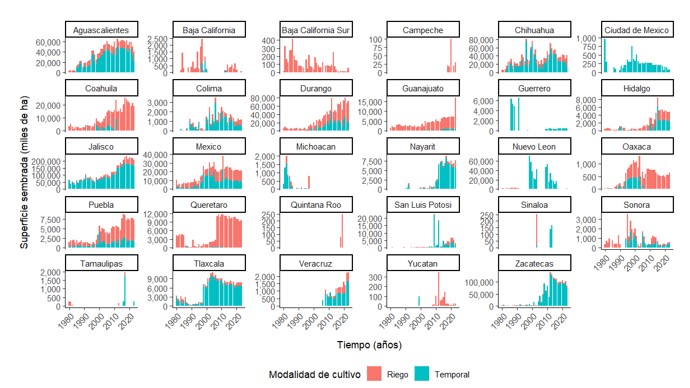
On the other hand, in Baja California, Durango, Guanajuato, Hidalgo, Michoacán, Nayarit, Nuevo León, Oaxaca, Querétaro, Sonora and Tamaulipas, production was maintained exclusively under irrigated conditions until 1990; however, from 2000 to date, planting under both modalities (rainfed and irrigated) was resumed, with San Luis Potosí, Sinaloa and Veracruz joining production. In 2006, the state of Yucatan had 2 000 ha, and as of 2018, it has maintained around 24 200 ha under irrigation. In this same period (2018 to date), Campeche has allocated an average of 1 870 ha exclusively to irrigation. Finally, the States of Mexico and Guerrero have participated in the production of fresh forage corn from 1980 to the present, exclusively under rainfed conditions (Figure 1) (SIACON, 2024).
Sánchez-Ramírez (2024) reports that most corn planting for grain and forage in Mexico is under rainfed conditions, and that approximately 90% allocates more than 10 ha. Nonetheless, as of 2023, the area decreased by 50%, attributed to severe droughts, late rainfall and the effects of climate change.
In the Pearson correlation matrix (Figure 2), the variables showed strong (>0.8) and moderately correlated (0.5-0.8) relationships with the production of grain corn (GR) and forage corn (FV) under irrigated conditions at the national level from 1980 to 2023. This indicates that the variables vary in the same direction.
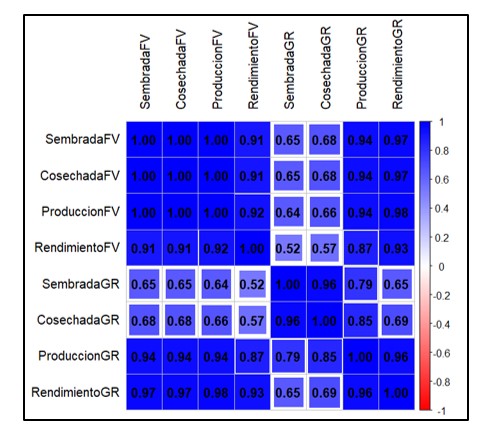
In their study on the regional analysis of corn production in Mexico, Guzmán-Anaya and Lugo-Sánchez (2024) report that, in 2005, 2009 and 2011, there was a loss of more than 50% of the planted area, attributed to atypical climatic conditions, delayed rainfall, droughts, frosts and floods; nevertheless, as of 2012, the harvest rose to 98%, which confirms the strong positive relationship between the area planted and the area harvested for grain corn.
On the other hand, under rainfed conditions in the same period at the national level (Figure 3), there were strong positive correlations (>0.75), strong negative correlations (<0.75) and to a lesser extent, weak negative correlations (<-0.5) between variables. According to Villagrana-Soto et al. (2024), the production of forage corn under rainfed conditions is closely related to the area planted.
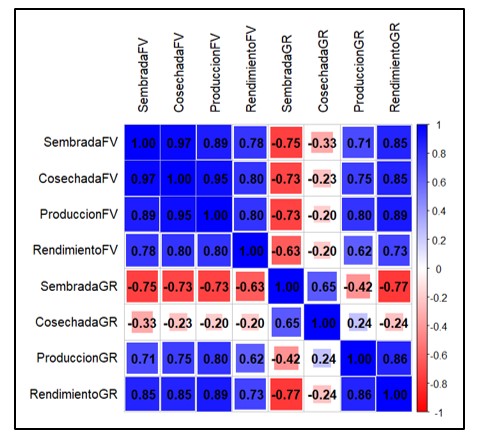
As the area planted with forage corn increases, so does the production of fresh and dry forage. Nonetheless, production can be affected by water scarcity; consequently, it is necessary to adopt efficient irrigation systems to maximize production without losing quality.
On the other hand, at the national level, under irrigated conditions (Figure 4A), there was an upward trend in the production of forage corn, beef and milk, with slight fluctuations in 1989 and 2007 in milk and forage corn production.
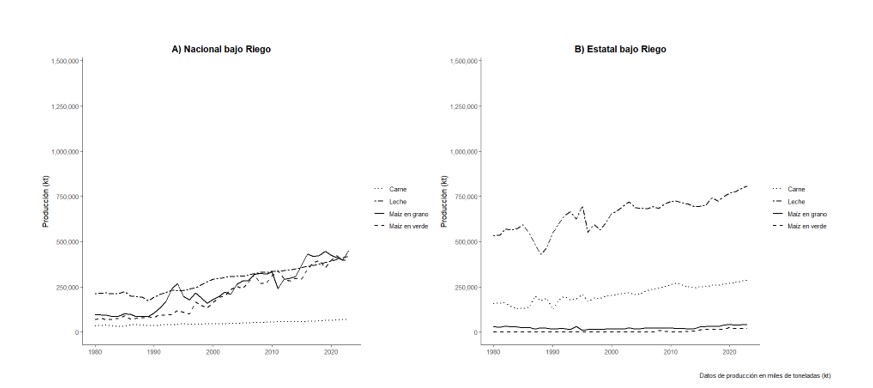
Similarly, grain corn production shows a positive evolution; however, it is characterized by greater variability throughout the period analyzed. According to Guzmán-Anaya and Lugo-Sánchez (2024), the variability of corn is related to changes in the agricultural structure in Mexico, as genotypes with adaptation to soil erosion, compaction and acidity are sought; likewise, it is related to climate change conditions, problems that, if not addressed, imply a constant dependence on imports.
In the case of the state of Veracruz, under irrigated conditions (Figure 4B), there is a lower production volume of corn for grain and forage than the national average, which is attributed to the limited area with irrigation infrastructure. Nevertheless, milk and beef production shows an upward trend, possibly due to the development of technified production units in certain regions of the state (SIAP, 2023).
Under rainfed conditions, at the national level (Figure 5A), production growth was more irregular and showed greater interannual variability, especially for grain corn; however, the volume of production is still considerable, as a large part of the national agricultural area depends on seasonal rainfall. On the other hand, meat and milk production maintains an upward trend, although with a lower relative participation than in irrigated areas.
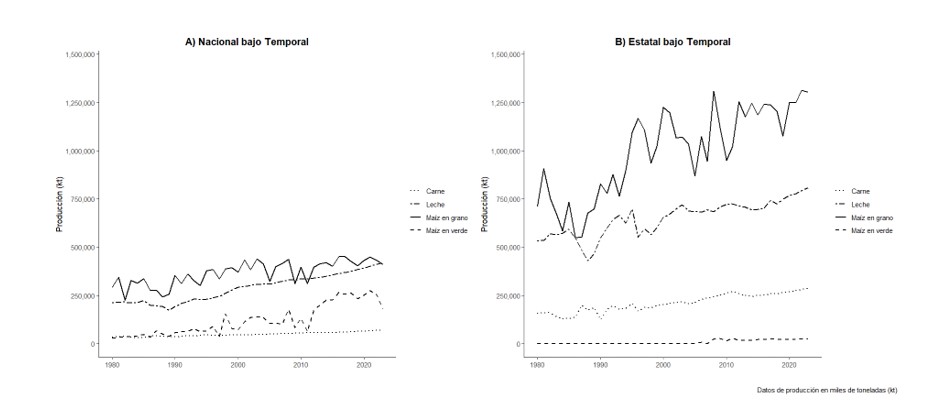
Findings such as those of López et al. (2025) indicate that the quantity and quality of corn forage under rainfed conditions depend on the seasonality of the rainy season, which has changed throughout the year.
Regarding the state of Veracruz (Figure 5B), most of the agricultural activity is carried out under rainfed conditions. The production of grain corn stands out, showing a long-term increasing trend, although it is strongly influenced by annual climatic conditions. Milk and beef production also show moderate growth, although with stagnation that could be associated with structural factors and technological limitations. On the other hand, the production of forage corn has shown sustained growth since its incorporation in 2006, going from 6 360 to 23 830 t at present.
The production (tons) of fresh corn forage in the country and the state of Veracruz from 1980 to 2023 was analyzed. The model identification process was based on the autocorrelation (ACF) and partial autocorrelation (PACF) functions of the differentiated series. For national production under irrigation, predictions were generated using the ARIMA (0, 1, 1) model. The data predicted a linear upward trend with minimal seasonal fluctuations (Figure 6A).
In the 10-year projection, it was observed that production will have a considerable increase from 302 781 t in 2023 to 357 328 t by 2033, representing an increase of 18.01%.
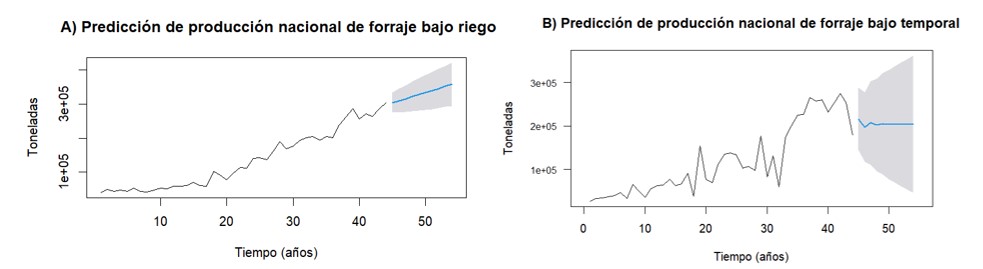
It is notable that, as the years of prediction increase, so does uncertainty, which is reflected in the confidence intervals (95%) since they gradually open up according to the prediction times.
For rainfed production (Figure 6B), the series conformed to an ARIMA (1, 1, 0) model; in this regard, a production of 207 227.4 t is expected by 2026, with a decrease of 3 000 t in the next seven years. After this period, forage production will stabilize at 204 013.2 t, while the confidence interval shows the existence of strong variations over time.
On the other hand, based on the quadratic linear regression model, forage production was estimated over a five-year horizon. Thus, under irrigated conditions (Figure 7A), the projected production for 2026 was approximately 24 915.12 t, whereas for 2028, an increase to 27 592.32 t is estimated. Nevertheless, there is a 16.8% probability that production will vary from the forecast, as indicated by the coefficient of determination (R2= 0.7891).
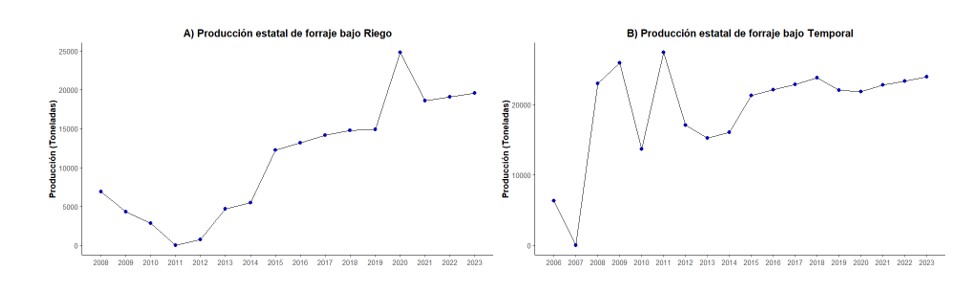
On the other hand, under rainfed conditions (Figure 7B), a production of 27 170.06 t is expected in 2026, with an estimated increase of 5.07% for 2028, reaching a total of 28 549.78 t. In this sense, it is anticipated that corn forage production at the state level under rainfed conditions will show a slight upward trend in the coming years.
In the state of Veracruz, livestock farming is a predominant activity that occupies approximately 70% of the territory, representing the largest area of grasslands in the region (Rodríguez-Montalvo et al., 2021). However, to mitigate the food deficit during the dry season, producers resort to the use of corn hybrids for forage production. This preference is due to the high energy value and nutritional quality that corn contributes to the animal diet, suggesting that the demand for this input will continue to grow in the coming years (Del Rosario-Arellano et al., 2024).
The production of corn forage will maintain an increasing trend in the coming years; at the national level, an availability of 357 328 t under irrigation and 204 013.2 t under rainfed conditions by the year 2033 is projected, which is beneficial for the livestock sector, as a constant source destined to meet the nutritional requirements of cattle is ensured.
At the state level in Veracruz, significant increases are reflected towards 2028, with around 27 592.32 t of forage corn under irrigated conditions and 28 549.78 t under rainfed conditions, mainly improving the efficiency of beef and milk production systems. Likewise, the use of predictive models is a strategic tool that enables producers and farmer organizations to anticipate decision-making by understanding production behavior, thereby planning the development of their agricultural and livestock activities more accurately and efficiently.
Del Rosario-Arellano, J. L.; Salazar-Ortiz, J.; Andrés-Meza, P.; Serna-Lagunes, R.; Borbonio-Fernández, V.; Real-Garrido, C. J.; Coria-Gil, N. A. B. 2024. Características agronómicas y forrajeras de variedades nativas de maíz en Las Montañas, Veracruz, México. Acta Agrícola y Pecuaria. Pecuaria. 10:1e0091003. https://doi.org/10.30973/aap/2024.10.0101003.
Guevara-Viera, R. V.; Lascano-Armas, P. J.; Arcos-Álvarez, C. N.; Hernán-Chancusig, F.; Armas-Cajas, J. A.; Serpa-García, G. V.; Soria-Parra, M. E.; Vera-Cedeño, J. C.; Torres-Inga, C. S.; Guevara-Viera, G. E.; Roca-Cedeño, A. J. y Curbelo-Rodríguez, L. M. 2016. Efecto de la inclusión del forraje de maíz molido en la respuesta productiva de vacas lecheras en pastoreo. Revista de Producción Animal. 28(1):16-22. http://scielo.sld.cu/scielo.php?script=sci-arttext&pid=S222479202016000100003&lng=es&tlng=es.
Rodríguez-Montalvo, F. A.; Sierra-Macías, M.; Espinosa-Calderón, A.; Vázquez-Hernández, M. V.; Barrón-Freyre, S.; Andrés-Meza, P. y Del Rosario-Arellano, J. L. 2021. Productividad de forraje en maíces híbridos bajo diferentes densidades de población y dosis de fertilización. Terra Latinoamericana. 39:1-12. https://doi.org/10.28940/terra.v39i0.676.
Villagrana-Soto, F.; Gutiérrez-Bañuelos, H.; Echavarría-Cháirez, F. G.; Sánchez-Gutiérrez, R. A.; García-Cervantes, D.; Espinoza-Canales, A.; Muñoz-Salas, L. C.; Aguirre-Calderón, C. E. y Martínez-Gómez, J. 2024. Productividad de maíz, sorgo, avena y girasol en temporal en clima semiseco de México. Chilean journal of agricultural & animal sciences. 40(2):387-398. https://dx.doi.org/10.29393/chjaas40-33pmfg90033.