elocation-id: elocation-id: e4077
Cotton (Gossypium spp.) plays an important role in cultural, economic and biological aspects. This text aims to present the history of the ‘Ixcatl’ botanical garden of wild and semi-domesticated Gossypium species in the state of Guerrero. This garden is unique in Mexico and is dedicated to protecting and conserving native cotton species. Information on botanical gardens and their role in conserving these species was reviewed. In 1978, the first botanical garden was founded in Iguala de la Independencia by INIA and the Vavilov Institute of Russia, which started with 259 accessions. In 1984, a second garden was established and in 2004, the third was created and remains active; it started with 120 accessions and currently has more than 180. It is crucial to continue conserving this garden to protect the genus Gossypium as part of Mexico’s natural heritage.
Gossypium spp., wild species, Guerrero.
Cotton (Gossypium spp.) is culturally, economically, and biologically relevant worldwide (Pérez et al., 2016), and 50 species of this genus have been identified to date, including annuals, biennials, perennials, herbaceous plants, shrubs and trees ( Gotmare et al., 2026). Mexico is the center of origin of the cultivated species with the highest production: Gossypium hirsutum L. (Ulloa et al., 2013). In the 2022-2023 cycle, world cotton production reached 25.844 thousand tonnes, with China, India, Brazil and the United States of America accounting for 72% (SIAP, 2023); in this scenario, Mexico contributed only 0.74%. In the country, in 2023, the area and intensive production of cotton were mainly concentrated in four states: Chihuahua with 74%, Baja California with 8.79%, Tamaulipas with 6.56%, and Coahuila with 7.44%, with average yields of 4.69 t ha-1(SIAP, 2025).
On the other hand, for the case of the native peoples, cotton is one of the crops of biocultural importance, since cotton fiber is the fundamental element for making clothing and producing handicrafts, and has been an economic activator for these peoples throughout history, which also contribute to the conservation of native cotton.
There are 11 wild species of cotton in the Mexican Republic: armourianum, lobatum, gossypioides, aridum, laxum, schwendimanii, thurberi, trilobum, davidsonii, turneri, and harknesii (Feng et al., 2011). An important strategy for preserving and conserving biodiversity is through herbaria, seed banks, arboretums and botanical gardens (Lee, 2023).
In this context, Dunn (2017) notes that botanical gardens are ex situ conservation centers, as they play a very important role in environmental education programs, research, and training in botanical knowledge at various levels. This work aims to present the history of the botanical garden of wild and semi-domesticated Gossypium species, located in the state of Guerrero.
This garden, unique in the country, has the mission of protecting and conserving, for posterity, the wild species and breeds of cotton native to Mexico. To achieve the objective, this study conducted a general diagnosis of the conservation of the genetic resources of cotton (Gossypium spp.) native to Mexico. To this end, bibliographic information on the genus Gossypium was reviewed: Chapingo Autonomous University (UACH), by its Spanish acronym, College of Postgraduates (COLPOS), by its Spanish acronym, National Autonomous University of Mexico (UNAM), by its Spanish acronym, Scientific Research Center of Yucatán (CICY), by its Spanish acronym and Autonomous University of Yucatán (UADY), by its Spanish acronym, interviews with researchers, and reports of work on genetic resources from the National Institute of Forestry, Agricultural and Livestock Research (INIFAP), by its Spanish acronym. Information generated by the online herbaria of the World Biodiversity Information Network (REMIB), by its Spanish acronym was also considered.
The results indicated that the existence of cotton species has been reported in 27 states of the Mexican Republic. In Mexico, from 1978 to 2006, 980 accessions of Gossypium have been collected, of which 451 correspond to G. hirsutum, followed by G. aridum (111), G. barbadense (76), G. davidsonii (48), G. harknesii (43), G. lobatum (29), G. thurberi (27), and G. turneri (22), and the species with the lowest number of specimens collected were G. armourianum, G. schwendimanii,G. laxum, and G. arboreum. These accessions, reported in herbaria, have resulted from different expeditions conducted by Mexican, American, Chinese, and Russian scientists.
As for the botanical gardens, it was found that, in 1978, Engineer Quintín Obispo González, then a researcher at the National Institute of Agricultural Research (INIA), now INIFAP, in collaboration with the Vavilov Institute of Russia, collected cotton germplasm in the states of Veracruz, Tabasco, Campeche, Yucatán, Chiapas, Guerrero, Oaxaca, Michoacán, Morelos, Colima, Sinaloa, Sonora and Baja California Sur. They also founded the first botanical garden of wild and semi-domesticated cotton species in the town of Iguala de la Independencia, Guerrero (Figure 1).
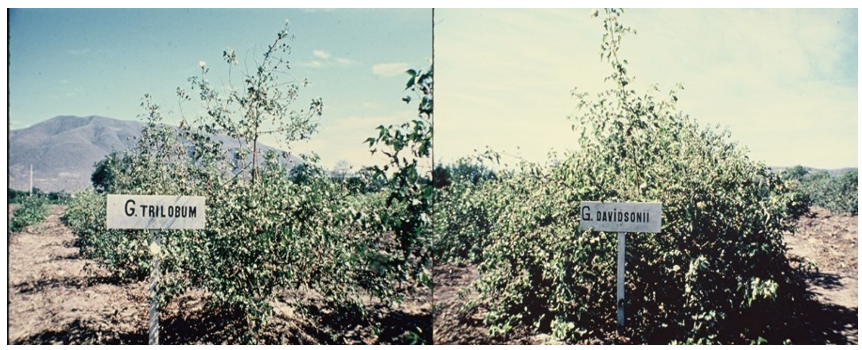
In this locality, the climatic and photoperiodic conditions that prevail year-round ensure optimal development of all native species and forms of cotton, regardless of their origin. This garden began with 259 accessions (ACCs) of the species G. hirsutum (234), G. barbadense (7), G. herbaceum(7) and G. arboreum (11); however, for unknown reasons, the garden disappeared.
In 1984, the second garden was established at the Iguala Experimental Field (CEIGUA, by its Spanish acronym) with 103 accessions (Figure 2a) of the species G. hirsutum (99 acc.), G. aridum (3 acc.) and G. barbadense (1 acc.), which were collected in the states of Tamaulipas, Veracruz, Tabasco, Oaxaca and Chiapas by the researchers Ma. Cristina Arroyo Lira, Arturo Hernández Jasso and Arturo Palomo Gil, who, at that time, were INIA researchers, as well as the staff of the Jiangsu Academy of Agricultural Sciences of China. Like the previous one, this garden also died.
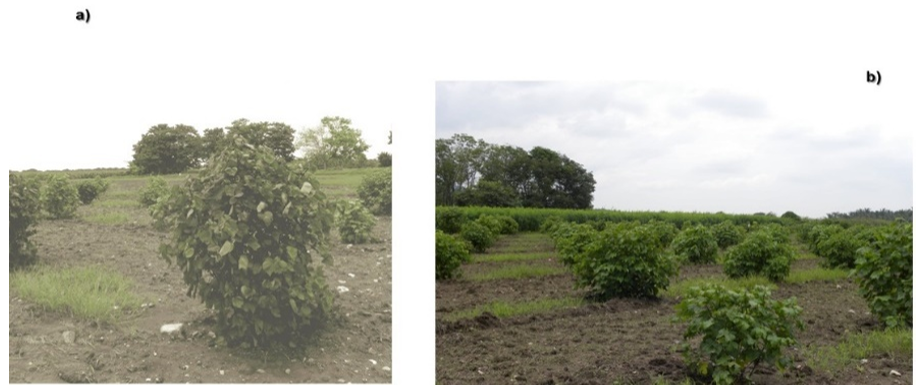
Subsequently, in 2004, the then INIFAP researchers Salvador Godoy Ávila, Enrique A. García Castañeda, Margarito Manjarrez Salgado† and Pablo Murillo Navarrete, together with Mauricio Ulloa of the United States Department of Agriculture and James Mcd Stewart† of the University of Arkansas, established the third garden at CEIGUA; this garden was under the responsibility of the researcher Pablo Murillo Navarrete until June 2008 (Figure 2b). This garden began with 120 cotton accessions from the states of Morelos, Puebla, Guerrero, Oaxaca, Chiapas, Colima, Jalisco, Nayarit, Michoacán, Sonora and Veracruz, among others.
From May 2008 to June 2011, the researcher Claudia Pérez Mendoza was in charge of this garden, and from September 2011 to December 2013, this responsibility was assigned to the researcher Manuel Flores Zárate; these researchers introduced more than 100 cotton accessions from the states of Yucatán, Campeche, Michoacán, Guerrero, Oaxaca and Morelos to the botanical garden. To date, this garden remains active and is under the care of the researcher Rocío Toledo Aguilar.
The garden is home to the species G. aridum (28 ACCs), G. barbadense (9 ACCs), G. hirsutum (91 ACCs), G. laxum (5 ACCs), G. lobatum (12 ACCs), G. schwendimanii (3 ACCs) and G. sp. (1 ACC), and to date, it has more than 180 accessions. Therefore, conserving this botanical garden is essential to safeguarding the genus Gossypium as part of Mexico’s natural heritage (Figure 3).
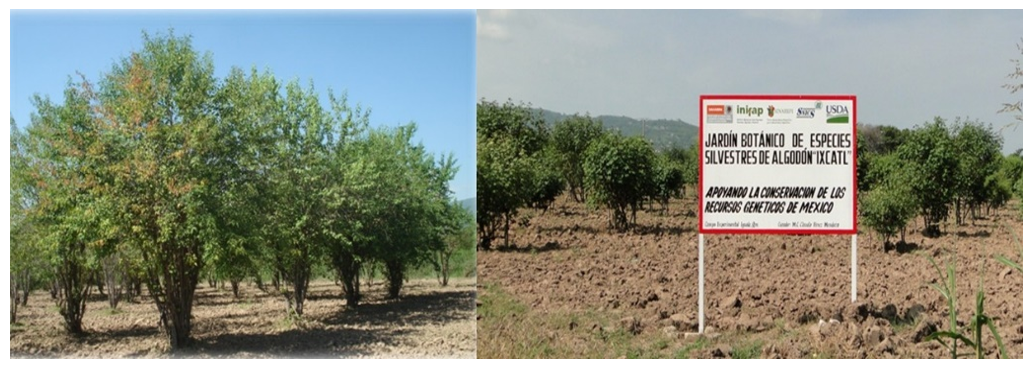
Currently, the conservation of botanical gardens is a priority due to the degradation and destruction of ecosystems worldwide. Mexico, being one of the main megadiverse countries on the planet, must prioritize the safeguarding of native species, among which are those of the genus Gossypium. This can be achieved through botanical gardens under the responsibility of various research and educational institutions, such as the ‘Ixcatl’ Cotton botanical garden of INIFAP, where research activities are conducted in addition to preserving Mexico’s natural and cultural heritage for posterity.
Given the limited representation of the genus Gossypium in the country’s herbaria, germplasm banks and botanical gardens, and the fact that the greatest representation of the genus Gossypium from Mexico is concentrated abroad, it is important that agrarian and sustainable development policies be designed in the country to protect wild and semi-domesticated cotton species in Mexico.
The authors wish to express their sincere thanks to the National Institute of Forestry, Agricultural and Livestock Research (INIFAP), by its acronym in Spanish, the Secretariat of Agriculture (SADER), by its acronym in Spanish through the National System of Plant Genetic Resources (SINAREFI), by its acronym in Spanish, SNICS (2011 to 2015) and the University of Arkansas (2008 to 2011) for the financial support provided for the maintenance and conservation of the ‘Ixcatl’ cotton botanical garden. Likewise, we are grateful to Engineer Quintin Obispo González, M. Sc. María Cristina Arroyo Lira and Dr. Mauricio Ulloa for the information provided for preparing this manuscript.