elocation-id: e4072
Wheat is an important cereal for the human diet due to its protein and caloric contribution; however, production by 2050 will be compromised by the effects of climate change, where periods of drought will be increasingly frequent, which will affect both rainfed and irrigated crops. Based on this problem, the need to develop water-stress-tolerant crops arises; therefore, several studies consider the estimation of drought indices as tools to select genotypes tolerant to water deficit. This study aimed to evaluate six drought indices in 15 crystalline wheat genotypes under two irrigation depths in two localities in Coahuila and Nuevo León during the autumn-winter 2023-2024 agricultural cycle. The evaluated treatments were two irrigation depths for each locality: IR1 of 37.27 cm and IR2 of 20.92 cm for Zaragoza, Coahuila, and IR1 of 42.24 cm and IR2 of 19.35 cm for Navidad, Nuevo León. The experimental design consisted of randomized complete blocks arranged in split plots with two replications. The water stress tolerance index was the one that best related to grain yield under water-deficit conditions for Zaragoza, Coahuila. The tolerance index was the one that was best associated with grain yield under water-stress conditions for Navidad, Nuevo León. 715 and 738 were the most tolerant to water stress in both localities.
Triticum durum L., tolerance, water deficit, yield.
Wheat (Triticum spp. L.) is the second most cultivated cereal in the world; the annual production is estimated at 770 million tons, of which 66% is destined for human consumption (FAO, 2022). Wheat plays an important role in the human diet because it is a source of plant-based protein and its consumption provides approximately 20% of daily calories (Raffo and Jensen, 2023).
In Mexico, wheat production in the autumn-winter 2023-2024 agricultural cycle was 3.47 million tons, of which 1.87 million tons correspond to crystalline wheat and 1.6 million tons were bread wheat; these values also show an annual reduction of 4% in wheat production (FIRA, 2025). This drop in production is mainly attributed to prolonged periods of drought and low levels of water storage in dams, which affects wheat-producing states such as Jalisco, Michoacán, Guanajuato, Sinaloa and Sonora, which have experienced a decrease of 56%, 39%, 31% and 21%, respectively, in production so far this year (FIRA, 2025).
Unfortunately, in the coming years, water scarcity is expected to become more frequent for the optimal development of crops, both in regions with irrigation and rainfed systems (Olivoto et al., 2019). In addition to limited water availability, high temperatures are another critical factor affecting wheat productivity. Drought and heat can occur at different stages of crop development and impact morphological, physiological and molecular processes, causing significant yield losses (Aberkane et al., 2021).
According to the World Meteorological Organization (WMO) and the Copernicus Climate Change Service (C3S), 2024 is considered to be the warmest year in history, and the trend is expected to continue due to the increase in the average annual temperature of 1.55 °C, which represents a risk to food security in the future (Setter and Waters, 2003; FIRA, 2025). Based on this problem, many wheat breeding programs are focusing on the development of varieties that adapt to the climatic conditions of the regions that produce this grass with the aim of increasing cereal production; likewise, other breeding programs are trying to adapt and expand the production of this crop to new areas (Raffo and Jensen, 2023).
Nonetheless, tolerance to water stress is a complex trait because it is controlled by numerous genes, making it difficult to incorporate it into new varieties (Olivoto et al., 2019). To facilitate the selection process, several authors have proposed using drought indices that allow the identification of more stable and tolerant genotypes under contrasting conditions of water availability. Among the most commonly used are the drought susceptibility index (SSI), tolerance index (TOL), mean productivity index (MP), water stress tolerance index (STI), yield stability index (YSI), and drought resistance index (DI) (Fischer and Maurer, 1978; Rosielle and Hamblin, 1981; Bouslama and Schapaugh, 1984).
In subsequent studies, these indices have been shown to be useful for plant breeding programs seeking to develop water-stress-tolerant genotypes (Fernández, 1993; Lan, 1998; Farooq et al., 2009; Mohi-Ud-Din et al., 2022). Recently, different studies have confirmed the effectiveness of drought indices in identifying superior genotypes. For instance, Aberkane et al. (2021) used indices such as MP, STI and modified stress tolerance index (MsSTI) in durum wheat lines, finding that these were mainly associated with yield under drought and heat.
Similarly, Ali and Hamad (2021) evaluated ten drought indices and reported that wheat growth and yield are strongly dependent on water depletion. In another study, Ayed et al. (2017) evaluated the STI, TOL, SSI and MP indices and determined that SSI and MP showed positive correlations with yield under both normal irrigation and drought, so they considered them more suitable for selecting tolerant genotypes. More recently, Patel et al. (2025) showed that the STI, HARM (harmonic mean), GMP (geometric mean productivity), and MP indices were positively and significantly correlated with yield in both stressed and non-stressed environments, confirming their usefulness for identifying high-yielding lines.
In this context, the objective of this study was to evaluate six drought indices in 15 crystalline wheat genotypes under two irrigation depths in two localities of Coahuila and Nuevo León, with the purpose of selecting genotypes tolerant to water stress in these regions.
The first experiment was conducted at the Ing. Humberto Treviño Siller Experimental Field of the Antonio Narro Autonomous Agrarian University (UAAAN, by its Spanish acronym) located in Navidad, Galeana, Nuevo León, (24° 50’ north latitude, 100° 12’ west longitude; altitude 1 891 m). The second was carried out at the UAAAN’s North Unit Experimental Station in Zaragoza, Coahuila (28° 33’ north latitude, 100° 55’ west longitude; altitude 350 m) (CONAGUA, 2025).
A total of 15 crystalline wheat genotypes were evaluated, of which 14 were improved advanced lines characterized by their quality and grain protein content, which are part of an international durum wheat yield nursery (IDYN) provided by the International Maize and Wheat Improvement Center (CIMMYT). The commercial variety CIRNO C2008, provided by the National Institute of Forestry, Agriculture and Livestock Research (INIFAP), was used as a control.
The treatments were randomized using a randomized complete block design arranged in split plots with two replications for the two localities. Irrigation depths were assigned to large plots and genotypes to small plots. The experimental units consisted of two beds, 0.9 m wide and 2 m long (3.6 m2), in both localities.
The irrigation treatments consisted of two irrigation depths (IR1 and IR2). In both localities, three establishment irrigations were applied at the stages of sowing, emergence, and the beginning of tillering to standardize the crop, and these were included in the total irrigation depth of each treatment. Subsequently, irrigation was applied in a differentiated manner by treatment.
In the locality of Zaragoza, from the end of tillering until flowering, irrigation IR1 corresponded to a total irrigation depth of 37.27 cm, with applications every 10 days, whereas IR2 presented a total depth of 20.92 cm, with applications every 24 days, in order to induce water stress during critical phenological stages of the crop. In the locality of Navidad, from the end of tillering until grain filling, the total depths were 42.24 cm (IR1, applications every 11 days) and 19.35 cm (IR2, applications every 20 days).
In total, 10 and 11 irrigations were applied in IR1 for Zaragoza and Navidad, respectively and five irrigations in IR2 in both locations. In the IR1 treatment, less irrigation was applied in Zaragoza than in Navidad because the cycle was longer in Navidad due to the climatic conditions. Irrigation was applied using a drip irrigation system, with a tape installed along the furrows in loam soil in both localities. The response of genotypes to water stress was evaluated indirectly through grain yield and drought index estimation.
The experiments were established during the autumn-winter (AW) 2023-2024 cycle (autumn-winter 2023-24). In the first locality (Zaragoza, Coahuila), the sowing was carried out on December 21, 2023; for the second locality (Navidad, NL), it was carried out on January 17, 2024, based on the recommendations of Ramírez-Pérez et al. (2021), with the purpose of reducing the risk of frost during the flowering stage of the crop in both localities.
Sowing was done manually, with a density of 80 kg ha-1, as recommended by Noriega-Carmona et al. (2019) for wheat sowing in rows. Crop fertilization was performed with a total dose of 260-100-00 (nitrogen units-phosphorus units). Urea was used as a source of nitrogen (N), and monoammonium phosphate as a source of phosphorus (P); the amounts of fertilizers applied were 520 kg and 192 kg, respectively. The fertilizers were applied in three stages: that is, at sowing, 40% of N and 100% of P; the second application (40% of N) was at the phenological stage of tillering (Zadoks 20), and the last fertilization at the heading stage (Zadoks 50) with 20% of N.
Grain yield (kg ha-1): when the genotypes reached the harvest stage (Zadoks 99), the heads of a bed from each plot (1.8 m2) were cut, then threshed with a stationary Pullman-type harvester. The harvested material was cleaned, the moisture content was measured in % using an Agratronix® Mt-pro-08125 portable grain moisture meter, and its weight was determined in grams with an analytical balance. These data were used to calculate the grain yield adjusted to 12% moisture (CIMMYT, 2012).
Prior to harvest, the uniformity of the establishment was verified, and no significant failures were observed in the harvested area. Based on the grain yield values obtained under optimal and water-stress conditions, six drought indices were estimated to evaluate the response of the genotypes. The indices and their respective mathematical expressions are described below.
Drought susceptibility index (SSI): it quantifies the relative reduction in a genotype’s yield under drought compared to optimal conditions (Fischer and Maurer, 1978).
Tolerance index (TOL): It represents the absolute difference in yield between optimal and water-stress conditions (Rosielle and Hamblin, 1981).
Mean productivity index (MP): It expresses the average yield of a genotype under optimal and water-stress conditions, without considering the magnitude of the reduction caused by drought (Rosielle and Hamblin, 1981).
Water stress tolerance index (STI): It allows the identification of high-yielding genotypes under optimal and in water-stress conditions, reflecting a balance between yield and drought tolerance (Fernández, 1993).
Yield stability index (YSI): It assesses the relative stability of a genotype’s yield under water-stress conditions compared to optimal conditions (Bouslama and Schapaugh, 1984).
Drought resistance index (DI): It allows the identification of genotypes with above-average yields under water-stress conditions (Lan, 1998).
Where: Yp = yield under optimal conditions, Ys = yield under water-stress or drought conditions, = average yield under drought conditions, = average yield under optimal conditions.
The grain yield values under optimal and water-restricted conditions, as well as the estimated drought indices for the crystalline wheat lines evaluated in both areas, are presented in Table 1. The TOL index identified genotype 738 (-996.73) for the locality of Navidad and genotype 715 (399.61) for the locality of Zaragoza as the most tolerant to water stress. According to Fischer y Maurer (1978), lower values indicate greater physiological efficiency in water use, which could be related to efficient stomatal regulation and stable maintenance of grain filling.
The MP index identified CIR (1651.35) for the locality of Navidad and genotype 738 (2171.96) for Zaragoza as the most productive under contrasting conditions of irrigation depths (Table 1), which agrees with Rosielle and Hamblin (1981), who relate high values of MP with greater active photosynthetic area and efficiency in the partitioning of biomass towards reproductive organs.
The YSI index identified genotype 738 (3.65) for Navidad and genotype 715 (0.83) for Zaragoza as the genotypes with the highest relative yield stability under water-deficit conditions (Table 1), these values suggest that the genotypes have greater tolerance to drought. Certain studies have indicated that this behavior may be possibly associated with the presence of adaptive mechanisms, such as less perspiration, thicker cuticles, or deep root systems, which are considered key to drought tolerance (Blum, 2011); however, identifying these mechanisms was not the focus of this study.
The SSI index pointed out genotype 738 for Navidad and genotype 715 for Zaragoza as the genotypes least affected by water deficit, which may be related to previous reports that associate a lower susceptibility to water stress with efficiency in physiological processes, such as osmotic adjustment and greater accumulation of osmoprotectants (Mohammadi and Prasanna, 2003), which were not directly evaluated in this research.
The STI index identified genotype CIR (1.22) for Navidad and genotype 711 (0.93) for Zaragoza as the most tolerant to water stress (Table 1). This suggests that, according to Fernández (1993), a high STI indicates that genotypes have the ability to maintain their productivity under variable irrigation water conditions.
The DI index identified genotype 705 (0.67) for the locality of Navidad and genotype 739 (0.58) as the most drought-resistant genotypes (Table 1). It is possible that these responses are related to greater development of root biomass and favorable phenological synchronization with the availability of water in the soil (Blum, 2011); nevertheless, these variables were not evaluated and should be considered in subsequent research.
Regression analyses for the locality of Navidad showed a significant positive relationship between the TOL index and grain yield under water deficit, with R2= 0.38 (Table 2). This is also the case for YSI, SSI, and DI, with R2= 0.37. The values obtained in the coefficient of determination suggest that these indices are the most useful for identifying drought-tolerant genotypes.
[i] SV= source of variation; STI= stress tolerance index; YSI= yield stability index; TOL= tolerance index; MP= mean productivity index; SSI= drought susceptibility index; DI= drought resistance index; β0= intercept; β1= slope of regression; R2= coefficient of determination; *= significant (p ≤ 0.05).
It should be noted that these indices, which describe absolute loss, relative stability, susceptibility and relative resistance, provide more information about the crop’s behavior under stress conditions compared to indices that are based only on average yield. In contrast, the STI index is not very useful for selecting drought-tolerant genotypes in environments with high experimental variation due to the agroclimatic and soil conditions in which the crop develops (Golabadi et al., 2006; Bhandari et al., 2024).
For its part, the MP index is not an indicator either, because it overestimates genotypes that perform well under optimal conditions but not under water stress (Rosielle and Hamblin, 1981).
Regression analyses for the locality of Zaragoza showed significant positive relationships between the STI (Table 3) and MP indices and grain yield, with R2= 0.89 and 0.79, respectively. The values obtained in the coefficients of determination indicate a greater variance due to the effect of the genotypes and less residual variation in this locality (Bänzinger et al., 2000; Blum, 2011).
[i] SV= source of variation; STI= stress tolerance index; YSI= yield stability index; TOL= tolerance index; MP= mean productivity index; SSI= drought susceptibility index; DI= drought resistance index; β0= intercept; β1= slope of regression; R2= coefficient of determination; **= significant (p ≤ 0.01).
In this case, the STI index allowed us to identify productive materials under water-deficit conditions, whereas the MP index identified productive genotypes under both optimal and water-deficit conditions (Fernández, 1993; Mohammadi et al., 2017). The conducted regression analyses showed a positive and significant relationship between the STI and YSI indices and the average grain yield of both localities (Figure 1). The coefficient of determination obtained for this regression was R2= 0.64 and 0.57, respectively.
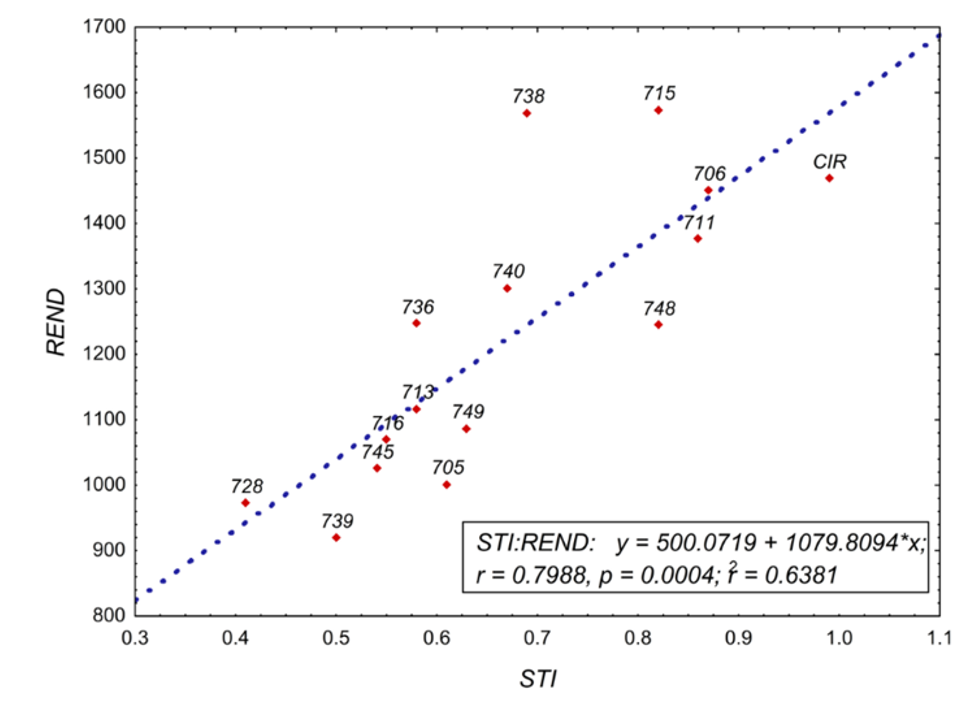
In agricultural research, STI and YSI are the most widely used indices because they allow the selection of genotypes under both optimal and stress conditions. Recent studies on wheat have shown that various indices, including SSI, STI and MP, are often positively associated with yield, making them effective for identifying high-yielding lines under both drought-stress and optimal conditions (Ayed et al., 2017; Patel et al., 2019; Patel et al., 2025).
The STI index showed the strongest association with grain yield under water-deficit conditions in Zaragoza, Coahuila, whereas the TOL index showed the highest association in the locality of Navidad, Nuevo León. Based on the estimation of drought indices in both localities, genotypes 715 and 738 showed better relative performance under conditions of water restriction. These results are preliminary and suggest that these genotypes could be considered for subsequent evaluations in environments with limited water availability, without compromising grain yield.
Aberkane, H.; Belkadi, B.; Kehel, Z.; Filali-Maltouf, A.; Tahir, I. S.; Meheesi, S. and Amri, A. 2021. Assessment of drought and heat tolerance of durum wheat lines derived from interspecific crosses using physiological parameters and stress indices. Agronomy. 11(695):1-20. https://doi.org/10.3390/agronomy11040695.
Ayed, S.; Rezgui, M.; Othmani, A.; Rezgui, M.; Trad, H.; Teixeira-Silva, J. A. and Kharrat, M. 2017. Respuesta al estrés hídrico de trigos duros (Triticum turgidum ssp. durum) y harineros (Triticum aestivum L.) de Túnez. Agrociencia. 51(1):13-26. https://www.agrociencia-colpos.org/index.php/agrociencia/article/view/1275/1275.
Bhandari, R.; Paudel, H.; Alharbi, S. A.; Ansari, M. J.; Poudel, M. R.; Neupane, M. P.; Solanki, P. and Singh, U. K. 2024. Evaluating stress tolerance indices for their comparative validity to access terminal heat stress and heat drought tolerance of winter wheat (Triticum aestivum L.) genotypes. Journal of Agriculture and Food Research. 18(101506):1-16. https://doi.org/10.1016/j.jafr.2024.101506.
Fernández, G. C. 1993. Effective selection criteria for assessing plant stress tolerance. In: Kuo, C. G. Ed. Adaptation of food crops to temperature and water stress: proceedings of an international symposium, Taiwan. Asian Vegetable Research and Development Center. Taiwán. 257-270 pp. https://worldveg.tind.io/record/18578?ln=en.
FAO. 2022. Food and Agriculture Organization of the United Nations) and International Institute for Applied Systems Analysis (IIASA). The Global Agro-Ecological Zoning Version 4 Crop profile: Wheat. Italia. 15 p. chrome-extension://efaidnbmnnnibpcajpcglclefindmkaj/https://s3.euwest1.amazonaws.com/data.gaezdev.aws.fao.org/crop-profiles/GAEZ-Crop-profile-wheat.pdf.
Noriega-Carmona, M. A.; Cervantes-Ortiz, F.; Solís-Moya, E.; Andrio-Enríquez, E.; Rangel-Lucio, J. A.; Rodríguez-Pérez, G. y García-Rodríguez, J. G. 2019. Efecto de la fecha de siembra sobre la calidad de semilla de trigo en el Bajío, México. Revista Fitotecnia Mexicana. 42(4):375-384. http://www.scielo.org.mx/scielo.php?script=sciarttext&pid=S018773802019000400375&lng=es&tlng=es.
Patel, J. M.; Patel, A. S.; Patel, C. R.; Mamrutha, H. M.; Pradeep, S. and Pachchigar, K. P. 2019. Evaluation of selection indices in screening durum wheat genotypes combining drought tolerance and high yield potential. International Journal of Current Microbiology and Applied Sciences. 8(4):1165-1178. https://doi.org/10.20546/ijcmas.2019.804.134.