elocation-id: elocation-id: e4022
Fragata F2025 is a new bread wheat variety developed for El Bajío, which was registered and protected in the National Catalog of Plant Varieties (CNVV, by its Spanish acronym) with the number TRI-216-030725. The cross that gave rise to it was carried out in the autumn-winter 2009-2010 cycle in Roque, Celaya, Guanajuato. The segregating generations were selected using the modified mass method. Its evaluation in yield trials began in the autumn-winter 2013-2014 cycle. Fragata F2025 is semi-dwarf and 90 cm tall; its vegetative cycle is intermediate, with 78 days to flowering and 125 days to physiological maturity. It is resistant to stripe or yellow rust, with only 5% severity, compared with 40, 60 and 100% exhibited by the Cortazar S94, Salamanca S75 and Luminaria F2012 varieties, respectively. In trials conducted across different planting dates, Fragata F2025 surpassed the control varieties Elia M2016 and Luminaria F2012 by 2.3 and 43.5%, respectively, and compared to Cortazar S94, the most planted variety in the El Bajío region, Fragata F2025 surpassed it by 15.3%. Under restricted irrigation, it was observed that, with two irrigations (0-55 days), the new variety obtained a yield of 4 519 kg ha-1, surpassing Cortazar S94 by 9.3%; with three irrigations (0-45 and 75 days), Fragata F2025 obtained a yield of 6 042 kg ha-1, surpassing the Cortazar S94 variety by 7.1%. Fragata F2025 has hard grains; its gluten is strong, with a W value of 313 x 10-4 J, and has a PL value of 6, which classifies the gluten of the new variety as strong tenacious.
industrial quality, rust resistance, yield.
Among the most important factors to increase the productivity of bread wheat (Triticum aestivum L.) is genetic improvement; the release of new varieties generates yield increases that fluctuate between 5 and 20% depending on whether the commercial varieties have lost their resistance to diseases caused by rusts (yellow rust caused by Puccinia striiformis and leaf rust caused by Puccinia triticina), or to replace older varieties with lower yield potential. El Bajío is the second-largest wheat-production area in the country, with 100 386 ha planted during the A-W 2024-25 cycle (SIAP, 2025). This region competes with the country’s northwest in yields, averaging 6.1 t ha-1 during 2023-2025.
The problems in the region include the incidence of stripe or yellow rust, wheat wilt caused by Fusarium, water scarcity, and high production costs, which have discouraged wheat planting in the region. Through genetic improvement, it has been considered to counteract these negative factors affecting production by generating new varieties that are resistant to foliar diseases, efficient in water use and have high yield potential. The use of new varieties has contributed to increasing the unit yields of Guanajuato (the largest wheat producer in the region) from 5.5 t ha-1 obtained in 1981 to 6.73 t ha-1 achieved during 2020-2024 (SIAP, 2025). Research work on wheat genetic improvement at the Bajío Experimental Field has enabled the development of new genotypes that are expected to increase the average yield of El Bajío to 6.5 t ha-1. Under this scenario, the new bread wheat variety Fragata F2025 is presented, which was registered in the National Catalog of Plant Varieties (CNVV) with the number TRI-216-030725.
The bread wheat variety Fragata F2025 was developed by INIFAP’s Bajío Irrigated Wheat Genetic Improvement Program. The line was obtained by hybridization from a single cross between the experimental lines: DIAMANTE/SILVINITA//CELESTINA; its pedigree is TR10CT143-18C-0R-0C-8R-0C. The cross was made in the A-W 2009-2010 cycle in Roque, Celaya, Guanajuato. The F1 generation of the cross was planted in the A-W 2010-2011 cycle in Roque, Celaya, Guanajuato (Roque) and was identified with the number 143. The segregating generations were subjected to the methods of mass and individual selection. The population from which the Fragata F2025 variety was derived in the F2 generation was identified with the number 2142, which was planted in Chapingo, Texcoco, State of Mexico (Chapingo), under rainfed conditions and spaced seed in the spring-summer (S-S) 2011 cycle; 100 spikes were selected for resistance to yellow rust and leaf rust diseases and for agronomic type and were used to form a balanced compound.
F3 was planted in A-W 2011-2012 in Roque in clumps; 100 spikes of the best 100 plants were selected for resistance to yellow rust and agronomic type and a balanced compound was made. F4 was evaluated in S-S 2012 in the locality of Chapingo for resistance to leaf and yellow rusts; the best plants were selected, and a balanced compound was made. F5 was planted in the A-W 2012-2013 cycle in the locality of Roque and was identified with the number 5237; from the selected family, 10 spikes were harvested based on the agronomic type and resistance to yellow rust disease. F6 was sown in a row per spike in S-S 2013 in Chapingo, where line 8 was selected and harvested. This line was evaluated in the preliminary yield tests in the A-W 2013-2014 cycle in Roque. Then, it was subjected to experiments of planting dates, where 36 genotypes are evaluated, consisting of the elite lines and the commercial controls of the region placed in an alpha lattice design with three replications, with a plot size of 4.5 m2, a density of 120 kg ha-1, fertilization of 240-60-00, and a calendar of five irrigations; it is placed on five sowing dates starting on November 15 with 15-day intervals; the dates are November 15, December 1, December 15, January 1, and January 15.
It was also subjected to experiments of irrigation calendars, where 36 genotypes are evaluated, consisting of the elite lines and the commercial controls of the region placed in an alpha lattice design with three replications, with a plot size of 4.5 m2, a density of 120 kg ha-1, fertilization of 240-60-00 and three irrigation calendars: two irrigations at 0-55 days, three irrigations at 0-45-75 days and four irrigations at 0-45-75 and 105 days; likewise, it was placed in nurseries for disease evaluation, where the lines are planted, and a susceptible variety is planted and inoculated with rust spores collected in previous years in the area, then the severity is evaluated with the modified Cobb scale.
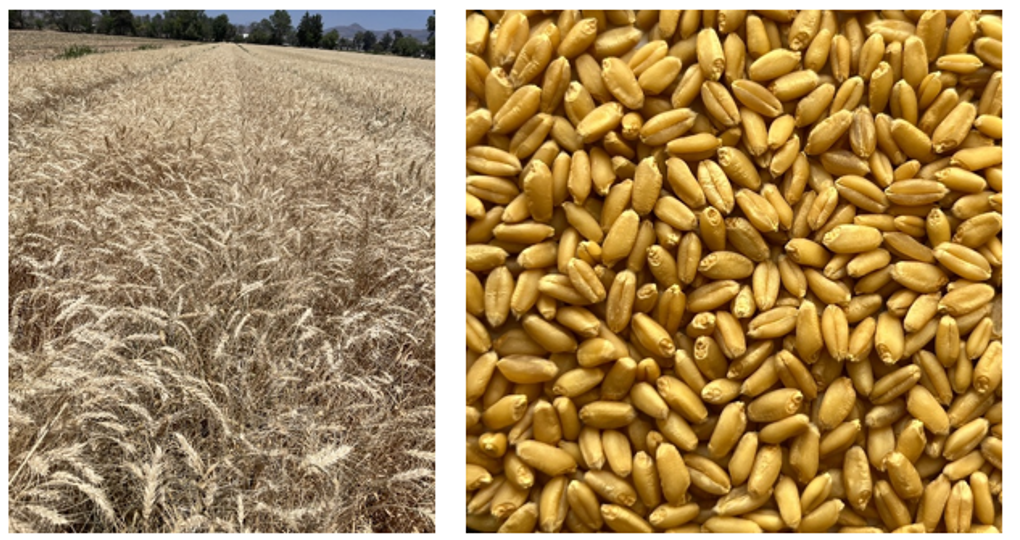
The Fragata F2025 variety, according to the descriptors of the International Union for the Protection of New Varieties of Plants (UPOV, 2017), has a spring growth habit, semi-dwarf, 90 cm tall; its vegetative cycle is intermediate, with 78 days to flowering and 125 days to physiological maturity. The stem is strong, hollow, cream-colored and moderately resistant to lodging. The spike is white with parallel edges in profile, has medium density and awns, is 10.3 to 12 cm long, and produces 18 to 21 spikelets, of which 1 or 2 at the base may be sterile. It generally produces three grains at the base, four in the middle, and three at the apex. The glumes are white; the tip is medium; the predominant shoulder shape is slightly inclined. The grain is white, moderately elongated in shape, with rounded edges and a strong endosperm (Figure 1).
The Fragata F2025 variety has been selected in the segregating generations and in yield trials for resistance to rusts, so this variety, when the climatic conditions are present in the area and the pathogen is present in the environment, only reaches 5% damage from stripe or yellow rust; on the contrary, older varieties such as Salamanca S75 and Cortazar S94 and the susceptible variety Luminaria F2012 reach severity levels of 60, 40 and 100%, respectively.
In adult plants, the resistance of Fragata F2025 is based on the additive-effect gene Lr46 for leaf rust, located on chromosome 1BL and initially identified in the Pavón F76 variety. Lr46 has also been associated with leaf tip burn, and its presence was determined by using a molecular marker. In adult plants, the presence of Yr29 was determined by using molecular markers; this gene is linked to the leaf rust gene Lr46 (William et al., 2003).
The Fragata F2025 variety was compared with 11 commercial wheat varieties planted in El Bajío on planting dates and irrigation calendars in 50 environments or production conditions during the A-W cycles from 2016-2017 to 2022-2023; the control varieties were Cortazar S94, Urbina S2007, Maya S2007, Bárcenas S2002, Ibis M2016, Alondra F2014, Faisán S2016, Salamanca S75, Luminaria F2012, and Elia M2016. In these tests, Fragata F2025 surpassed the control varieties Elia M2016 and Luminaria F2012 by 2.6% and 43.5%, respectively and surpassed Cortazar S94, the most planted variety in El Bajío (Solís et al., 2018) by 15.3% (Table 1).
When comparing the new variety with the control varieties in irrigation calendars, it was observed that, with two irrigations (0-55 days), Fragata F2025 obtained a yield of 4 519 kg ha-1, surpassing the Cortazar S94 variety by 9.3%; with three irrigations (0-45 and 75 days), Fragata F2025 had a yield of 6 042 kg ha-1, surpassing Cortazar S94 by 7.1%. With four irrigations (0-45-75 and 100 days), Fragata F2025 yielded 7 370 kg ha-1, surpassing the Cortazar variety by 15.9%. On average, of the three irrigation calendars, Fragata F2025 outperformed the Cortazar S94 variety by 11.1% (Table 2). Fragata F2025 has hard grains; its dough has strong gluten, with a W value of 313 x 10-4 J and a PL value of 6, which classifies it as strong tenacious.
The bread volumes are 750 ml, very similar to those of the Borlaug 100 and Cisne F2016 controls. The flour from this variety is suitable for baking in the mechanized industry and as an improver for weak-gluten flours. The new variety Fragata F2025 is recommended for the region called El Bajío, which includes parts of the states of Guanajuato, Michoacán, Jalisco and Querétaro, with altitudes of 1 500 to 1 800 m, an average temperature of 20 °C, and rainfall of 450 to 650 mm.
The basic seed of Fragata F2025 will be available at the Bajío Experimental Field-INIFAP for sale to seed-producing companies that request it starting in December 2026. To obtain yields greater than 8 t ha-1, the Fragata F2025 variety must be sown in El Bajío between November 25 and December 10, with a density of 120 kg ha-1, a calendar of four irrigations at 0-45-75 and 100 days after planting, and a fertilization dose of 300-60-00, applying all the phosphorus and 100 kg of nitrogen at sowing and 100 kg in the first and second supplemental irrigation. Suggested products for weed and pest control can be consulted in Ledesma and Solís (2024).
Fragata F2025 is an intermediate-cycle variety with white grain, resistant to stripe or yellow rust and leaf rust; its yield is superior to all control varieties, both in terms of planting dates and under restricted irrigation. It has strong gluten and can be used in the mechanized baking industry. It is suggested that it be planted in the region called El Bajío, which includes parts of the states of Guanajuato, Michoacán and Jalisco.