elocation-id: elocation-id: e4016
Vermicompost is an organic amendment of broad interest in sustainable agriculture, as it improves substrate fertility and exerts suppressive effects against pests and diseases. The objective of the present research was to determine the effect of vermicompost on the growth of banana seedlings in the nursery stage. Four treatments were established: T1 (100 g vermicompost + 650 g rice husks + 650 g sand); T2 (200 g vermicompost + 600 g rice husks + 600 g sand); T3 (300 g vermicompost + 500 g rice husks + 500 g sand); and T4 (control: 0 g vermicompost + 500 g rice husks + 300 g soil + 500 g sand). Parameters related to aerial and root growth were evaluated, including height, pseudostem diameter, leaf emission, chlorophyll content, root and corm weight, as well as root length. The results showed that vermicompost favored the development of seedling morphology, especially at the 300 g dose, which increased pseudostem robustness and leaf emission. These findings confirm the potential of vermicompost as a sustainable tool to strengthen the health, productivity and quality of banana plants in a nursery.
Musa spp., composting, micropropagation, substrate.
Banana (Musa spp.) is a herbaceous plant that produces year-round and contributes to food security as a staple food and source of income for hundreds of millions of people in the tropics and subtropics. Production is mainly concentrated in Asia (55.9%), followed by Africa (24.6%) and the Americas (Akech et al., 2024). The areas cultivated with bananas around the world are constantly expanding and renewing, with farmers requiring plant material that is free of pathogens and above all, that increases or maintains its yield rate once established in the field.
Therefore, it is important to consider factors such as seed origin and the substrate used to support banana plants during their nursery stage, prior to final planting (Barrezueta et al., 2022; Zambrano-Saavedra et al., 2024; Vargas-Sarmiento et al., 2025). A vigorous seedling that is well established in the nursery is more likely to survive and thrive after transplanting to the field (Quispe et al., 2021; García et al., 2022).
In this sense, the Williams clone (Musa AAA) is propagated using biotechnological tools such as micropropagation (apical meristem culture), which ensures the uniformity and health of the propagule in its later stage in the field (García et al., 2022). However, its productivity depends on adequate substrates that promote efficient rooting (less time), along with good aeration and nutrition from the nursery stage (Vargas-Sarmiento et al., 2025).
Several authors point out that incorporating vermicompost into the substrate stimulates germination and root growth (López et al., 2011; Cruz et al., 2024). In addition, vermicompost improves the substrate’s structure and acts as a conditioner (Yatoo et al., 2021), thereby increasing the water retention capacity and aeration of the environment (Acosta et al., 2013; Quispe et al., 2021; García et al., 2022). Likewise, vermicompost in banana substrates contributes to pest control by suppressing edaphic pathogens, such as Fusarium oxysporum and nematodes (Briseño-López et al., 2025).
The induction of systemic resistance through phytoalexins and defensive enzymes, and the release of allelopathic compounds with repellent effects on insects (García et al., 2021). Its incorporation reduces dependence on chemical pesticides and strengthens the sustainability of integrated management in Musa spp. nurseries (García et al., 2022; Omokaro et al., 2024; Vargas-Sarmiento et al., 2025). Therefore, this study aimed to determine the effect of vermicompost on the growth of banana seedlings in the nursery stage.
The study was conducted on a banana farm in El Cambio parish of the Machala canton (province of El Oro, Ecuador). The farm is located at 3° 19’ 26” S and 79° 54’ 31” W, at an altitude of 8 m. The climate corresponds to tropical dry forest, with average temperatures between 25 and 31 °C, annual rainfall of 364 mm and relative humidity of 80%.
The biomass used for composting is described in Table 1. Banana rachises were collected from the farm itself, along with dried leaves, Janeiro grass, wet cow manure, cocoa leaf litter, leaf litter from sweet acacia (Acacia farnesiana) and Saman (Samanea saman) trees, as well as whey and charcoal from the remains of the cocoa pod obtained by slow pyrolysis.
| Material | Amount (kg) |
|---|---|
| Banana rachis | 830.68 |
| Charcoal | 20.91 |
| Grass | 7.27 |
| Cow manure | 79.09 |
| Cocoa leaf litter | 17.27 |
| Forest leaf litter | 267.73 |
| Whey (L) | 30 |
| Cocoa charcoal | 10 |
The materials were weighed in sacks and mixed in layers in a 2 m × 2 m × 1.8 m pit. At the bottom of the pit, the chopped rachis was placed and each component was added successively. A perforated galvanized iron pipe was installed in the center to promote aeration, and the mixture was covered with plastic to maintain moisture.
For two months, the mixture was turned every three days to avoid anaerobiosis. Once the decomposition was completed, the compost was transferred to four wooden boxes, measuring 0.6 m per side and 0.6 m deep, mounted on 1 m bases. In order to adapt the annelid biota to the compost, 1 kg of soil, previously disinfected with hot water and dried in the environment for 48 hours, was mixed with 1 kg of compost in each box.
Each box was filled with the compost almost to the brim, leaving 5 cm free and approximately 300 worms of the species Eisenia foetida were incorporated into each box; the boxes were watered twice a week to maintain humidity without saturating the substrate. After 60 days, the vermicompost was collected, dried in the sun for 72 h, and then sieved through a 3-mm-opening metal mesh in order to remove impurities and obtain a homogeneous material. The product was stored in plastic bags until it was used in the treatments.
The material used consisted of 60 ‘Williams’ clone banana seedlings from the acclimatization stage, with an approximate age of two months, an average height of 18-22 cm, and provided with true leaves and root system. The seedlings were in suitable condition for their nursery phase and subsequent hardening. The experiment was set up under a completely randomized design, with three treatments and a control. Each treatment includes 15 replications. Table 2 presents the composition of each treatment. The control (T4) contained agricultural soil instead of vermicompost to compare the effect of organic fertilizer.
| Treatment | Vermicompost (g) | Rice husk (g) | Sand/soil (g) |
|---|---|---|---|
| T1 | 100 | 650 | 650 (sand) |
| T2 | 200 | 600 | 600 (sand) |
| T3 | 300 | 500 | 500 (sand) |
| T4 (control) | 0 | 500 | 300 (soil) + 500 (sand) |
The 20 × 20 cm plastic bags were distributed homogeneously in the experimental area, under a shade net with 50% reduction in solar radiation and an approximate opening of 1-1.5 mm, in order to minimize thermal stress. Each experimental unit receives 1 L of water weekly, without the application of chemical fertilizers.
The electrical conductivity (EC) and pH of compost and vermicompost were determined every ten days, from seedling planting to 60 days of evaluation. For this analysis, 10 g samples were taken and mixed with 20 ml of distilled water (1:2 ratio), and measurements were made using a Hanna multiparameter meter (Romania). In total, six samples were obtained for each material type.
In the nursery, seedling height was measured from the base to the apical meristem, as well as to the apex of the last leaf formed, using a tape measure. Pseudostem diameter was recorded at half the height of the Pseudostem. Leaf emissions were quantified as the number of leaves emitted per plant per week. Finally, root length was determined by carefully extracting the seedling from the bag and measuring from the base of the corm to the longest root.
The fresh mass of the corm and roots was determined by cutting the plant at neck level. Subsequently, the corm and roots were separated, and the root + corm weight was recorded, along with the individual root and corm weights, using a digital scale. The foliar chlorophyll content was estimated using a Spad meter (Konica Minolta), with readings taken every ten days from day 15 of seedling plating until day 60 of evaluation.
Readings were made on the third fully expanded leaf, counted from the apex, avoiding the midrib. On each floor, a 5 × 5 cm quadrant was delimited in the middle third of the leaf blade; within this quadrant, six punctual readings were taken from the central area to the edge, separated by at least 1 cm from each other. The values were averaged to obtain a single record per plant (SPAD units). The measurements were taken with the leaf clean and free of water droplets, between 9:00 and 11:00 h.
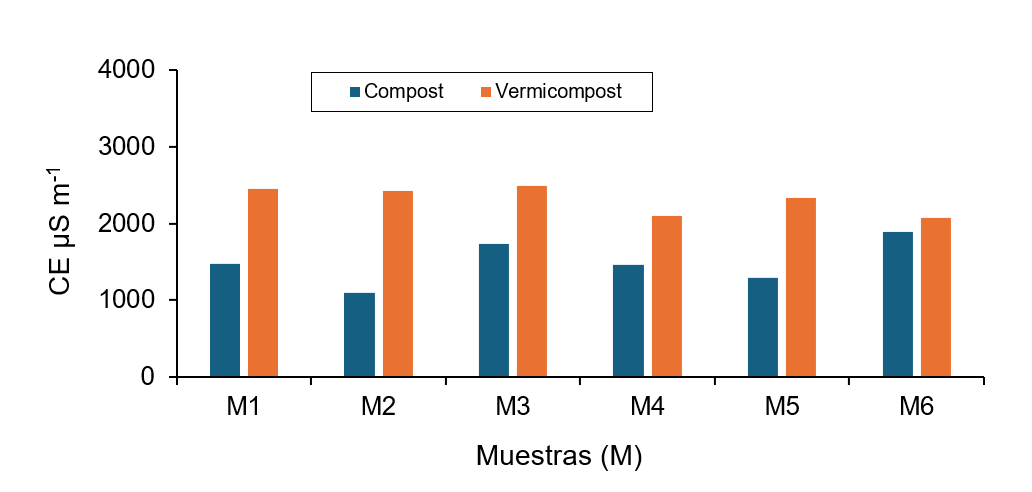
The electrical conductivity of the compost showed relatively low and fluctuating values over the 60 days of measurement (Figure 1), with no statistical differences at the 5% significance level. The lowest mean corresponded to the second sample, with 1 099 μS m-1 and the highest mean to the fourth sample, with 1 890 μS m-1, showing some variability, but without exceeding the optimal levels (<2 000 μS m-1) for agricultural soils (USDA-NRCS, 2011).
In the case of vermicompost, there were statistically significant differences between the samples at the 5% significance level; the initial EC values were high (2 454 μS m-1) due to the presence of soluble salts released during the digestion of the worms; nevertheless, from day 40, the EC decreased to 2 076 μS m-1. This indicates a gradual washing of soluble salts, a decrease attributed to periodic irrigation and percolation of water through the substrate, favoring the leaching of ions such as Na+, K+, Ca2+, and Mg2+ released during the digestion of organic matter by worms (Patel et al., 2025).
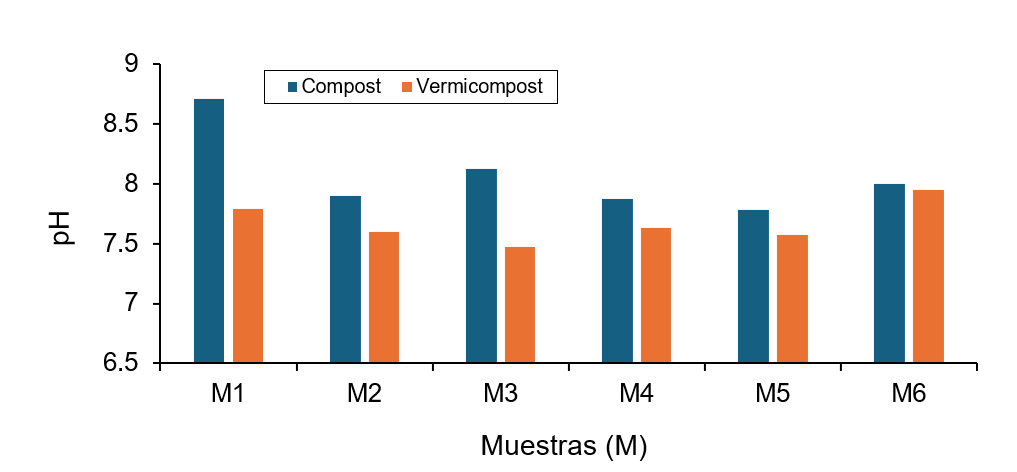
The pH of the compost remained slightly alkaline, ranging between 7.9 and 8.7, with a statistical difference at the 5% significance level; in contrast, vermicompost presented values between 7.5 and 7.95 (Figure 2), a variation that did not indicate a statistical difference at the 5% significance level, a result obtained by Rodríguez and Cortéz (2025).
The pH values obtained were higher than the records of Parmar et al. (2019), who obtained a vermicompost with a pH between 7.1 and 7.3, which the authors attribute to the secretion of NH4+ ions, which reduce the concentration of H+ ions, and to the activity of the calciferous glands in worms, which contain carbonic anhydrase that catalyzes the fixation of CO2 as CaCO3, thus preventing the decrease in pH. Despite this alkaline character, no chlorosis symptoms were observed in the plants.
The morphological variables evaluated showed significant differences between treatments (Table 3). The longest seedling length was obtained in treatment T2 (51.5 ±12.8 cm), followed by T3 (50 ±12.9 cm) and T1 (45.5 ±11.2 cm); by contrast, the control (T4) presented the lowest height (41.8 ±11.2 cm).
No significant differences were observed among treatments 1, 2 and 3; however, significant differences were observed compared to the control. Likewise, a trend towards greater growth in height was observed in treatment T2. This is consistent with what Vargas-Sarmiento et al. (2025) pointed out, who demonstrated that a greater amount of vermicompost in the substrate mixture favors stem elongation in Musa spp. by optimizing the availability of nutrients, especially nitrogen and phosphorus.
This morphological response can be attributed to the presence of growth-regulating substances and increased microbial activity in vermicompost, which stimulates cell division and vegetative vigor in the initial stages of the crop (Correa-Delgado et al., 2026). In general, treatment T3 (300 g of vermicompost) showed the best performance across the morphological variables evaluated, evidencing a greater vegetative vigor of the seedlings at the nursery stage (Table 3).
Treatment T3 had the largest pseudostem diameter (10.3 ±0.7 cm), with statistically significant differences (p≤ 0.05) compared with the other treatments. This result was followed by T4 (9.5 ±0.6 cm); by contrast, the lowest values corresponded to T2 (9.1 ±0.6 cm) and T1 (9 ±0.5 cm). The increase in pseudostem diameter observed in T3 indicates greater structural robustness of seedlings, a key attribute for field establishment.
This behavior is consistent with what was reported by Mago et al. (2021), who noted that high doses of vermicompost significantly increase pseudostem thickness in Cavendish bananas, thereby improving the vigor and support capacity of plants in the nursery. The highest leaf emission was observed in T3 (8.8 ±0.41, a), together with T4 (8.6 ±0.45, a), whereas T1 (8.4 ±0.4, b) showed an intermediate value and T2 (8.1 ±0.59, c) showed the lowest. These significant differences indicate that applying 300 g of vermicompost stimulated the production of new leaves, increasing the active photosynthetic surface, although the control maintained a comparable performance in this variable.
Similar results were obtained by Mago et al. (2021); Yunida et al. (2023), who highlighted that vermicompost promotes leaf expansion and leaf number by improving nutrient release and microbial activity in the substrate. On the other hand, chlorophyll values were highest in T1 (30.4 ±6.5), followed by T4 (29.6 ±5) and T3 (27 ±2.2), and the lowest value corresponded to T2 (26.2 ±4).
Significant differences indicate that the application of vermicompost did not directly increase chlorophyll content, since the highest values were observed in the low dose and in the control. This behavior could be due to the progressive release of nutrients in vermicompost, which initially prioritizes structural growth over the synthesis of photosynthetic pigments (Parmar et al., 2019). Similarly, Fetjah et al. (2022) pointed out that the incorporation of organic matter in Musa spp. substrates increased biomass and leaf production but did not always increase chlorophyll concentration in the early stages of growth.
The variables of root biomass and length were analyzed using Anova (Table 4). Although no significant differences were detected, a trend towards higher values was observed in vermicompost treatments. The combined weight of root and corm ranged from 0.43 ±0.06 kg in T2 to 0.54 ±0.04 kg in T3, with no significant differences between treatments.
Nonetheless, the higher value recorded in T3 suggests a positive trend associated with the higher dose of vermicompost on the accumulation of underground biomass. Similar results were reported by Mago et al. (2021) in Cavendish bananas, who noted that the application of vermicompost does not always produce statistical differences in root weight, but it does tend to yield higher values in treatments with a higher proportion of organic amendment.
Root weight ranged from 0.34 ±0.06 kg in treatment T2 to 0.43 ±0.03 kg in treatment T3, with no statistically significant differences observed between treatments (Table 4). Nevertheless, the higher value recorded in T3 suggested that applying 300 g of vermicompost favored root system development, which could increase plants’ potential for water and nutrient absorption.
This behavior is consistent with what García et al. (2022) reported, who noted that vermicompost improves root architecture and soil exploration efficiency, even when statistical differences are not marked. In corm weight, the values ranged from 0.1 ±0.01 kg in T2 and T4 to 0.11 ±0.01-0.03 kg in T1 and T3, with no significant differences between treatments (p> 0.05). The stability of corm weight suggests that this structural component was less sensitive to variations in the dose of vermicompost in early stages of development.
The findings of Acosta et al. (2013); Yatoo et al. (2021) indicate that organic amendments gradually improve the substrate; however, their effects on underground reserve organs may be limited in the early stages, coinciding with the observed stability in corm weight. On the other hand, root length ranged from 44 ±7 cm in T2 to 52 ±1 cm in T3, with no significant differences.
The higher value in T3, although statistically similar to the others, reflects a possible positive effect of vermicompost on the development of larger roots. This result is consistent with Vargas-Sarmiento et al. (2025), who reported that adding organic matter enhances root elongation, thereby improving the root system’s exploratory capacity.
The application of vermicompost promoted the growth of Williams banana seedlings in the nursery, especially in pseudostem diameter and leaf emission, with the dose of 300 g standing out; in contrast, the variables of the root system showed a homogeneous response, confirming the potential of vermicompost as a sustainable organic amendment at this stage.
Akech, V.; Bengtsson, T.; Ortiz, R.; Swennen, R.; Uwimana, B.; Ferreira, C. F.; Amah, D.; Amorim, E. P.; Blisset, E.; Van den Houwe, I.; Arinaitwe, I. K.; Nice, L.; Bwesigye, P.; Tanksley, S.; Uma, S.; Suthanthiram, B.; Saraswathi, M. S.; Mduma, H. and Brown, A. 2024. Genetic diversity and population structure in banana (Musa spp.) breeding germplasm. The Plant Genome. 17:e20497. https://doi.org/10.1002/tpg2.20497.
Omokaro, G. O.; Osarhiemen, I. O.; Idama, V.; Airueghian, E. O.; West, S. T.; Igbigbi, F. E.; Nnake, D. C.; Obolokor, E.; Ahmed, A. and Omoshie, V. O. 2024. The role of organic amendments and their impact on soil restoration: a review. Asian Journal of Environment & Ecology. 23(11):41-52. https://doi.org/10.9734/ajee/2024/v23i11620.