DOI: https://doi.org/10.29312/remexca.v17i2.4014

elocation-id: e4014

Pérez-López, Mauricio-Gutiérrez, Amaro-Leal, Huerta-Lara, Parraguirre-Lezama, and Romero-Arenas: Protective effect of Pycnoporus sanguineus against phytopathogenic fungi in tomato and strawberry plants

Journal Metadata

Journal Identifier: remexca [journal-id-type=publisher-id]

Journal Title Group

Journal Title (Full): Revista Mexicana de Ciencias Agrícolas

Abbreviated Journal Title: Rev. Mex. Cienc. Agríc [abbrev-type=publisher]

ISSN: 2007-0934 [pub-type=ppub]

ISSN: 2007-9934 [pub-type=epub]

Publisher

Publisher’s Name: Instituto Nacional de Investigaciones Forestales, Agrícolas y Pecuarias

Article Metadata

Article Identifier: 10.29312/remexca.v17i2.4014 [pub-id-type=doi]

Article Grouping Data

Subject Group [subj-group-type=heading]

Subject Grouping Name: Article

Title Group

Article Title: Protective effect of Pycnoporus sanguineus against phytopathogenic fungi in tomato and strawberry plants

Contributor Group

Contributor [contrib-type=author]

Name of Person [name-style=western]

Surname: Pérez-López

Given (First) Names: Ricardo Irving

X (cross) Reference: 1 [ref-type=aff; rid=aff1]

Contributor [contrib-type=author]

Name of Person [name-style=western]

Surname: Mauricio-Gutiérrez

Given (First) Names: Amparo

X (cross) Reference: 1 [ref-type=aff; rid=aff1]

Contributor [contrib-type=author]

Name of Person [name-style=western]

Surname: Amaro-Leal

Given (First) Names: Luis Josué

X (cross) Reference: 1 [ref-type=aff; rid=aff1]

Contributor [contrib-type=author]

Name of Person [name-style=western]

Surname: Huerta-Lara

Given (First) Names: Manuel

X (cross) Reference: 2 [ref-type=aff; rid=aff2]

Contributor [contrib-type=author]

Name of Person [name-style=western]

Surname: Parraguirre-Lezama

Given (First) Names: Conrado

X (cross) Reference: 3 [ref-type=aff; rid=aff3]

Contributor [contrib-type=author]

Name of Person [name-style=western]

Surname: Romero-Arenas

Given (First) Names: Omar

X (cross) Reference: 3 [ref-type=aff; rid=aff3]

X (cross) Reference: § [ref-type=corresp; rid=c1]

Affiliation [id=aff1]

Label (of an Equation, Figure, Reference, etc.): 1

Institution Name: in an Address: Posgrado en Manejo Sostenible de Agroecosistemas-Instituto de Ciencias-Benemérita Universidad Autónoma de Puebla. Edificio Val 1, carretera a San Baltazar Tetela km 1.7, San Pedro Zacachimalpa, Puebla, México. CP. 72960. [content-type=original]

Institution Name: in an Address: Benemérita Universidad Autónoma de Puebla [content-type=normalized]

Institution Name: in an Address: Posgrado en Manejo Sostenible de Agroecosistemas [content-type=orgdiv2]

Institution Name: in an Address: Instituto de Ciencias [content-type=orgdiv1]

Institution Name: in an Address: Benemérita Universidad Autónoma de Puebla [content-type=orgname]

Address Line

City: San Pedro Zacachimalpa

State or Province: Puebla

Postal Code: 72960

Country: in an Address: México [country=MX]

Affiliation [id=aff2]

Label (of an Equation, Figure, Reference, etc.): 2

Institution Name: in an Address: Departamento de Desarrollo Sustentable-Instituto de Ciencias-Benemérita Universidad Autónoma de Puebla. Puebla, México. CP. 72570. [content-type=original]

Institution Name: in an Address: Benemérita Universidad Autónoma de Puebla [content-type=normalized]

Institution Name: in an Address: Departamento de Desarrollo Sustentable [content-type=orgdiv2]

Institution Name: in an Address: Instituto de Ciencias [content-type=orgdiv1]

Institution Name: in an Address: Benemérita Universidad Autónoma de Puebla [content-type=orgname]

Address Line

City: Puebla

State or Province: Puebla

Postal Code: 72570

Country: in an Address: México [country=MX]

Affiliation [id=aff3]

Label (of an Equation, Figure, Reference, etc.): 3

Institution Name: in an Address: Centro de Agroecología-Instituto de Ciencias-Benemérita Universidad Autónoma de Puebla. Edificio Val 1, Carretera a San Baltazar Tetela km 1.7, San Pedro Zacachimalpa, Puebla, México. CP. 72960. [content-type=original]

Institution Name: in an Address: Benemérita Universidad Autónoma de Puebla [content-type=normalized]

Institution Name: in an Address: Centro de Agroecología [content-type=orgdiv2]

Institution Name: in an Address: Instituto de Ciencias [content-type=orgdiv1]

Institution Name: in an Address: Benemérita Universidad Autónoma de Puebla [content-type=orgname]

Address Line

City: San Pedro Zacachimalpa

State or Province: Puebla

Postal Code: 72960

Country: in an Address: México [country=MX]

Author Note Group

Correspondence Information: [§] Autor para correspondencia: biol.ora@hotmail.com. [id=c1]

Publication Date [date-type=pub; publication-format=electronic]

Day: 01

Month: 02

Year: 2026

Publication Date [date-type=collection; publication-format=electronic]

Season: Feb-Mar

Year: 2026

Volume Number: 17

Issue Number: 2

Electronic Location Identifier: e4014

History: Document History

Date [date-type=received]

Day: 01

Month: 01

Year: 2026

Date [date-type=accepted]

Day: 01

Month: 03

Year: 2026

Permissions

License Information [license-type=open-access; xlink:href=https://creativecommons.org/licenses/by-nc/4.0/; xml:lang=es]

Este es un artículo publicado en acceso abierto bajo una licencia Creative Commons

Abstract

Title: Abstract

The search for sustainable alternatives to synthetic fungicides has increased interest in bioactive compounds from basidiomycetes, particularly Pycnoporus sanguineus. The present study evaluated the protective effect of aqueous extracts of P. sanguineus against two phytopathogens of agricultural importance: Botrytis cinerea in strawberries (Fragaria ananassa) and Fusarium oxysporum in tomatoes (Solanum lycopersicum). The tests were conducted under controlled conditions, applying different concentrations of extract (25-100 g L-1). In strawberries, using an infection scale that was established in vitro, the severity caused by B. cinerea declined significantly in the treatments with the highest concentrations (50 and 75 g L-1), which decreased leaf damage by 58 and 74%, respectively. In tomatoes, the treatments with the highest concentrations (50 and 100 g L-1) promoted an aboveground biomass similar to that of non-infected plants (p = 0.05), which shows a positive effect against F. oxysporum. Nonetheless, no significant differences were observed in root biomass, indicating limited systemic activity or low mobility of the compounds. Although these findings are promising, it is necessary to optimize the formulations and validate their efficacy in field conditions.

Keyword Group [xml:lang=en]

Title: Keywords:

Keyword: biological control

Keyword: phytopathogens

Keyword

Italic: Pycnoporus sanguineus [toggle=yes]

Keyword: secondary metabolites

Keyword: synthetic fungicides

Counts

Figure Count [count=2]

Table Count [count=4]

Equation Count [count=0]

Reference Count [count=29]

Abstract

The search for sustainable alternatives to synthetic fungicides has increased interest in bioactive compounds from basidiomycetes, particularly Pycnoporus sanguineus. The present study evaluated the protective effect of aqueous extracts of P. sanguineus against two phytopathogens of agricultural importance: Botrytis cinerea in strawberries (Fragaria ananassa) and Fusarium oxysporum in tomatoes (Solanum lycopersicum). The tests were conducted under controlled conditions, applying different concentrations of extract (25-100 g L-1). In strawberries, using an infection scale that was established in vitro, the severity caused by B. cinerea declined significantly in the treatments with the highest concentrations (50 and 75 g L-1), which decreased leaf damage by 58 and 74%, respectively. In tomatoes, the treatments with the highest concentrations (50 and 100 g L-1) promoted an aboveground biomass similar to that of non-infected plants (p = 0.05), which shows a positive effect against F. oxysporum. Nonetheless, no significant differences were observed in root biomass, indicating limited systemic activity or low mobility of the compounds. Although these findings are promising, it is necessary to optimize the formulations and validate their efficacy in field conditions.

Keywords:

phytopathogens, biological control, , phytopathogens, secondary metabolites, synthetic fungicides.

Introduction

The search for sustainable alternatives to synthetic fungicides has driven interest in natural products with antifungal activity; among them, basidiomycete fungi extracts have gained significant relevance (Sivanandhan et al., 2017; Waszczuk and Zapora, 2021). This is especially true for degrading species, given their high and complex metabolic production (Pinar and Rodríguez-Couto, 2024). In this sense, P. sanguineus, a saprobic fungus widely distributed in tropical and subtropical regions, including Mexico (Téllez-Téllez et al., 2016), has stood out for its richness in secondary metabolites, where up to 19 biosynthetic clusters have been identified in its genome, all of them related to the production of bioactive metabolites, such as clavaric acid, cinnabarin, cinnabarinic acid, as well as phenolic compounds and terpenoids (Lin et al., 2020). Additionally, its high enzymatic capacity, conferred by laccases, enables particularly efficient lignocellulolytic degradation, thus supporting its great metabolic versatility (Saat et al., 2014).

In the agricultural context, its primary derived pigments, such as cinnabarin, cinnabarin acid and tramesanguine, have been evaluated, reflecting an important antimicrobial activity against both Gram-positive and Gram-negative bacteria, including Escherichia coli, Klebsiella pneumoniae, Pseudomonas aeruginosa, Salmonella spp. and Staphylococcus aureus (Smânia et al., 1995; Smânia et al., 2003). Soluble formulations based on P. sanguineus extracts have been directly evaluated for the control of early rot and bacterial spot in tomato crops, such as Alternaria solani, Xanthomonas vesicatoria (Assi et al., 2017) and Xanthomonas campestris (Romero-Arenas et al., 2021). In postharvest, P. sanguineus is effective against relevant phytopathogens, such as Erwinia amylovora and Pectobacterium carotovorum (Cruz-Muñoz, 2021).

In addition to its effectiveness on phytopathogenic bacteria, recent studies show that the extract of this fungus can significantly inhibit the in vitro growth of phytopathogenic fungi, such as B. cinerea and F. oxysporum (Pérez-López et al., 2024); therefore, the evaluation of these effects at the in vivo level is very valuable, due to the commercial impact that these fungi have on strawberry and tomato production worldwide (Hassan et al., 2021; Heikal et al., 2025). Additionally, it has been determined that the extract of P. sanguineus has nematicidal activity and the ability to induce defense responses in plants (Brito et al., 2025), expanding its spectrum of usefulness in comprehensive disease management and thus reducing the ecological and health risks associated with the use of synthetic products.

The study evaluated the protective potential of aqueous extracts of P. sanguineus at different concentrations under controlled conditions against infections caused by B. cinerea, as measured by foliar severity in strawberries and by F. oxysporum, as measured by its impact on tomato aboveground and root biomass. This research will expand knowledge of the use of mycological resources present in Mexico within integrated agricultural disease management strategies, providing new, consistent findings and promoting their practical application.

Materials and methods

Description of the strains

Three strains were characterized and preserved in the Phytopathology Laboratory 204 of the Center for Agroecology, Institute of Sciences of the Meritorious Autonomous University of Puebla (BUAP), by its Spanish acronym. The strain of P. sanguineus (Basidiomycota) was isolated from a wild specimen in the vicinity of the state of Puebla, identified by morphoanatomical and molecular characterization, designated as the MA-Ps1 strain, and later registered with the National Center for Biotechnology Information (NCBI) under the accession number OR622486.1. The phytopathogen strains corresponded to F. oxysporum (MA-FC220) and B. cinerea (MA-BC20), isolated from strawberry roots and fruits and registered in NCBI under accession numbers OM473290.1 and OM473288.1, respectively.

Protective treatment trials with P. sanguineus

Two protective trials were conducted to evaluate the effect of P. sanguineus extracts against B. cinerea infections in strawberries (Fragaria × ananassa Duch.) variety ‘Camino Real’ and F. oxysporum in tomatoes (Solanum lycopersicum L.) variety ‘Río Grande’. In both cases, aqueous extracts of fruiting bodies obtained from the fruiting of the MA-Ps1 strain were applied, pulverized, and diluted to different concentrations, additionally the estimated concentration of cinnabarin derived from (Pérez-López et al., 2024) is reported, followed by inoculation with the corresponding pathogen (Table 1).

Table 1

Table 1. Trial treatments for the application of aqueous extracts of P. sanguineus as a protective treatment against B. cinerea and F. oxysporum on strawberry and tomato plants, respectively.

Treatment Protective trial against B. cinerea in strawberry leaves (g L-1) Protective trial against F. oxysporum in tomato plants (g L-1) Estimated amount of cinnabarin (g L-1)
Extract 25% 25 25 1
Extract 50% 50 50 2
Extract 75% 75 - 3
Extract 100% - 100 4
Positive control Untreated infected plant Untreated infected plant -
Negative control Plant without infection or treatment Plant without infection or treatment -

In both trials, the cultivation characteristics were the same: greenhouse conditions with 8 h of light, humidity of 60%, temperature of 25-30 °C and sterilized substrate made up of 70% forest soil, 20% black soil, 5% sand and 5% perlite. Irrigation was carried out every third day. For the protective test against B. cinerea in strawberry leaves, a total of 225 80-day-old strawberry plants were distributed in five treatments with three replications (25 plants per replication). An in vitro severity index was established using sterile leaves cut and disinfected with 1% sodium hypochlorite for 5 min, then placed in Petri dishes.

These leaves were treated with a single spray with a solution of 5 ml of P. sanguineus at different concentrations (25% extract, 50% extract and 75% extract); then, 5 ml of B. cinerea suspensions was applied at a concentration of 8 × 10³ conidia ml-1; a positive control (untreated B. cinerea) and a negative control (sterile distilled water) were also considered. The progression of foliar damage was recorded daily until 100% severity was reached, with maximum severity defined as the presence of chlorotic and wilted leaves. The damage was analyzed with the Can-Eye V6.49 software, and the results were transformed into percentages; to determine the severity index, the Barremo index was used, given by the formula: SIBarremo = ∑(ni × vi) / N. Where: ni= number of leaves in class i; vi= severity value of class i according to Barremo (0, 1, 3 and 5); and N= total number of leaves evaluated. This index enabled the quantification of damage levels based on discrete severity categories (Table 2).

Table 2

Table 2. Severity table according to the Barremo index.

Severity index Damage description Value (vi)
0 Undamaged leaves (healthy green) 0
1 Minor damage (<5%, localized spots) 1
2 Moderate damage (5-25%, visible chlorotic areas) 3
3 Severe damage (>25%, wilted and necrotic leaf) 5

The trial concluded when the leaves reached 100% severity, which made it possible to compare the efficacy of the extracts against the control group with sterilized water. In the case of the tomato study, 300 120-day-old plants were used, distributed across five treatments with six replications each. Each plant was given single doses of 20 ml of P. sanguineus extract at different concentrations directly into the substrate, while the controls received the same volume of distilled water without P. sanguineus. One week after applying the extracts, the plants were inoculated with 20 ml of a suspension of F. oxysporum (8 × 10³ conidia ml-1).

These suspensions were obtained from cultures in PDA medium grown for one week and were adjusted by serial dilution until the desired concentration was reached, using spore counts in a Neubauer hematocytometer (Neubauer-imp®, Marienfeld, Germany). Negative controls received only distilled water without pathogens. Three days after inoculation, the plants were extracted and separated into aboveground and root parts. Both fractions were dehydrated in an oven at 40 °C until they reached a constant weight. Subsequently, dry aboveground biomass (g) and dry root biomass (g) were recorded. The expression of characteristic symptoms in plants and microscopic observation of mycelium and conidia confirmed the presence of the pathogen in both trials.

Statistical analysis

In both trials, a single-factor analysis of variance (Anova) (α= 0.05) was performed to evaluate differences in leaf damage in strawberries and in biomass in tomatoes. Tukey’s tests were applied to compare the effectiveness of the treatments. The analyses were carried out using R v4.5.0.

Results and discussion

In the B. cinerea infection trial on strawberry leaves, there were statistically significant differences (p ≤ 0.05) in the severity of infection between treatments with different concentrations of the extract and the controls (Table 3).

Table 3

Table 3. Analysis of variance (Anova) for the percentage of severity caused by B. cinerea in strawberry plants under protective treatment with P. sanguineus at different concentration levels.

Treatment Average severity (%) Severity class p ≤ 0.05
Positive control 87.1 ±5.2 3 a
Extract 25% 62.5 ±4.6 3 a
Extract 50% 36.2 ±3.8 3 b
Extract 75% 22.4 ±2.9 2 b
Negative control 0 ±0 0 c

[i] HSD (Tukey, p ≤ 0.05)= 14.72; CV (%)= 9.8. Average values with the same letter do not represent statistically significant differences (p ≤ 0.05) according to Tukey’s tests.

Treatments with extracts of 50 and 75 g L-1 significantly reduced the severity of damage (36.2 and 22.4%, respectively) compared to the positive control (87.1%), highlighting a clear dose-dependent effect (Figure 1), where higher concentrations reduce leaf damage.

Figure 1

Figure 1. Trial of application of P. sanguineus extracts at different concentrations as a preventive treatment against foliar damage in strawberries caused by B. cinerea. Treatments: a) 25% extract; b) 50% extract; c) 75% extract; d) positive control; and e) negative control.

2007-0934-remexca-17-2-4014-gf1.jpg

Similarly, in the trial of tomato infected with F. oxysporum, the Anova showed significant differences in aboveground biomass between treatments (p ≤ 0.05), but not in root biomass (Table 4).

Table 4

Table 4. Analysis of variance (Anova) for aboveground and root biomass in relation to damage caused by F. oxysporum under protective treatment with Pycnoporus sanguineus at different concentration levels.

Treatment Average aboveground biomass (g) p ≤ 0.05 Average root biomass (g) p ≤ 0.05
Positive control 0.052 ±0.011 c 0.022 ±0.005 a
Extract 25% 0.117 ±0.022 a 0.049 ±0.01 a
Extract 50% 0.1 ±0.018 b 0.039 ±0.008 a
Extract 100% 0.154 ±0.025 b 0.069 ±0.012 a
Negative control 0.08 ±0.017 b 0.037 ±0.007 a

[i] HSD (Tukey, p ≤ 0.05): aboveground= 0.028; root= 0.019; CV (%): aboveground= 11.2; root= 14.6. Average values with the same letter do not represent statistically significant differences (p ≤ 0.05) according to Tukey’s tests.

The 50% and 100% extracts expressed values of aboveground biomass statistically comparable to those of the negative control, far outperforming the positive control, suggesting a subtly observable protective effect of the extract (Figure 2). However, the lack of differences in root biomass indicates a limited influence of the treatment on the belowground system.
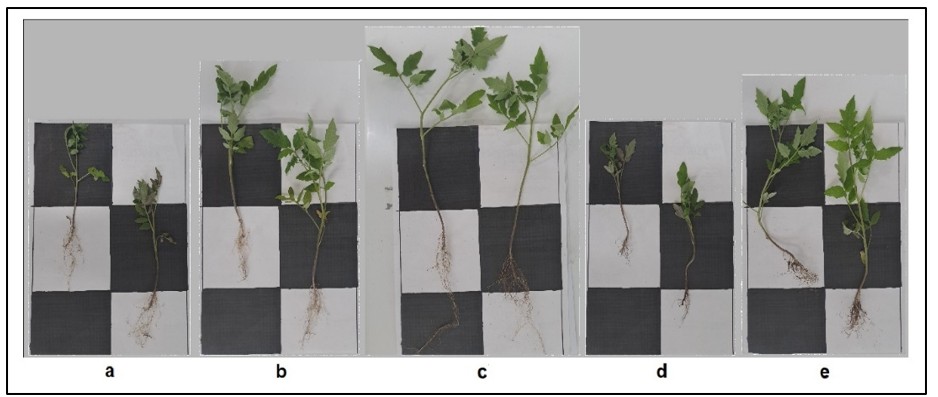
Figure 2

Figure 2. Trial of application of P. sanguineus extracts at different concentrations as a preventive treatment against tomato wilt caused by F. oxysporum. Treatments: a) 25% extract; b) 50% extract; c) 75% extract; d) positive control; and e) negative control.

2007-0934-remexca-17-2-4014-gf2.jpg

These findings confirm the preventive antifungal action of P. sanguineus and agree with previous studies that attribute this activity to secondary metabolites, such as cinnabarin and phenolic compounds (Elisashvili et al., 2009; Patel et al., 2009). In strawberries, treatment with the 75 g L-1 extract reduced leaf damage by 74.3%, which coincides with reports of the potent inhibitory activity of cinnabarin and cinnabarinic acid against bacteria and fungi (Smânia et al., 1995; Pineda-Insuasti et al., 2017).

In tomatoes, the recovery of aboveground biomass in the 50 and 100% treatments supports the hypothesis of a dose-dependent, albeit limited, protective effect in roots. The observed antifungal capacity is close to values reported in PDA media supplemented with complete extracts of P. sanguineus, where B. cinerea was more sensitive than F. oxysporum (Pérez-López et al., 2024). This suggests that crude extracts, containing diverse metabolites such as ergosterol (Téllez-Téllez et al., 2016), polyporins (Rosa et al., 2003), phenolic compounds and terpenoids (Teoh et al., 2011), as well as clavaric acid and laccases (Lin et al., 2020), act synergistically, surpassing the efficacy of isolated compounds.

Nonetheless, the absence of effect on root biomass may be due to the limited mobility of the compounds in belowground tissues, a phenomenon previously described for contact fungicides (Agrios, 2005; Brent and Hollomon, 1995). In addition, the soil microbiota can accelerate the degradation of compounds, reducing their effectiveness in the rhizosphere (Cycoń et al., 2017). In addition, a better selection of methodological procedures, such as pathogen infection by direct inoculation, or more efficient recording of severity through the calculation of disease progression (Gayosso-Barragán et al., 2021), could also influence the evaluation of the observed results.

It should be noted that, in addition to the mechanisms of direct inhibition of membranes and hyphal structures, recent studies suggest that phenolic compounds of P. sanguineus could induce systemic resistance in plants (Lim et al., 2024). This mechanism would explain the similarity observed in some treatments with negative control. Equivalent results have been described for phenol-rich plant extracts, such as Punica granatum and Salvia spp., which have been able to inhibit F. oxysporum in correlation with their phenolic content (Rongai et al., 2015; Kursa et al., 2022). Therefore, the efficacy of the extract could derive not only from a direct antifungal action, but also from the activation of immune responses in plants.

Consequently, P. sanguineus extract shows potential as a biocontrol agent within integrated management strategies, although with certain limitations, including biophysical limitations faced by both management and application of this type of formulation outside the laboratory. For example, low mobility to roots suggests the need to optimize formulations (encapsulation or emulsifiers) to improve compound distribution and persistence. Likewise, variability in environmental factors, such as humidity and wind, or exposure to light (Lim et al., 2024), could affect the performance of these metabolites in the field.

Conclusions

The aqueous extract of fruiting bodies of P. sanguineus showed potential as a protective agent against the effects of B. cinerea in strawberries and F. oxysporum in tomatoes. Nevertheless, the recovery of aboveground biomass in infected tomato plants was only observable under the highest concentrations; likewise, the significant reduction of leaf damage in strawberries was observable only in the extracts of higher concentration.

These effects are associated with the presence of metabolites such as cinnabarin and phenolic compounds, which may be responsible for the antifungal action and a possible induction of systemic defenses in plants. However, the limited response in root biomass suggests that techniques and formulations should be improved for greater effectiveness. It is recommended to evaluate their application in field conditions and to delve deeper into the characterization and mode of action of their active compounds.

Bibliography

1 

Agrios, G. N. 2005. Plant pathology. Elsevier. 5a Ed. San Diego, California, EUA. 952 p.

2 

Arfi, Y.; Levasseur, A. and Record, E. 2013. Differential gene expression in Pycnoporus coccineus during interspecific mycelial interactions with different competitors. Applied and Environmental Microbiology. 79(21):6626-6636.

3 

Assi, L.; Meinerz, C. C.; Stangarlin, J. R.; Kuhn, O. J.; Viecelli, C. A. and Schwan-Estrada, K. R. F. 2017. Control of Alternaria solani and Xanthomonas vesicatoria in tomato by Pycnoporus sanguineus formulated extract. Scientia Agraria Paranaensis. 16(3):314-320.

4 

Borderes, J.; Costa, A.; Guedes, A. and Tavares, L. B. B. 2011. Antioxidant activity of the extracts from Pycnoporus sanguineus mycelium. Brazilian Archives of Biology and Technology. 54(4):1167-1174.

5 

Brent, K. J. and Hollomon, D. W. 1995. Fungicide resistance in crop pathogens: how can it be managed? FRAC. Monograph núm. 1. 48 p.

6 

Brito, O. D. C.; Schons, B. C.; Junior, R. C.; Dalevedove, D. B.; Fujimoto, J. Y. H. and Stangarlin, J. R. 2025. Proteins of Pycnoporus sanguineus have nematicide activity and induce resistance to Meloidogyne spp. in micro-tom tomato plants. Tropical Plant Pathology. 50(1):43-53.

7 

Cruz-Muñoz, R. 2021. Aplicación del hongo Pycnoporus sanguineus en postcosecha. Universidad Autónoma Chapingo (UACH). Chapingo, Estado de México. 150 p.

8 

Cycoń, M.; Mrozik, A. and Piotrowska-Seget, Z. 2017. Bioaugmentation as a strategy for the remediation of pesticide-polluted soil: a review. Chemosphere. 172:52-71.

9 

Elisashvili, V.; Kachlishvili, E.; Tsiklauri, N.; Metreveli, E.; Khardziani, T. and Agathos, S. N. 2009. Lignocellulose-degrading enzyme production by white-rot Basidiomycetes isolated from the forests of Georgia. World Journal of Microbiology and Biotechnology. 25(2):331-339.

10 

Gayosso-Barragán, O.; López-Benítez, A.; Marroquín-Morales, J. Á.; López-Aguilar, K.; Hidalgo-Ramos, D. M. y Chávez-Aguilar, G. 2021. Evaluación de la respuesta de diferentes genotipos de tomato a Fusarium oxysporum raza 3. Revista Mexicana de Ciencias Agrícolas. 12(3):409-420.

11 

Hassan, E. A.; Mostafa, Y. S.; Alamri, S.; Hashem, M. and Nafady, N. A. 2021. Biosafe management of Botrytis grey mold of strawberry fruit by novel bioagents. Plants. 10(12):2737. https://doi.org/10.3390/plants10122737.

12 

Heikal, Y. M.; Albahi, A. M.; Alyamani, A. A.; Abdelmigid, H. M.; Haroun, S. A. and Soliman, H. M. 2025. Integrated management of tomato fusarium wilt: ultrastructure insights into zn nanoparticles and phytohormone applications. Cells. 14(14):1055. https://doi.org/10.3390/cells14141055.

13 

Kursa, W.; Jamiołkowska, A.; Wyrostek, J. and Kowalski, R. 2022. Antifungal effect of plant extracts on the growth of the cereal pathogen Fusarium spp. an in vitro study. Agronomy. 12(12):3204. https://doi.org/10.3390/agronomy12123204.

14 

Lim, C. L.; Yang, C. H.; Pan, X. Y.; Tsai, H. Y.; Chen, C. Y. and Chen, W. L. 2024. Different wavelengths of LED irradiation promote secondary metabolite production in Pycnoporus sanguineus for antioxidant and immunomodulatory applications. Photochemical & Photobiological Sciences. 23(5):987-996.

15 

Lin, W.; Jia, G.; Sun, H.; Sun, T. and Hou, D. 2020. Genome sequence of the fungus Pycnoporus sanguineus, which produces cinnabarinic acid and pH- and thermo-stable laccases. Gene. 742:144586. https://doi.org/10.1016/j.gene.2020.144586.

16 

Patel, H.; Gupte, A. and Gupte, S. 2009. Effect of different culture conditions and inducers on production of laccase by a basidiomycete fungal isolate Pleurotus ostreatus HP-1 under solid state fermentation. BioResources. 4(1):268-284.

17 

Pérez-López, R. I.; Romero-Arenas, O.; Parraguirre-Lezama, C.; Romero-López, A.; Rivera, A. and Cedillo-Ramírez, L. 2024. Comparison of three biological control models of Pycnoporus sanguineus on phytopathogenic fungi. Applied Sciences. 14(18):8263. https://doi.org/10.3390/app14188263.

18 

Pinar, O. and Rodríguez-Couto, S. 2024. Biologically active secondary metabolites from white-rot fungi. Frontiers in Chemistry. 12:1363354. https://doi.org/10.3389/fchem.2024.1363354.

19 

Pineda-Insuasti, J. A.; Gómez-Andrade, W. E.; Duarte-Trujillo, A. S.; Soto-Arroyave, C. P.; Pineda-Soto, C. A.; Fierro-Ramos, F. J. y Álvarez-Ramos, S. E. 2017. Producción de Pycnoporus spp. y sus metabolitos secundarios: Una revisión. ICIDCA. sobre los derivados de la caña de azúcar. 51(2):60-69.

20 

Romero-Arenas, O.; Jara-Rivera, A. P.; Valencia-de-Ita, M. A.; Parraguirre-Lezama, C.; Villa-Ruano, N. and Rivera, A. 2021. In vitro antimicrobial activity of Cinnabarin on Xanthomonas campestris isolated from bean crops of Puebla, Mexico. Applied Sciences. 11(12):5391. https://doi.org/10.3390/app11125391.

21 

Rongai, D.; Pulcini, P.; Pesce, B. and Milano, F. 2015. Antifungal activity of some botanical extracts on Fusarium oxysporum. Open Life Sciences. 10(1):220-225.

22 

Rosa, L. H.; Machado, K. M. G.; Jacob, C. C.; Capelari, M.; Rosa, C. A. and Zani, C. L. 2003. Screening of Brazilian basidiomycetes for antimicrobial activity. Memórias do Instituto Oswaldo Cruz. 98(7):967-974.

23 

Saat, M. N.; Annuar, M. S. M.; Alias, Z.; Chuan, L. T. and Chisti, Y. 2014. Modeling of growth and laccase production by Pycnoporus sanguineus. Bioprocess and Biosystems Engineering. 37(5):765-775.

24 

Sivanandhan, S.; Khusro, A.; Paulraj, M. G.; Ignacimuthu, S. and Al-Dhabi, N. A. 2017. Biocontrol properties of basidiomycetes: an overview. Journal of Fungi. 3(1):2. https://doi.org/10.3390/jof3010002.

25 

Smânia, A.; Delle-Monache, F.; Smânia, E. F. A.; Gil, M. L.; Benchetrit, L. C. and Cruz, F. S. 1995. Antibacterial activity of a substance produced by the fungus Pycnoporus sanguineus (Fr.) Murr. Journal of Ethnopharmacology. 45(3):177-181.

26 

Smânia, A.; Marques, C. J. S.; Smânia, E. F. A.; Zanetti, C. R.; Carobrez, S. G.; Tramonte, R. and Loguercio-Leite, C. 2003. Toxicity and antiviral activity of Cinnabarin obtained from Pycnoporus sanguineus (Fr.) Murr. Phytotherapy Research. 17(9):1069-1072.

27 

Téllez-Téllez, M.; Villegas, E.; Rodríguez, A.; Acosta-Urdapilleta, M. L.; O’Donovan, A. and Díaz-Godínez, G. 2016. Mycosphere essay 11: fungi of Pycnoporus: morphological and molecular identification, worldwide distribution and biotechnological potential. Mycosphere. 7(10):1500-1525.

28 

Teoh, Y. P.; Don, M. M. and Ujang, S. 2011. Media selection for mycelia growth, antifungal activity against wood-degrading fungi and GC-MS study by Pycnoporus sanguineus. BioResources. 6(3):3001-3015.

29 

Waszczuk, U. and Zapora, E. 2021. Arboreal fungi in biological control against soil fungi. Environmental Sciences Proceedings. 9(1):31.