elocation-id: e3969
In recent years, the avocado crop has aroused great interest among farmers in the state of Guerrero, thanks to its economic importance, profitability and nutritional and nutraceutical benefits. In addition, it is a high-demand product both at home and abroad. However, various factors limit the scope of the crop’s potential yield, such as edaphic conditions, nutritional status, climate, pest and disease incidence and water resources, among others. This research aimed to carry out an edaphic characterization, nutritional diagnosis of the vegetative tissue and evaluation of the incidence of pests in the avocado crop in the locality of Izotepec, municipality of General Heliodoro Castillo, in the region Sierra of Guerrero. To this end, soil and leaf tissue sampling was carried out in an orchard in the study area in order to determine the physical and chemical composition of the soil and leaf tissue, as well as the incidence of pests and diseases. The results indicated that the soil texture is suitable for the avocado crop. Nevertheless, deficiencies in nutrient content, soil pH below optimal values, and low concentration of essential elements, such as N, P, K, Mg, S, Mn and B, in leaf tissue were identified. In addition, the susceptibility of pests and nutritional deficiencies was confirmed, which can be prevented and controlled through an integrated management of plant nutrition and health.
nutrient composition, organic matter, pH, texture
The avocado (Persea americana Mill.) is the fruit crop with the highest economic value in Mexico; the production value is equivalent to $60 097 064 pesos; the state of Michoacán stands out with a production of 43 681 225 t, followed by Jalisco and the State of Mexico. In Guerrero, avocado cultivation is a growing activity; in 2023, the state was the seventh-largest national producer, with a volume of 22 518 t; the municipalities that contribute the highest production for the state are General Heliodoro Castillo, Técpan de Galeana, and Leonardo Bravo (SIAP, 2023).
The Hass cultivar stands out as one of the most commercialized avocado varieties in the world. It requires specific agroecological conditions to optimize tree growth and ensure fruit production, yet it is highly susceptible to pests and diseases (Garrido-Ramírez et al., 2013; Rodríguez et al., 2020). Due to its high profitability, the crop demands large quantities of fertilizers and agrochemicals to achieve healthy and safe production. Because of this, it is necessary to generate specific nutritional treatments for each avocado region based on soil conditions and plant behavior (Villalva-Morales et al., 2015), as well as to develop specific management for each region.
The lack of recommendations, based on preliminary research or analysis, for establishing new orchards leads to the overuse of inorganic fertilizers (Shunfeng et al., 2018). This type of management, by not integrating other relevant factors such as biological control and organic fertilization, generates problems such as the transformation of natural areas, soil contamination and erosion, contamination of water resources, alterations in climatic patterns, negative impacts on local fauna, and risks to human health (Garrido-Ramírez et al., 2013; Alfaro and Flores, 2024).
Faced with this situation and given the commercial importance of avocados, sustainable and environmentally friendly integrated management alternatives that allow production without damaging other resources are being investigated. Among these alternatives is crop zoning, which identifies areas and periods in which agroecological productivity is possible and efficient (Garrido-Ramírez et al., 2013; Figueroa-Figueroa et al., 2024). In this context, the objective of this research was to characterize the edaphic conditions, diagnose the nutritional status of the leaf tissue, and evaluate the incidence of pests in the avocado crop in the locality of Izotepec, municipality of General Heliodoro Castillo, in the region Sierra of Guerrero.
The research was conducted in 2020 in the municipality of General Heliodoro Castillo, in the locality of Izotepec, in the region Sierra of Guerrero, in a Hass avocado orchard with one hectare in production and representative of the management and production conditions of the area. The trees had a mean age of eight years, a population density of 150 trees ha-1 and a yield of 5.5 t ha-1. The flowering stage begins in March and ends in April, the fruiting period is from May to December, and the harvest takes place between January and April. The site was located at 17° 30’ north latitude and 100° 0’ west longitude, with an altitude of 2 100 m. The climate is semi-warm-subhumid (Aw), with temperatures of 5 to 22 °C, an average annual rainfall of 1 650 mm concentrated between May and October, and soils with slopes of 15 to 40%.
In January, 12 soil subsamples were collected using a zigzag sampling design, considering two criteria: soil color and terrain slope. Four zones were delimited, and within each zone, sampling was carried out at three depths (0-30, 30-60 and 60-90 cm), yielding a total of 12 composite samples, with approximately one kilogram of soil per sample. Subsequently, they were transferred to the soil laboratory of the Cep-Csaegro for processing.
In the laboratory, the samples were dried, then ground, and sieved with 10- and 20-mesh screens. Texture and physical and chemical properties (pH, EC, organic matter, total nitrogen, phosphorus, exchangeable cations, extractable sulfur and manganese) were determined following the methodology established in Nom-021-Recnat-2000 (SEMARNAT, 2000). pH and EC were determined by potentiometry; exchangeable cations were extracted by ammonium acetate 1N and pH 7; potassium and sodium were quantified by flammometry; calcium and magnesium were quantified by titration using the 0.01 N ethylenediaminetetraacetic acid (EDTA) solution.
In each of the four areas of the study area, four trees were selected at random and four healthy leaves (blade + petiole) were collected from the middle part of terminal shoots without fruiting, of the same physiological age (6 and 7 months) and visually healthy (Salazar-García and Lazcano-Ferrat, 1999). The leaves were deposited in brown paper bags labeled by area and orientation; these were transferred to the Soil Laboratory of the Cep-Csaegro for processing.
In the laboratory, the leaves were washed with running and distilled water to remove residues of potential nutritional interference. Subsequently, they were dried with absorbent paper, the middle part of the leaf blade was separated and they were subjected to dehydration in an electric oven with forced air circulation at 70 °C for 48 h until constant weight was obtained; the samples were ground and sieved (0.5 mm mesh) and the contents of P, K, Mg, S, Mn and B were determined; wet digestion of the tissue was performed, with a mixture of nitric and perchloric acids (HNO3:HClO4, 2:1) (Alcántar and Sandoval, 1999).
Random samples of fruits and leaves were collected from 15 trees in the study area; they were transferred to the Phytopathology Laboratory of the Cep-Csaegro and the identification of pests and diseases was carried out afterwards. To this end, an incidence scale of 0 to 100% was established to evaluate the presence and damage caused to leaves and fruits.
To evaluate the differences and similarities between the strata and sampling areas, a principal component (PC) analysis was performed using the statistical software R (R Development Core Team, 2012). A biplot was generated with the dispersion of the sampling areas in the plane of the first two PCs (biplot), and the correlations between the components and variables were analyzed.
The percentages of sand, clay and silt particles that make up the soil texture show similarities at the same level, stratum E3, in Zones 1 and 3, but they differ with respect to Zones 2 and 4. According to the classification of Nom-021-Recnat-2000, these soils were identified as clay loam (Table 1) due to the proportion of particles. In contrast, the other strata show variations in their contents according to the study area (Table 1).
Avocado crops can be grown in various types of soil; however, those with a loamy texture are the most recommended, as they promote drainage, reduce the risk of waterlogging, and reduce the incidence of root diseases caused by fungi, which contributes to prolonging the productive life of the tree (Garrido-Ramírez et al., 2013; García-Martínez et al., 2021). According to Salazar-García et al. (2008), soils with a clay content exceeding 35% are not recommended for this crop, so the clay-loam and silty-clay-loam textural classes have limitations for their optimal development.
The pH values in the first stratum, 0-30 (E3), show similarities in zones 2, 3 and 4, whereas in zone 1, they are lower. According to the classification of Nom-021-Recnat-2000, these soils are considered moderately acidic and have no significant salinity effects (Table 2). In strata E6 and E9, the pH is lower than in E3 in all zones, being classified as strongly acidic.
This variation in depth gradients is attributed to fertilizer application and agronomic management of the crop. In addition, the rhizosphere for this type of crop is found in the first 30 cm of the soil, since its predominant root system is superficial in soils with light texture (Salazar-García and Cortés-Flores, 1986). The pH recorded is below the optimal range for avocado crops, as is the organic matter and nitrogen content in stratum 1 for zones 2, 3 and 4. According to Salazar-García et al. (2008), avocado plants develop adequately in soils with a pH between 5.5 and 6; higher values can generate micronutrient deficiencies, while lower values can cause toxicity from elements such as aluminum in high concentrations.
The contents of organic matter and nitrogen vary between the three strata and show a downward trend. In all zones, the organic matter (OM) level in E3 is medium (< 3%), whereas the levels in E6 and E9 are classified from low to very low (<1.5%), which represents a limitation for the crop. This explains the low nutrient levels in the lower strata, related to OM availability and soil texture. Campos et al. (2020) attribute the effect of organic matter on root development to its influence on soil structure and aggregation, as well as to factors such as soil fauna, microorganisms, environmental variables, inorganic cementing agents, and roots. Other benefits indicated by Ramírez et al. (2015) include that they facilitate tillage and increase aeration and water retention capacities. Therefore, organic matter represents an important component in the dynamics of soil properties and characteristics.
The eigenvalue matrix of the PC indicated that the first two principal components explained 66.6% of the total variation. The first principal component (PC1) explained 50.9% of the variation, while the second (PC2) explained 15.7% of the variation. The variables that contributed the most to PC1 were EC, Ca, OM, N and P, while sand (SAN) and clay (CLA) had a greater influence on PC2. Figure 1 shows the dispersion of the sampling zones and strata in the plane of the first two PCs, where three groups are identified. Regarding the variables analyzed, a positive correlation was observed between pH, K, EC, OM, N, SIL and Ca, as well as between SAN, B, P, Mn and SAN (angles ≤45°). In contrast, there was a negative correlation (angles >90°) between pH, EC, and SIL with CLA, S and Mg, as well as between CLA and SAN, which indicated that an increase in clay (CLA) content is associated with a decrease in sand (ARE) percentage.
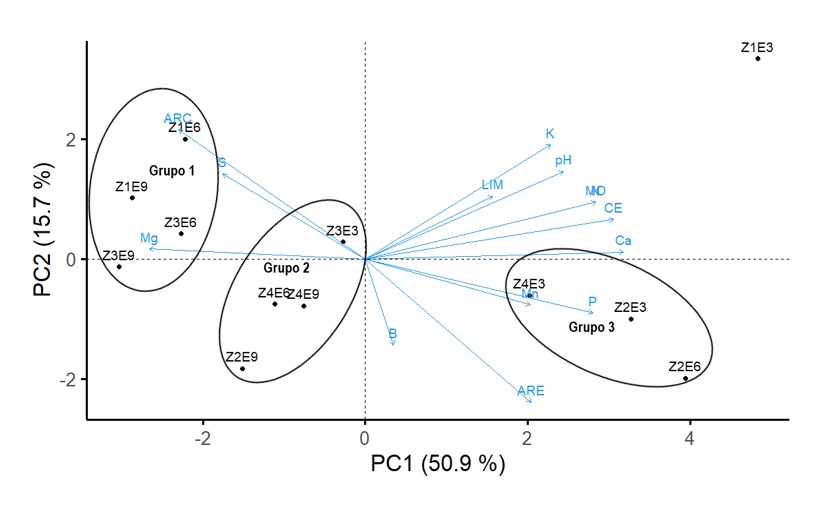
Group 1 includes four samplings (Z1E6, Z1E9, Z3E6, and Z3E9), which show similarities between the strata of their respective areas. In this group, Z1E6 stands out for the highest percentage of clay (47.2%), whereas Z3E9 had a higher concentration of Mg (24 mEq 100 g-1). Group 2 is made up of Z3E3, Z4E9, Z4E6, and Z2E9, characterized by intermediate values in the evaluated variables and low K levels (Table 2). Group 3 includes Z4E3, Z2E3 and Z2E6, where the last two have high concentrations of P and Mn (Table 2). Finally, Z1E3 sampling was not associated with any other group due to its contrasting values with the rest of the samplings, registering the highest levels in SIL, pH, EC and K (Table 2). In general terms, stratum E3 in the four zones showed the highest fertility; however, its nutrient content is insufficient to cover the nutritional demand of the crop.
The results indicated that the highest concentration of P and Mn was found in the north-facing leaves, while the highest values of K and B were recorded in the west-facing leaves, and those of Mg and S in the south-facing leaves. The method used did not detect the presence of N (Table 3). In terms of nutritional sufficiency, the recommended N values range from 2.17 to 2.19%, considered suitable for the crop, as indicated by García-Martínez et al. (2021).
The P percentage was low, the K and Mg levels were normal and the S level was found to be deficient (García-Martínez et al., 2021). In contrast, the Mn concentration was excessive and that of B was high (Raya et al., 2021; García-Martínez et al., 2021). None of the sampled trees presented an optimal balance in their nutritional status (García-Martínez et al., 2021). This is attributed to the close relationship between soil nutrient composition and plant nutrient uptake. Nonetheless, some studies have pointed out that even when soil has adequate texture, pH, EC, and nutrient concentration, these are not always available for use by crops (García-Martínez et al., 2021; Raya et al., 2021).
These results highlight the need to develop a comprehensive management plan that includes soil conditioning, a series of practices that minimize slope erosion, thus minimizing nutrient carryover, and the strategic application of organic or inorganic fertilizers to improve fertility and meet the nutritional requirements of the crop (Salazar-García et al., 2021), as there is a potential to increase yield in orchards through the optimal design of fertilization programs (García-Martínez et al., 2022). Avocado trees produce for an extended period; therefore, such long-term fertility requires that the effective annual amounts of added nutrients correspond to the annual amounts required by the fruits (Silber et al., 2018).
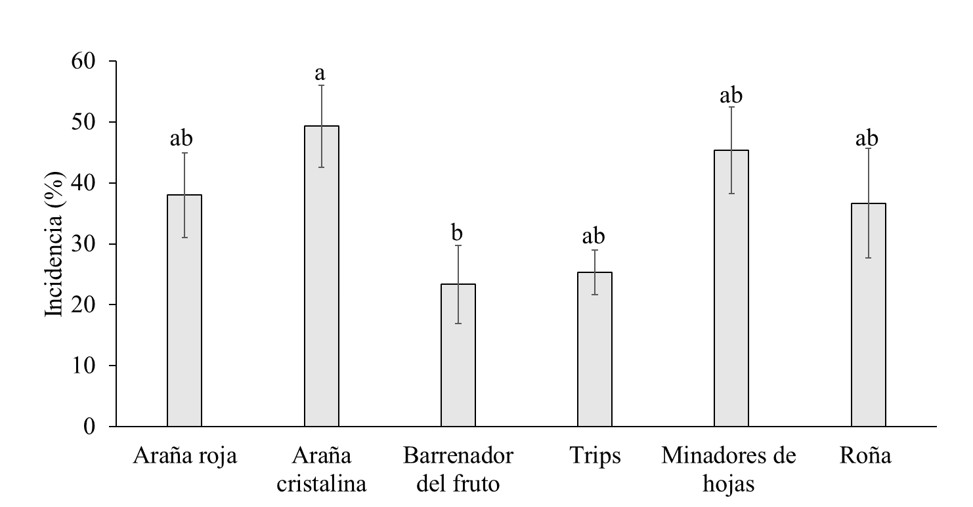
Six pests belonging to the following genera were identified: Tetranychus (red spider mite), Oligonychus (crystalline spider mite), Stenoma (fruit borer), Frankliniella (thrips), and Phyllocnistis and Caloptilia (leaf miners); likewise, a disease caused by fungi of the genus Sphaceloma (scab) was detected. In relation to the incidence scale, red spider mites had an incidence of (38%), which indicates their presence in less than 50 leaves (Figure 2).
The crystalline spider reached 49.33%, colonizing half of the leaves. For its part, the fruit borer had an incidence of 23.33%, with less than five holes per fruit. Thrips registered 25.33%, affecting less than three fruits. The leaf miner presented 45.33%, with at least ten damaged leaves. Finally, the scab reached 36.66%, being detected in more than ten fruits. The presence of pests and diseases is common in avocado crops (Acosta-Guadarrama et al., 2017; Rodríguez et al., 2020); nevertheless, the incidence observed was moderate, since no organism exceeded 50% of damage, due to the agroecological characteristics of the cultivation area, considering that the annual rainfall is greater than 1 000 mm.
The locality of Izotepec, in the municipality of General Heliodoro Castillo, in the region Sierra of Guerrero, has soils with a suitable texture for avocado crops. However, soil chemical properties such as pH, organic matter content, and nutrient availability are deficient. The Hass avocado is susceptible to pests and nutritional deficiencies, which can be prevented and managed through an integrated and efficient pest and disease control and fertilization program.
The publication of this research was partially supported by the Chair Researchers Program-COMECYT-2024 (RCAT2024-0003).
Acosta-Guadarrama, A. D.; Ramírez-Dávila, J. F.; Rivera-Martínez, F.; Figueroa-Figueroa, D. K.; Lara-Díaz, A. V.; Maldonado-Zamora, F. I. y Tapia-Rodríguez, A. 2017. Distribución espacial de Trips spp. (Thysanoptera) y evaluación de su control mediante el depredador Amblyseius swirskii en el cultivo de aguacate en México. BioOne. 42(2):435-446. https://doi.org/10.3958/059.042.0214.
García-Martínez, R.; Cortés-Flores, J. I.; López-Jiménez, A.; Etchevers-Barra, J. D.; Carrillo-Salazar, J. A. y Saucedo-Veloz, C. 2021. Rendimiento, calidad y comportamiento poscosecha de frutos de aguacate ‘Hass’ de huertos con diferente fertilización. Revista Mexicana de Ciencias Agrícolas. 12(2):205-218. https://doi.org/10.29312/remexca.v12i2.2232.
Ramírez, M. G.; Chávez-García, M. A. y Mejía-Carranza, J. 2015. Evaluación de un vermicompost y lixiviados en Solidago x hybrida, y mineralización de C orgánico en incubaciones aerobias. Phyton. 84(1):397-406. https://www.scielo.org.ar/scielo.php?script=sciarttext&pid=S1851-56572015000200019&lng=es.
Rodríguez, A. T.; Dávila, J. F. R.; Siclán, M. L. S.; Vildózola, Á. C.; Zamora, F. I. M. y Díaz, A. V. L. 2020. Distribución espacial de antracnosis (Colletotrichum gloeosporioides Penz.) en aguacate en el Estado de México, México. Revista Argentina de Microbiología. 52(1):72-81. https://doi.org/10.1016/j.ram.2019.07.004.
Villalva-Morales, A.; Damián-Nava, A.; González-Hernández, V. A.; Talavera-Mendoza, O.; Hernández-Castro, E.; Palemón-Alberto, F.; Díaz-Villaseñor, G. y Sotelo-Nava, H. 2015. Nutrición química y orgánica en aguacate Hass en Filo de Caballos, Guerrero, México. Revista Mexicana de Ciencias Agrícolas. 6(11):2169-2176. https://doi.org/10.29312/remexca.v0i11.794.