Typology of sugar mills by plant efficiency based on sucrose losses
DOI:
https://doi.org/10.29312/remexca.v17i6.4206Keywords:
hierarchical clustering, principal component analysis, specific energy consumption, sucrose recoveryAbstract
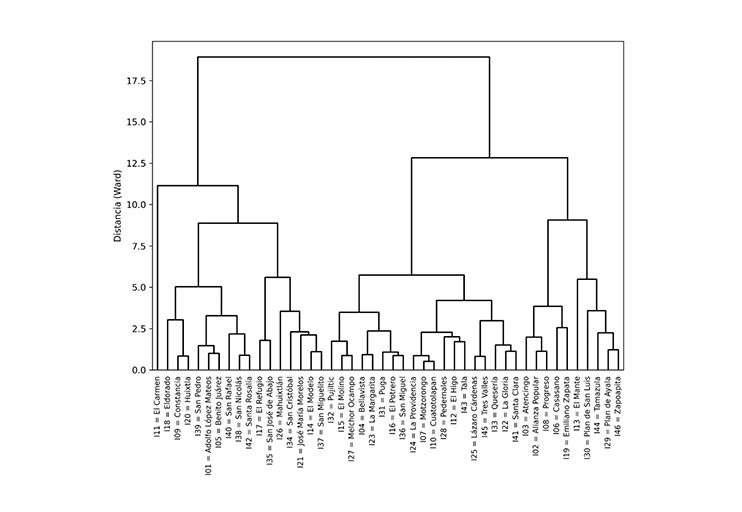
The sugar agribusiness requires tools that enable comparison of mill performance and focus actions to reduce in-plant sucrose losses. This study aimed to construct a typology of Mexican sugar mills based on indicators of sucrose losses and factory performance. The research was conducted in Mexico by analyzing secondary information from 46 mills observed in 10 harvests (2012/13-2021 and 2022), which was processed and synthesized in 2025. The base was collapsed at the mill level using the median by variable and standardized with Z-scores. Principal component analysis was applied to integrate four dimensions: sucrose losses, quality and technological potential of cane and juice, sucrose extraction from juice and industrial yield, and operational-energy intensity in the plant. The dimensional scores were used to perform hierarchical clustering (Ward’s method and Euclidean distance), which allowed the identification of six types of mills. Types IV and V concentrated the best overall performance by combining high quality/potential and higher extraction-yield with lower operational-energy intensity; Bellavista and Atencingo stand out. Types I and II showed lags associated with low quality/potential and lower extraction-yield; type VI presented high losses and operational-energy intensity despite relatively high potential, and type III corresponded to the El Carmen mill as an atypical case with high sucrose losses. The main conclusion is that the typology enabled us to guide differentiated strategies for improving and monitoring the plant performance of sugar mills in the Mexican sugar agribusiness.
Downloads
References
Adolfsson, A.; Ackerman, M. and Brownstein, N. C. 2019. To cluster, or not to cluster: an analysis of clusterability methods. Pattern Recognition. 88(4):13-26. https://doi.org/10.1016/j.patcog.2018.10.026.
Alvarez, S.; Timler, C. J.; Michalscheck, M.; Paas, W.; Descheemaeker, K.; Tittonell, P.; Andersson, J. A. and Groot, J. C. J. 2018. Capturing farm diversity with hypothesis-based typologies: an innovative methodological framework for farming system typology development. PLoS One. 13(5):e0194757. https://doi.org/10.1371/journal.pone.0194757.
Birru, E.; Erlich, C. and Martin, A. 2019. Energy performance comparisons and enhancements in the sugar cane industry. Biomass Conversion and Biorefinery. 9(2):267-282. https://doi.org/10.1007/s13399-018-0349-z.
Broadfoot, R. 2020. Benchmarking and improving sugar recovery from final molasses. Sugar Industry/Zuckerindustrie. 145(3):166-171. https://doi.org/10.36961/si24157.
CNIAA. 2024. Cámara Nacional de las Industrias Azucarera y Alcoholera. Manual azucarero mexicano 2024- Manual/Libro digital. Compañía Editorial del Manual Azucarero. https://es.scribd.com/document/759734142/Libro-Digital-Manual-Azucarero-Edicion-2024.
Everingham, Y. L.; Muchow, R. C.; Stone, R. C.; Inman-Bamber, N. G.; Singels, A. and Bezuidenhout, C. N. 2002. Enhanced risk management and decision-making capability across the sugarcane industry value chain based on seasonal climate forecasts. Agricultural Systems. 74(3):459-477. https://doi.org/10.1016/S0308-521X(02)00050-1.
Jolliffe, I. T. and Cadima, J. 2016. Principal component analysis: a review and recent developments. Philosophical Transactions of the Royal Society A. 374(2065):20150202. https://doi.org/10.1098/rsta.2015.0202.
Júdez, A.; L. 1989. Técnicas de análisis de datos multidimensionales: bases teóricas y aplicaciones en agricultura. Ministerio de Agricultura, Pesca y Alimentación. Centro de Publicaciones. Madrid, España. 253-301 pp.
LaFevor, M. C. 2022. Characterizing agricultural diversity with policy-relevant farm typologies in Mexico. Agriculture. 12(9):1-16. https://doi.org/10.3390/agriculture12091315.
McKinney, W. 2010. Data structures for statistical computing in python. In: proceedings of the 9th python in Science Conference (SciPy 2010). 56-61 pp.
Núñez-Peñaloza, J. L.; Pérez-Nieto, J. y Prado-Hernández, J. V. 2023. Análisis de indicadores e índices de calidad de suelos en México. Revista Mexicana de Ciencias Agrícolas. 14(6):e3148. https://doi.org/10.29312/remexca.v14i6.3148.
Rencher, A. C. and Christensen, W. F. 2012. Methods of multivariate analysis. 3rd. Editioin. John Wiley and Sons. https://doi.org/10.1002/9781118391686.
Sandoval-Romero, F.; Montiel-Batalla, B. M.; Garay-Jácome, Á. S. y Blas-Cortes, J. 2025. Identificación de los ingenios azucareros de mayor eficiencia técnica relativa en México. Revista Mexicana De Ciencias Agrícolas. 16(3):e3611. https://doi.org/10.29312/remexca.v16i3.3611.
Santiago-Zárate, I. M.; Martínez-Damián, M. Á.; Cuevas-Alvarado, C. M.; Valdivia-Alcalá, R.; García-Hernández, M. I. y Hernández-Toscano, J. 2021. Productividad y cambio tecnológico en la agroindustria de la caña de azúcar en México. Revista Mexicana de Ciencias Agrícolas. 12(6):1005-1017. Doi: https://doi.org/10.29312/remexca.v12i6.2692.
Sibomana, M. S.; Sobratee, N.; Workneh, T. S. and Bezuidenhout, C. 2016. Post-harvest changes in sugarcane during harvest-to-crush delays in the KwaZulu-Natal Midlands. International Sugar Journal. 118(1410):442-449. https://www.researchgate.net/publication/305006068-Post-harvest-changes-in-sugarcane-during-harvest-to-crush-delays-in-the-Kwazulu-Natal-Midlands.
Solomon, S. 2009. Post-harvest deterioration of sugarcane. Sugar Tech. 11(2):109-123. https://doi.org/10.1007/s12355-009-0018-4.
Taner, T. and Sivrioglu, M. 2015. Energy-exergy analysis and optimization of a model sugar factory in Turkey. 93(Part 1):641-654. https://ui.adsabs.harvard.edu/abs/2015Ene....93..641T/abstract.
UNC-CNPR. 2025. Unión Nacional de Cañeros, AC y Confederación Nacional de Propietarios Rurales. Estadísticas de la agroindustria de la caña de azúcar 2016-2025. Ciudad de México, México. 85-415 pp.
Valdivia-Alcalá, R.; Cuevas-Alvarado, C. M.; Vázquez-Muñoz, J. S.; García-Hernández, M. I.; Santiago-Zárate, I. M. y Garay-Jácome, Á. S. 2022. Análisis de la eficiencia y retornos de escala de los ingenios azucareros de México. Revista Mexicana de Ciencias Agrícolas. 13(1):141-153. Doi: https://doi.org/10.29312/remexca.v13i1.2639.
Wibowo, A.; Nugroho, G. and Muflikhun, M. A. 2025. Complex evaluation process on the sugarcane juice harvesting by using preparation index related to the mechanical properties: a key foundation for modeling and improved milling efficiency. Food and Bioproducts Processing. 153(5)22-32. Doi: https://doi.org/10.1016/j.fbp.2025.05.011.
Downloads
Published
Issue
Section
License
Copyright (c) 2026 Revista Mexicana de Ciencias Agrícolas

This work is licensed under a Creative Commons Attribution-NonCommercial 4.0 International License.
The authors who publish in Revista Mexicana de Ciencias Agrícolas accept the following conditions:
In accordance with copyright laws, Revista Mexicana de Ciencias Agrícolas recognizes and respects the authors’ moral right and ownership of property rights which will be transferred to the journal for dissemination in open access. Invariably, all the authors have to sign a letter of transfer of property rights and of originality of the article to Instituto Nacional de Investigaciones Forestales, Agrícolas y Pecuarias (INIFAP) [National Institute of Forestry, Agricultural and Livestock Research]. The author(s) must pay a fee for the reception of articles before proceeding to editorial review.
All the texts published by Revista Mexicana de Ciencias Agrícolas —with no exception— are distributed under a Creative Commons License Attribution-NonCommercial 4.0 International (CC BY-NC 4.0), which allows third parties to use the publication as long as the work’s authorship and its first publication in this journal are mentioned.
The author(s) can enter into independent and additional contractual agreements for the nonexclusive distribution of the version of the article published in Revista Mexicana de Ciencias Agrícolas (for example include it into an institutional repository or publish it in a book) as long as it is clearly and explicitly indicated that the work was published for the first time in Revista Mexicana de Ciencias Agrícolas.
For all the above, the authors shall send the Letter-transfer of Property Rights for the first publication duly filled in and signed by the author(s). This form must be sent as a PDF file to: revista_atm@yahoo.com.mx; cienciasagricola@inifap.gob.mx; remexca2017@gmail.
This work is licensed under a Creative Commons Attribution-Noncommercial 4.0 International license.