elocation-id: elocation-id: e4167
This study evaluated the effects of two spray-mixture agitation systems -mechanical (propeller) and hydraulic (vortex)- combined with different flow rates and nozzle types on the viability of Bradyrhizobium japonicum and Azospirillum brasilense. Four randomized block experiments were conducted to assess agitation mode, flow rate and nozzle type under simulated application conditions. Viability was quantified by colony-forming unit (CFU) counts in 2023. Agitation type, flow rate, nozzle type and the complete system configurative; does not increase bacterial mortality. It is concluded that the agricultural sprayer system and its operational parameters do not influence the viability of the tested inoculants.
application technology, bioinputs, microbial inoculants, microbial viability.
Rhizobia are among the oldest and most widely used inoculants. These diazotrophic bacteria colonize the rhizosphere and form root nodules, particularly in legumes, enabling biological nitrogen fixation at levels that often meet the plant’s full nitrogen requirements (Alemneh et al., 2020; Nakei et al., 2022). Other diazotrophic bacteria, such as Azospirillum spp., establish fewer intimate associations with plant roots but still contribute significantly to nitrogen uptake (Santos et al., 2019; Cassán et al., 2020; Bhattacharjee et al., 2023).
Traditionally, seed treatment has been the main method for applying microbial agents, ensuring direct contact between seeds and inoculants. However, alternative application methods, such as in-furrow application and foliar spraying, are increasingly used due to their operational flexibility and potential to optimize microbial distribution in the rhizospheric environment (O’Callaghan et al., 2022; Sivasakthivelan et al., 2023).
The increasing use of microbial bioinputs in agriculture has created new technical challenges related to formulation, handling, storage and application under field conditions. Microbial inoculants are products based on living organisms and their agronomic performance depends on maintaining cell viability until delivery to the target site.
Recent reviews have highlighted that biofertilizers and microbial inoculants are increasingly important for sustainable agriculture, but their field performance may be affected by limitations associated with formulation stability, shelf life and application procedures (O’Callaghan et al., 2022; Díaz-Rodríguez et al., 2025).
Despite the need for studies validating application technologies and identifying operational factors that may affect microbial survival during agricultural use, information on the effects of sprayer components, agitation systems, pressure, flow rate and nozzle passage on bacterial inoculant viability remains limited.
During mechanized spraying, most inoculant formulations are subjected to agitation, pressurization and atomization through hydraulic nozzles. Although these systems are well established for applying chemical inputs, their effects on microbial viability remain poorly understood (Oliveira et al., 2022; Kumar et al., 2023; Beltrán-Martí et al., 2024).
Given this scarcity of information, it was hypothesized that the operational variables of sprayer systems may reduce the viability of microorganisms in inoculant formulations. Therefore, this study aimed to evaluate the effects of two mixture agitation systems (propeller and vortex), combined with four types of spray nozzles at an application pressure of 4 bar, on the viability of Bradyrhizobium japonicum and Azospirillum brasilense.
The experiments were conducted between August and November 2023 at the Research and Development Laboratory of Forbio Agrociência Ltda. (Apucarana, Paraná, Brazil). Four independent randomized block experiments were performed: two with B. japonicum (strains SEMIA 5079 and 5080; Aladin Plus Nod®, containing 7 × 10⁹ colony-forming units, CFU, ml-1, applied at 300 ml ha-1), and two with A. brasilense (strains Ab-V5 and Ab-V6, Grammy Crop®, containing 2 × 10⁸ CFU ml-1, applied at 200 ml ha-1).
Each experiment was arranged in a randomized block design with nine treatments and three replications, with two forms of agitation (propeller and vortex), application at 4 bar, and four spray nozzles. The experimental unit consisted of a 0.3 L spray-mixture sample collected from the agricultural sprayer simulator under each treatment condition. The blocking factor corresponded to the experimental run, which was used to control possible variation associated with spray-mixture preparation, simulator operation, sample collection, and microbial plating. Thus, each experiment comprised 27 observations, totaling 108 observations across the four independent experiments.
Experiments 1 and 3 used propeller agitation (for B. japonicum and A. brasilense, respectively), whereas experiments 2 and 4 used vortex agitation under the same set of treatments.
The nozzles were selected for their representativeness in field operations, as follows: two nozzles for foliar application (COAP 90° 015 and LBD 110° 015) and two nozzles for in-furrow application (MJS M1041 and MJS M1040), as described by Mota and Raetano (2019).
To maintain constant pressure (4 bar) across flow conditions, calibrated valves were used to match nominal flow rates of 0.68, 0.25 and 0.21 L min-1, corresponding to the nozzle sets evaluated. All treatments were performed at 25 ±1 °C.
The following treatments were used: T1= control (spray mixture manually stirred); T2= 2 h agitation; T3= 2 h agitation, applied at 4 bar and 0.68 L min-1; T4= 2 h agitation, applied at 4 bar and 0.68 L min-1 using COAP 90° 015; T5= 2 h agitation, applied at 4 bar and 0.68 L min-1 using LBD 110° 015; T6= 2 h agitation, applied at 4 bar and 0.25 L min-1; T7= 2 h agitation, applied at 4 bar and 0.25 L min-1 using MJS M1041; T8= 2 h agitation, applied at 4 bar and 0.21 L min-1; and T9= 2 h agitation, applied at 4 bar and 0.21 L min-1 using MJS M1040.
An agricultural sprayer simulator was developed by Atomizer of Brazil and was used to reproduce field-like hydraulic circulation and nozzle passage under controlled conditions, allowing comparisons among agitation systems and pump configurations (Figure 1).
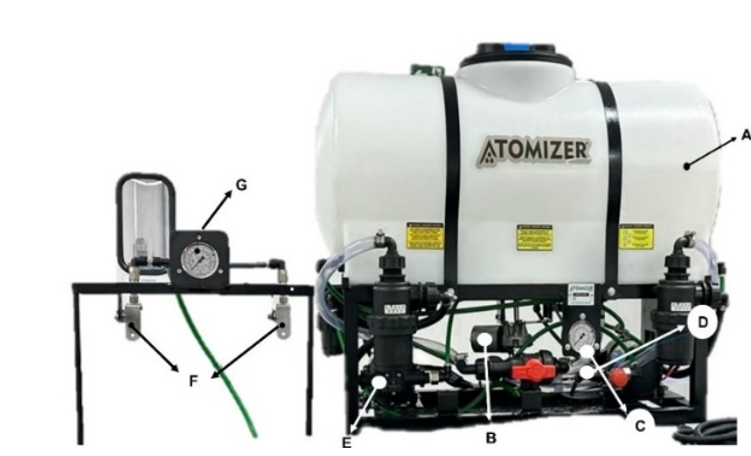
In all experiments, samples were collected at nine predefined points (T1-T9) to isolate the effects of agitation, pressurization, circulation and nozzle passage. T1 was the manually handled control, T2 was collected after 2 h agitation (2.76 bar), and T3 after exposure to 4 bar without nozzle passage; T4-T9 were collected after passage through the system under each nozzle/flow-rate condition. Between treatments, the system was sanitized with three rinsing cycles and carryover was checked by plating.
Samples from each treatment were subjected to serial dilutions under aseptic conditions. For each dilution, a 1 ml aliquot of sample was transferred to a test tube containing 9 ml of 0.1% sterile peptone water (10-fold dilution). The mixture was homogenized using a Vortex Mixer® (Gilson) to ensure uniform dispersion. This process was repeated successively until reaching a concentration of 10-4 for B. japonicum and 10-3 for A. brasilense.
The viability of the biological agents was determined by CFU counting by the spread plating method, as described by Pereira (2020). For this, 100 µl aliquots of each dilution were spread onto the solidified surface of a culture medium specific to each bacterium using a Drigalski loop. Plates were prepared in triplicate and incubated in a bacteriological incubator (SolidSteel) at 30 ±2 °C.
In experiments 1 and 2, B. japonicum was cultured on yeast mannitol agar supplemented with Congo red and incubated for 7-10 days, according to Fred and Waksman (1928). In experiments 3 and 4, A. brasilense was cultured on Congo red agar and incubated for 3-5 days, according to Cassán et al. (2010).
The data were subjected to analysis of variance (Anova). Residuals were evaluated using the Jarque-Bera, Cochran and additivity tests to assess the assumptions of normality, homoscedasticity and additivity, respectively. Means were then analyzed using the one-way Holm test at the 5% significance level (α) to determine whether isolated sprayer components, or the complete system, influenced the viability of B. japonicum or A. brasilense.
Treatment effects were evaluated using 12 a priori planned contrasts. Contrast Ĉ1 (T1 vs T2) evaluated the effect of agitation alone. Contrasts Ĉ2 (T2 vs T3), Ĉ5 (T2 vs T6) and Ĉ7 (T2 vs T8) evaluated the effect of application at 4 bar without nozzle passage at flow rates of 0.68, 0.25 and 0.21 L min-1, respectively.
Contrasts Ĉ3 (T3 vs T4) and Ĉ4 (T3 vs T5) evaluated passage through the COAP 90° 015 and LBD 110° 015 nozzles, respectively, whereas Ĉ6 (T6 vs T7) and Ĉ8 (T8 vs T9) evaluated passage through the MJS M1041 and MJS M1040 nozzles, respectively. Contrasts Ĉ9 (T1 vs T4), Ĉ10 (T1 vs T5), Ĉ11 (T1 vs T7) and Ĉ12 (T1 vs T9) evaluated the complete system configurations using the COAP 90° 015, LBD 110° 015, MJS M1041, and MJS M1040 nozzles, respectively.
Statistical analyses were performed using SPEED Stat software version 3.3, developed in Brazil by the Federal University of Viçosa (Carvalho et al., 2020).
Viability results for B. japonicum showed that neither propeller nor vortex agitation affected CFU counts (Tables 1 and 2). In experiment 1 (propeller agitation) and experiment 2 (vortex agitation), Ĉ1 (T1 × T2) indicated that agitation alone did not cause significant bacterial mortality compared with the manually stirred control.
Consistent results were obtained for Ĉ9, Ĉ10, Ĉ11 and Ĉ12, which evaluated the complete sprayer system, including type of agitator (propeller or vortex), application at 4 bar and different flow rates associated with the spray nozzles. These planned contrasts showed that the complete sprayer system configurations did not affect bacterial viability.
The other planned contrasts, involving different flow rates and spray nozzles, also did not result in significant effects. In experiment 1, B. japonicum counts ranged from 7.97 to 10.99 × 10⁶ CFU ml−1, whereas, in experiment 2, the range was 8.41 to 9.58 × 10⁶ CFU ml−1. Similarly, agitation systems did not affect the viability of A. brasilense in experiments 3 (Table 3) and 4 (Table 4).
Counts ranged from 2.32 to 3.43 × 10⁶ CFU ml-1 in experiment 3 and from 4.7 to 7.1 × 10⁶ CFU ml-1 in experiment 4, with no significant differences between treatments. That is, none of the operating conditions compromised the viability of the bacterial inoculants.
Few studies have investigated application technologies for bioinputs from the perspective of how spray systems influence microbial survival. Existing research is limited and primarily focused on fungal products (Hidalgo et al., 2003; Gouli et al., 2011; Zampiroli et al., 2019; Ru et al., 2020; Loeblein et al., 2022), making it difficult to isolate the factors directly associated with the application system.
Recent studies on biofertilizers, biopesticides and application technologies have shown that microbial performance depends not only on the biological potential of the active organism but also on formulation quality, cell viability, storage stability and compatibility with application procedures. For microbial biofertilizers, maintaining viable cells during storage, transport and field application remains one of the main factors associated with inconsistent field performance (Fadiji et al., 2024; Díaz-Rodríguez et al., 2025).
In addition, recent reviews have emphasized the increasing agricultural use of microbial inoculants and the need to integrate these products safely and efficiently into current production systems (dos Reis et al., 2024; Díaz-Rodríguez et al., 2025). Regarding biopesticides, studies simulating spray application conditions have demonstrated that mechanical stress, thermal stress, hydraulic pumps, filters, and operational conditions may affect microbial survival, especially for fungal propagules (Grella et al., 2023; Beltrán-Martí et al., 2024).
In this context, the absence of significant reductions in B. japonicum and A. brasilense viability observed in the present study indicates that the evaluated sprayer and in-furrow applicator systems were compatible with these bacterial inoculants under the tested conditions.
Bacteria are unicellular organisms whose primary protective structure is the cell wall, a rigid matrix of adjacent chains linked by amino acid cross-bridges. This structure maintains cell shape, provides mechanical strength, and prevents lysis under internal osmotic pressure, which under natural conditions reaches ~2 atm (2.03 bar) (Madigan et al., 2016).
In the operating range evaluated here (4 bar), recirculation and nozzle passages did not measurably reduce viable counts, consistent with bacterial tolerance to transient pressure changes under typical ground-sprayer conditions (Mota and Raetano, 2019). Thus, the pressure used in this study reflects common field settings.
These results support the compatibility of spray application systems with bacterial inoculants. Although many current bioproducts are formulated with bacteria in the vegetative state or as endospores, further research is still needed to deepen our understanding of how spray systems interact with different microbial groups and operational conditions, including variations in flow rate, sprayer type, pressure and application duration, tank temperature and holding time after spray-mixture preparation (Zampiroli et al., 2019; Grella et al., 2023). Therefore, additional studies should be conducted to elucidate these aspects and strengthen the scientific foundation for the safe and efficient use of bioinputs.
Agricultural sprayer systems operated at 4 bar were compatible with inoculants containing Bradyrhizobium japonicum and Azospirillum brasilense. Propeller and vortex agitation, the evaluated flow rates and nozzles used for foliar and in-furrow applications did not reduce bacterial viability.
Beltrán-Martí, R.; Garcerá, C.; Cuquerella, J. J.; Catalá-Senent, L.; Izquierdo-Sanz, H.; Garrido-Jurado, I. and Chueca, P. 2024. Do hydraulic pumps and filters of sprayers influence the viability of Beauveria bassiana based mycoinsecticide Botanigard®? Crop Protection. 180:106639. https://doi.org/10.1016/j.cropro.2024.106639.
Cassán, F.; Coniglio, A.; López, G.; Molina, R.; Nievas, S.; de Carlan, C. L. N.; Donadio, F.; Torres, D.; Rosas, S.; Pedrosa, F. O.; Souza, E.; Zorita, M. D.; de Bashan, L. and Mora, V. 2020. Everything you must know about Azospirillum and its impact on agriculture and beyond. Biology and Fertility of Soils. 56(4):461-479. https://doi.org/10.1007/s00374-020-01463-y.
Cassán, F.; Penna, C.; Creus, C.; Radovancich, D.; Monteleone, E.; García-de Salamone, I.; Di Salvo, L.; Mentel, I.; García, J.; Mayans-Pasarello, M. C.; Lett, L.; Puente, M.; Correa, O.; Valerio-Punschke, K.; Massa, R.; Catafesta, M.; Rossi, A.; Díaz, M.; Righes, S.; Carletti, S. and Rodríguez-Cáceres, E. 2010. Protocolo para el control de calidad de inoculantes que contienen Azospirillum sp. Argentina, Asociación Argentina de Microbiología. Documento de Procedimientos de la Redcai, núm 2, vol. 1 (Ed.). Buenos Aires, Argentina.13 p.
Díaz-Rodríguez, A. M.; Parra-Cota, F. I.; Cira-Chávez, L. A.; García-Ortega, L. F.; Estrada-Alvarado, M. I.; Santoyo, G.; and de los Santos-Villalobos, S. 2025. Microbial inoculants in sustainable agriculture: advancements, challenges, and future directions. Plants. 14(2):191. https://doi.org/10.3390/plants14020191.
dos Reis, G. A.; Martínez-Burgos, W. J.; Pozzan, R.; Pastrana Puche, Y.; Ocán-Torres, D.; Mota, P. Q. F.; Rodrigues, C.; Serra, J. L.; Scapini, T.; Karp, S. G. and Soccol, C. R. 2024. Comprehensive review of microbial inoculants: agricultural applications, technology trends in patents and regulatory frameworks. Sustainability. 16(19):8720. https://doi.org/10.3390/su16198720.
Grella, M.; Gioelli, F.; Marucco, P.; Zwertvaegher, I.; Mozzanini, E.; Pittarello, M.; Balsari, P.; Fountas, S.; Nuyttens, D.; Mezzala, M. and Pugliese, M. 2023. Assessment of microbial biocontrol agent (BCA) viability to mechanical and thermal stress by simulating spray application conditions. Pest Management Science. 79(11):4423-4438.
Kumar, M.; Mehta, C. R.; Bhargav, V. K.; Tripathi, M. K.; Agrawal, K. N. and Babu, V. B. 2023. Effect of spray operating parameters on viability of Bacillus thuringiensis based biopesticide under laboratory conditions. Agricultural Research. 12(2):189-196. https://doi.org/10.1007/s40003-022-00639-2.
Sivasakthivelan, P.; Mawar, R.; Sayyed, R. Z.; Sharma, S. K. and Sattiraju, K. S. 2023. Inoculant production and formulation of Azospirillum species. In: Mawar, R.; Sayyed, R. Z.; Sharma, S. K. and Sattiraju, K. S. (Eds.). Plant growth promoting microorganisms of arid regions. Singapura, Springer. 393-414 pp.
Zampiroli, R.; Alvarenga, C. B. D.; Vieira, B. S.; Prado, J. R. D.; Rinaldi, P. C. N. and Horácio, L. F. 2019. Effect of phytosanitary spray solution storage time on the viability of Beauveria bassiana conidia. Pesquisa Agropecuária Tropical. 49:e55513. https://doi.org/10.1590/1983-40632019v4955513.