elocation-id: elocation-id: e4080
The research evaluated the effect of three soil moisture levels (30%, 70% and 100% of usable moisture) combined with two densities (30 and 40 plants m-2) on the yield of the bean (Phaseolus vulgaris L.) crop, variety Pinto Saltillo, under drip irrigation in Salinas de Hidalgo, San Luis Potosí. The design used was a 3 × 2 factorial design with three replications, totaling 18 experimental units. The variables analyzed included plant height, stem thickness, leaf dimensions, number of pods, plant dry weight, pod weight and grain yield. The treatment with 30% moisture (90 000 L ha-1 per irrigation) and 30 plants m-2 presented the best performance, reaching 47 cm in height, 15 pods per plant and a yield of 118 g m-2 (1 180 kg ha-1). Treatments with 70% (210 000 L ha-1 per irrigation) and 100% moisture (300 000 L ha-1 per irrigation), together with higher density, showed negative effects due to intraspecific competition. There were no significant differences in yield across moisture levels, even when irrigation volume was doubled or tripled. Significant correlations were identified between height and number of pods (r= 0.716), pod weight and grain yield (r= 0.987) and leaf dimensions (r= 0.887). The results indicated that moderate water stress and adequate density favor bean development and allow efficient water use. The study provided technical evidence to optimize water management and agronomic practices in semi-arid regions.
drip irrigation, optimization of water resources, plant population.
Beans (Phaseolus vulgaris L.) are one of the most important crops in Mexico, especially in semi-arid areas, due to their drought resistance and their role in food security. Since 1990, their yields have increased thanks to new varieties and improvements in agronomic management (Osuna et al., 2021; INIFAP, 2022). Planting density has proven to be an effective strategy to improve yield, although its effect varies according to variety characteristics and environmental conditions (Padilla-Ramírez et al., 2003).
On the other hand, water availability is critical for crop development, and its proper management can reduce water stress and increase productivity (Londoño, 2020; SIAP, 2023a). Recent studies have analyzed how the interaction between density and moisture influences the efficiency of water use, biomass and yield of beans (Rosales-Serna et al., 2021; Godoy-Avila, 1990). However, there is still a knowledge gap on how these factors behave under different conditions.
Optimizing planting density and moisture management is key to improving bean productivity without compromising water resources. The water problem has intensified in recent decades due to climate change and increased agricultural demand, which has generated a growing interest in practices that optimize the use of this resource. In this sense, beans represent a strategic crop due to their relative tolerance to drought and their socioeconomic importance in rural communities (Vélez, 2025; Hernández-Cortés et al., 2026).
At the international level, research has confirmed the importance of studying beans under water-stress conditions and innovative systems. Geleta et al. (2024) reported differentiated phenotypic responses of bean varieties at different moisture levels; on the other hand, Rai et al. (2020) showed that irrigation management in arid and semi-arid climates directly influences yield. Likewise, Ángeles et al. (2025) showed that beans maintain productivity and adapt their morphology in agrivoltaic systems with modified radiation.
This background reinforces the need to generate applied knowledge that enables the design of water management strategies adapted to different contexts. This research aimed to evaluate three soil moisture levels (100%, 70% and 30%) and two planting densities (30 and 40 plants m-2) to increase bean crop yield. The initial hypothesis was that using a moisture level of 70% and a density of 40 plants m-2 would improve the yield of the bean crop.
The experiment was conducted in the 2024 summer-autumn cycle in plots 4 and 5 of the ‘La Huerta’ experimental area of the College of Postgraduates, Campus San Luis Potosí, located in Salinas de Hidalgo, SLP, with coordinates: 22° 37’ 32” north latitude and 101° 42’ 49” west longitude. The region has annual temperatures between 3°C and 28°C, with rainfall concentrated from June to September, with July being the rainiest month (71 mm), and a relative humidity of 44% to 74%.
Soil sampling was carried out in the experimental plots, yielding a sandy-loam texture, alkaline pH (8.01 and 7.99), good macronutrient fertility, deficiencies in Fe, Mn and Cu, and high salinity and sodium. A 2021 study was used to calculate the depths and irrigation times. The plant material corresponded to Pinto Saltillo beans (Phaseolus vulgaris L.), characterized by their tolerance to drought and diseases, with flowering between 62 and 70 days and physiological maturity between 115 and 123 days (Osuna-Ceja et al., 2012; INIFAP, 2023).
The sowing was performed with a seeder modified to establish densities of 30 and 40 plants m-2 in beds of three and four rows, respectively. In plot 4, four-row beds with 40 cm spacing between rows and 10 cm spacing between plants were established, whereas in plot 5, three-row beds with 60 cm spacing between rows were used. In both plots, 1 m corridors were left between beds and on the edges. The irrigation system consisted of 40 m tapes with drippers every 20 cm, installed along each row. In total, 21 tapes were placed: 9 in plot 5 and 22 in plot 4. The irrigation time was estimated based on flow tests and the water usable by the plant (15%), calculating the necessary depth as shown in Table 1.
[i] Calculations: Tape length (m) * distance between lines (m)= irrigation area (m2). FC (%) - PWP (%)= usable water (%). Effective root depth (mm) * usable water (0.15)= required irrigation depth (mm). Irrigation area (m2) * required irrigation depth (m)= required water volume (m3). Required water volume (m3) * 1 000 = Liters of water required (L). Number of drippers * dripper flow rate per hora (L h-1)= Liters per hora of irrigation (L h-1). Liters of water required (L) / Liters per hora of irrigation (L h-1) = irrigation time (h).
The irrigation time for the 100% level served as the basis for determining the times for the other two levels (Table 2).
A nutrient solution prepared in a 450 L tank was applied, injected into the irrigation system every four days for five minutes, the composition of which is detailed in Table 3 (Gómez-González, 2023).
| Element | ppm |
|---|---|
| N | 67 |
| P | 58 |
| K | 120 |
| Ca | 41 |
| Mg | 20 |
| Na | 58 |
| Cl | 28 |
| S | 2 |
| Micronutrients | 2.36 |
Weed removal was done manually to prevent damage to the tapes. Likewise, tensiometers were installed at depths of 10, 20 and 30 cm, working mainly with the one at a depth of 20 cm, where the highest root density was concentrated. Although the irrigations had been previously calculated, the rains during the fieldwork reduced the application time. The 30% and 70% moisture treatments were adjusted based on the tensiometer readings of the 100% treatment, starting irrigation when the reading reached 40 kPa and stopping it when it dropped to 10 kPa. The total water applied, including 217 mm of rainfall, is presented in Table 4.
| Treatment | 30 plants m-2 | 40 plants m-2 |
|---|---|---|
| 30% | 261 | 255 |
| 70% | 350 | 306 |
| 100% | 373 | 346 |
During harvest, the plants and pods were separated into paper bags according to the treatment applied and placed in a solar dryer to obtain the dry weight. The pods were also dried to extract the grain and calculate the yield. The bags of dry plant were weighed, and pod weight and grain yield were recorded separately.
The study used a split-plot design with a 3 × 2 factorial arrangement and three replications, considering three moisture levels (30%, 70% and 100% of usable moisture) and two planting densities (30 and 40 plants m-2), for a total of 18 experimental units. The sampling units were 1 m × 1.2 m, with 30 or 40 plants depending on the number of rows. In total, 2 100 plants were worked on: 900 in three-row areas and 1 200 in four-row areas.
Three sampling replications were carried out at the center of the plots, starting with a 1 m wide measurement that generated six reference areas. With the three additional replications, a total of 18 sampling areas were obtained. Physiological variables, including plant height, stem thickness, leaf dimensions (leaf width and length) and the number of pods, were recorded. Measurements were made with a 30 cm ruler and a tape measure, whereas the pods were manually counted per plant.
Plant height and stem thickness evaluations were performed at 30, 50, 70 and 90 days after planting; leaf length and width and number of pods were evaluated at 50, 70 and 90 days after planting; and yield variables were determined at the end of the cycle, including plant dry weight (without pod or grain), pod dry weight (without grain) and grain yield. The statistical analysis was performed in SAS using Anova with a significance level of 0.05. Tukey’s test (p ≤ 0.05) was applied to compare means and correlation analyses between variables were performed to evaluate relationships between physiological and reproductive characteristics.
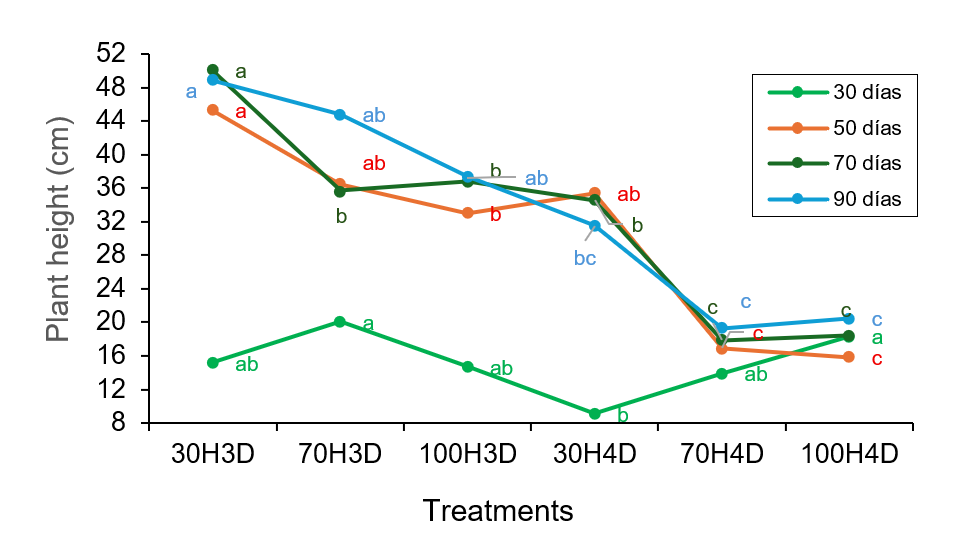
Plant height, stem diameter, number of pods and leaf dimensions were evaluated. Treatment with 30% moisture and 30 plants m-2 promoted greater height at all dates (Figure 1), which is consistent with Rosales-Serna et al. (2021), who point out that beans under moderate water stress prioritize vegetative growth. Nonetheless, treatments with 70% and 100% moisture and 40 plants m-2 showed lower height than the treatment with 30% moisture and 30 plants m-2, possibly due to competition between plants, as INIFAP (2022) warns. This confirms that adjusting irrigation and density improves development and water efficiency.
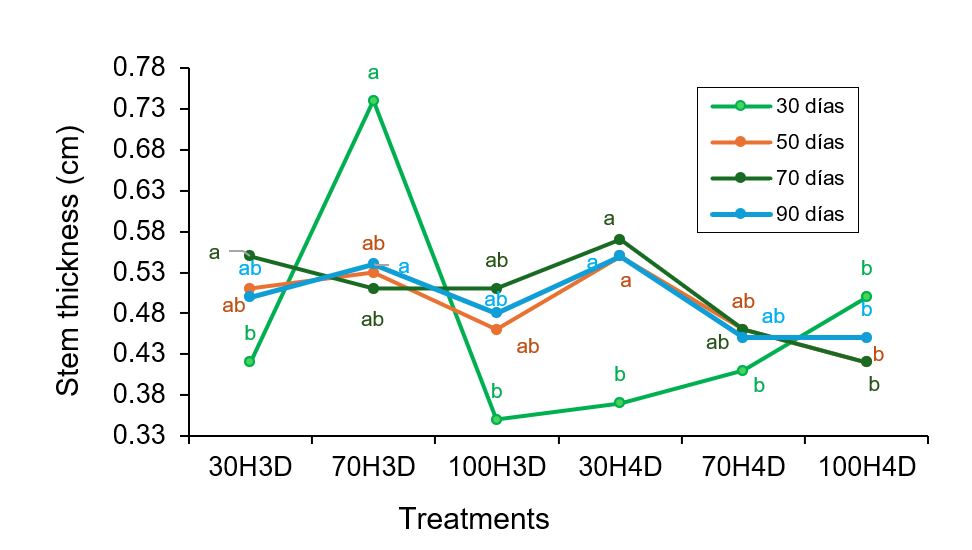
Stem thickness varied with moisture and density (Figure 2). At 30 days, treatment with 70% moisture and 30 plants m-2 showed the highest thickness (0.7 cm), suggesting that an intermediate water level favors structural growth, as noted by Rosales-Serna et al. (2021).
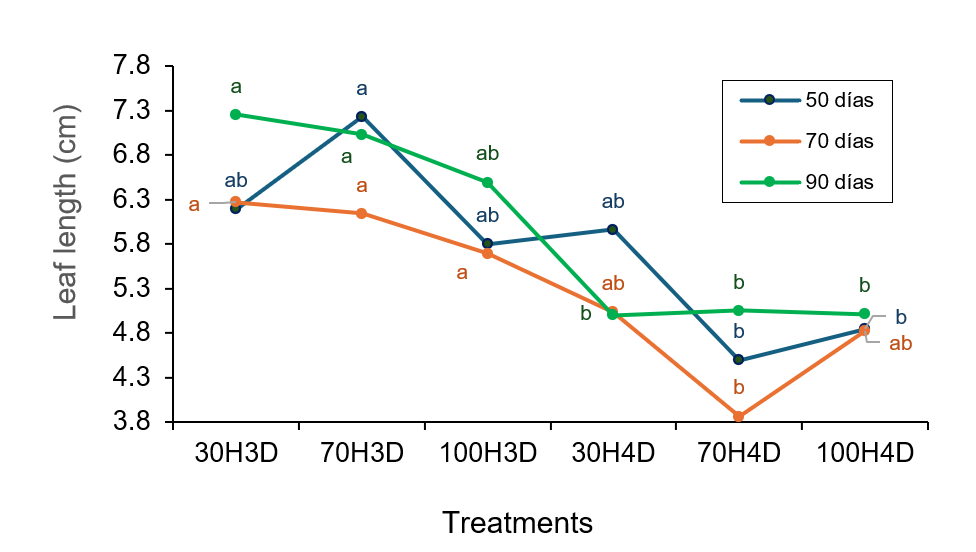
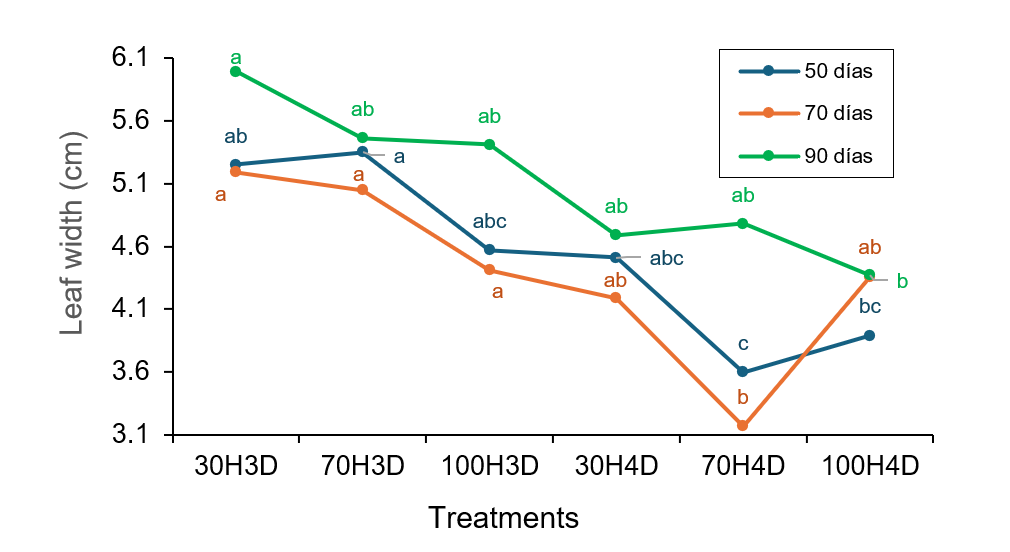
Regarding leaf dimensions (leaf width and leaf length), no significant differences were observed between treatments or times evaluated (Figures 3 and 4), indicating a more stable morphological response in this variable.
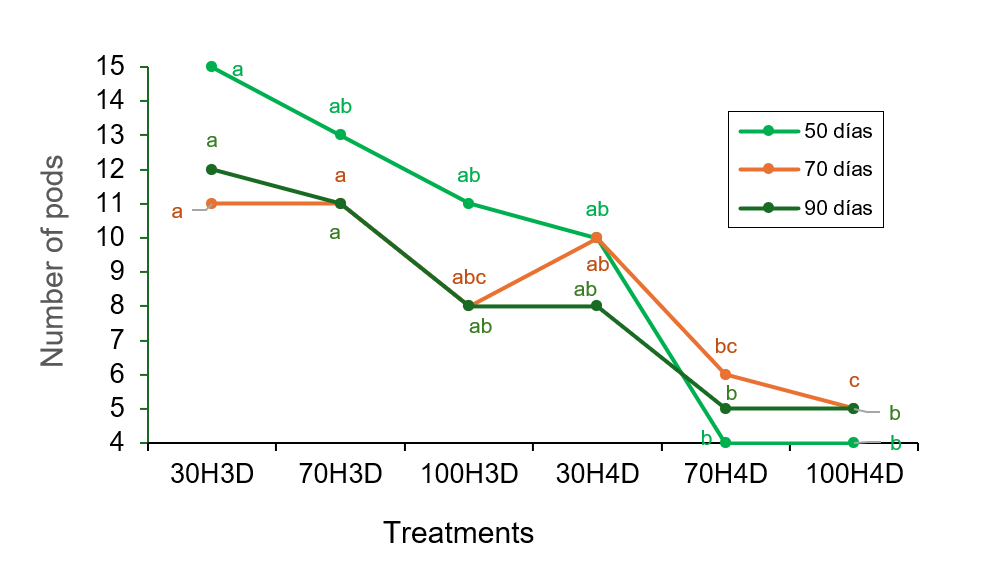
The treatment with 30% moisture registered the highest number of pods during the cycle; for its part, the treatment with 70% moisture also presented good performance at 70 and 90 days with 30 plants m-2 (Figure 5), suggesting that a moderate level of water stress and adequate spacing favor reproductive efficiency. Osuna-Ceja et al. (2012) indicate that three-row plantings under rainfed conditions reduce competition and improve ventilation, which stimulates the formation of reproductive structures.
In contrast, excess water did not increase yield and could lead to root stress. At high densities (40 plants m-2), the number of pods decreased when 70% and 100% moisture was applied at 50 and 90 days, with the lowest values being observed. INIFAP (2022) notes that competition between plants can limit essential components of yield.
A correlation analysis was performed, which showed significant associations between structural and reproductive variables of Pinto Saltillo beans (Table 5). Plant height and stem thickness showed a moderate positive correlation (r= 0.602), suggesting that vegetative growth is linked to structural strengthening, as also observed by Osuna-Ceja et al. (2012) under rainfed conditions.
Leaf length and leaf width showed a strong correlation (r= 0.887), reflecting a coordinated pattern of leaf expansion; Aguirre-Santos (2024) attribute this morphological stability to the variety’s adaptive capacity. The relationship between plant height and the number of pods was strong (r= 0.716), indicating that vegetative development favors reproductive development, as highlighted by Hernández-Álvarez et al. (2023) in contexts of technological adoption.
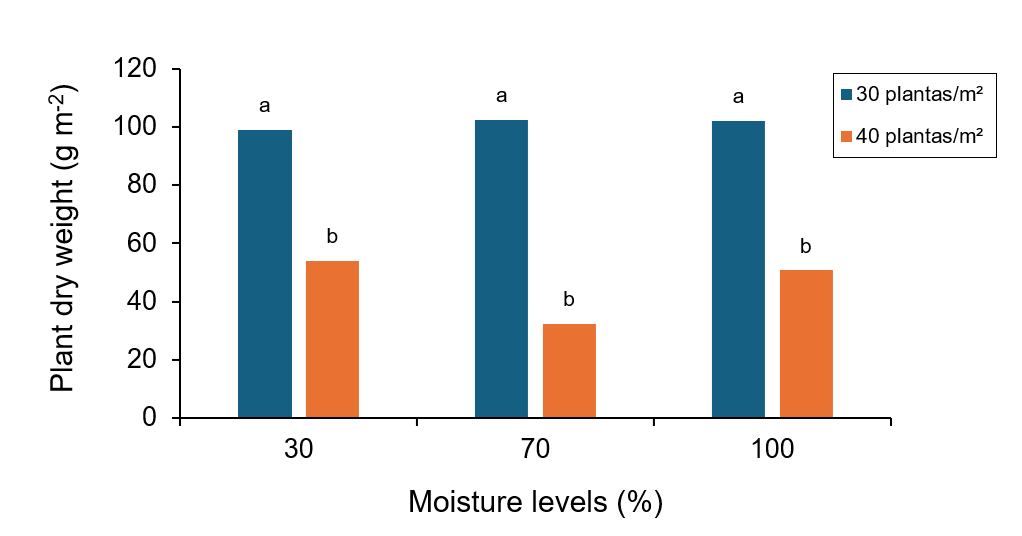
All correlations were statistically significant (p < 0.0001), underscoring the importance of integrating structural and reproductive variables into the crop’s agronomic management. The best yields in plant dry weight (without pod or grain) were obtained with 30 plants m-2 at all moisture levels, reaching up to 102 g m-2, significantly higher than treatments with 40 plants m-2 (32 - 52 g m-2; Figure 6). This supports what Osuna-Ceja et al. (2012) noted, stating that more spaced arrangements improve leaf distribution and dry matter accumulation.
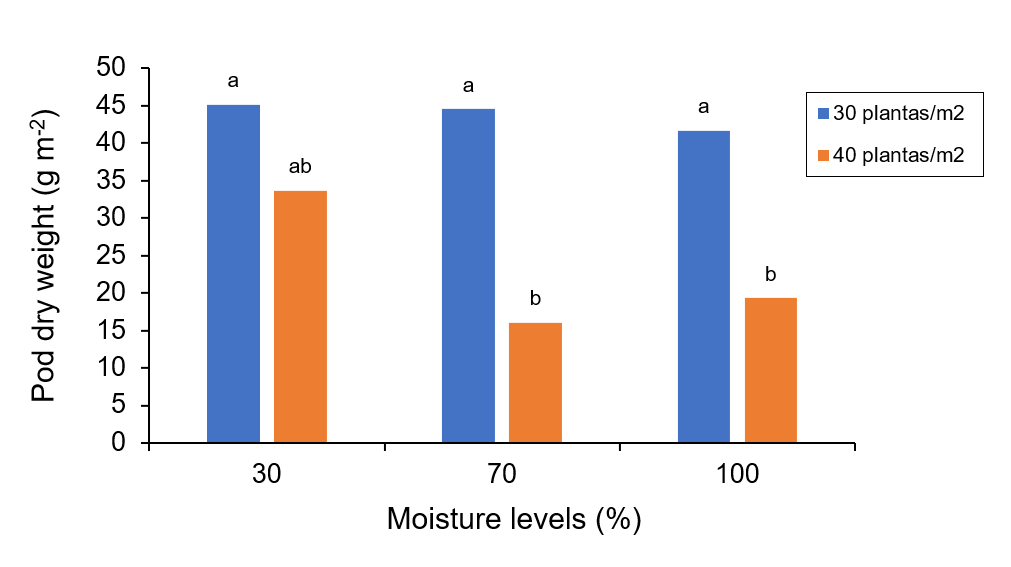
Treatments with 30 plants m-2 showed the highest values of dry weight of pod without grain (Figure 7), at all moisture levels (41-45 g m-2), compared to high-density treatments (40 plants m-2), where drastic reductions were observed (16-34 g m-2), suggesting that moderate water stress favors reproductive development. Morales-Elias et al. (2021) note that water restriction during pod filling alters the carbon allocation, benefiting reproductive biomass.
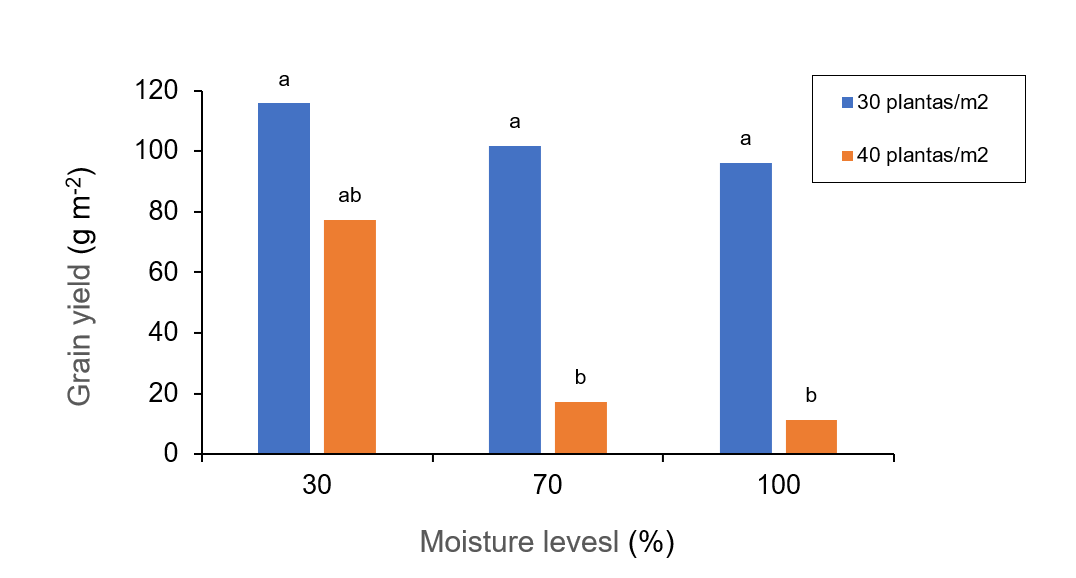
Ángeles et al. (2025) highlight that intermediate spatial arrangements improve light capture and ventilation, favoring the number and weight of pods. Overall, treatments with low density and controlled moisture appear to be the most efficient for maximizing reproductive biomass without compromising the water balance. Moisture levels of 70% and 100%, treatments with 30 plants m-2 presented significantly higher yields than those with 40 plants m-2 (Figure 8), reflecting that high density under more favorable water conditions can generate competition and reduce yield, as Osuna-Ceja et al. (2012) warn.
On the contrary, Geleta et al. (2024) point out that excess water negatively affects the harvest index, while Morales-Elias et al. (2021) highlight that controlled moisture favors the allocation of carbon to reproductive structures. Overall, treatments with low density and moderate or high moisture appear to be the most efficient for maximizing grain yield without compromising the water balance. A moderate positive correlation was observed between plant weight and grain yield (r= 0.748); however, pod weight showed an even stronger relationship with yield, making it a better direct predictor (Ghobary and Abd-Allah, 2010).
The treatment with a density of 30 plants m-2, under an irrigation depth equivalent to 90 000 L ha-1 per irrigation (30% moisture), presented the highest grain yield, with 118 g m-2 (1 180 kg ha-1). Nevertheless, the differences with the treatments at 70% (210 000 L ha-1 per irrigation) and 100% moisture (300 000 L ha-1 per irrigation) were not statistically significant.
Notably, the volumes applied at 70% and 100% were double and triple, respectively, compared to the 30% treatment, without resulting in a proportional increase in yield. The correlations between morphological and reproductive variables confirm their value as predictive indicators. These results highlight the importance of adjusting irrigation and density to achieve efficient and sustainable agronomic management.
Ángeles, W. G.; Banda-Martínez, D.; Barrena-Gurbillón, M. Á.; Espinoza-Canaza, F. I.; Santillán-Gómez, H.; Mori-Serván, D. C.; Yalta-Chappa, M.; Huanes-Mariños, M. A.; Gamarra-Torres, O. A. and Oliva-Cruz, M. 2025. Productivity and morphological adaptation of Phaseolus vulgaris L. in agrivoltaic systems with different photovoltaic technologies: A case study in Chachapoyas, Amazonas, Peru. Agronomy. 15(3):529-544. https://doi.org/10.3390/agronomy15030529.
Baez-Gonzalez, A. D.; Padilla-Ramírez, J. S.; Fajardo-Diaz, R.; Osuna-Ceja, E. S.; Kiniry, J. R.; Meki, M. N. and Acosta-Díaz, E. 2020. Yield performance and response to high plant densities of dry bean (Phaseolus vulgaris L.) Cultivars under Semi-Arid Conditions. Agronomy. 10(11):1-14. https://www.mdpi.com/2073-4395/10/11/1684.
Chacón-Ordóñez, T.; Campos-Boza, S.; Gamboa-Moreno, P.; Chaves-Barrantes, N. F. y Acosta-Montoya, Ó. 2024. Frijol (Phaseolus vulgaris L.) endurecido y alternativas tecnológicas para su aprovechamiento en la industria alimentaria. Agronomía Mesoamericana, 35(1)1-20. https://doi.org/10.15517/am.2024.59614.
Hernández-Cortés, S.; Hernández-Alcántara, N.; Díaz-Yayguaje, M.; Agustín-Guzmán, J.; Tenorio, D.; Oliva, A. M.; Rodríguez, M. C.; Dussán, J.; Rada, F. and Lasso, E. 2026. Enhancing drought resilience in common bean (Phaseolus vulgaris) through Lysinibacillus sphaericus inoculation. Discover Plants. 3(1):1-13. https://doi.org/10.1007/s44372-025-00459-y.
Morales-Elias, N. C.; Martínez-Barajas, E.; Bernal-Gracida, L. A.; García-Esteva, A.; Peña-Valdivia, C. B. and Padilla-Chacón, D. 2022. 14 C-Partitioning and biomass allocation in common bean (Phaseolus vulgaris L.) under different moisture levels during pod filling. Journal of Agronomy and Crop Science. 208(6):898-909. https://doi.org/10.1111/jac.12550.
Padilla-Ramirez, J. S.; Ochoa-Marquez, R.; Acosta-Diaz, E.; Acosta-Gallegos, J. A.; Mayek-Perez, N. and Kelly, J. D. 2003. Grain yield of early and late dry bean genotypes under rainfed conditions in Aguascalientes, Mexico. Annual Report of the Bean Improvement Cooperative. 46:89-90. https://europepmc.org/article/agr/ind43757200.
Rosales-Serna, R.; Flores-Gallardo, H.; López-González, J. C.; Rubiños-Panta, J. E.; Ortiz-Sánchez, A. I.; Flores-Magdaleno, H.; Santana-Espinoza, S. y Domínguez-Martínez, P. A. 2021. Fenología y productividad del agua en variedades mejoradas de frijol ET cultivadas en Durango, México. Revista Fitotecnia Mexicana. 44(4):511-519. https://doi.org/10.35196/rfm.2021.4.511.