elocation-id: elocation-id: e4405
Modern agriculture demands strategies that integrate organic amendments and bioinputs to reduce dependence on synthetic fertilizers and restore soil health. This study aimed to evaluate the interaction between increasing doses of solarized bovine manure (0, 21, 42, 63 and 84 t ha-1) and inoculation with a consortium of plant growth-promoting bacteria (Azospirillum brasilense, Bacillus atrophaeus and Bacillus velezensis) on the yield and quality of melon (Cucumis melo L.). A randomized complete block design with a 5 × 2 factorial arrangement and four replications was used. A significant interaction was detected for yield; the dose of 63 t ha-1 with inoculation increased yield by 16.2% compared to the control, while the dose of 84 t ha-1 reduced productivity. Inoculation increased fruit and manure firmness and soluble solids. Integrating both bioinputs constitutes a viable biotechnological alternative for optimizing melon yield and commercial quality while promoting soil sustainability and crop profitability.
Cucumis melo L., biofertilizers, organic amendments, sustainability.
Melon (Cucumis melo L.) is a crop of high economic and nutritional importance, particularly in arid and semi-arid regions where limited water availability and soil salinity restrict its productivity. In these systems, the intensive use of fertilizers has made it possible to maintain high yields; however, their prolonged application can degrade the soil’s physical, chemical and biological properties, compromising the sustainability of the agroecosystem (Quishpe-Franco et al., 2026).
In this scenario, the use of organic amendments is essential to restore soil functionality. In particular, solarized bovine manure improves soil structure, increases nutrient availability and stimulates microbial activity, favoring nutrient recycling and reducing the environmental impacts associated with the excessive use of chemical inputs (Pan et al., 2026).
Nonetheless, their application at high doses can increase soil electrical conductivity and generate osmotic stress, making it essential to determine optimal application levels (Zapata-Sarmiento et al., 2025).
The efficiency of organic fertilizers can be enhanced by integrating plant growth-promoting bacteria (PGPB), capable of improving nutrient absorption, stimulating root development, and increasing tolerance to abiotic stress (Hernández-Ramírez et al., 2025). The manure-PGPB interaction can intensify soil biological activity and strengthen rhizosphere colonization, generating synergistic effects on crop growth and quality (Luna-Fletes et al., 2025).
In La Comarca Lagunera, northern Mexico, bovine manure is produced and applied in large quantities, often without technical criteria for optimal dosing, which can increase risks of soil salinity and degradation (Shi et al., 2024). Despite the individual benefits of manure and PGBP, there is little evidence of their interaction in melon under semi-arid conditions.
Therefore, this study aimed to evaluate the effect of increasing doses of solarized bovine manure and inoculation with a PGBP consortium on melon fruit yield and quality.
The study was conducted during the spring-summer cycle of 2025 at the experimental field of the Polytechnic University of the Laguna Region in San Pedro de las Colonias, Coahuila, Mexico (25° 46’ 57.8” north latitude, 103° 11’ 30.1” west longitude). The region has a warm semi-arid climate, with an average annual temperature of 22 °C (16.1-38.5 °C) and an average annual rainfall of 258 mm.
The soil has a clay loam texture, with a moderately alkaline pH of 7.92, an electrical conductivity (EC) of 3.02 dS m-1 and an organic matter content of 1.25%. The usable levels of nitrogen and phosphorus were 17.14 and 13.82 mg kg-1, respectively. Extractable cations had concentrations of 535.85 (K), 6 594.94 (Ca), 714.67 (Mg) and 587.97 (Na) mg kg-1.
The availability of micronutrients (Fe, Cu, Zn, and Mn) was low, ranging from 0.26 to 3.28 mg kg-1. The irrigation water had a neutral pH but moderate-to-high salinity; therefore, leaching fractions were used to prevent salt accumulation in the root zone.
The Cruiser hybrid melon (Harris Moran®) was used. Land preparation was typical of the region, including plowing, cross-harrowing, and leveling. Double-row beds were built with a spacing of 4 m between them and a spacing of 30 cm between plants, resulting in a density of 16 665 plants ha-1.
Fertilization for the control treatment followed local recommendations, consisting of the 180-60-00 (N-P2O5-K2O) formula with NH4H2PO4 and NH4SO4. Gravity irrigation was applied. At pre-planting, an initial irrigation sheet of 0.3 m was applied, followed by another of 0.25 m; subsequently, six supplemental irrigations were applied with sheets of 0.09 m each, totaling 0.74 m applied throughout the crop cycle.
The design used was a randomized complete block design with a 5 × 2 factorial arrangement and four replications. The factors evaluated were five doses of solarized bovine manure (control, 21, 42, 63 and 84 t ha-1) and PGPB inoculation (with and without). The manure doses were equivalent to 25, 50, 75 and 100% of the nitrogen fertilization dose recommended for melon crops (180 kg ha-1).
The previously characterized manure contains an average of 0.97% N, 67% moisture and 4.37% organic matter. It was incorporated into the soil 30 days before planting to facilitate mineralization and prevent phytotoxicity effects. Manure doses were calculated following the methodology of López-Calderón et al. (2015).
The commercial product Bactisoil® was used, which contains a consortium of Azospirillum brasilense, Bacillus atrophaeus, and Bacillus velezensis at a concentration of 1 x 10⁸ CFU ml-1, as verified by plate counting on nutrient agar before application.
Inoculation was carried out via drenching 30 days after planting, using a manual sprayer. A total of four applications were made at 15-day intervals, ensuring uniform coverage in the root zone with a volume of 50 ml per application.
The fruits of each treatment were harvested and counted upon reaching commercial maturity, identified when the netting was fully formed and the peduncle detached easily. Subsequently, all the fruits were weighed on a Rhino® digital scale with a maximum capacity of 40 kg.
The yield per hectare was calculated based on the total weight obtained from each experimental unit. Additionally, the polar and equatorial diameters were determined using an Insize® 1 108-300 digital caliper, and the values were recorded in centimeters.
Total soluble solids (TSS) and firmness were assessed in five fruits per replication for each treatment. The soluble solids content (°Brix) was determined using a manual refractometer with a range of 0-32% (Hanna® HI96801).
Firmness was measured using an FH20000 penetrometer (Extech®, USA) with an 8 mm tip. For the procedure, the rind was removed, the fruit was placed on a rigid, flat surface and four penetrations were made per fruit. The values obtained were averaged and reported as maximum compression force in Newtons (N).
The data obtained were tested for normality (Kolmogorov-Smirnov) and homogeneity of variance (Bartlett). A two-way analysis of variance (Anova) was performed to evaluate the main effects of solarized manure and PGBP, as well as their interaction. When statistical significance for the interaction was detected, the means were compared using Fisher’s test (p≤ 0.05) within each level of the other factor. For main effects with no significant interaction, the means were compared independently.
The application of solarized bovine manure, PGPB inoculation and their interaction significantly increased melon yield (Table 1).
Yield was proportional to the increase in manure dose, peaking at the dose of 63 t ha-1, representing a 16.2% increase over the control; this substantial increase is attributed to solarized manure acting as a reservoir of slow-release nutrients and a conditioner of soil physical properties, improving porosity and moisture retention (Lu et al., 2025).
Nevertheless, the application of the maximum dose (84 t ha-1) reduced yield, a result that aligns with reports by Gómez-Núñez et al. (2025), who indicate that excessive doses of manure can induce increases in the electrical conductivity (EC) of the soil, generating osmotic stress in the roots and reducing the efficiency of water and nutrient uptake, thus affecting the C:N ratio limiting the immediate availability of nutrients for the crop.
Recent research has shown that overapplication of manure can lead to nutritional imbalances, accumulation of ammonium and nitrates, and alterations in the soil microbiota, which negatively affect plant physiology and limit its productivity (Zhang et al., 2022).
Studies conducted by Sun et al. (2023) have shown that maintaining EC within a moderate range (2-3 dS m-1) favors the obtaining of fruits with greater sweetness, firmness and commercial acceptance, while optimizing yield per plant.
For their part, Cervantes-Vázquez et al. (2022) state that an increase in EC above 5 dS m-1 causes toxicity in the plant due to sodium. In these circumstances, it is essential to examine and determine the optimal EC range for melon production systems, especially in areas with changing conditions, where the possibility of access to nutrients and the control of salinity are crucial elements for sustainable agriculture.
Organic matter positively affects soil restoration; however, it is important to make ideal estimates since the amounts of organic matter applied are not reflected in the amount of biomass or yield, as was the case in the study by Barcia et al. (2025) with the application of bovine manure at a dose of 30 t ha-1, in which rice yield did not increase significantly.
When comparing these results with reports by Moreno-Reséndez et al. (2023), who used vermicompost under plastic mulch, relevant differences are identified in the nature of the organic source used. Vermicompost is characterized by its high biological quality, providing beneficial microorganisms, humic acids and a faster release of nutrients, which resulted in increases in yield and fruit quality (Fletes et al., 2025).
Nonetheless, inoculation of exogenous microbial consortia can interactively influence the amounts of nitrogen and organic matter, as reported by Miranda-Ramírez et al. (2025), who obtained 33 t ha-1 with the application of Azospirillum brasilense with low levels of organic matter in soil; likewise, Vendruscolo et al. (2019) reached average yields of 40.36 t ha-1 with the inoculation of A. brasilense, surpassing the commercial control, which averaged 30.06 t ha-1.
Thus, Luna-Fletes et al. (2023) found favorable results with doses of manure inoculated with microorganisms (manure + PGPB) applied to melon, with a yield of 80 t ha-1, exceeding the commercial control by 12.61%; for their part, Wen et al. (2022) mention that the nutritional requirement for commercial production can be found within the range of sufficiency only with manure and PGPB treatment.
In addition, excessive doses of organic matter can induce processes of temporary immobilization of nutrients, especially nitrogen, due to intense microbial activity. This phenomenon reduces the immediate availability of the crop and could explain the decrease in yield compared to the dose of 63 t ha-1.
In intensive agricultural systems, the literature emphasizes that the proper management of organic amendments must consider not only the amount applied but also the dynamics of mineralization and interactions with edaphoclimatic conditions (Li et al., 2023). Regarding bacterial inoculation, a significant improvement in yield was observed, which shows the functional role of these microorganisms in agriculture.
PGPB inoculation with the different manure doses showed a differential response (Figure 1). At doses of 0 to 63 t ha-1, no significant differences attributable to bacterial inoculation were observed, suggesting that the limited availability of organic carbon and nutrients restricted the establishment and metabolic activity of the microbial consortium (Yu et al., 2025).
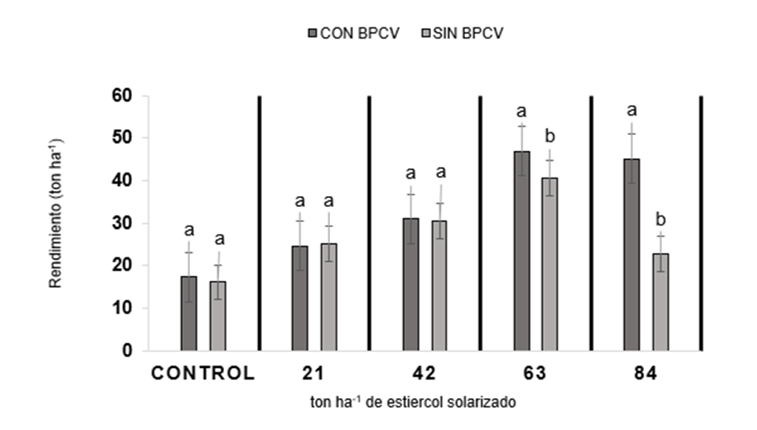
In contrast, at doses of 63 and 84 t ha-1, the presence of the microbial consortium (Azospirillum brasilense, Bacillus atrophaeus and Bacillus velezensis) enhanced yield. At the highest manure dose (84 t ha-1), it likely mitigated the negative effects associated with the overapplication of manure, significantly increasing crop productivity.
This response suggests a synergistic effect in which organic matter provides the carbon and energy needed for more efficient colonization by PGBP, facilitating nutrient mineralization, phosphorus solubilization and production (Ruelas-Islas et al., 2023).
Regarding the morphological variables, the equatorial and polar diameters showed a trend similar to yield, with the manure dose of 63 t ha-1 promoting the largest fruit size (15.92 and 15.95 cm, respectively).
The lack of significant interaction for these variables indicates that melon fruit size was mainly determined by the nutritional contribution of manure and by variety-specific genetic factors, rather than by bacterial inoculation (Reyes-Mayobre et al., 2025). On the other hand, fruit firmness was positively influenced by PGPB inoculation, registering an average of 14.25 N compared to 13.52 N in control.
Solarized bovine manure can replace the use of conventional fertilizers in melon cultivation when applied in adequate quantities. The use of plant growth-promoting bacteria improves fruit quality.
The interaction between bovine manure and plant growth-promoting bacteria on yield was observed only at medium and high doses of manure (63 and 84 t ha-1), indicating that there is a minimum level of organic carbon necessary to activate microbial processes that promote growth.
Combining solarized bovine manure with bacteria is a sustainable and effective approach to increasing melon production and quality while reducing the need for traditional fertilizers.
Alrbaihat, M. R. 2023. Agricultural nano fertilizers: macronutrient types and applications review. In: Karkush, M.; Choudhury, D. and Han, J. (Eds.). Current trends in geotechnical engineering and construction. ICGECI 2022. Springer, Singapore. 325-340 pp. https://doi.org/10.1007/978-981-19-7358-1-26.
Barcia, T. A. Z.; Cevallos, J. C. M.; Vivas, J. R. M.; Almeida, J. A. A. y Macias, P. S. Z. 2025. Evaluación del efecto de la materia orgánica y iones sulfatos en suelos salinos sobre el crecimiento de Oryza sativa L. Recursos Naturales Producción y Sostenibilidad. 4(1):1-11. https://doi.org/10.61236/renpys.v4i1.999.
Cervantes-Vázquez, T. J. Á.; Preciado-Rangel, P.; Fortis-Hernández, M.; Valenzuela-García, A. A.; García-Hernández, J. L. y Cervantes-Vázquez, M. G. 2022. Efectos en el suelo por la aplicación de estiércol bovino y vermicompost en el cultivo de sandía (Citrullus lanatus). Terra Latinoamericana. 40(1):1-13. https://doi.org/10.28940/terra.v40i0.835.
Hernández-Ramírez, U.; Rojas-Hernández, S.; Gruintal-Santos, M. A.; Morales-Barrera, J.; Vázquez-Villamar, M. y Romero-Rosales, T. 2025. Efecto de tres fertilizantes orgánicos foliares en el crecimiento de Agastache mexicana subespecie mexicana (Lamiaceae). Polibotánica. 59(30):261-274. https://doi.org/10.18387/polibotanica.59.17.
Levario, E.; Saldivar, J.; Cobos-Mercado, I.; Torres-Montijo, L.; Álvarez, L. H. and Cervantes, F. J. 2025. Sustainable farming by implementing the water-energy-food nexus between piggery production and wheat cultivation. Energy for Sustainable Development. 85:101688. https://doi.org/10.1016/j.esd.2025.101688.
López-Calderón, M. J.; Figueroa-Viramontes, U.; Fortis-Hernández, M.; Núñez-Hernández, G.; Ochoa-Martínez, E. y Sánchez-Duarte, J. I. 2015. Evaluación de dosis equivalentes de fertilizante y estiércol en la producción de maíz forrajero (Zea mays). Phyton. 84(1):8-13. https://doi.org/10.32604/phyton.2015.08408.
Lu, W.; Zhou, Y.; Ma, X.; Gao, J.; Guo, J.; Fan, X.; Xing, W.; Gao, W.; Lin, M. and Wang, R. 2025. Impacts of organic fertilizer substitution on soil ecosystem functions: synergistic effects of nutrients, enzyme activities, and microbial communities. Agronomy. 15(12):2798. https://doi.org/10.3390/agronomy15122798.
Luna-Fletes, J. A.; Mancilla-Villa, O. R.; Cruz-Crespo, E.; Can-Chulím, Á.; Martínez-Rodríguez, O. G. y Guevara-Gutiérrez, R. D. 2025. Enmiendas orgánicas en las características edáficas y el rendimiento de melón. Revista Mexicana de Ciencias Agrícolas. 16(5):e3773. https://doi.org/10.29312/remexca.v16i5.3773.
Luna-Fletes, J. A.; Ruiz-Andalón, C. A.; Mancilla-Villa, O. R.; Cruz-Crespo, E.; Can-Chulím, Á. y Martínez-Rodríguez, O. G. 2023. Inoculación de Metarhizium anisopliae, Beauveria bassiana y bacterias BPCV combinada con fertilizantes orgánicos en el cultivo de melón. Idesia (Arica). 41(4):73-82. https://doi.org/10.4067/S0718-34292023000400073.
Mayobre, C.; Gonzalo, M. J.; Vergés, M.; Guardia-Bersabé, G.; Jiménez-Sánchez, D.; Monforte, A. J.; García-Mas, J. and Pujol, M. 2025. Targeted editing and phenotypic profiling of CmOFP13 mutants reveal its role in melon fruit morphogenesis. Physiologia Plantarum 177(6):e70641. https://doi.org/10.1111/ppl.70641.
Pan, W.; Gao, L.; Xu, Y.; Guo, H.; Abdulla, A.; Abdurim, A.; Liu, X.; Gao, X. and Wu, H. 2026. Comparative effects of exogenous organic amendments on rhizosphere microbial communities and soil properties in continuous cropping watermelon. Microorganisms. 14(4):837. https://doi.org/10.3390/microorganisms14040837.
Reyes-Pérez, J. J.; Llerena-Ramos, L. T.; Jerez-Mompie, E. I.; López-Ortega, O. F.; Quinatoa-Lozada, E. F. y Espinosa-Palomeque, B. 2025. Respuesta agronómica a nanopartículas de quitosano e indicadores de calidad en frutos de pepino (Cucumis sativus L.). Chilean Journal of Agricultural y Animal Sciences. 41(2):250-263. https://doi.org/10.29393/CHJAAS41-23AGJU60023.
Shi, J.; Lu, Z.; Lu, T.; Luan, S. yang, Y.; Wu, Z.; Wang, Y. yang, J. and Han, X. 2026. Long-term differential fertilization strategies enhance soil quality and microbial metabolic functions: Evidence from a 45-year field experiment. Agriculture. 16(6):691. https://doi.org/10.3390/agriculture16060691.
Vendruscolo, E. P.; Oliveira, P. R.; Campos, L. F. C.; Seleguini, A. y Lima, S. F. 2019. Método de siembra, fertilización nitrogenada e inoculación de bacterias diazotróficas para plantas de melón Cantaloupe. Revista Colombiana de Ciencias Hortícolas. 13(1):18-25. https://doi.org/10.17584/rcch.2019v13i1.9720.
Yu, X.; Liu, J.; Zhang, R.; Liu, E.; Fang, Z. and Yun, L. 2025. Characteristics of microbial communities at different soil depths in areas subjected to cattle manure application: A 1- and 10-year comparative study. Environmental Sciences Europe. 37(1):152-164. https://doi.org/10.1186/s12302-025-01161-2.
Zapata-Sarmiento, D. H.; Evangelista-Lozano, S.; Martínez-Ayala, A. L.; Rodríguez-Hernández, A. A.; Rodríguez-Monroy, M. y Sepúlveda-Jiménez, G. 2025. Mecanismos de tolerancia y respuesta antioxidante a metales pesados en Trichoderma. Terra Latinoamericana. 43(1):e1999. https://doi.org/10.28940/terra.v43i.1999.