elocation-id: elocation-id: e4364
In Mexico, mezcal production has a designation of origin, and the largest production at the national level occurs in communities in Oaxaca, with cultural and economic importance; the municipality of San Baltazar Chichicapám is located in the Mezcal Region. The objective was to analyze the mezcal production process, quantifying the raw materials used and the yield obtained in each batch. The information was obtained in 2023 in 10 palenques through semi-structured interviews, dialogues, and participatory direct observation. Chi-square tests and Spearman’s correlations (α= 0.05) were performed. The mezcal production volume is highly dependent (p≤ 0.01) on the producer’s sex and marital status, as well as on their level of education, experience, and the organization with which they are affiliated. The total weight of the hearts of Agave angustifolia and A. marmorata was 80 kg and 20 kg, respectively. Mesquite (Prosopis spp.) and oak ( Quercus ) firewood are mainly used in stem cooking, and the type and amount of firewood influenced the baking time. In the various palenques, mezcal production varied from 2 000 to 15 000 L year-1; when using Agave angustifolia , A. potatorum (tobalá) and a mixture (ensamble) of A. angustifolia and A. marmorata , an average of 9-9.6, 16.66 and 8.42 kg of stems of those species were used for each liter of mezcal produced, respectively.
Agave angustifolia, artisanal production, mezcal, palenques.
In Mexico, the genus Agave has been used by human societies for at least three millennia, constituting a biocultural resource of historical, economic, and ecological relevance. Several species are intended for specific uses: Agave salmiana Otto. ex Salm-Dyck and A. atrovirens Karw. Ex Salm-Dyck, for obtaining aguamiel and producing pulque ( Huezcas-Garrido et al ., 2022 ); A. tequilana Weber, for producing tequila, and species such as A. angustifolia Haw., A. cupreata Trel & A. Berger, A. potatorum Zucc., A. karwinskii Zucc., and A. americana var. Oaxacensis Gentry as a raw material for mezcal production ( Martínez-Jiménez et al ., 2019 ).
Other species, such as A. fourcroydes Lem. and A. lechuguilla Torr., are mainly used to obtain fibers; in contrast, different vegetative and reproductive organs of various species are used as food and construction materials, which shows their cultural importance for numerous indigenous peoples of Mexico ( González-López and González-Uribe, 2022 ).
Mezcal, whose term derives from the Nahuatl mezcalli ‘cooked maguey’, is a traditional Mexican distilled alcoholic beverage, historically produced through artisanal processes dating back more than 2 000 years ( Pérez-Hernández et al ., 2016 ). It is defined by law as a 100% Mexican distilled beverage made from maguey (Agave spp.) ( Molina-Guerrero et al ., 2007 ) and is characterized by being colorless, although it can acquire yellowish tones when it is subjected to resting for 2 to 12 months or aging for at least 12 months in wooden containers, mainly oak ( SAGARPA, 2011 ).
In recent decades, mezcal has experienced increased consumption in national and international markets, which has raised its economic value and the demand for raw materials from both wild and cultivated agaves. The designation of origin of mezcal includes nine states: Guerrero, Oaxaca, Durango, Zacatecas, San Luis Potosí, Guanajuato, Tamaulipas, Puebla and Michoacán ( COMERCAM, 2022 ).
Oaxaca has consolidated itself as the largest producer, particularly in the districts of Sola de Vega, Miahuatlán, Yautepec, Ocotlán, Ejutla, Zimatlán, and Tlacolula ( Hernández et al ., 2022 ). Likewise, the Mixteca region stands out, where the collection of wild agaves, plantations, and artisanal palenques coexist ( Vega-Vera and Pérez-Akaki, 2017 ).
Mezcal production is governed by the Official Mexican Standard NOM-070-SCFI-2016, which recognizes the categories of ancestral, artisanal, and industrialized mezcal, differentiated primarily by the equipment and techniques used in each stage of the production process ( COMERCAM, 2022 ). According to data from the Mexican Mezcal Quality Regulatory Council ( COMERCAM, 2023 ), Oaxaca concentrated 91.31% (12 934 522 L) of the national production (14 165 504 L) of certified mezcal, with 8 543 324 L destined for export and the remainder for the national market.
Mezcal is a strategically relevant product from an economic perspective; nevertheless, artisanal production systems compete with industrialized schemes that tend to homogenize the product. Despite the persistence of traditional knowledge transmitted over several generations, a large part of the production units lack certification, which limits their access to specialized markets and reduces the positive impact of this activity on the quality of life of the producing communities ( Álvarez-Hernández and Mercado-Salgado, 2022 ).
The raw material for mezcal production comes from both wild populations and established plantations. During the 2000-2022 period, 21 318 ha were cultivated, with an average annual harvested area of approximately 2 800 ha ( SIAP, 2021 ). In the Mezcal Region, particularly in the municipality of Santiago Matatlán, Tlacolula, Oaxaca, there are more than 1 000 producers, mostly mezcal masters who, based on a standardized general process, implement technical variations that impart sensory and territorial identity to the product.
These variations include the species and soil origin of the agave, the cooking system, the type of biomass used as fuel, the crushing methods, the physicochemical conditions of fermentation, the origin of the water, the distillation techniques and the producer’s sensory experience, constituting a heterogeneous, altering production system with strong biocultural roots ( Camacho-Vera et al ., 2020 ).
In the community of San Baltazar Chichicapám, the collection of wild or cultivated agaves to make mezcal is a very important economic activity, which, according to the description in NOM-070-SCFI-2016, is considered artisanal; however, there are no precise data on the production process in this community. This work aimed to diagnose the mezcal production process, with emphasis on the particularities of technification and the quantification of raw materials used.
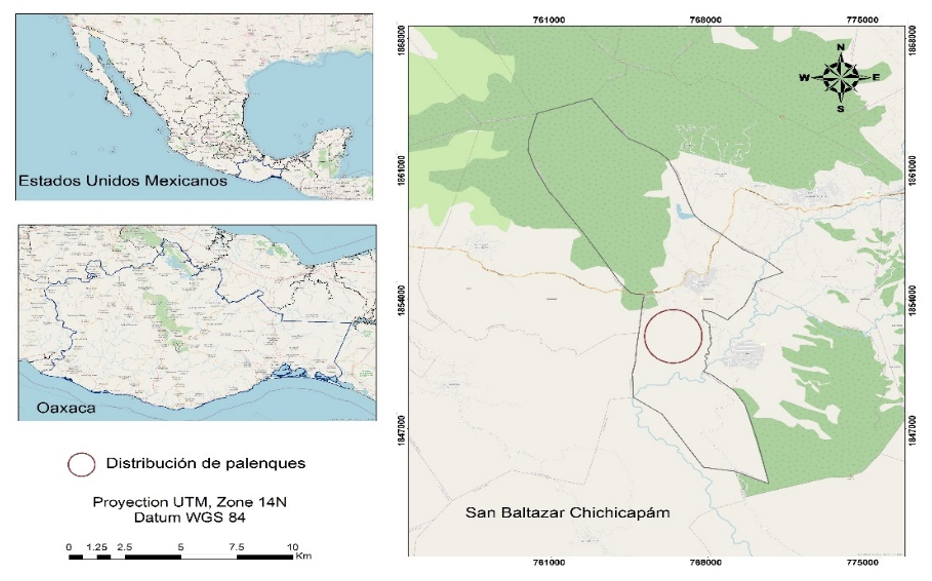
The research was conducted in the community of San Baltazar Chichicapám, District of Ocotlán de Morelos, Oaxaca, at coordinates 96° 29’ 22” west longitude, 16° 46’ 40” north latitude ( Figure 1 ); the altitude varies between 1 552 and 2 600 m, with an area of 10 079 ha, which represents 10% of the district of Ocotlán.
The community has 2 576 inhabitants, of whom 1 351 are women and 1 225 are men; of the total number of people aged three years and older, 2 099 people speak Zapotec, 3 speak Mixtec and 2 speak Mixe ( INEGI, 2020 ).
In the highest parts located to the north of this territory, a subhumid temperate climate predominates, with summer rainfall and an average temperature of 14 °C; 10 years of data show that the average annual rainfall is 747.6 mm, with a maximum of 1 080 and a minimum of 457 mm. For its part, the southern part is at a lower altitude and has a semi-dry, semi-warm climate, with 18-21°C and rainfall of 454.5 mm. The predominant plant species is the oak ( Quercus sp.) (PDM, 2008).
Through community tours, it was determined that there are 10 palenques (distilleries where mezcal is produced); in these places, talks were held with the people in charge, and frequent communication was maintained. Subsequently, from January to March 2023, interviews were conducted with these 10 people. Each interview consisted of 59 questions that were asked in the Zapotec language. To conduct the interviews, non-probabilistic convenience sampling was used, which implies that only people who had palenques were interviewed ( Otzen and Manterola, 2017 ).
Information was obtained on mezcal production, type of firewood used and number of stems (piñas: agave hearts) used to produce one liter of mezcal per type of maguey (kg L-1), among other production and marketing variables. The data were coded in an Excel® database and then analyzed with the Statistical Analysis System ( SAS, 2022 ). Goodness-of-fit tests (2, 0.05) and Spearman’s correlations (α= 0.05) were performed, which are applicable for sample sizes smaller than 30 individuals ( Montes-Díaz et al ., 2021 ).
Two palenques were selected in which mezcal production is the only source of income for families that are not affiliated with any of the mezcal associations existing in the region. From January to October 2023, frequent visits were made to the palenques and through participatory direct observation techniques, dialogues, monitoring of the process, data recording and taking photographs, information was obtained to quantitatively and qualitatively describe the facilities and the areas that make it up, with their respective equipment (Geilfus, 2009; Hernández-Sampieri et al., 2014).
The procedure for making mezcal was described, from the harvest of the hearts (jimación) and their transfer to the palenque, description of the type of oven and the process for cooking hearts, with the amount and type of firewood used, the type of grinding, fermentation, distillation, refining and the graduation of the alcoholic concentration in an artisanal way, until the product is obtained for commercialization. To quantify the firewood used during cooking, distillation, and refining, it was weighed using a Pretul and Chasiris spring scale with a capacity of 100 ±0.5 kg.
In the community studied, there are 10 palenques, whose managers range in age from 34 to 64 years, with a clear predominance of men (90%) and a smaller proportion of women (10%), with only one woman in charge of a palenque (mezcal teacher). This sex pattern coincides with previous studies that indicate that women’s participation in mezcal production has historically been infrequent and frequently invisible, due to cultural norms that associate this work with male work (Flores et al., 2022) (Table 1).
| Age (years) | TSP (years) | Sex (absolute frequency) | Annual production (L) |
|---|---|---|---|
| Young (<34] Adult (>34 ≤54] Older adult (>54) | 7 14-25 35-48 | Mal (1) Mal (4) / Fem (1) Mal (4) | 3 000 3 000-15 000 2 000-10 000 |
Data obtained by Flores et al. (2022) document that in artisanal areas of Guerrero and Oaxaca, women’s work has been central yet underrepresented in official narratives, particularly in technical activities such as production and commercialization, even when they perform essential tasks in the agave-mezcal production chain.
This pattern is also reflected in other contexts in the country: in Oaxaca, the study by Sánchez-Gómez et al. (2022) reports that women mezcal producers, with an age range similar to that of the community palanquera, face social and economic limitations to fully integrate into productive networks and rural organizations.
In addition, recent research indicates that the invisibilization of the female role is not exclusive to mezcal but is a common feature in traditional agrifood systems in Mexico, where women’s work is subsumed within unpaid or non-formally recognized work ( Table 2).
[i] The absolute frequency (relative percentage frequency) is indicated. Chi-square tests (α= 0.05); *=significant (p≤ 0.05); **=highly significant (p≤ 0.01); PS= percentage of the total studied; Batches= production batches. IMPI= Mexican Institute of Industrial Property; COMERCAM= Mexican Mezcal Quality Regulatory Council.
Authors such as Cuenca-Morales et al. (2025) explore how gender relations mediate access to resources, recognition, and opportunities for participation in the mezcal value chain, showing that, despite structural barriers, women have driven processes of resistance and collective organization that point towards greater productive inclusion.
Regarding producers’ age, the data from the community (34 to 64 years old) reflect that the largest volume of mezcal is produced by adults. This partially aligns with Espejel et al. (2019), who report that producers’ ages range from 25 to 75 years, indicating intergenerational transmission of the trade, influenced by community factors and opportunities, such as available education.
The research by Benítez et al. (2025) on artisanal producers reports that the average age among the interviewed producers is 51 years, and that 70% had secondary education or less, suggesting that this pattern of adult producers with basic education is common in different rural mezcal contexts.
Formal education in the community shows a distribution of 10% without studies, 20% with primary education, 40% with secondary education and 30% with a bachelor’s degree. These findings contrast with those reported by Espejel. (2019), who, in a larger study, observed that most producers only reached primary or secondary education and only 2% had higher education, indicating a significant discrepancy.
This difference could be explained by variations and differing sampling times, since in certain communities, they have had greater access to higher education in recent years, whereas other contexts remain with low and entrenched educational levels. Ethnographic studies suggest that formal education can catalyze innovations in the production and commercialization of mezcal, as is the case with educated young people who apply technical and business knowledge in their family palenques.
In terms of institutional affiliation, most producers are affiliated with COMERCAM and the Mexican Institute of Industrial Property (IMPI, by its Spanish acronym), which may reflect a growing trend of formalization and professionalization of the mezcal sector.
Producer’s sex, the organization with which they are affiliated, experience in the production process, and their marital status are highly correlated (p= 0.0001) with the volume of annual mezcal production, since, of the total number of mezcal masters, 82% are men whose marital status is married and who together produced a total of 59 000 L year-1. Single men accounted for 4% of the volume of mezcal produced, which was 3 000 L year-1. Female and widowed owners of palenques generated 14% of the total mezcal volume, 10 000 L year-1( Table 3 ).
[i] ns= not significant (p> 0.05); *= significant (p≤ 0.05); ** =highly significant (p≤ 0.01); Spearman’s correlation test; Affi= affiliation; Ysp= years spent on production; Lmy= liters of mezcal per year; Anb= annual batches; Seas= seasons of higher production; Wwl= with whom they learned to make mezcal; Marsta= marital status; Chs= Celebrations with higher sales; Varpro= varieties produced; Plit= price per liter; Mau= maguey used.
The male producers whose marital status is married and who are affiliated with the IMPI produced 44% of the total mezcal (32 000 L year-1); in contrast, married and single men, as well as widowed women, who are affiliated with both IMPI and COMERCAM, produced 40 000 L year-1, which was 55% of the total produced in the community ( Table 3 ).
The mezcal masters with 22 years or more of experience are married, and they made 42% of the total mezcal, distributed across 39 batches over a year, which ran from mid-2022 to mid-2023. The person who is single has 7 years of experience and produced 25 batches during the study period, as this person is in charge of a palenque with 11 fermentation vats. Widowed women worked 8% of the total batches produced in the community during the year ( Table 3 ).
Correlation analyses show a negative correlation between people’s marital status and the time spent on production, which indicates that people who have been in the production process for a longer time tend to have a married marital status (r= -0.68, p≤ 0.02), since those who are married have spent more time on the production of this drink, because, as they are heads of households, they are responsible for covering the economic expenses ( Table 3 ) ( Camacho-Vera et al ., 2020 ).
On the other hand, marital status and the person with whom this trade was learned showed a positive correlation (r= 0.64, p≤ 0.04), indicating that most producers who learned from their parents are married. Similarly, there is a positive correlation (r= 0.81, p≤ 0.01) between mezcal masters’ age and the years spent on production, which may indicate that the permanence of people in this activity is associated with age; the older they are, the more years spent on this activity ( Table 3 ).
Similarly, a positive correlation (r= 0.75, p≤ 0.01) arises between producers’ level of education and the number of annual batches, indicating that the higher the level of education, the greater the production of annual batches, as they seek alternatives with higher yields in volume of mezcal.
On the other hand, one of the positive correlations was between producers’ level of schooling and affiliation (r= 0.78, p< 0), which indicates that a higher level of education is more favorable to seeking opportunities for expansion in the national and international markets and registration with institutions such as COMERCAM and IMPI.
The process of making mezcal in the community of San Baltazar Chichicapám, Ocotlán, Oaxaca, is artisanal and across 10 palenques, it was found that those who are in charge of the process are 90% men and 10% women.
In the 10 palenques, a total of 72 000 L of mezcal were made, distributed in 91 batches. The productive capacity of the palenques ranges from 166 to 1 250 L month-1. In the production of 1 L of mezcal, around 9.09-9.6, 16.66, and 8.42 kg of espadín agave, tobalá agave and the espadín-tepeztate combination were used, respectively.
Productive variables such as the volume of mezcal production are highly dependent (p≤ 0.01) on the producer’s sex and marital status, as well as on their level of education, experience, and the type of organization with which they are affiliated; likewise, it is highlighted that each mezcal master has particularities in the way of working, all this because of the customs and traditions that were transmitted from generation to generation.
Hernández, S.; Gnolonfin, A.; Bialostosky, M. and García-Contreras, G. 2022. Economía y degradación de tierras: la economía de la producción de Mezcal en Oaxaca, México. El camino hacia la producción sostenible de agave. Giz: Bonn, Alemania. 78 p. https://www.eld-initiative.org/fileadmin/ELD-Filter-Tool/Case-Study-Mexico-2022/Mexico-Oaxaca-2022-Mezcal-ELD-Case-Study-Report-ES.pdf.
Montes-Díaz, A.; Ochoa-Celis, J.; Juárez-Hernández, B.; Vázquez-Mendoza, M. y Díaz- León, C. 2021. Aplicación del coeficiente de correlación de Spearman en un estudio de fisioterapia. Decimocuarta Semana Internacional de la Estadística y la Probabilidad. 4 p. https://www.researchgate.net/publication/366346712-Neuromarketing-como-predictor-en-la-decision-de-compra-de-clientes-en-farmacias-y-boticas/fulltext/63d28d416fe15d6a574db1a0/Neuromarketing-como-predictor-en-la-decision-de-compra-de-clientes-en-farmacias-y-boticas.pdf.
Osipova, S. V.; Permyakov, A. V.; Permyakova, M. D.; Rudikovskaya, E. G.; Verchoturov, V. V. and Rudikovsky, A. V. 2019. Tolerance of the photosynthetic apparatus in recombinant lines of wheat adapting to water stress of varying intensity. Photosynthetica. 57(1):160-169. https://doi.org/10.32615/ps.2019.007.