elocation-id: elocation-id: e4358
In the state of Oaxaca, Mexico, Agave potatorum is collected from wild populations or propagated by seeds in small areas and used to make the distilled beverage mezcal. The species has been propagated in vitro, and the resulting plants are transplanted into a substrate for 90 days of acclimatization, then established in a greenhouse for 12 months to reach a larger size; likewise, fertilizing the plants has improved their growth. The objective was to evaluate the leaf area and CO2assimilation rate of micropropagated-acclimatized plants fertigated with California (Cal) or Steiner (St) nutrient solutions. Plants fertigated with Cal-5% and Cal-100% had 20.8 and 27.7 leaves, leaf areas of 1 031.5 cm2and 1 867.4 cm2, rosette diameters of 37 and 52.3 cm, and heights of 19.5 and 29.5 cm, respectively. Stomatal opening and CO2assimilation began at 16:00 h as photosynthetically active radiation decreased, reaching maximum assimilation values between 19:00 and 22:00 h. Plants fertigated with Cal-100% and St-100% showed CO2assimilation values of 17 and 11 μmol CO2m-2s-1, respectively.
leaf area, micropropagated plants, nutrient solution, photosynthesis.
Agaves have morphological and physiological characteristics, such as shallow and branched roots, thick cuticle, succulent tissues, sunken stomata and CAM photosynthesis, to fix CO2during the night and accumulate it as malic acid, so they use water more efficiently than C3and C4plants ( Carrillo et al ., 2014 ) and are adapted to arid and semi-arid environments and poor soils ( Cen-Cen et al ., 2015 ).
In the state of Oaxaca, Mexico, Agave potatorum Zucc., called maguey Tobalá, is used to produce the distilled alcoholic beverage mezcal. Due to the intensive collection of adult specimens, their populations have declined, and since the 1990s, peasant groups have implemented seed propagation and established plantations ( Enríquez-del Valle, 2008 ). The asexual micropropagation of A. potatorum has been carried out through the plant culture technique, and the plants obtained are acclimatized in greenhouses, where thickening of the stem and development of new leaves (large, rigid, and succulent) occur in preparation for their establishment in a greenhouse ( Cruz-García et al ., 2017 ; Bautista-Castellanos et al ., 2020 ; Correa-Hernández et al ., 2022 ).
They are then established in the greenhouse for 12 months to achieve the greater size and hardiness needed in the field ( Enríquez-del Valle, 2008 ). The plant’s vigor is affected by its nutritional condition and requires energy and photosynthates produced in the photosynthetic organs ( Jarquín-Rosales et al ., 2022 ).
The nutritional supply in micropropagated-acclimatized plants of A. potatorum was related to their growth in greenhouses and nurseries ( Enríquez-del Valle et al ., 2016 ; Luna-Luna et al ., 2017 ; Bautista-Castellanos et al ., 2020 ; Ramírez-Mosqueda et al ., 2022 ). It is important to understand the photosynthetic activity in interaction with the nutritional supply; the objective was to evaluate the leaf area and the CO2assimilation rate of micropropagated-acclimatized plants that were fertigated.
Micropropagated-acclimatized plants of Agave potatorum Zucc were used, following the methodology of Luna-Luna et al . (2017) . Acclimatization was carried out in the greenhouse of the Technological Institute of the Valley of Oaxaca, Mexico, and the plants were then taken to a greenhouse of the College of Postgraduates, Montecillo Campus, Texcoco, State of Mexico. After 220 days of ex vitro growth, 42 plants, each between 10 and 13 cm tall, were selected and established in 30 x 30 cm pots containing sand as the substrate.
Six groups of seven plants were formed to be fertigated with Steiner (1984) universal solution and California nutrient solution ( Sánchez-del Castillo, 1989 ) at concentrations of 5%, 50% and 100%, with the pH adjusted to 5.8. The Steiner (1984) universal solution and the California solution contain the following in mg L-1: MgSO4.7H2O, 49.768 and 52.0; Ca(NO3)2.4H2O,107.415 and 72; K(NO3), 28.128 and 66; K2SO4, 25.153 and 0.0; KOH, 2.329 and 0.0; KH2PO, 26.95 and 0.0; MnSO4, 0.62 and 0.62; ZnSO4, 0.11 and 0.11; H3BO3, 0.44 and 0.44; CuSO4.5H2O, 0.02 and 0.02; Na2MoO4.2H2O, 0.048 and 0.048, respectively.
Fertigation was performed at the substrate level using 400 ml twice a week for 360 days. At 60 and 360 days, the following variables were recorded: plant height (PH), number of unfolded leaves (NL), rosette diameter (RD), and the distance of the distal ends of the largest opposite leaves. The experiment was established under a CRD with one plant as the experimental unit. Analysis of variance and comparison of means (Tukey, 0.05) were performed using SAS 9.4 (SAS Institute Inc., 2022).
On each fully extended leaf, the mean length (L), excluding the terminal spine, and the mean width (W) were recorded. To determine the leaf area (LA), 30 leaves of different sizes were selected; their outline was traced on paper and cut out and the area was quantified using a LI-3100 optical leaf area integrator. A linear regression analysis was performed, with LA as a function of its length L and W, to obtain a conversion factor.
This factor was used to estimate the individual leaf area of each leaf and the total leaf area per plant. Analysis of variance and comparison of means using Tukey’s test (α= 0.05) were performed with the SAS statistical package, version 9.4 ( SAS Institute Inc. 2022 ).
At six months of age, three plants per treatment (St-100%, St-5%, Cal-100% and Cal-5%) were established in 25.5 x 20 cm pots (9.4 dm3) containing soil-moss peat substrate (1:2). Thirty days after transplanting, a fully developed leaf was selected from the middle part of the rosette of each plant, and the instantaneous CO2assimilation rate was recorded using a LI 6400 portable IRGA and attachments to quantify CO2.
The plants were subjected to two edaphic moisture conditions to determine the instantaneous CO2assimilation rate: 1) irrigation once a week (without restriction); and 2) when they were not irrigated for 17 days and soil moisture was less than the permanent wilting point, PWP (soil drought). To determine the moisture content, field capacity (85%), and PWP (60%) of the substrate, a moisture retention curve was developed in the Soil Physics Laboratory of the College of Postgraduates, Montecillo Campus.
In each period, CO2assimilation rate, stomatal conductance, transpiration, mesophyll CO2(Ci) and photosynthetically active radiation (PAR) were determined, with eight measurements of each leaf at 3 h intervals for 24 h starting at 10:00 h. The experiment was established under a completely randomized design with a 2 x 2 x 2 x 9 factorial arrangement (two levels of soil moisture, two levels of NS, two levels of NS concentration, and nine levels of times in which measurements were taken), with a total of 72 treatments.
One plant was used as an experimental unit with three replications per treatment and a total of 216 experimental units. Analysis of variance and comparisons of means (Tukey, 0.05) were performed using the SAS 9.4 package (SAS Institute Inc., 2022).
Leaf area, photosynthetic capacity, biomass accumulation, and crop yield are factors that depend on nutrient supply ( Makino, 2011 ). Corn plants that received fertilization developed up to 4.6 times leaf area index, 1.06 times height, 1.38 times dry weight, 1.4 times grain yield, 1.11 times the weight of 1 000 grains and 66 days after planting, the photosynthetic rate was 1.27 times compared to unfertilized plants. In addition, there was a high correlation (r= 0.926) between photosynthetic rate and yield ( Efthimiadou et al ., 2010 ).
At the beginning of the experiment, A. potatorum plants had 7.9 to 8.3 leaves, a rosette diameter of 16.6 to 17 cm and a height of 10.3 to 13 cm. From fertigation over 12 months, the number of leaves (Table 1 showed that nutrient solution treatments had significant (p≤ 0.05) different effects on rosette diameter and plant height at 60 days, and highly significant effects at 360 days (p≤ 0.01) for leaf number, plant height, and rosette diameter.
| SV | DF | NL60 | NL360 | RD60 | RD360 | PH60 | PH360 |
|---|---|---|---|---|---|---|---|
| Treatment | 5 | 7.23ns | 59.75** | 54.7* | 308.89** | 9.47* | 105.71** |
| Error | 36 | 2.92 | 7.03 | 10.56 | 33.18 | 1.98 | 14.16 |
| Total | 41 |
All plant groups that received nutrient solutions were larger at 60 days of age than at the start date, and plant size was positively related to the NS dose. The largest plants were those that received 100% NS, either Cal or St, whereas the smallest plants were those fertigated with 5% NS, either Cal or St.
Plants fertigated with Cal-100% and St-5% had, on average, 11.7 and 8.7 leaves, rosette diameters of 24.1 and 17.9 cm, and heights of 13.3 and 10.4 cm, respectively, which were significantly different (Tukey, 0.05) ( Table 2 ).
After 360 days, the plants fertigated with NS Cal-100% and NS St-5% had 27.7 and 20.1 leaves, rosette diameters of 52.3 and 34 cm, heights of 29.5 and 19.9 cm, respectively; significantly different magnitudes (Tukey, 0.05); on the other hand, they had 3.4 and 2.4 times the number of leaves, 3.11 and 2.02 times the diameter of the rosette, 2.54 and 1.71 times the height compared with their size at the beginning of the experiment ( Table 2 ). Morales et al . (2017) reported that A. potatorum plants fertigated with St-50% showed an increase of 13% in height but not in the number of leaves, compared to unfertilized plants.
Leaf area together with the periods in which A. potatorum plants were exposed to contrasting edaphic moisture conditions: 1) without moisture restriction; and 2) soil drought condition; the analyses of variance ( Table 3 ) showed that the plants had significant differences (p≤ 0.01) in leaf area according to the measurement period, since during the first period, they had 1 053.5 cm2, with an increase to 1 221.4 cm2, significantly (Tukey 0.05) different.
[i] SV= sources of variation; DF= degrees of freedom; Per= periods that contrasted in soil moisture; NS= nutrient solution; Conc= concentration of nutrients; MeaT= measurement time; Int= interaction; Int1= Per x NS; Int2= Per x Conc; Int3= Per x MeaT; Int4= NS x Conc; Int5= NS x MeaT; Int6= Conc x MeaT; Int7= Per x NS x Conc; Int8= Per x NS x MeaT; Int9= NS x Conc x MeaT; Int10= Per x NS x Conc x MeaT; CO2A= CO2assimilation; Trans= transpiration; Cond= stomatal conductance; CO2(Ci)= mesophyll carbon dioxide; LA= leaf area; *= significant F-value (p> 0.05); **= highly significant F-value (p≤ 0.01). For space reasons, non-significant interactions were not included in the table.
Therefore, short periods of water supply in the soil did not affect the growth of agave plants ( Tables 3 and 4 ). The natural habitat of this species is sloping, stony terrain, so it can be useful for productively taking advantage of areas where water is limited. In corn plants ( Badr and Brüggemann, 2020 ) and wheat plants ( Osipova et al ., 2019 ), limited soil water availability negatively affects growth, transpiration rate, stomatal conductance, leaf photosynthetic capacity and yield.
[i] Per= periods contrasting in soil moisture; withI= with irrigation; withoutI= without irrigation; NS= nutrient solution; St= Steiner; Cal= California; Conc= concentration; CO2A= CO2assimilation; Trans= transpiration; Cond= stomatal conductance; CO2(Ci)= mesophyll carbon dioxide; LA= leaf area. Different letters within columns indicate significant differences (p≤ 0.05).
Plants fertigated with Cal-100% or St-100% had a leaf area of 1 407.2 cm2, 1.62 times, significantly higher (Tukey, 0.05) than the 867.2 cm2of LA of plants fertilized with Cal-5% or St-5%. NS dilutions had different significant (p≤ 0.05) and highly significant (p≤ 0.01) effects on leaf area and stomatal conductance.
During the times in a 24-h cycle when photosynthetically active radiation variation occurs, there were highly significant, different values (p≤ 0.01) in CO2assimilation, transpiration, and stomatal conductance. The irrigation period and recording time showed highly significant effects (p≤ 0.01) on transpiration intensity, photosynthesis, and stomatal conductance.
During a 24-h cycle in the first and second periods in which CO2assimilation rate was evaluated, photosynthetically active radiation (PAR) presented a characteristic diurnal pattern, reaching its maximum value at 13:00 h with approximately 900 μmol photon m-2s-1, and decreased to zero at 19:00 h, and increased again from 07:00 h the next day.
CO2assimilation occurred during the night period and began from 16:00 h, with the onset of stomatal opening, when PAR was around 300 μmol photon m-2s-1, which favored the progressive increase in CO2fixation ( Figure 1 ), with the highest values between 19:00 h and 01:00 h, and the maximum fixation occurred at 22:00 h, with a rate of 15.29 μmol m-2s-1.
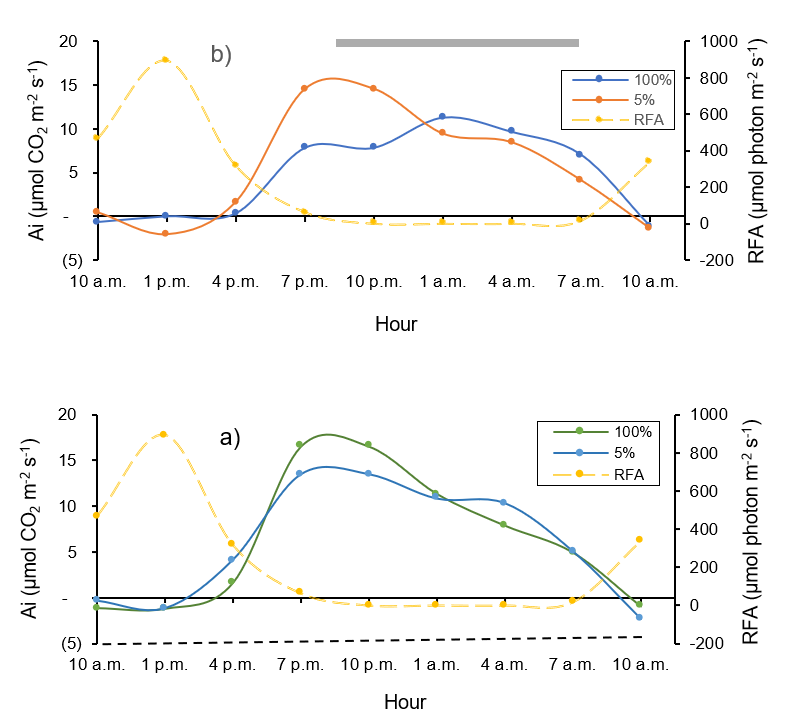
The plants maintained CO2assimilation during the early hours of the morning, which ceased at approximately 09:00 h, when PAR reached values near 200 μmol photon m-2s-1. Nobel (1976) documented that plants of A. deserti Engelm, in the field, showed maximum CO2assimilation (5.5 μmol m-2s-1) around 22:00 h, and this process remained active even after sunrise.
A. potatorum plants that had water availability showed nocturnal CO2assimilation (CAM mechanism) for almost 18 h. Plants fertigated with Cal-100% and with St-100% showed CO2assimilation of 17 μmol CO2m-2s-1and 11 μmol CO2m-2s-1, respectively ( Figure 1 ).
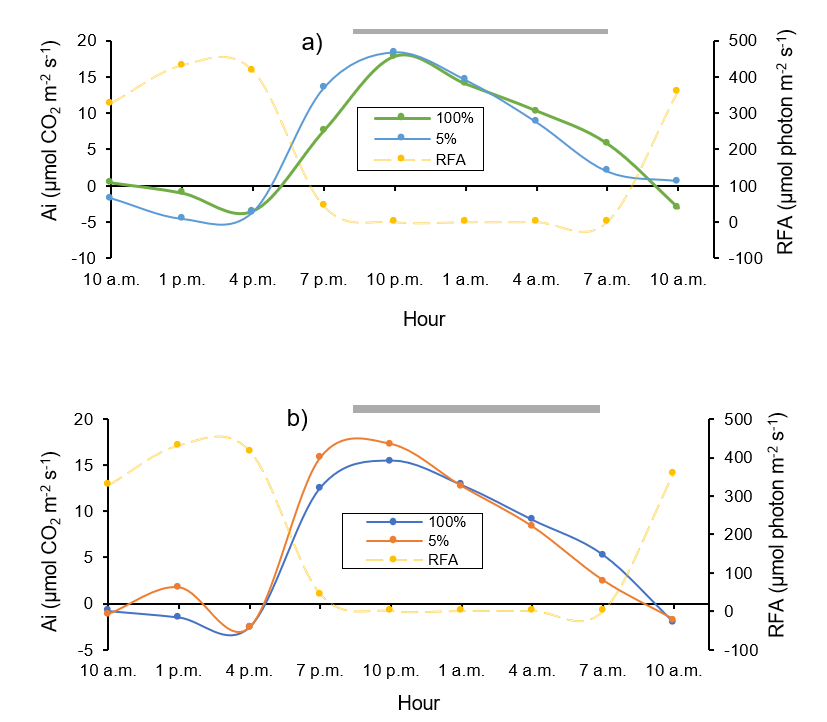
Similar trends were observed in plants subjected to edaphic drought conditions, when the substrate was below the PWP ( Figure 2 ); that is, A. potatorum plants continued to assimilate CO2, probably because they had water stored in their tissues, as they exhibit crassulaceous acid metabolism (CAM).
The plants fertigated at 100% and 5% showed no differences in CO2assimilation per unit area. Plants supplied with 100% NS, either St or Cal, had a leaf area of 1 407.2 cm2, which was 1.62 times the LA of plants supplied with 5% NS. The plants supplied with Cal-100% and Cal-5% had leaf areas of 1 867.37 and 1 031.16 cm2, respectively.
In contrast, the plants supplied with St-100% and St-5% solution had leaf areas of 1 504.55 and 1 005.6 cm2, respectively. Therefore, LA is a factor explaining the accumulation of biomass between plants with high-dose and low-dose fertilization.
CO2fixation gradually decreased from 4:00 am to 09:00 am (stomatal closure), after which negative values were recorded ( Figures 1 and 2 ). In A. tequilana , higher values of nocturnal CO2assimilation occurred (7.5 and 16.2 μmol CO2m-2s-1), and in the period from 10 am to 4 pm, negative assimilation rates were recorded ( Pimienta-Barrios et al ., 2006 ).
For plants under conditions of available soil water, CO2assimilation occurred between 16:00 h and 09:00 h the next day ( Figure 1 ), and plants where irrigation was suspended for 17 days and the soil was below the PWP, assimilated CO2in the interval from 17:00 h to 09:00 h the next day ( Figure 2 ). Water-restricted plants kept their stomata open for a shorter time compared to plants without water limitations.
The stomatal opening began at 16:00 h, and the maximum CO2fixation occurred at 22 h, with values of 17.81 and 18.41 μmol CO2m-2s-1in the plants that were fertigated with NS Cal-100 and Cal-5%, respectively. In each period, plants fertigated with NS Cal-100 and Cal-5% had higher CO2assimilation than plants fertilized with NS St-100 and St-5%.
The evidence from the present work is consistent with Pimienta-Barrios et al . (2005) in that CAM plants subjected to lower soil water availability reduce their photosynthetic activity and increase respiration, but positive CO2assimilation values remain. Patishtán et al . (2010) reported that Aloe vera plants subjected to water stress reduced stomatal conductance. Authors such as Pimienta-Barrios et al . (2006) report that A. tequilana , under conditions of extreme drought, decreased its CO2assimilation but did not cease it.
When soil moisture was below the PWP, plants had stomatal conductance of 0.036 and 0.062 g ( Table 4 ) and PAR of 223.3 and 176 μmol photon m-2s-1( Figure 1 ). The application of 100% and 5% nutrient solutions to plants showed transpiration rates of 0.0007 and 0.0009 mm, stomatal conductances of 0.03 and 0.06 mmol CO2m-2s-1, and leaf areas of 1 407.2 and 867.2 cm2, significantly different magnitudes (Tukey, 0.05).
Agave potatorum plants fertigated for 360 days with 100% California nutrient solution presented 27 leaves on average, a rosette diameter of 52.3 cm, and a height of 29.5 cm, which was a larger size than fertigated plants with 100% Steiner solution.
Plants given more nutrients developed greater leaf area. Plants show nocturnal CO2assimilation when PAR decreases; the stomatal opening began at 16:00 h and reached maximum values of net CO2assimilation of 15.29 μmol m-2s-1at 22:00 h.
Plants fertigated with Cal-100% showed higher CO2assimilation than the rest of the plants. Plants that were in soil with moisture below the permanent wilting point for 17 days continued to assimilate CO2.
Jarquín-Rosales, D.; Enríquez-del Valle, J. R.; Alpuche-Osorno, J. J.; Rodríguez-Ortiz, G.; Martin, M. P. and Campos-Ángeles, G. V. 2022. The effects of fertirrigation and Azospirillum brasilense inoculation on photosynthetic compounds of Agave angustifolia. Australian Journal of Crop Science. 16(01):162-168. https://doi.org/10.21475/ajcs.22.16.01.p3280.
Osipova, S. V.; Permyakov, A. V.; Permyakova, M. D.; Rudikovskaya, E. G.; Verchoturov, V. V. and Rudikovsky, A. V. 2019. Tolerance of the photosynthetic apparatus in recombinant lines of wheat adapting to water stress of varying intensity. Photosynthetica. 57(1):160-169. https://doi.org/10.32615/ps.2019.007.