elocation-id: elocation-id: e4322
Conventional strawberry propagation is performed using runners, which may limit the number and health of plants. The present work assessed the effects of different culture media variants on shoot proliferation in vitro, shoot size and root formation. Twenty-seven variants of culture media were prepared with inorganic salts of the Murashige and Skoog (MS) formulation, different concentrations of two cytokinins, benzylaminopurine, BAP (0, 0.5 and 1 mg L-1) and thidiazuron TDZ (0, 0.5 and 1 mg L-1) and different pH levels (5, 5.5 and 5.8). Data was taken on the number of shoots, the number of leaves and root formation. The data were subjected to analysis of variance and Tukey’s test (0.05). The highest number of shoots (11), with up to 57 leaves, was obtained in the culture medium with 0.5 mg L-1 TDZ, 0 mg L-1 BAP and a pH of 5.5. The lowest numbers of shoots (2.3), with 18 leaves, were obtained in CM without TDZ, 0.5 mg L-1 BAP and a pH of 5.5. In environments with only BAP, the new shoots were taller and formed adventitious roots. TDZ inhibited root formation. It is concluded that the presence of TDZ in CMs stimulated more axillary buds to sprout, while BAP promoted the development of axillary buds but with a lesser effect than that of TDZ.
Fragaria x ananassa, benzylaminopurine, shoot proliferation, thidiazuron.
The strawberry (Fragaria x ananassa) is a herbaceous species less than 50 cm tall; its reproduction is asexual using runners generated from axillary buds of the crowns. A mother plant produces 8 to 80 runners per year, depending on the variety and the environmental conditions (Benavides-Mendoza et al., 2021; Kirschbaum, 2021), and the demand for strawberry plants is met by the cultivation of mother plants that produce runners in nurseries and greenhouses.
The development of runners is conditioned by environmental factors, photoperiod and temperature (Kirschbaum, 2021; Al-Madhagi, 2023; Guevara-Matus et al., 2023). At the commercial level, the production of mother plants is being implemented through plant tissue culture, a technique for isolating plant tissues or cells established under aseptic, controlled conditions of culture media (CM) of defined composition (Pérez, 2007).
The cell division response of in vitro cultures depends on conditions where the following are established: a) chemical composition of the CM, such as water, inorganic salts, organic compounds such as carbohydrates, vitamins, amino acids, growth regulators (GR) and physical support substances; and b) the physical conditions of incubation, including temperature, lighting, relative humidity and atmospheric gases (Enríquez-Valle, 2008; Miguel-Luna et al., 2022).
Cell division and morphogenesis are caused by the type of GR and its concentration in the CM (Pasternak and Steinmacher, 2024). GRs promote plant development by influencing gene expression and physiological processes (Miguel-Luna et al., 2013). Auxins, cytokinins and gibberellins are the main classes used. The most commonly used cytokinins are: benzylaminopurine (BAP), kinetin (kin), 2iP and thidiazuron (TDZ) (Cappelletti et al., 2016). In strawberry plants, the plant tissue culture (PTC) technique has been applied since the 1980s (Boxus, 1983).
Propagation programs include procedures to obtain plants free of phytopathogens using PTC. Micropropagated plants are established in greenhouses and used as mother plants to generate new plants through runners (FAO, 2023), thereby guaranteeing the genetic and health quality of the plants (Capocasa et al., 2019). Gonzáles-Arteaga et al. (2023) propagated the strawberry var. Albión using in vitro culture of crown buds that were established in CM with MS mineral salts (Murashige and Skoog, 1962), 0.5 mg L-1 BAP, 0.6 mg L-1 indoleacetic acid (IAA), 30 g L-1 of sucrose, pH adjusted to 5.6 and the addition of agar.
Cultures were incubated for 32 days under conditions with lighting of 14.02 μmol m-2 s-1. New shoots had formed from each axillary bud. Neri et al. (2022) micropropagated strawberry plants var. Aroma, starting the in vitro culture with meristematic apices and achieving the proliferation of shoots, which were established in various variants of CM containing 0.5 mg L-1 BAP, 100 or 200 ml L-1 coconut water, 1 or 1.5 mg L-1 TDZ, 1 or 2 mg L-1 of zeatin, or gibberellic acid.
Cultures were incubated for five weeks at 25 ±1 °C under a photoperiod of 16 h of light and an intensity of 3 000 lux. The apices in CM with BAP and coconut water developed 1-2 shoots, whereas the apices in CM with TDZ, zeatin or GA3 formed 1-4 shoots and most of these formed roots. pH is an important factor in CM, as it affects nutrient availability to cells and there are optimal pH ranges for this availability (Pasternak et al., 2024).
Pérez-Molphe (2022) notes that pH is generally set between 5.5 and 5.8 and that when it is outside this range, cell division or morphogenesis responses in some plant materials are negatively affected. However, studies on pH effects are considered to be relatively rare. Therefore, the objective was to evaluate the proliferation of strawberry shoots established in CM with different cytokinin types (BAP or TDZ) and their respective concentrations, as well as variations in the pH of the culture medium. It is hypothesized that the composition of type and concentration of cytokinins, as well as the pH of the culture medium, have different effects on proliferation, shoot growth and root formation.
In January 2025, in vitro shoot cultures were obtained from meristematic apices of runners of strawberry (Fragaria x ananassa) plants, var. Albión. They were established in 145 cm3 glass containers containing 20 ml of sterilized and gelled CM, prepared with MS mineral salts (Murashige and Skoog, 1962), 1 mg L-1 of thiamine-HCl, 100 mg L-1 of myo-inositol, 25 g L-1 of sucrose, 0.5 mg L-1 of benzylaminopurine and pH adjusted to 5.8 before adding 5.7 g L-1 agar.
To induce shoot development, in vitro cultures of meristematic apices were incubated for two months under LED illumination of 35 μmol m-2 s-1, a photoperiod of 16 h of light and 8 h darkness and temperatures of 15 to 29 °C. The meristematic apices developed clusters of multiple shoots, which were used for the experiment.
Under aseptic conditions of a horizontal laminar flow hood with filtered air, the clusters of shoots were extracted from the in vitro culture and placed in sterile glass Petri dishes (10 × 100 mm); using sterile dissection tools, they were separated into individual shoots (stems with leaves and axillary buds) 1.5 cm tall and four shoots were transferred to each container with some variant of CM.
Culture medium variants included: 1) MS mineral salts (Murashige and Skoog, 1962) at a 70% dilution, 25 g L-1 sucrose, 100 mg L-1 myo-inositol and 1 mg L-1 thiamine-HCl; 2) combinations of cytokinins, BAP at three concentrations (0, 0.5, and 1 mg L-1) and TDZ at concentrations (0, 0.5, and 1 mg L-1); and 3) each of the nine CM variants was separated into three volumes to adjust it to different pH levels (5, 5.5 and 5.8), and then 5.7 g L-1 of agar was added.
This was dissolved with heat and stirring to distribute 20 ml of culture medium per 145 cm3 glass container and the polypropylene lid was placed. They were then sterilized for 15 minutes in an autoclave at 1.2 kg cm-2 pressure and 121 °C. After establishing four stems with axillary buds in each container with CM, the lid was replaced and sealed with adherent polyethylene, and the containers were incubated for eight weeks under lighting, photoperiod, and temperature conditions similar to those in the meristematic apices establishment stage.
After the incubation time, survival (%) was evaluated in all explants (shoots) in each treatment and in twelve shoots-stems with buds per treatment, the following variables were determined: development of new axillary shoots, the height of the largest shoot (cm) using a ruler graduated in cm with precision of 0.1 cm; stem diameter (mm) with a calibrated vernier; number of leaves; the aerial dry weight (stems, leaves and roots) was determined using an analytical balance (accuracy ±0.1 mg) in n= 12 experimental units/treatment.
The leaves were separated from the stems and digitized to determine leaf area (cm2) using the ImageJ computational package. The plant material developed from each explant was placed in a paper bag and then placed in a convection oven (Memmerth) at 70 °C for 96 h to dry; subsequently, the dry weight was determined using an analytical balance.
The experiment was established according to a completely randomized design with a 3 × 3 × 3 factorial treatment arrangement, resulting in 27 treatments. The factors evaluated were TDZ concentration (0, 0.5 and 1 mg L-1), BAP concentration (0, 0.5 and 1 mg L-1), and pH of the CM (5, 5.5 and 5.8) (Table 1). The experimental unit was an initial stem-shoot, and four shoots (explants) were established in each bottle; there were six bottles of in vitro cultures per treatment. For data collection, 12 experimental units per treatment were used, randomly selecting two experimental units in each of six bottles.
The assumptions of normality and homogeneity of variances of the data were verified using the Kolmogorov-Smirnov and Levene tests (α= 0.05); subsequently, the data were subjected to analysis of variance and for Tukey’s test (0.05), untransformed data were used. For statistical analyses, the SAS 9.4 statistical package (SAS Institute Inc., 2022) was used.
After eight weeks of incubation, all (100%) of the shoot-explants in the 27 treatments survived. In the shoots-explants established in the various CM variants, new shoot development and proliferation occurred, but the level of response was related to the type and concentration of cytokinins. The analysis of variance (Table 2) showed that TDZ concentrations had highly significant effects (p ≤ 0.01) on most of the variables evaluated, except for leaf area (LA).
[i] SV= source of variation; DF= degrees of freedom; TDZ= Thidiazuron; BAP= Benzylaminopurine; SD= stem diameter; NS= number of shoots; HEI= height of the largest shoot; NL=number of leaves; RL= root length; ADW= dry weight of the aerial part (leaves + stem); RDW= root dry weight; LA= leaf area; *= significant F-values (p ≤ 0.05); **= highly significant F-values (p ≤ 0.01); ns= non-significant F-values (p > 0.05).
BAP concentrations had significantly different effects (p ≤ 0.05) on root length (LR) and aerial dry weight (ADW); on the other hand, pH factor levels showed significant differences (p ≤ 0.05) only in stem diameter (SD). The TDZ*BAP interaction had significant effects (p ≤ 0.05) on the height of the largest shoot (HEI), number of leaves (NL), and root length (RL). The TDZ×pH interaction had significant effects (p ≤ 0.05) on the height of the largest shoot (HEI) and the number of leaves (NL). The BAP×pH interaction had significant effects (p ≤ 0.05) on the number of shoots (NS) and height of the largest shoot (HEI).
Strawberry shoots grown in CM with 1 mg L-1 TDZ, 1 mg L-1 BAP and a pH of 5.5 developed new axillary shoots with diameters of 3.4 mm. The cultures established in CM with 0.5 mg L-1 TDZ, without BAP and a pH of 5.5 developed 11 new axillary shoots, a number 4.7 times and significantly higher (Tukey, 0.05) than the 2.3 new axial shoots that developed in the cultures established in CM without TDZ, with 0.5 mg L-1 BAP and a pH of 5.5, and in CM without TDZ, with 0.5 mg L-1 BAP and a pH of 5.
The tallest new axillary shoots (5.7 and 5.8 cm) developed in CM without TDZ, with 0 or 0.5 mg L-1 BAP and a pH of 5.5 and in CM without TDZ, with 0.5 mg L-1 BAP and a pH of 5.8, respectively, which were significantly greater (Tukey, 0.05) than the 1.5 cm of the new axillary shoots that developed in CM with 0.5 mg L-1 TDZ, 1 mg L-1 BAP and a pH of 5.5. Cultures established with 0.5 mg L-1 TDZ, 1 mg L-1 BAP and a pH of 5.5 developed a significantly higher number of leaves (85) (Tukey, 0.05) than the 18.8 leaves developed in the cultures established in CM without TDZ, with 0.5 mg L-1 BAP and a pH of 5.5, and in the cultures established in CM without TDZ, with 1 mg L-1 BAP and a pH of 5. The number of leaves was related to their fresh weight (Table 3).
Stems with axillary buds established in CM with 1 mg L-1 TDZ, 0.5 mg L-1 BAP and a pH of 5 developed larger sizes in their aerial parts (stems and leaves), with an aerial dry weight of 84.7 mg (Table 4).
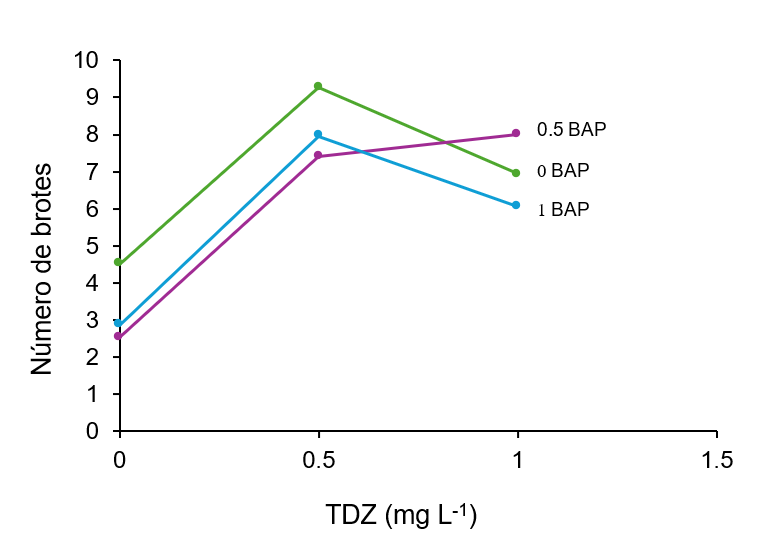
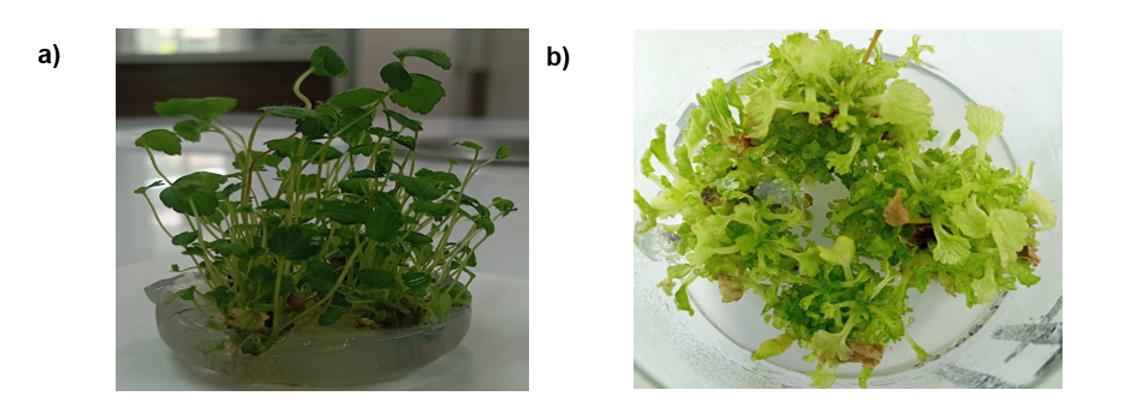
The fewest (2.8 to 4.5) shoots developed in CMs without TDZ and with 0 to 1 mg L-1 BAP. Increasing the concentration of TDZ with some concentration of BAP stimulated the development of more shoots from axillary buds (Figure 1). Therefore, it can be deduced that the presence of TDZ in CMs stimulated more axillary buds to sprout; by contrast, BAP also promoted the development of axillary buds, but with a lesser effect than that of TDZ (Figure 2).
TDZ and BAP promoted multiple bud sprouting in strawberry axillary buds, but BAP had a smaller effect than TDZ in stimulating axillary bud sprouting, in smaller numbers. pH influenced only the stem diameter. TDZ and BAP are classified in the group of cytokinin GRs, which, in general terms, have similar biological effects- stimulating cell division and the formation of multiple shoots- but to a different degree, since TDZ stimulated a greater number of shoots originating from axillary buds compared to BAP.
TDZ also inhibited adventitious root formation to a greater degree than BAP, since the stems established in CM with TDZ did not form roots, whereas in CM with BAP, the stems did form roots. In the in vitro propagation of Fragaria x ananassa, Cuazil-Flores and Núñes-Palenius (2017) reported that shoots established in CM with TDZ formed a greater number of leaves but also formed roots.
In this context, Pillco-Tancara et al. (2017) propagated two strawberry varieties, initiating culture with leaf tissues, and when they established them in CM with 9.08 μM TDZ combined with 0.98 μM IAB, it promoted the formation of shoots (5) in callus cultures. TDZ is a highly effective cytokinin in strawberry micropropagation, as Wang et al. (2025) reported that it significantly increased shoot regeneration and multiplication, since it improved the cytokinin signaling pathway, which is crucial for cell division and shoot initiation.
According to Ruíz-Anchondo et al. (2018), using TDZ in strawberry propagation protocols has shown that TDZ could be associated with its ability to modify endogenous cytokinin signaling and stimulate the activation of dormant meristems, so strawberry micropropagation protocols represent an efficient alternative for the production of pathogen-free plants; however, the response may differ depending on the variety and growing conditions.
In the present work, it was observed that TDZ promoted a greater number of axillary shoots than BAP, confirming its superior effect on in vitro multiplication. Similarly, for the Camino Real cultivar of Fragaria x ananassa, Venegas-Tarancón et al. (2024) reported that strawberry leaf extract, alone or in combination with BAP, improved explant response by controlling oxidation and contamination.
The results obtained in the work of Adak et al. (2009), where TDZ promoted a greater number of axillary shoots compared to BAP, coincide with what was reported in the Camarosa cultivar, in which TDZ alone or in combination with IAA significantly increased the rate of shoot multiplication (28.46 per explant). Cuazil-Flores and Núñes-Palenius (2017) mentioned that pH adjustment in temporary immersion systems enhances the robustness of strawberry seedlings; by contrast, in the present work, the different pH values of the culture medium influenced stem thickness without significantly influencing other variables.
Establishing stems with axillary buds in CM with the cytokinins TDZ and BAP stimulated the development of axillary shoots, but TDZ had a more notable effect than BAP. In addition to achieving the development of multiple shoots in each stem with axillary buds-explants, in CM with BAP, adventitious root formation occurred in the stems; by contrast, this response was completely inhibited. The pH of the CM, in the range 5 to 5.8, showed no notable differences in the evaluated characteristics. Stems with axillary buds established in the CM without cytokinins developed the fewest shoots, but they were the tallest and formed adventitious roots.
FAO. 2023. Guía práctica para la aplicación de las normas para bancos de germoplasma de recursos fitogenéticos para la alimentación y la agricultura: conservación mediante cultivo in vitro. Comisión de Recursos Genéticos para la Alimentación y la Agricultura. Roma. 120 p. https://doi.org/10.4060/cc0025es.
Gonzales-Arteaga, J. J.; Rodríguez-Layza, J. Romero-Rivas, L. C.; Párraga-Quintanilla, A. and Olivera-Soto, J. A. 2023. Role of BA and IAA on regeneration and shoot proliferation in vitro of three strawberry (Fragaria x ananassa Duch.) varieties. Agroindustrial Science. 13(2):93-102. http://doi.org/10.17268/agroind.sci.2023.02.05.
Pillco-Tancara, H. C. y Quezada-Portugal, J. Á. N. 2017. Efecto del tidiazurón y ácido indolbutírico en la propagación in vitro de dos variedades de frutilla (Oso Grande y Sweet Charlie) a partir de secciones foliares. Journal of the Selva Andina Research Society. 8(1):53-64. http://www.scielo.org.bo/pdf/jsars/v8n1/v8n1-a05.pdf.
Romero-Rivas, L. C.; Gonzales-Arteaga, J. J.; Rodríguez-Layza, J.; Párraga-Quintanilla, A. y Olivera-Soto, J. A. 2023. Multiplicación y enraizamiento in vitro de Fragaria x ananassa Duch. Var. ‘Aromas’. Revista de Investigaciones Altoandinas-Journal of High Andean Research. 25(4):205-212.https://doi.org/10.18271/ria.2023.563.