elocation-id: elocation-id: e4259
Avocado is a crop of great economic relevance for Mexico; exports of the fruit reach markets in North America, Asia, Europe and Latin America. The main challenge in this activity is the long transport times for the fruit; therefore, there is a need to develop new technologies that prolong the fruit’s shelf life. The research aimed to delay the postharvest ripening process of avocados by applying aqueous solutions containing peduncle extract, plant growth regulators, and acetylsalicylic acid at different concentrations. The harvest was carried out in December 2022 at ‘Huerto La Labor’, Temascaltepec de González, State of Mexico (19° 02’ 39.40” north latitude and 99° 58’ 35.62” west longitude). Eight treatments were applied to the fruits: six aqueous solutions formulated with peduncle extract, auxins (IAA + IBA), gibberellic acid 3 and acetylsalicylic acid, a treatment with 1-methylcyclopropene and an absolute control. The response variables evaluated were weight loss (%), firmness, respiration rate and pulp and peel color. A completely randomized experimental design and statistical analysis with the nonparametric Kruskal-Wallis test were employed. According to the results obtained, the aqueous solutions resulted in a lower percentage of weight loss, greater firmness, a lower respiration rate, and greener coloration in the pulp and peel, compared to untreated fruits, allowing the delay of the ripening process; in contrast, the relative control remained unripe until day eleven postharvest.
gibberellic acid 3 and 1-methylcyclopropene, auxins.
Avocado is a crop of great economic importance to Mexico because of the foreign exchange it generates; it is one of the three most important fruit trees in the country. The planted area was 263 212.06 ha, and the harvested area was 253 043.65 ha, yielding 2 761 327.85 t (SIAP, 2024). In 2024, exports amounted to 3 783 million dollars (FAO, 2024).
Exporting to the United States of America requires an average transport time of 48 to 72 h when originating from Michoacán; other producing states such as Mexico and Nayarit send their fruit to more distant markets in Canada, Japan, Asia, Europe Central and South America, where transport is typically by sea and transit times are 28 to 40 days (Herrera-González et al., 2020).
The need to reach more distant markets requires developing postharvest technologies that delay ripening and preserving fruit quality, since under ambient temperature conditions (20 °C), shelf life is eight days. Some technologies used are based on the application of 1-methylcyclopropene, an antagonist of ethylene (the ripening hormone) action, which decreases its production, thereby affecting autocatalytic synthesis and signaling (Balaguera-López et al., 2014; Dias et al., 2021).
For example, applying an aqueous solution of 1-methylcyclopropene to avocados, followed by storage at 20 °C, delayed the loss of firmness (21.3 N) and prolonged the time to reach maximum ethylene production (seven days), accumulation of total soluble phenolics (nine days), flavonoids (six days), and total antioxidant capacity (six days) (Zhang et al., 2013).
Salicylic acid (a phenolic phytohormone) has also been used and has been shown to reduce ethylene production because it modulates stress signaling pathways, activates the phenylpropanoid pathway, enhances antioxidant enzyme systems, and is an antifungal (Rodríguez-Guzmán et al., 2021; Sharma et al., 2026).
When avocado fruits are immersed in a salicylic acid solution and then stored at 15 °C and 85% RH, there is a decrease in respiratory activity (two days), less weight loss (8.56%), firmness (321.09 gF), sugar synthesis (at day eight of storage), and degradation of organic acids (29.87 μg GAE 100 g-1, 29.26 DPPH%) (Sanches and Repolho, 2022).
Other hormones used include auxins (IAA and NAA), which reduce respiration rate and ethylene production (Ramos et al., 2019), and gibberellic acid 3, which controls ethylene production and enzymatic activity, thereby slowing down the ripening process (Yadav et al., 2022).
The objective of this research was to delay the postharvest ripening process of avocados by applying aqueous solutions based on peduncle extract, plant growth regulators and acetylsalicylic acid at different concentrations.
In December 2022, 280 ‘Hass’ avocado fruits with peduncles and an average dry matter of 31 ±0.97% were harvested at ‘Huerto La Labor’ of the Salvador Sánchez Colín Foundation-CICTAMEX, SC, in Temascaltepec de González, State of Mexico, at coordinates 19° 02’ 39.40” north latitude and 99° 58’ 35.62’ west longitude, at an altitude of 2 080 m.
The fruits were transported in coolers at room temperature to the Postharvest Physiology Laboratory of the College of Postgraduates during a 5 h journey.
Peduncles previously separated from the fruits were weighed on an ALSEP EY-2200 digital scale (873 g), then crushed with a Nutribullet® food processor (Pro 900-Magic Bullet), and finally macerated (24 h, x 4) with 3.5 L of hexane (J. T. Baker®).
Every 24 h, the mixture was filtered through Whatman® filter paper, grade 1. The filtrates were gathered and evaporated under reduced pressure of 25 kPa in a rotary evaporator (Buchi® Rotavapor® R-300) at 36 °C. The plant residue was macerated and extracted a second time with methanol (J. T. Baker®) under the same conditions (24 h, x 4; 36 °C), then subjected to three successive partitions with 350 ml of distilled water (J. T. Baker®) and 700 ml of methylene chloride (J. T. Baker®).
The mixture was placed in a covered separatory funnel to prevent degradation of the compounds by light, then stirred and left to stand for 24 h. Subsequently, the lower phase of methylene chloride was collected and evaporated at reduced pressure. The aqueous phase was extracted three times with ethyl acetate (J. T. Baker®) following the procedure described for methylene chloride. The ethyl acetate was removed at reduced pressure, and the residual aqueous phase was evaporated to obtain an aqueous extract of the peduncle (PE).
Additionally, indole-3-acetic acid (IAA, 99% purity), indole-3-butyric acid (IBA, ≥98% purity), gibberellic acid 3 (GA3, 90% purity), acetylsalicylic acid (ASA, ≥ 95% purity), and 1-methylcyclopropene (3.3% ±0.33%) were used to prepare the chemical solutions.
1-Methylcyclopropene was used at 200 nl L-1 (1-MCP), while the remaining compounds were homogeneously mixed into drinking water until the following concentrations were obtained: PE= aqueous extract of the peduncle at 200 ppm; A1= IAA at 100 ppm + IBA at 10 ppm; A2= IAA at 10 ppm + IBA at 100 ppm; G1= GA3 at 20 ppm; G2= GA3 at 100 ppm; and ASA= acetylsalicylic acid at 3 g L-1.
Eight treatments were applied to the fruits, with five replications. The aqueous solutions were PE, A1, A2, G1, G2 and ASA; the absolute control (AC) consisted of fruits that received no solution and the relative control was 1-MCP.
Each solution -PE, A1, A2, G1, G2, and ASA- was placed in 5 L tubs, in which the avocado fruits were immersed for 5 min. For the relative control (1-MCP), the application was carried out in an airtight container of 0.125 m3 at 20 °C for 10 h; the compound (0.04 g) was dissolved in warm water (2 ml, 40 °C).
The variables evaluated were daily weight, respiration rate and skin color, while pulp firmness and color were measured every third day until the fruits ripened under ambient temperature conditions (20 °C).
Weight was recorded in grams using a digital scale (ALSEP EY-2200) to later determine the percentage of weight loss employing equation 1:
Where: Wi= initial fruit weight (g); Wf= final weight of the fruit (g).
Firmness was measured in Newtons (N) using a texture meter fitted with a 7 mm diameter conical tip (Wagner Force Five model FDV30) (Tesfay and Magwaza, 2017).
To determine the respiration rate (equation 2), the concentration of CO2 produced by avocado fruits in a 5 L container, hermetically sealed for thirty minutes, was measured at room temperature with a Telaire® 7001 device (Saltveit and Sharaf, 1992).
Where: %CO2= percentage of CO2 determined with the Telaire® 7001 device; VolTotal= total container volume (ml); Weight= fruit weight (kg); Time= time for CO2 determination (h).
The pulp and skin color parameters were evaluated with the Linshang® LS170 portable colorimeter; the L, a and b values were used to determine lightness (L), saturation index, and Hue angle using equations 3 and 4 (Lancaster et al., 1997).
Where: SI= saturation index; a= chromatic coordinate (a); b= chromatic coordinate (b).
Where: Hue= Hue angle; b= chromatic coordinate (b); a= chromatic coordinate (a).
The experimental design was completely randomized, with fruit as the experimental unit and treatments corresponding to the six aqueous solutions, AC and 1-MCP. Statistical analysis was carried out using the nonparametric Kruskal-Wallis test. Data were processed using SAS OnDemand for Academics software (SAS Institute), considering a significance level of p< 0.05 (Richards et al., 2006).
AC fruits had the highest average losses, at 13.08% at 11 days postharvest, whereas 1-MCP had the lowest losses (8.93%), followed by the treatments G1, ASA, A1, A2, PE and G2, with values of 10.34, 11.16, 11.2, 11.65, 12.18 and 12.42%, respectively (Figure 1). However, the Kruskal-Wallis test did not indicate statistically significant differences among treatments (p= 0.1764).
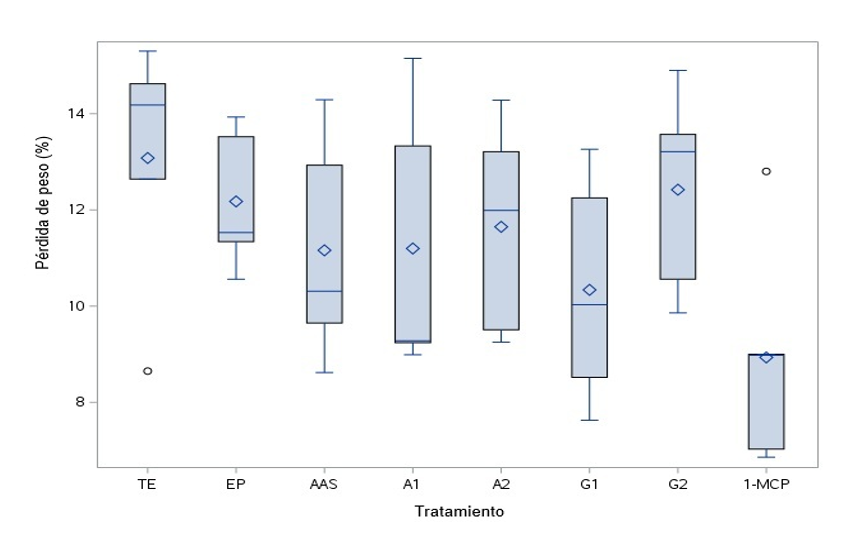
Fruit weight loss is primarily attributed to water loss during postharvest (Kathimba et al., 2022). Osuna et al. (2017) reported 9.9% weight loss in ‘Hass’ fruits (with a dry matter content of less than 28%); this value is lower than that obtained in AC (13.08%), which is due to the dry matter content, since fruits with higher dry matter have more metabolic activity and weight loss (Lufu et al., 2024).
Regarding the application of 1-methylcyclopropene, Ruiz-Aracil et al. (2024) mentioned that in ‘Hass’ avocado, it delays weight loss because of the late onset of the climacteric respiratory phase in the fruit, which aligns with the results obtained. Of the eight treatments applied, 1-MCP had the lowest weight loss, with a difference of 4.15% compared to AC. In relation to the aqueous solutions, G1 was favorable, showing the lowest fruit weight loss, with a difference of 2.74% compared to AC.
On day five postharvest, AC and ASA had a drastic decrease in firmness, going from 19.84 to 1.56 N and from 19.29 to 2.37 N, respectively. The 1-MCP values were higher than those of the other treatments throughout the 11 days postharvest (Figure 2).
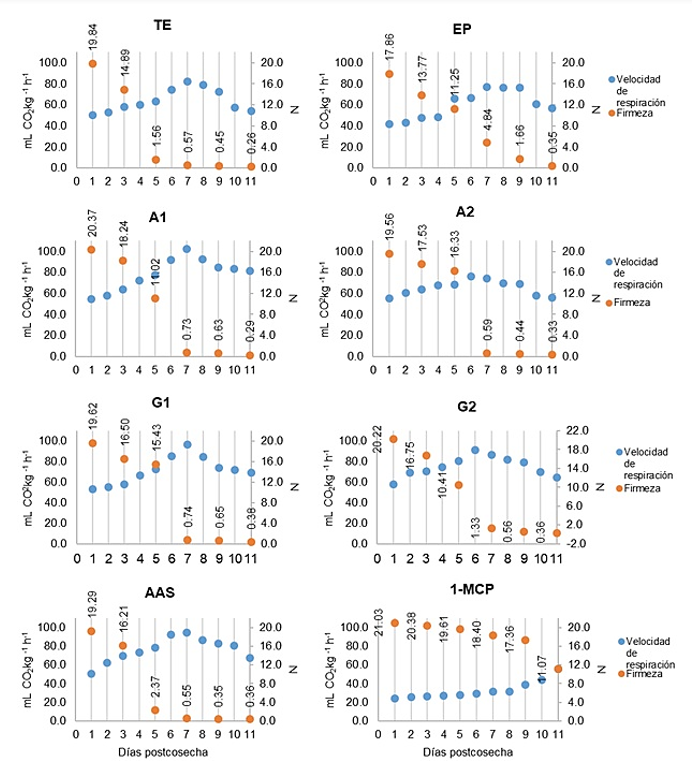
Compared with AC, the other treatments led to greater firmness in the avocado fruits on day eleven, and PE exhibited greater firmness on day seven (4.84 N). The Kruskal-Wallis test indicated statistically significant differences between treatments during postharvest (p< 0.0001).
The treatment 1-MCP had the highest median (38). In contrast, the lowest median values were observed in PE on days 1 and 3 (3), in AC on days 5 and 11 (3), and in ASA on days 7 and 9 (5.1 and 3, respectively).
The most significant postharvest losses of fruits are due to their excessive softening (El-Sharkawy et al., 2016), which limits their storage and shelf life. The application of 1-methylcyclopropene reduced degradation of the fruit cell wall by decreasing the enzymatic activities of cellulase and polygalacturonase (Feng et al., 2000).
The respiration rate of the fruits treated with the solutions and AC resulted in a typical climacteric pattern, with a peak on day six postharvest for A2 and G2, and on day seven for AC, PE, ASA, A1 and G1.
Although the autocatalytic synthesis of ethylene was carried out similarly across treatments, PE and A2 peaked at 77.2 and 76.4 ml CO2 kg-1 h-1, respectively, whereas AC peaked at 82.1 ml CO2 kg-1 h-1; thus, the fruits of PE and A2 exhibited lower metabolic activity than the absolute control.
In the case of 1-MCP, respiration still increased gradually until day eleven postharvest, confirming its antagonism to ethylene action and thereby allowing fruit ripening to be delayed (Figure 2).
The pulp of AC fruits showed the lowest lightness after 11 days of postharvest. ‘a’ values increased, while those of ‘b’ decreased (Figure 3), indicating a shift in coloration towards less green and more yellow tones.
For the Hue angle, the Kruskal-Wallis test indicated statistically significant differences among treatments (p= 0.0392, 0.0073, 0.0251, 0.0065 and 0.0014). The treatment ASA had the highest median on day 3 (27.5), and G2 had the highest median on days 5, 7, 9 and 11 (30, 32.2, 33.4 and 32.5, respectively). In contrast, the lowest values were observed in AC on days 3 and 5 (6.8 and 5.8), and in 1-MCP on days 7, 9 and 11 (9.6, 6.8 and 5).
In the saturation index, the Kruskal-Wallis test showed statistically significant differences among treatments over the 11 days postharvest (p= 0.0216, 0.0022, 0.0017, 0.0005, 0.0057 and 0.0011).
The treatment 1-MCP had the highest median throughout the evaluation period (33.8, 36.2 and 36.9 on days 1, 3 and 5, respectively, and 38 on days 7, 9 and 11). In contrast, the lowest values were observed in G1 on day 1 (9.4), in ASA and G1 on day 3 (10.8), in ASA on day 5 (8), and in G2 on days 7, 9 and 11 (8.5, 10.4 and 7.9, respectively).
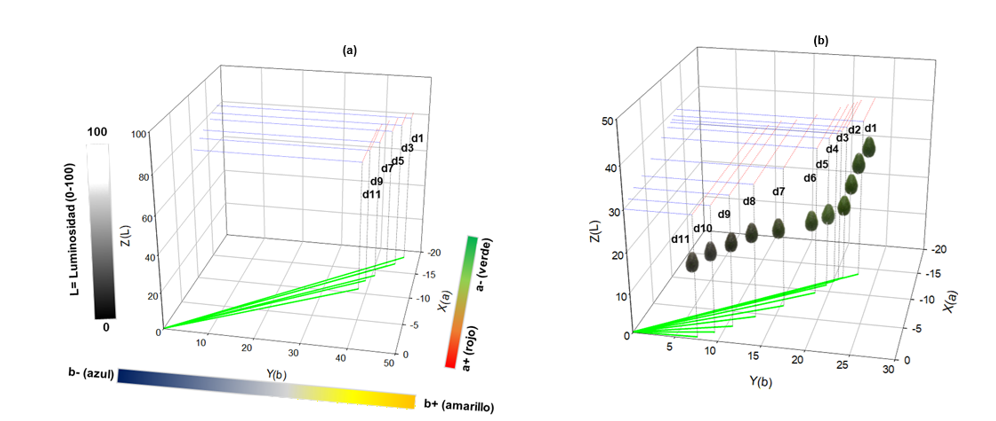
The skin exhibited lower lightness values than the pulp. The fruits with PE, ASA and A2 delayed the change from green to black by two days compared with AC, in which the change occurred on day 7 postharvest (Figure 3). In the case of 1-MCP, the skin remained green, primarily due to delayed chlorophyll degradation.
The variable ‘a’ went from more to less negative values, and ‘b’ decreased as the days went by; this was reflected in the change of color of the skin, from green to dark purple or black, and is attributed to the degradation of chlorophylls, which allows the presence of anthocyanins to be visualized.
For the Hue angle, there was a shift towards the origin of the plane (Figure 3), and the Kruskal-Wallis test indicated statistically significant differences among the treatments on days 6 and 7 (p= 0.0128 and 0.0208, respectively). The treatment 1-MCP had the highest median values (37.2 and 37.4), while the lowest values were observed in A1 on day 6 (10) and in G2 on day 7 (8.8).
The saturation index showed a decrease in its values during postharvest, and the Kruskal-Wallis test showed statistically significant differences among the treatments on days 9, 10 and 11 (p= 0.028, 0.0325 and 0.0302). The treatment 1-MCP had the highest median (38), while AC had the lowest values (11.4, 11.6 and 12, respectively).
The aqueous solutions helped preserve firmness longer and delay the change in skin color from green to black compared with the absolute control, with G2 and ASA treatments standing out as the most effective alternatives. However, treatment with 1-methylcyclopropene was superior in prolonging shelf life and preserving fruit quality.
To the Salvador Sánchez Colín Foundation-CICTAMEX, SC, which, through Dr. María de la Cruz Espíndola Barquera, provided support for carrying out this project.
Balaguera-López, H. E.; Salamanca-Gutiérrez, F. A.; García, J. C. y Herrera-Árevalo, A. 2014. Etileno y retardantes de la maduración en la poscosecha de productos agrícolas. Una revisión. Revista Colombiana de Ciencias Hortícolas. 8(2):302-313. https://revistas.uptc.edu.co/index.php/ciencias-horticolas/article/view/3222.
Herrera-González, J. A.; Bautista-Baños, S.; Salazar-García, S. y Gutiérrez-Martínez, P. 2020. Manejo postcosecha aguacate: situación actual del manejo poscosecha y de enfermedades fungosas del aguacate ‘Hass’ para exportación en Michoacán. Revista Mexicana de Ciencias Agrícolas. 11(7):1647-1660. https://doi.org/10.29312/remexca.v11i7.2402.
Rodríguez-Guzmán, C. A.; Montaño-Leyva, B.; Velázquez-Estrada, R. M.; Sánchez-Burgos, J. A.; García-Magaña, M. de L.; González-Estrada, R. R. y Gutiérrez-Martínez, P. 2021. Estado actual de métodos alternativos de control de hongos y su efecto en la calidad postcosecha de frutos de jitomate (Solanum lycopersicum). TIP Revista Especializada en Ciencias Químico-Biológicas. 24:1-15. https://doi.org/10.22201/fesz.23958723e.2021.388.
Sharma, N.; Bakshi, P.; Dhotra, B.; Sheikh, Z. N.; Alharby, H. F.; Hakeem, K. R.; Alzahrani, O. R. and Rahimi, M. 2026. Integrated preharvest salicylic acid maleic hydrazide and postharvest 1-MCP delay softening and preserve strawberry quality during cold storage. Scientific Reports. Advance online publication. 16(4723):1-12. https://doi.org/10.1038/s41598-026-36487-1.
Tesfay, S. Z. and Magwaza, L. S. 2017. Evaluating the efficacy of moringa leaf extract, chitosan and carboxymethyl cellulose as edible coatings for enhancing quality and extending postharvest life of avocado (Persea americana Mill.) fruit. Food Packaging and Shelf Life. 11:40-48. https://doi.org/10.1016/j.fpsl.2016.12.001.
Yadav, S.; Yadav, S. P.; Adhikari, N.; Sah, R. K. and Gupta, S. 2022. Effects of gibberellic acid (GA₃) on shelf life and physiochemical properties of mango (Mangifera indica L. var Bombay Green). Archives of Agriculture and Environmental Science. 7(4):541-548. https://doi.org/10.26832/24566632.2022.0704010.