DOI: https://doi.org/10.29312/remexca.v17i2.4228

elocation-id: e4228

Durán-Méndez, Almeraya-Quintero, Guajardo-Hernández, Sangerman-Jarquín, and Pérez-Hernández: Bibliometric analysis of artisanal textile clothing

Journal Metadata

Journal Identifier: remexca [journal-id-type=publisher-id]

Journal Title Group

Journal Title (Full): Revista Mexicana de Ciencias Agrícolas

Abbreviated Journal Title: Rev. Mex. Cienc. Agríc [abbrev-type=publisher]

ISSN: 2007-0934 [pub-type=ppub]

ISSN: 2007-9934 [pub-type=epub]

Publisher

Publisher’s Name: Instituto Nacional de Investigaciones Forestales, Agrícolas y Pecuarias

Article Metadata

Article Identifier: 10.29312/remexca.v17i2.4228 [pub-id-type=doi]

Article Grouping Data

Subject Group [subj-group-type=heading]

Subject Grouping Name: Article

Title Group

Article Title: Bibliometric analysis of artisanal textile clothing

Contributor Group

Contributor [contrib-type=author]

Name of Person [name-style=western]

Surname: Durán-Méndez

Given (First) Names: Jorge Antonio

X (cross) Reference: 1 [ref-type=aff; rid=aff1]

Contributor [contrib-type=author]

Name of Person [name-style=western]

Surname: Almeraya-Quintero

Given (First) Names: Silvia Xochilt

X (cross) Reference: 1 [ref-type=aff; rid=aff1]

X (cross) Reference: § [ref-type=corresp; rid=c1]

Contributor [contrib-type=author]

Name of Person [name-style=western]

Surname: Guajardo-Hernández

Given (First) Names: Lenin G.

X (cross) Reference: 1 [ref-type=aff; rid=aff1]

Contributor [contrib-type=author]

Name of Person [name-style=western]

Surname: Sangerman-Jarquín

Given (First) Names: Dora Ma.

X (cross) Reference: 2 [ref-type=aff; rid=aff2]

Contributor [contrib-type=author]

Name of Person [name-style=western]

Surname: Pérez-Hernández

Given (First) Names: Luz María

X (cross) Reference: 1 [ref-type=aff; rid=aff1]

Affiliation [id=aff1]

Label (of an Equation, Figure, Reference, etc.): 1

Institution Name: in an Address: Colegio de Postgraduados-Campus Montecillo. Carretera México-Texcoco km 36.5, Montecillo, Texcoco, Estado de México. CP. 56230. [content-type=original]

Institution Name: in an Address: Colegio de Postgraduados [content-type=normalized]

Institution Name: in an Address: Colegio de Postgraduados [content-type=orgname]

Institution Name: in an Address: Campus Montecillo [content-type=orgdiv1]

Address Line

City: Texcoco

State or Province: Estado de México

Postal Code: 56230

Country: in an Address: México [country=MX]

Affiliation [id=aff2]

Label (of an Equation, Figure, Reference, etc.): 2

Institution Name: in an Address: Campo Experimental Valle de México-INIFAP. Carretera Los Reyes-Texcoco km 13.5, Coatlinchán, Texcoco, Estado de México. CP. 56250. [content-type=original]

Institution Name: in an Address: Instituto Nacional de Investigaciones Forestales, Agrícolas y Pecuarias [content-type=normalized]

Institution Name: in an Address: Instituto Nacional de Investigaciones Forestales, Agrícolas y Pecuarias [content-type=orgname]

Institution Name: in an Address: Campo Experimental Valle de México [content-type=orgdiv1]

Address Line

City: Texcoco

State or Province: Estado de México

Postal Code: 56250

Country: in an Address: México [country=MX]

Author Note Group

Correspondence Information: [§] Autora para correspondencia: xalmeraya@colpos.mx. [id=c1]

Publication Date [date-type=pub; publication-format=electronic]

Day: 01

Month: 02

Year: 2026

Publication Date [date-type=collection; publication-format=electronic]

Season: Feb-Mar

Year: 2026

Volume Number: 17

Issue Number: 2

Electronic Location Identifier: e4228

History: Document History

Date [date-type=received]

Day: 01

Month: 12

Year: 2025

Date [date-type=accepted]

Day: 01

Month: 02

Year: 2026

Permissions

License Information [license-type=open-access; xlink:href=https://creativecommons.org/licenses/by-nc/4.0/; xml:lang=es]

Este es un artículo publicado en acceso abierto bajo una licencia Creative Commons

Abstract

Title: Abstract

Studies on artisanal textile clothing (ATC) contribute to preserving this productive activity; this study aimed to conduct a bibliometric analysis on the topic of ATC using the Scopus digital library through the construction of an algorithm that allowed selecting documents that have addressed the subject during the last two decades and thus measure the scientific activity and identify the different study approaches from which it has been analyzed; the methodology used was divided into seven stages through which the consulted information was systematized; the metadata imported in CSV format were interpreted using the bibliometrix library of the RStudio program, version 4.4.2; among the main results, it was obtained that the scientific production on ATC in Scopus has increased by 4.7 times in the period analyzed, mostly under historical, anthropological and archaeological orientations, among others and with greater productivity within the Asian continent; likewise, greater connectivity was observed through the set of metadata via the term ‘traditional’ located in the abstract section; however, it is believed that within this segment of scientific production, it is necessary to develop research that addresses the current contexts on the ATC production, such as the value chain approach.

Keyword Group [xml:lang=en]

Title: Keywords:

Keyword: artisanal textiles

Keyword: bibliometric

Keyword: handmade

Keyword: traditional clothing

Counts

Figure Count [count=5]

Table Count [count=2]

Equation Count [count=1]

Reference Count [count=44]

Abstract

Studies on artisanal textile clothing (ATC) contribute to preserving this productive activity; this study aimed to conduct a bibliometric analysis on the topic of ATC using the Scopus digital library through the construction of an algorithm that allowed selecting documents that have addressed the subject during the last two decades and thus measure the scientific activity and identify the different study approaches from which it has been analyzed; the methodology used was divided into seven stages through which the consulted information was systematized; the metadata imported in CSV format were interpreted using the bibliometrix library of the RStudio program, version 4.4.2; among the main results, it was obtained that the scientific production on ATC in Scopus has increased by 4.7 times in the period analyzed, mostly under historical, anthropological and archaeological orientations, among others and with greater productivity within the Asian continent; likewise, greater connectivity was observed through the set of metadata via the term ‘traditional’ located in the abstract section; however, it is believed that within this segment of scientific production, it is necessary to develop research that addresses the current contexts on the ATC production, such as the value chain approach.

Keywords:

artisanal textiles, bibliometric, handmade, traditional clothing

Introduction

Textiles, according to the American Textile History Museum (2025), are materials made using filaments obtained from fibers that, through a process of weaving and spinning manually or mechanically, materialize objects for various purposes of use, such as clothing, decoration or some daily use; nevertheless, within the artisanal sector, textiles are usually mainly related to artisanal clothing, which some authors also name as indigenous crafts (Del Carpio, 2012), textile weaving (Marceleño and Ariza, 2017) and textile crafts (Pérez and Neme, 2021).

Among others and even though the idea is easy to understand, it has been possible to corroborate from the review of the research carried out by the aforementioned authors that they allude to handmade clothing that incorporates elements of manufacture, which can vary in color, thickness, texture, composition and shape and that relies on ancestral and vernacular technologies for their manufacture, which give them the category of artisanal; therefore, it has been determined that an appropriate term to refer to them within this study is Artisanal Textile Clothing (ATC) because it establishes, comprehensively, clearly and precisely, the components that identify them.

Within the global scope, the ATC contributes to preserving cultural and traditional identities that grant particularities to the territorial space, which according to Arriaga and González (2016), has also favored the development of local and regional economies through the preservation of ancestral knowledge and techniques for its production in various countries, which makes it a cross-cutting topic of study that has been analyzed from multiple disciplines, such as the anthropology, history, ethnography, economics, and environmental sciences, among others, which have helped to broaden the panorama of the ATC from different perspectives of analysis and therefore address problems that arise from various contexts.

Based on Flores (2019), these problems are mainly linked to the harmful effects of globalization and modernity, which can be summarized in the substitution of traditional forms of production, a decrease in the succession of knowledge and formation of human capital, modifications in its distinctive value, commercial intermediations, alterations, and cultural appropriation, to mention a few.

From the relevance that the ATC has had as a research topic through different disciplines, the interest arises in developing an exploration of literature through bibliometrics, which is a discipline belonging to scientometrics that, through mathematical algorithms, generates statistical information on the scientific production stored in digital libraries, thus making it easier to select indexed documents on specific topics and measure the impact and relevance of research through metrics that show the evolution of the topic over time, trending words, and most cited authors, among other options.

This tool has been used in recent studies, such as those conducted by Tomás and Tomás (2018); Duque et al. (2021); Khan et al. (2021); Maseda et al. (2021); Salinas and García (2022); Sorzano et al. (2022), who, from their respective areas of specialty, refer to it as useful for the production of knowledge. Therefore, the research aimed to carry out a bibliometric analysis of information obtained on the subject of ATC using the Scopus digital library through the construction and use of an algorithm that allowed selecting documents that have addressed the subject during the last two decades and thus measure the scientific activity and identify the different study approaches from which it has been analyzed, which also contributes to the construction of the state of the art for the content of documents that constitute an agenda for future research.

Materials and methods

The research process was desk-based using a methodology that consisted of seven stages: 1) keywords related to the topic of ATC were selected; 2) a digital library was chosen considering that, within its search scheme, it offered options for downloading metadata that could be entered into a data reading program, so the digital library selected was Scopus because it met the desired parameters and because of its level of specialization in the content of scientific quality information; 3) documents related to the ATC were searched for by transcribing the previously selected keywords into the search engine; likewise, the search was refined by defining a period of time of twenty years (2005-2025); the search was limited by title, keywords and abstract in any type of document indexed in Scopus; 4) once the search filters were applied, the selected documents were those considered appropriate in the topic of ATC within their content, such selection was based on reading and analyzing the abstracts; 5) at the end of the search and selection process, a list was created within Scopus to house the documents; once saved, information was configured for the download of metadata and then export them in CSV format (from Scopus to Excel); 6) in order to process the exported metadata, Bibliometrix was used, which is a processing and mathematical language tool included in the RStudio program, version 4.4.2, that facilitated the analysis of bibliometric information; and 7) within the options or indicators of analysis contained in Bibliometrix, the following sections were selected: a) productivity; b) sources; c) authors; d) affiliations; e) countries; and f) keywords. The growth rate by period in subsection ‘a’ was calculated according to the methodology of Brambila (2011), using equation 1.

1)
G R = F V I V - 1 * 100

Results and discussion

Productivity

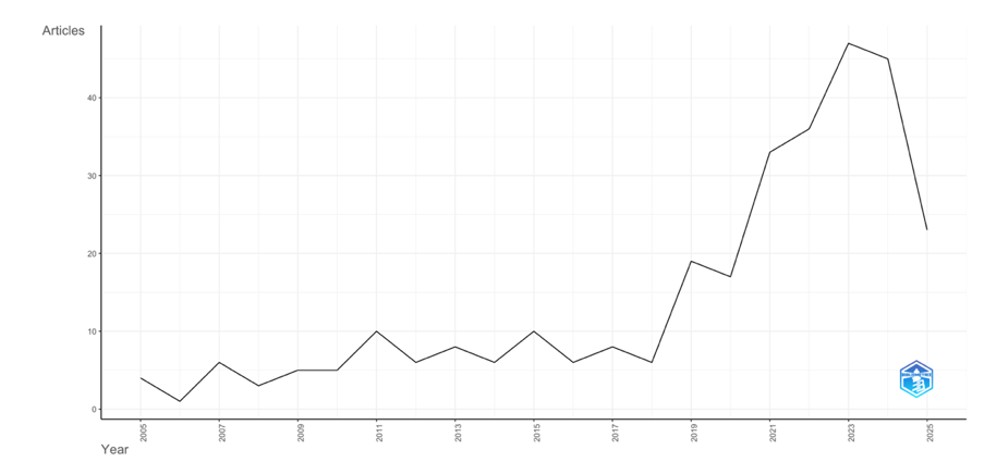
Considering a 20-year analysis period (2005-2025), Figure 1 shows growth peaks in 2007, 2011, 2015, 2019, 2021 and 2023, which reflect that there was an increase in scientific production on ATC in the years indicated, corresponding to 4.7 times.

Figure 1

Figure 1. Annual scientific production (Bibliometrix, 2025).

2007-0934-remexca-17-2-4228-gf1.jpg

Sources

The parameter through which Bibliometrix determines the most relevant sources is productivity; that is, the number of papers that each source has published; the five sources with the highest productivity in the Scopus collection on ATC are seen in Table 1.

Table 1

Table 1. Most relevant sources.

No. Name of the source No. of papers Years
1 Journal of Silk 26 2007-2025
2 Textile: The Journal of Cloth and Culture 10 2013-2025
3 Craft Research 8 2011-2025
4 Izvestiya Vysshikh Uchebnykh Zavedenii Seriya Teknologiya Tekstil Noi Promyshlennosti 7 2010-2025
5 Milli Folklor 6 2007-2025

[i] Bibliometrix (2025).

Authors

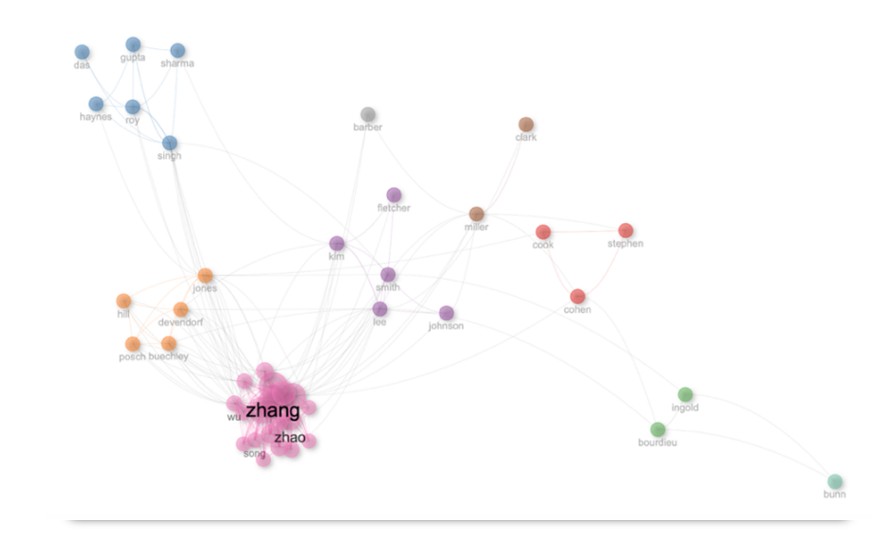
To determine the most relevant authors, Bibliometrix takes into account the number of documents in which an author appears; this characteristic, according to López et al. (2008), is due to components such as the networks generated between authors, which can show inaccuracy in the metrics, which, according to Miguel et al. (2007), infers that groups of authors cite each other; on the other hand, Tomás and Tomás (2018) point out that the nature of collaborative relationships can be overestimated in bibliometrics, because the logic of the algorithm generates honors for appearing in research on the same network, as can be seen in Figure 2.

Figure 2

Figure 2. Co-citation network between authors (Bibliometrix, 2025).

2007-0934-remexca-17-2-4228-gf2.jpg

Affiliations

According to Tomás and Tomás (2018), affiliations reflect scientific production between institutions; regarding the topic of ATC, the results show that the production generated in academic spaces such as universities generates a greater nucleus of collaborations, particularly in the Asian continent; Table 2 presents the main university institutions that, during the last five years, have strengthened a collaboration scheme to produce scientific information about ATC.

Table 2

Table 2. Main institutional affiliations.

Institution Years No. publications Publications by affiliation
Bina Nusantara University 2021-2024 66 20
Zhejiang Sci-Tech University 2021-2024 49 14
M. Auezov South Kazakhstan State University 2019-2024 59 13
Jiangnan University 2022-2024 23 10

[i] Bibliometrix (2025).

Countries

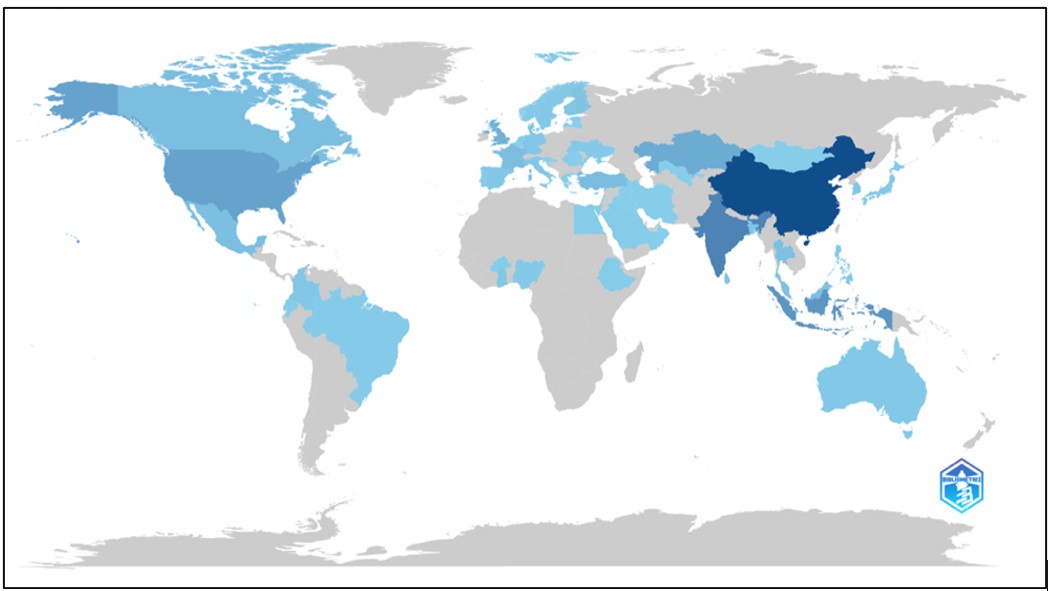
Figure 3 shows the geographical distribution of scientific production on ATC, where ten main countries stand out, among which China shows a higher level of scientific production on ATC with a total of 133 documents, a fact that Molero (2024) relates to the centuries of history in the production of textiles and their distribution through trade.

Figure 3

Figure 3. Scientific production by country (Bibliometrix, 2025).

2007-0934-remexca-17-2-4228-gf3.jpg

For its part, the information that India produces on ATC is reflected in 77 identified documents; however, according to Vásquez (2021), there is currently a debate about the industrial overproduction of clothing, which broadens the analysis by considering problems such as imitation or plagiarism, as well as negative environmental and social impacts. Other notable countries are Indonesia (55), the United States of America (43), Kazakhstan (35), the United Kingdom (28), Turkey (17), Canada (16), France (16) and Mexico (15); the latter with a large productive wealth on ATC with problems similar to those described in China and India, such as plagiarism and industrial imitation.

Keywords

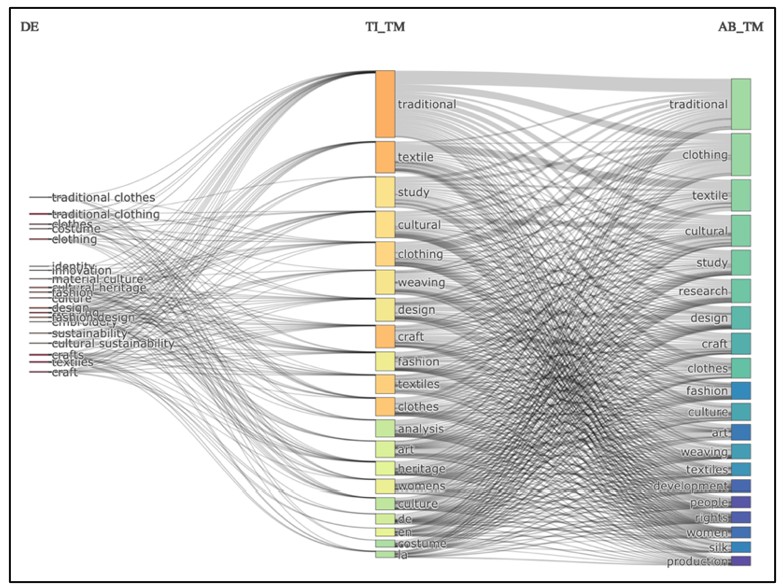
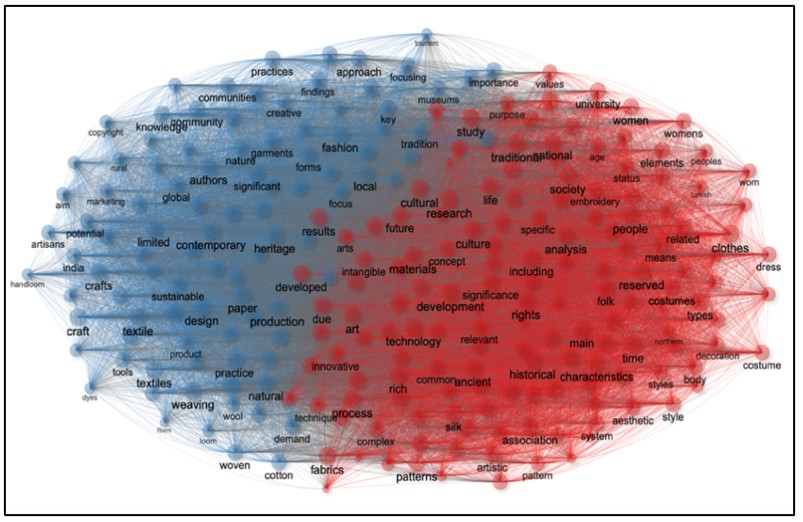
According to Flores (2023), the use of words in scientific production contributes to generating a system for searching, coding, storing, and retrieving documents through concurrence. For the topic of ATC, it was observed that a greater number of documents are related by the use of the word ‘traditional’, particularly located within the abstract, as opposed to sections such as title and keywords, as can be seen in Figure 4; likewise, the co-occurrence network is also shown in Figure 5, which represents the relationships generated within the dataset that show greater connectivity in the information on ATC, through the term ‘traditional’.

Figure 4

Figure 4. Coding of terms by section (Bibliometrix, 2025).

2007-0934-remexca-17-2-4228-gf4.jpg
Figure 5

Figure 5. Co-occurrence network by summary (Bibliometrix, 2025).

2007-0934-remexca-17-2-4228-gf5.jpg

The thematic evolution within the scientific production on ATC shows variation over time, which was corroborated by selecting the most cited documents worldwide during the established period of time (2005-2025), where there was a compendium of studies in the Scopus collection that mostly address ATC from historical, anthropological, and archaeological approaches; for example, Hendon (2006) locates her object of study in Mesoamerica, as do authors such as Cohen (2007); Cohen et al. (2011); Theodossopoulos (2012); García and Vinebaum (2016); Franco et al. (2019); Méndez and Ávila (2019); Antaki and Medvedev (2021); O’Connell (2021); Raas (2022); Tacchetti et al. (2023); Moya et al. (2024); Mondragón (2024).

Nonetheless, within the aforementioned approaches, Asian production predominates through the Journal of Silk source, which has generated constant productivity during the established period; in the work of authors such as Xue et al. (2022); Wang et al. (2023); Yan and Deng (2024), the historical context of the textile trade is addressed; other authors such as Song et al. (2023) study the ancient trades and techniques for the production of ATC.

Some authors such as Affinito et al. (2017); Ma et al. (2019); Fan and Zhou (2020) relate ATC to issues in fashion and design, under approaches that promote sustainability, which is also the case for Granger et al. (2007), who establish principles of reuse and exploitation of biotic resources; finally, technological innovation becomes relevant through the analysis of industrial production in studies carried out mainly by Deshpande et al. (2021); Rajput and Aneja (2021); Zhang (2022).

Conclusions

The conducted work made it possible to identify a 4.7-fold increase in production during the established period (2005-2025), during which there is an abundance of studies under historical, anthropological and archaeological orientations and to a lesser extent in areas such as design, sustainability, technology, innovation and socioeconomics; it is suggested that future studies consider approaches that lean towards the analysis of the productive, organizational and trade processes of artisans, such as the value chain approach, from which it will be possible to expand the information on the current problems and needs of those who subsist through the production of ATC to continue contributing to the construction of their analysis and preservation.

Bibliography

1 

Affinito, L.; Conti, G. M. and Motta, M. 2017. New vision on knitwear design. How the traditional craft methodologies are evolving into fashion international scenarios. The Design Journal. 20(1):2760-S2770. https://doi.org/10.1080/14606925.2017.1352787.

2 

Antaki, B. and Medvedev, K. 2021. Bolivian textile crafts and the subversion of institutionalized sustainability. Clothing Cultures. 7(1):91-100. https://doi.org/10.1386/cc-00031-1.

3 

Arriaga, N. R. y González, P. C. R. 2016. Efectos económicos del sector cultural en México. Universidad Autónoma Metropolitana (UAM). Análisis Económico. 31(77):219-246. https://www.redalyc.org/journal/413/41345703010/html/.

4 

ATHM. 2025. Amercian textile history museum. Textiles: definition, types, history and uses. https://www.athm.org/textiles/.

5 

Brambila, P. J. J. 2011. Bioeconomía: instrumentos para su análisis económico. Secretaría de Agricultura, Ganadería, Desarrollo Rural Pesca y Alimentación (SAGARPA). Primera edición, México, DF. 19-20 pp.

6 

Clarke, R. C. 2007. Traditional Nepali hemp textiles. Journal of Industrial Hemp. 12(2):97-113. https://doi.org/10.1300/J237v12n02-07.

7 

Cohen, J. H. and Browning, A. 2007. The decline of a craft: basket making in San Juan Guelavia, Oaxaca. Human Organization. 66(3):229-239 https://doi.org/10.17730/humo.66.3.w8877r7724520137.

8 

Cohen, J. H.; Browning, A. and Montiel, I. F. A. 2011. The collapse of a craft: basketmaking in San Juan Guelavia, Oaxaca. Chungará (Arica). 43(2):257-266. https://dx.doi.org/10.4067/S0717-73562011000200007.

9 

Del Carpio, O. P. S. 2012. Entre el textil y el ámbar: las funciones psicosociales del trabajo artesanal en artesanos Tzotziles de la Ilusión, Chiapas, México. Athenea Digital. Revista de Pensamiento e Investigación Social. 12(2):185-198. https://www.redalyc.org/articulo.oa?id=53723279010.

10 

Deshpande, H.; Takahashi, H. and Kim, J. 2021. EscapeLoom: fabricating new affordances for hand weaving. Association for Computing Machinery. 630(21):1-13. https://doi.org/10.1145/3411764.3445600.

11 

Devi, M. R; Poornima, N. and Guptan, P. S. 2007. Bamboo the natural, green and eco-friendly new-type textile material of the 21st century. Journal of the Textile Association. 67(5):221-224. https://www.researchgate.net/publication/283837761-Bamboo---The-natural-green-and-eco-friendly-new-type-textile-material-of-the-21st-century.

12 

Duque, P.; Trejos, D.; Hoyos, O. y Chica, M. J. C. 2021. Finanzas corporativas y sostenibilidad: un análisis bibliométrico e identificación de tendencias. Semestre Económico. 24(56):25-51. https://doi.org/10.22395/seec.v24n56a1.

13 

Fan, K. K. and Zhou, Y. 2020. The influence of traditional cultural resources (TCRs) on the communication of clothing brands. Sustainability. 12(6):2379. https://doi.org/10.3390/su12062379.

14 

Flores, M. J. 2019. Mercancías únicas. La fantasía ideológica de la producción de textiles artesanales. LiminaR. Estudios Sociales Y Humanísticos. 18(1):49-60. https://doi.org/10.29043/liminar.v18i1.730.

15 

Flores, R. J. A. 2023. El valor de las palabras clave en los artículos científicos. Gestión I+D. 8(1):11-13. http://saber.ucv.ve/ojs/index.php/rev-GID/article/view/25193.

16 

Franco, M. S.; Arredondo, A. G. M.; Cruz, B. Y. and Endara, A. A. 2019. The use of dye plants in a Mazahua community in Central Mexico. Econ. Bot. 73(1):13-27. https://doi.org/10.1007/s12231-018-9431-5.

17 

García, E. and Vinebaum, L. 2016. The Museo Textil de Oaxaca: a live space for the textile arts: Interview with Ana Paula Fuentes. Textile. 14(1):122-135. https://doi.org/10.1080/14759756.2016.1142787.

18 

Granger, T. H. 2007. Weaving clothes to shape in the ancient world’ 25 years on: corrections and further details with reference to the cloaks from Lahun. Archaeological Textiles Newsletter. 13(1)13-25. https://doi.org/10.1179/TEX.1982.13.1.3.

19 

Hendon, J. A. 2006. Textile production as craft in Mesoamerica: time, labor and knowledge. Journal of Social Archaeology. 6(3):354-378. https://doi.org/10.1177/1469605306067841.

20 

Khan, I. K.; Nasir, A. and Saleem, S. 2021 Bibliometric analysis of post covid-19 management strategies and policies in hospitality and tourism. Front. Psychol. 12(13):769-760. Doi: 10.3389/fpsyg.2021.769760.

21 

López, G. Á. A.; Nuñez-Fernández, C.; Vicente-Herrero, M. T.; Monroy-Fuenmayor, M. N.; Sarasibar-Ezcurra, H. y Tejedo-Benedicto, E. 2008. Análisis bibliométrico de la productividad científica de los artículos originales relacionados con salud laboral publicados por diferentes revistas españolas entre los años 1997 y 2006. Medicina Balear. 23(1):17-24. https://portalcientifico.universidadeuropea.com/documentos/63f6c2bf3dae6d15e23a8aca.
22 

Ma, Q.; Abdeljelil, H. M. and Hu, L. 2019. The Influence of consumer ethnocentrism and cultural familiarity on brand preference: evidence of event-related potential (ERP). Front. Hum. Neurosci. 13(220):1-9. https://doi.org/10.3389/fnhum.2019.00220.

23 

Marceleño, A. I. R. y Ariza, A. S. V. 2017. El tejido textil tarahumara. Hilos, cobija y faja. Chihuahua Hoy. 15(15):179-206. https://doi.org/10.20983/chihuahuahoy.2017.15.

24 

Maseda, A.; Iturralde, T.; Cooper, S. and Aparicio, G. 2021. Mapping women’s involvement in family firms: a review based on bibliographic coupling analysis. International Journal of Management Reviews. 24(2):279-305. https://doi.org/10.1111/ijmr.12278.

25 

Méndez, N. J. y Ávila, M. J. 2019. Tejedoras, bordadoras y armadoras en Yucatán: nuevas y antiguas clases trabajo en casa. Íconos. Revista De Ciencias Sociales. 23(65):155178. https://doi.org/10.17141/iconos.65.2019.3417.

26 

Miguel, S.; Moya, A. F. y Herrero, S. V. 2007. El análisis de co-citas como método de investigación en bibliotecología y ciencia de la información. Investigación bibliotecológica. 21(43):139-155. http://www.scielo.org.mx/scielo.php?script=sciarttext&pid=S0187358X2007000200006&lng=es&tlng=es.

27 

Molero, G. J. 2024. Vistiendo a la moda de la China: consumo de vestimenta oriental entre Nueva España y Sevilla durante el reinado de Felipe III. Investigaciones Históricas. Época Moderna y Contemporánea. 44(13):303-339. https://doi.org/10.24197/ihemc.44.2024.303-339.

28 

Mondragón, T. B. 2024. Artisanal collaborations in the Mexican fashion industry: the case of Otomi embroiderers and Carla Fernández. fashion, style & popular culture, issue latin american/latinx fashion. 11(2):305-319. https://doi.org/10.1386/fspc-00238-1.

29 

Moya, E. P. I.; Cortes, R. N. C. and Socha, L. J. C. 2024. Social innovation for conserving textile-craft practices in boyacá, Colombia. Apuntes del Cenes. 43(77):153-178. https://doi.org/10.19053/uptc.01203053.v43.n77.2024.16248.

30 

O’Connell, M. J. 2021. Traditional weaving cultures in a global market: the case of Zapotec weavers. International Journal of Fashion Studies. 8(1):85-103. https://doi.org/10.1386/infs-00038-1.

31 

Pérez, H. D. M. y Neme, C. S. 2021. La cadena de valor en la artesanía textil: el caso de la tira bordada tabasqueña. Nova Scientia. 13(2):1-22. https://dialnet.unirioja.es/servlet/articulo?codigo=8954527.

32 

Raas, K. 2022. Pensar la persona a través del tejido: una propuesta de interpretación a partir del ejemplo de los tejidos jalq’a (Bolivia). Revista Española de Antropología Americana. 52(1):95-112. https://doi.org/10.5209/reaa.75690.

33 

Rajput, P. S. and Aneja, S. 2021. IndoFashion: apparel classification for Indian ethnic clothes. IEEE/CVF conference on computer vision and pattern recognition workshops (CVPRW). 3930-3934 pp. Doi: 10.1109/CVPRW53098.2021.00440.

34 

Salinas, R. K. y García, L. A. G. 2022. Bibliometría, una herramienta útil dentro del campo de la investigación. Journal of Basic and Applied Psychology Research. 3(6):10-17. https://doi.org/10.29057/jbapr.v3i6.

35 

Song, J.; Post, Y. and Zhou, H. 2023. The application of clothing tying method in clothing design in the Ming Dynasty. Journal of Silk. 60(7):100-106. Doi: 10.3969/j.issn.1001-7003.2023.07.013.

36 

Sorzano, R. D. M.; Galván, V. E.; Bonilla, O. M. E. y Ravina, R. R. 2022. Estudio bibliométrico del constructo teórico ‘víctima’: acercamiento a partir del conflicto armado en Colombia. Jurídicas CUC. 18(1):09-134. Doi: http://dx.doi. org/10.17981/juridcuc.18.1.2022.05.

37 

Tacchetti, M.; Chocontá, P. A.; Quiceno, T. N. and Papadopoulos, D. 2023. Memorial reparation: women’s work of remembrance, repair and restoration in rural Colombia. Memory Studies. 17(6):1327-1345. https://doi.org/10.1177/17506980231188482.

38 

Theodossopoulos, D. 2012. Indigenous attire, exoticization, and social change: dressing and undressing among the Emberá of Panama. Journal of the Royal Anthropological Institute. 18(3):591-612. https://doi.org/10.1111/j.1467-9655.2012.01778.x.

39 

Tomás, G. V. y Tomás, C. V. 2018. La bibliometría en la evaluación de la actividad científica. Hosp Domic. 2(4):145-63. https://doi.org/10.22585/hospdomic.v2i4.51.

40 

Vásquez, M. L. I. 2021. Stained supply chains: labor exploitation in the textile industry of China and India. Online Journal Mundo Asia Pacifico. 10(19):85-97. https://publicaciones.eafit.edu.co/index.php/map/article/view/7208.

41 

Wang, H.; Zu, Y.; Su, J. and Zhang, Y. 2023. Comparison and analysis of influencing factors of the Tang and Song Dynasties. Journal of Silk. 60(5):135-142. Doi: 10.3969/j.issn.1001-7003.2023.05.018.

42 

Xue, D.; Zhao, F.; Zhao, A. and Wang, S. 2022. Research on the skills of ‘knitting shoes’ in the tomb of Zhao Boqi in the southern song dynasty. Journal of Silk. 59(2):145-151. Doi: 10.3969/j.issn.1001-7003.2022.02.018.

43 

Yan, B. and Deng, L. 2024. Analysis of the evolution of the clothing characteristics of the Northern Dynasty and its causes. Ournal of Silk. 61(11):130-138. Doi: 10.3969/j.issn.1001-7003.2024.11.015.

44 

Zhang, Y. 2022. On the integration path of hand embroidery and machine embroidery needlework under the background of craftsmanship. Journal of Silk. 59(10):1-9. Doi:10.3969/j.issn.1001-7003.2022.10.001.