elocation-id: elocation-id: e4219
Soil is an essential resource for life, as it provides nutrients, water and ecosystem services. Nevertheless, its degradation seriously affects food production, considering that 95% of food comes from it. FAO estimates that agricultural demand will increase by 60% by 2050; however, 33% of the world’s soil is currently infertile. The study aimed to characterize the physicochemical properties of the soil in Santiago de Anaya, Hidalgo. The research was conducted in 2025 using a randomized complete block experimental design to determine potential crops and promote agricultural production. The results show that the soils have a sandy loam texture, which favors water and nutrient retention and is related to the bulk density that oscillates between clay and loam soils (1.02 to 1.23 g cm-3). All the soils evaluated are classified as having a very low organic matter concentration (less than 4%). Regarding pH, soils are classified from medium to strongly alkaline, with values of up to 9.79. Electrical conductivity indicates low salinity, in ranges of 1.5 to 3 dS m-1. Total carbonates have high values (35%), associated with Leptosols and Phaeozems. The cation exchange capacity is classified as high, with values of 29 to 33.5 Cmol(+) kg-1. Tukey’s multiple mean comparison test (p≤ 0.05) indicates that the soils of Santiago de Anaya, Hidalgo, Mexico are suitable for short-cycle, drought-resistant crops, such as forages, legumes and certain tubers and roots.
edaphic parameters, Mezquital Valley, rainfed conditions.
Soil is the layer of organic and mineral materials that covers the Earth’s crust and in which plants develop their roots and take the food that is necessary for their nutrition (Tofiño-Rivera, 2020).
FAO (2019) predicted that agricultural production will need to increase by 60% to meet global food demand by 2050. Nonetheless, 33% of soils are infertile, and since 95% of food comes from them, science is seeking sustainable solutions.
On the other hand, it is mentioned that in rainfed agriculture in Mexico, only 1.75 million hectares exhibit mild sodicity, and 3.47 million hectares report mild salinity at depths of 0 to 30 cm, which is equivalent to almost a fifth (19.7%) of Mexican agriculture.
At depths of 30 to 100 cm, 3.37 million hectares under irrigation and 3.69 million hectares under rainfed conditions are reported to contain salts, resulting in an increase of 2.15 million saline hectares in this layer (SADER, 2021).
In the Mezquital Valley, soil salinization has been increasing due to the prolonged use of wastewater for irrigation (Huerta et al., 2002; Lucho et al., 2005; Ponce et al., 2019).
After 20 years of flood irrigation, the soils lost fertility. García-Carrillo (2020) reported bulk densities of 1.21, 1.25, and 1.5 g cm-3 in soils irrigated with raw, treated and mixed wastewater, respectively; pH values of 8.04 and 8.6 in soils irrigated with raw and treated wastewater, respectively, and ESP values of 1.64, 4.64, and 6.44%, respectively; they concluded that the use of raw wastewater degrades physicochemical properties and increases heavy metal levels in surface soil strata.
Another factor that influences the infertility of an agricultural soil is the misuse of pharmaceutical products and agrochemicals; for example, it has been shown that using glyphosate in the cultivation of beans altered the soil’s chemical properties, increasing organic matter with levels of 1.82% and 1.48%; also, the pH was significantly increased to 6.79, and electrical conductivity decreased to 0.3 dS m-1 (Siemens et al., 2008; Tofiño-Rivera, 2020; Jing et al., 2025; Castro-Flores et al., 2026).
Likewise, the cation exchange capacity (CEC) was 8.2 Cmol(+) kg-1; the assimilable iron decreased and obtained a value of 31 mg kg-1 relative to the initial value, and there was a slight decrease in the manganese available in the soil, with 1.5 mg kg-1 at a maximum concentration of 6.2 mg kg-1 (Tofiño-Rivera, 2020).
The findings of Cotter (2020) revealed that 16% of rainfed agricultural soil is infertile, with the light level predominating. It is distributed across 27 states, with the highest concentrations in Jalisco (13%), Oaxaca (12%), Michoacán (9%), Chihuahua (9%) and Guanajuato (8%). In Chihuahua and Zacatecas, moderate infertility predominates.
The objective of the document was to characterize the soil’s physicochemical properties in Santiago de Anaya using multivariate analysis, in order to determine potential crops and promote agricultural production.
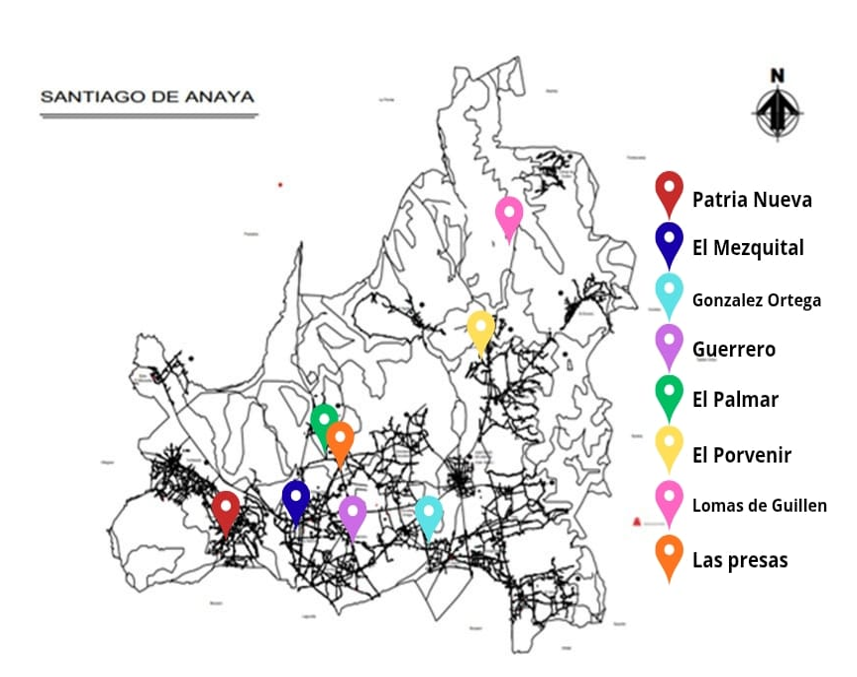
The research was conducted in agricultural plots in the municipality of Santiago de Anaya, Hidalgo, Mexico at depths of 0 to 30 cm (Figure 1).
The study locations were: Lomas de Guillén at coordinates 20° 29’ 38” north latitude, 98° 55’ 29” west longitude and 20° 29’37” north latitude, 98° 55’ 27” west longitude; El Porvenir at coordinates 20° 26’ 08.3” north latitude, 98° 57’ 00.1” west longitude and 20° 26’ 09.4” north latitude, 98° 57’ 04.6” west longitude; Vicente Guerrero at coordinates 20° 21’ 50.5” north latitude, 99° 00’ 25” west longitude, and 20° 21’ 47” north latitude, 99° 00’ 27” west longitude; El Palmar at coordinates 20° 23’ 43” north latitude, 98° 59’ 56” west longitude, and 20° 24’ 02.3” north latitude, 99° 00’ 40.3” west longitude; Patria Nueva at coordinates 20° 23’ 27” north latitude, 99° 02’ 21.4” west longitude and 20° 23’ 29.2” north latitude, 99° 02’ 23.4” west longitude; González Ortega at coordinates 20° 21’ 17” north latitude, 99° 00’ 57” west longitude and 20° 21’ 26” north latitude, 99° 00’ 57” west longitude.
Las Presas at coordinates 20° 23’ 42.9” north latitude, 98° 59’ 56.9” west longitude; and ejido El Mezquital at coordinates 20° 373’ 056” north latitude, 99° 021’ 111” west longitude and 20° 22’ 22” north latitude, 99° 01’ 05” west longitude. A composite sample was taken, and all analyses were performed based on the methods established by NOM-021-RECNAT-2000.
R-Core Team version 2026 was employed to examine the acquired data using a randomized complete block experimental design with two replications. All soil physicochemical parameters were tested using Tukey’s method (p≤ 0.05).
Soil analyses at all sampling points revealed a loam textural class; this type of soil is characterized by a medium texture that combines the ability to retain water and nutrients with good drainage and air infiltration, compared with sandy soils (Marques, 2019; Acuña et al., 2025).
The textural class of loam soil affects rainfed regions because of the balance of the soil’s granulometric fractions, which improve bulk density; in this sense, even though there is no significant difference in this variable (Tukey, p≤ 0.05). El Palmar reflected 0.21 g cm-3 more than Las Presas, which indicates that there are variations in the content of organic matter and compaction, which favors the retention of rainwater, releasing it during dry periods, increasing productive stability without depending exclusively on irrigation in these rainfed areas (Delgado-González, 2022).
Table 1 shows that El Porvenir and El Mezquital presented significantly more organic matter. El Porvenir obtained 2.09% more organic matter than Patria Nueva, the latter community being the one with the lowest % OM; this means that El Porvenir is much more fertile than the other communities evaluated; therefore, a high content of organic matter favors greater porosity and aeration and neutralizes the pH of the soil, a parameter that allows the availability of essential nutrients (Osorio, 2012).
Research such as Santander’s (2024) reported an organic matter content of 1.59% in the municipality of Santiago de Anaya, which is attributed to low rainfall and the xerophilous ecosystem characteristic of the region. Therefore, pH is an indicator that determines whether a soil is acidic, neutral or alkaline.
In the Mezquital Valley, Hidalgo, this parameter is closely linked to the dynamics of organic matter (Cruz-Macías et al., 2020); likewise, Delgado (2022) reported a pH of 8.2 in the municipality of Actopan, specifically in the Chicavasco region; this value is below the data obtained for the localities evaluated in Table 1, where even though the soils present significant differences (Tukey, p≤ 0.05), they are classified from medium to strongly alkaline.
The community of Mezquital reports a pH 1.09 higher than González Ortega, which limits the availability of essential nutrients such as phosphorus, iron, and manganese, mitigating the reproduction of microorganisms and soil fertility (Osorio, 2012).
On the other hand, NOM-021-RECNAT-2000 mentions that the soil’s electrical conductivity (EC) is key to evaluating salinity and establishes a saline soil with an EC greater than 4 dS m-1. This parameter allows us to know simply and reliably the changes in the chemical condition after the implementation of management practices such as fertilization and irrigation (Campos-Granados, 2025).
In this case, there is no significant difference in EC across the sampling points; however, the study areas of González-Ortega, Las Presas, Lomas de Guillén and El Palmar present negligible salinity effects; for their part, Guerrero, Patria Nueva and El Mezquital report very slightly saline soils, and the community of El Porvenir stands out as moderately saline.
In this sense, Alonso (2022) indicated that ranges from 1.5 dS m-1 to 3 dS m-1 are considered adequate for agricultural production; therefore, they have low concentrations of soluble salts and low nutrient availability, an effect that is characterized in all the study sites in Table 1.
Likewise, the content of total carbonates present in the soils is related to increases in pH and EC, which act as a key indicator of the availability of iron, zinc, manganese and phosphorus, leading to precipitation and chemical blockage, causing chlorosis in crops (Andrades-Rodríguez, 2022).
In this sense, Lomas de Guillén and Las Presas have the highest values of total carbonates, resulting from sedimentary and extrusive igneous rocks, which give rise to Leptosols and Phaeozems, respectively (INEGI, 2020).
Studies in Mexico show that in arid and semi-arid regions (La Paz, BCS), carbonates are usually integrated into the soil’s solid phase due to low rainfall, and they cause phosphorus deficiencies in crops (Ayala-Niño, 2018).
The contributions of Ávila-Uribe (2025) reported up to 32.2% of carbonates in the state of Oaxaca, specifically in Sitio Xitlapehua and San Luis Amatlán, Miahuatlán de Porfirio Díaz, attributing this to soil edaphology.
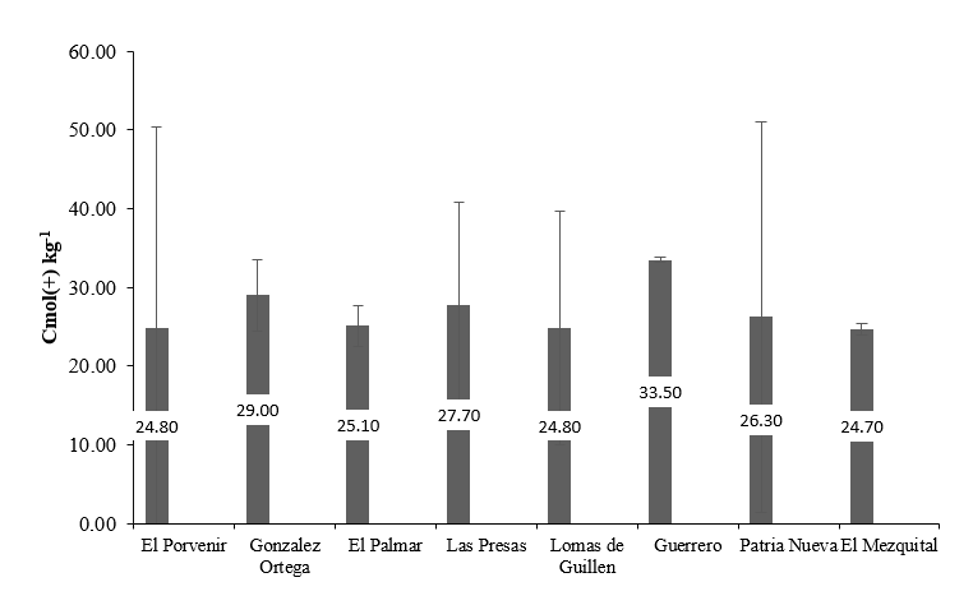
Figure 2 presents the exchangeable bases of the study plots; this parameter measures the amount of cations such as Ca²⁺, Mg²⁺, K⁺ and Na⁺ that can be retained and exchanged by soil particles (López-Báez, 2019).
It is closely linked to soil organic matter, since the functional groups present in the organic fraction (mainly carboxyl groups and phenols) generate negative charges that increase the retention of these cations (Solly, 2020).
The result indicates that the community of Guerrero presents 4.5 Cmol(+) kg-1 more than González-Ortega, which are classified with a very high cation exchange; it is worth mentioning that previous studies by Santander (2024) in Santiago de Anaya reported a CEC of 24.7 Cmol(+) kg-1, indicating that it is an indirect parameter of the soil for the exchange of cations and provides information on soil fertility.
The influence of pH on CEC is highlighted, since higher alkalinity values tend to alter cation availability. In this sense, soils with higher organic matter content show higher CEC (López-Báez, 2019; Cruz-Macías, 2020).
Lomas de Guillén, El Mezquital and El Porvenir fall within the average classification, with CEC values between 15 and 25 Cmol(+) kg-1 based on NOM-021-RECNAT-2000, a figure similar to that reported by Santander (2024) for the same municipality of Santiago de Anaya, Hidalgo. In alkaline soils, CEC is not only a chemical parameter but also a strategic tool for ensuring nutrient availability, optimizing fertilization, and improving soil structure. In short, knowing it enables more precise and sustainable decisions to be made in agricultural production.
The importance of this study in the communities of Santiago de Anaya emphasizes knowing the limitations that directly influence agricultural productivity; the results indicate highly alkaline soils, which is an indicator of the low availability of essential nutrients.
In sandy loam soils, drought-tolerant crops such as sorghum, barley and sunflower are recommended; for short cycles, nitrogen-fixing legumes such as chickpeas and lentils are recommended. Soil characterization is essential for choosing crops or designing practices that maintain fertility and productivity.
Castro-Flores, F.; Galván-Romero, V. S.; Zamora-Mendoza, B. N.; Macias, A. A.; Garcia-Grimaldo, J. A.; Medellin-Castro, N. A.; Vallejo-Pérez, M. R. and Flores-Ramírez, R. 2026. Detection of antimicrobial resistance and application of molecularly imprinted polymers for detection of antibiotics in wastewater samples from San Luis Potosí. Microchemical Journal. 220:116643. https://doi.org/10.1016/j.microc.2025.116643.
Cruz, M. W. O.; Rodríguez L. L. A.; Salas M. M. Á.; Hernández V.; Campos S. R. A.; Chávez H. M. H. y Gordillo C. A. 2020. Efecto de la materia orgánica y la capacidad de intercambio catiónico en la acidez de suelos cultivados con maíz en dos regiones de Chiapas, México. Terra latinoamericana. 3(38):475-480. https://doi.org/10.28940/terra.v38i3.506.
Delgado-González, C. R.; Rodríguez-Laguna, R.; Capulín-Grande, J.; Madariaga-Navarrete, A. y Islas-Pelcastre, M. 2022. Caracterización fisicoquímica de suelos salinos agrícolas, en la localidad de Chicavasco, estado de Hidalgo, México. South Florida Journal of Development. 3(1):335-344. https://doi.org/10.46932/sfjdv3n1-026.
Huerta, L.; Contreras-Valadez, R.; Palacios-Mayorga, S.; Miranda, J. and Calva-Vasquez, G. 2002. Total elemental composition of soils contaminated with wastewater irrigation by combining IBA techniques. Nuclear Instruments and Methods in Physics Research Section B. 189:158-162. https://doi.org/10.1016/S0168-583X(01)01029-1.
Lucho-Constantino, C. A.; Prieto-García, F.; Del Razo, L. M.; Rodríguez-Vázquez, R. and Poggi-Varaldo, H. M. 2005. Chemical fractionation of boron and heavy metals in soils irrigated with wastewater in central Mexico. Agriculture. Ecosystems and environment. 108(1):57-71. https://doi.org/10.1016/j.agee.2004.12.013.
Marques, K. P.; Rizzo, R.; Carnieletto-Dotto, A.; Souza, A. B.; Mello, F. A.; Neto, L. G.; Anjos, L. H. C. and Demattê, J. A. 2019. How qualitative spectral information can improve soil profile classification? Journal of Near Infrared Spectroscopy. 2(27):156-174. https://doi.org/10.1177/0967033518821965.
Ponce-Lira, B.; Serrano-Olvera, M.; Rodríguez-Martínez, N. and Sánchez-Herrera, S. G. 2019. Polluted wastewater for irrigation in the Mezquital Valley, Mexico. In: Otazo-Sánchez, E.; Navarro-Frómeta, A.; Singh, V. (eds). Water Availability and Management in Mexico. Water Science and Technology Library, vol 88. Springer, Cham. https://doi.org/10.1007/978-3-030-24962-5-10.
Solly, E. F.; Weber, V.; Zimmermann, S.; Walthert, L.; Hagedorn, F. and Schmidt, M. W. 2020. A critical evaluation of the relationship between the effective cation exchange capacity and soil organic carbon content in Swiss forest soils. Frontiers in Forests and Global Change. (3):98. https://doi.org/10.3389/ffgc.2020.00098.