elocation-id: elocation-id: e4213
Maguey pulquero is an emblematic species of Mexico because of its productive, ecological and cultural importance; however, sexual reproduction has been underutilized, limiting plant availability and conservation. In this context, nanotechnology represents an innovative alternative to improve the initial establishment of the crop. This research aimed to evaluate the effect of imbibing seeds of Agave salmiana Cv. Xaminí in solutions of zinc oxide nanoparticles (ZnO-NPs) and their combination with silver (ZnO+Ag1%-NPs) on emergence and initial growth. The study was conducted under semi-controlled conditions at the Higher Technological Institute of Huichapan, Hidalgo, Mexico, in 2025. Concentrations of 50, 100 and 200 mg L-1, plus a control in deionized water, were evaluated under a completely randomized design with three replications. The variables evaluated were percentage of emergence, days to maximum emergence, emergence speed index and cotyledonary leaf height. The data were analyzed using Anova and Tukey’s test (p≤ 0.05). The results showed that the treatments remained statistically similar in emergence percentage, with values above 90%, promoting faster and more uniform emergence and reducing the time needed to reach the established maximum by up to nine days, mainly in ZnO+Ag 1% treatments. Intermediate concentrations promoted initial growth, increasing cotyledonary leaf height by up to 33% and improving the emergence speed index. The positive effect is attributed to zinc, a necessary element in essential physiological processes related to plant growth, as well as to the possible physiological stimulation effect of silver at low concentrations. Seed imbibition with nanoparticles improves the initial establishment of A. salmiana, representing a promising tool for propagating and conserving this high-value species in Mexico.
initial establishment, maguey pulquero, nanotechnology.
The agave pulquero (Agave salmiana Otto ex Salm-Dyck cv. ‘Xaminí’) is an economically (SIAP, 2026), ecologically (Mota et al., 2024), culturally (Navarrete and García, 2021), and gastronomically important crop (Velázquez et al., 2021) due to its high capacity to adapt to limited environmental conditions (Roldan-Cruz et al., 2023).
The state of Hidalgo produces 54% of national production (SIAP, 2026); nevertheless, the production of plants of this species has decreased by 56% over the last 30 years (Soto-Alarcón et al., 2022) due to the predominance of asexual reproduction and the abandonment of cultivation (Sánchez et al., 2024), which hinder strategies for the conservation, management and production of seedlings (Trejo et al., 2020).
Agronomy research is carried out based on sustainable practices (Cerroblanco-Vázquez, 2025), with nanotechnology being important in this regard (Zulfiqar et al., 2019). Zinc and silver nanoparticles have shown positive effects on seed germination (Spinoso-Castillo et al., 2017; Mazumder et al., 2020), root development and plant growth (Shaik et al., 2020).
Using nanoparticles in plants minimizes fertilizer use, increases nutrient availability and efficiency (Nandhini et al., 2019), and shows positive effects on plant growth and development compared to fertilizers used conventionally (Kolĕncík et al., 2019).
However, information on their use in the sexual reproduction of A. salmiana is non-existent. This study aimed to determine the effect of seed imbibition in solutions of zinc oxide nanoparticles and zinc oxide combined with silver on seedling emergence and initial development.
The work was conducted at the Higher Technological Institute of Huichapan, Huichapan, Hidalgo, Mexico, in 2025. Seeds of A. salmiana cv. Xaminí were used; they were collected in the Mezquital Valley, Hidalgo, between the geographic coordinates of 20° 22’ 12” north latitude and 99° 39’ 36” west longitude.
The seeds were soaked for 24 h in solutions of nanoparticles of zinc oxide (ZnO-NPs) and zinc oxide combined with silver (ZnO + Ag1%-NPs) at 50, 100 and 200 mg L-1 (Akbay and Yalçın, 2025).
The treatments consisted of different concentrations used for imbibition: T1= control (the seeds were soaked in deionized water), T2= 50 mg L-1 of ZnO-NPs, T3= 100 mg L-1 of ZnO-NPs, T4= 200 mg L-1 ZnO-NPs, T5= 50 mg L-1 of ZnO + Ag-NPs, T6= 100 mg L-1 of ZnO + Ag-NPs and T7= 200 mg L-1 of ZnO + Ag-NPs.
The seeds were sown 0.5 cm deep in 50-cavity polystyrene trays, with one seed per cavity, using commercial peatmoss as the substrate, and kept under semi-controlled conditions (25 ± 5 °C, 12:12 h photoperiod, and 60 ±10% RH) in a Prendo® CB-14 bioclimatic chamber. Irrigation was supplied every 48 h by sprinkling with running water, maintaining moisture at field capacity.
Three replications were performed for each treatment, and each replication consisted of one tray.
Each emerged seedling was counted up to day 19 after sowing (das) (the day the highest emergence percentage was observed across treatments). The data were converted to emergence percentage using the following equation:
The days elapsed until the day the highest emergence percentage was obtained were counted.
It was obtained from the daily count of emerged seedlings. It was calculated using the expression proposed by Maguire (1962):
Where: ESI= emergence speed index; Xi= number of seedlings emerged per day; Ni= number of days after sowing; n= number of counts 1, 2, ..., n counts.
It was recorded at 19 das by measuring the length of the cotyledonary leaf using a metallic vernier (Truper® with a range of 0-150 mm).
The experimental design was completely randomized. The data obtained were subjected to an analysis of variance (Anova) using the Minitab® statistical package and a Tukey mean test (p≤ 0.05) to identify differences among treatments.
Seed imbibition with nanoparticles significantly affected the emergence and initial growth of A. salmiana. The treatments reduced the time required to reach the highest emergence percentage and increased emergence speed compared with the control.
The observed emergence percentage confirms seed viability. The statistical analysis indicated no significant differences among treatments (p-value= 0.1641; α= 0.05).
The control had an average emergence of 90.3 ±4.5%, with greater variability among replications (86-95%); in treatments with ZnO 50 mg L-1, the average emergence percentage was 95 ±5%, with no marked statistical differences compared to the control (Figure 1).
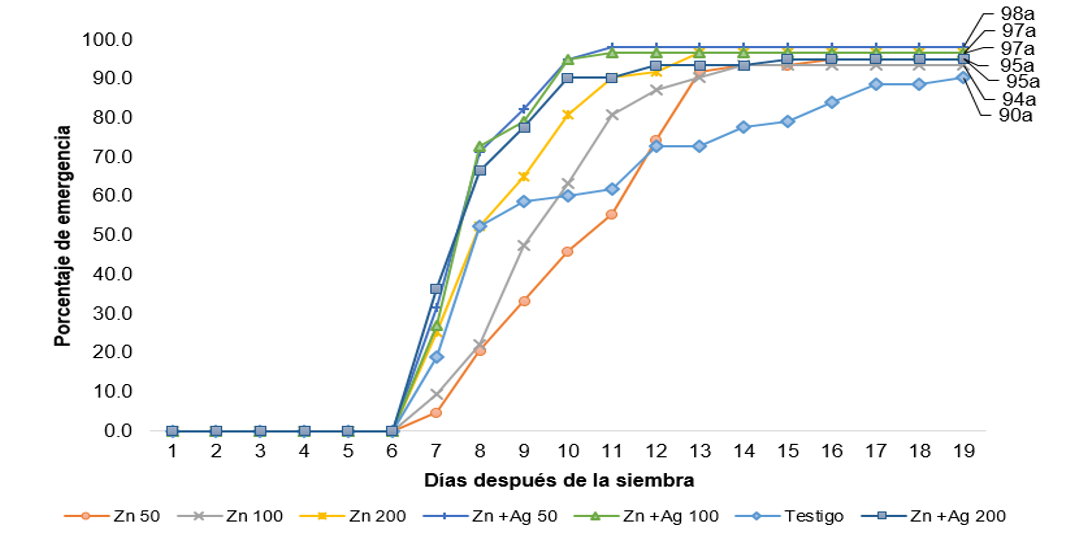
In contrast, ZnO100 and ZnO200 treatments showed more stable, higher values, with averages of 93.3 ±2.9% and 96.7 ±2.9%, respectively. Treatments with ZnO+Ag NPs showed the most consistent values, with averages of 98.3 ±2.9% in Zn+Ag 50 mg L-1, 96.7 ±2.9% in Zn+Ag 100 mg L-1 and 95 ±0% in Zn+Ag 200 mg L-1, which, although not statistically different, were superior to the control.
In their study, Sturikova et al. (2018) note that zinc is a biological micronutrient that promotes auxin metabolism for plant growth, influencing cell elongation and division; likewise, it promotes protective activity against environmental stress and stabilizes cell membranes, promoting early crop development.
Nanoparticle treatments significantly reduced emergence time compared to the control (p-value= 0.0001; α= 0.05).
The control reached maximum emergence between 16 and 19 days (d), with an average of 17.3 ±1.5 d and was the slowest treatment; the application of ZnO 50 mg L-1 reduced DME to values between 13 and 16 d (mean 14.3 ±1.5 d), whereas ZnO 100 mg L-1 reduced it more markedly (12-14 d; mean 12.7 ±1.2 d). The ZnO 200 mg L-1 treatment showed values of 10-13 d (mean 12 ±1.7 d), representing a reduction of up to 5 d compared to the control (Figure 2).
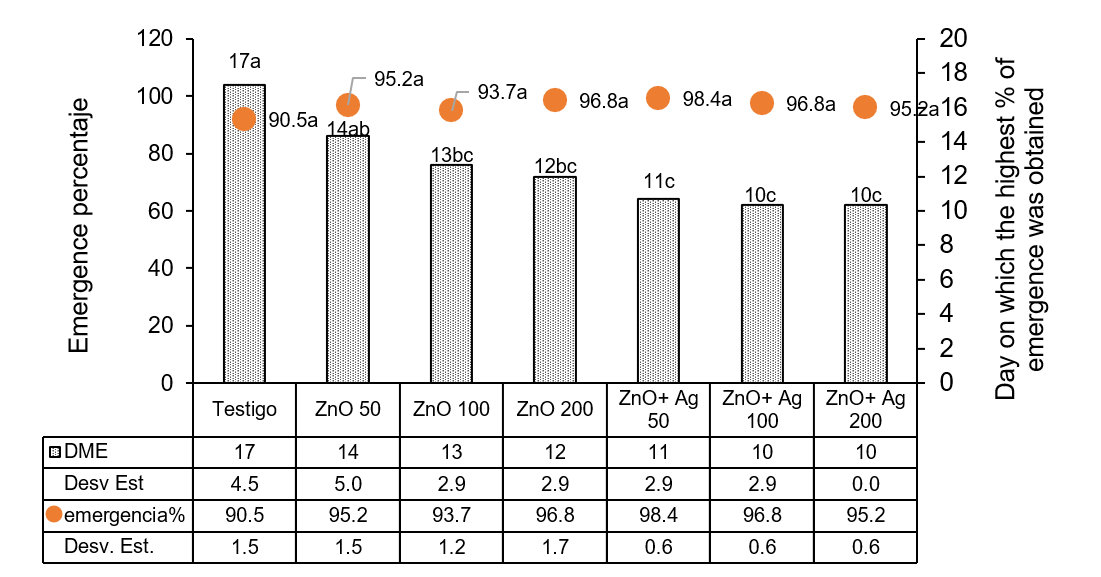
The combined ZnO+Ag treatments achieved the highest emergence percentage in the shortest time. ZnO+Ag 50 mg L-1, ZnO+Ag 100 mg L-1 and Zn+Ag 200 mg L-1 recorded averages of 10.7 ±0.6, 10.3 ±0.6 and 10.3 ±0.6 d, respectively, and were statistically inferior to the control and ZnO alone treatments (Tukey, p≤ 0.05). This reduction is equivalent to a 6-9 d advancement in the initial establishment.
In nanoparticulate form, ZnO has a greater surface area and reactivity, which facilitates its interaction with the seminal coat and possible entry during imbibition, promoting early metabolic processes associated with emergence (Mazumder et al., 2020; Shaik et al., 2020). This aligns with the results of the present study, where treatments with ZnO-NPs and ZnO+Ag-NPs significantly reduced the days needed to reach the highest emergence percentage and increased the emergence speed index, promoting faster and more uniform emergence of A. salmiana seedlings.
ZnO-NPs have been reported to increase the speed and uniformity of germination and emergence in agricultural crops, attributed to increased antioxidant activity and reserve mobilization during the initial heterotrophic phase (Mazumder et al., 2020; Manh-Cuong et al., 2021).
This coincides with reports by Pivaral et al. (2026) on the importance of using nanoparticles in plants. Méndez-Andrade et al. (2024) report that silver nanoparticles improve water absorption by activating enzymes necessary for germination.
Nonetheless, the nonlinear positive response is consistent with the phenomenon known as hormesis, which describes biological stimulation at low doses and inhibition at high concentrations, attributed to the generation of oxidative stress when cells’ antioxidant capacity is exceeded (Calabrese, 2008; Calabrese et al., 2021).
In this sense, it has been documented that nanoparticles can activate antioxidant responses in plants (Moreno-Guerrero et al., 2025). Previous studies in tomato have reported similar dose-dependent effects of silver nanoparticles, where high doses showed negative effects (Noori et al., 2020).
These results are relevant given that sexual propagation of A. salmiana has been little used in production systems, despite its importance for the conservation and sustainability of the crop (Trejo et al., 2020; Soto-Alarcón et al., 2022), representing a promising biotechnological tool to improve plants’ ability to absorb nutrients and grow faster (Lira et al., 2018).
The imbibition of seeds with ZnO-NPs and ZnO+Ag-NPs significantly improves the emergence of A. salmiana, particularly by reducing the time needed to achieve high emergence percentages, which coincides with previous reports in other crops and reinforces the potential of nanotechnology as a sustainable alternative in the propagation of species of agricultural and ecological interest (Rodríguez-González et al., 2024). In this regard, Raliya et al. (2017) reports that nanotechnology improves nutrient use efficiency and increases plant productivity.
The analysis of variance shows statistically significant differences in cotyledonary leaf height among treatments (p-value= 0.0003; α= 0.05), indicating an effect of the type and concentration of nanoparticles applied (Figure 3).
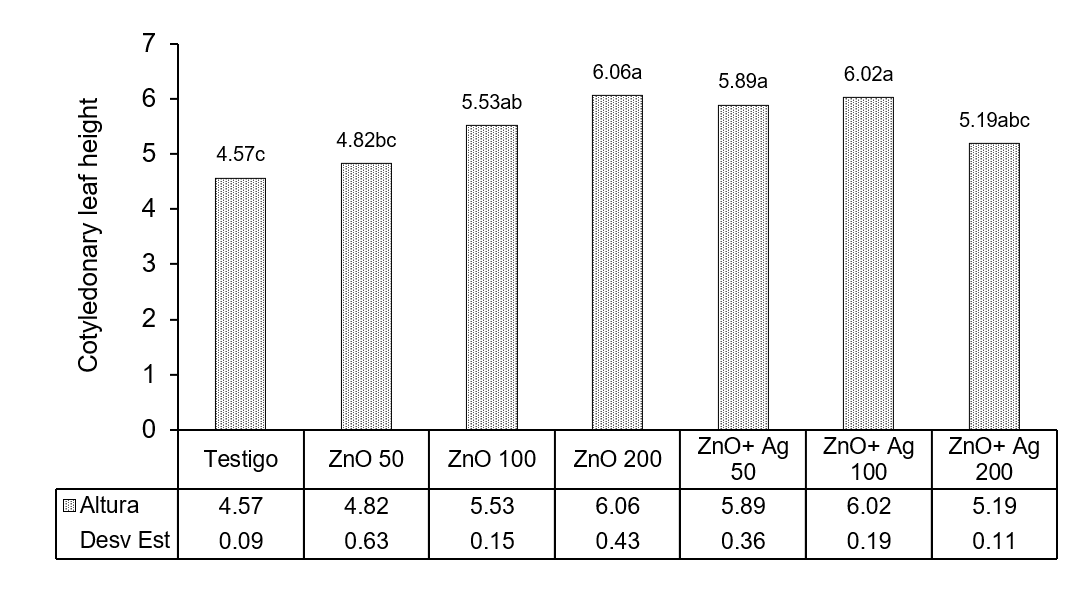
The control treatment showed the lowest heights, with values between 4.47 and 4.65 cm and an average of 4.56 ±0.09 cm, indicating limited initial growth in the absence of nanoparticles. Treatments with ZnO 50 mg L-1 showed higher heights (4.25-5.48 cm; mean 4.82 ±0.63 cm), with no statistical differences compared to the control (Tukey, p> 0.05).
When the concentration of ZnO increased to 100 mg L-1, height increased significantly (5.41-5.71 cm; mean 5.52 ±0.15 cm), representing a 21% increase compared to the control. The ZnO 200 mg L-1 treatment increased height (5.80-6.58 cm; mean 6.06 ±0.43 cm) and was statistically superior to the control and ZnO 50 (Tukey, p≤ 0.05).
This increase is equivalent to a 33% increase compared to the control. The combined ZnO+Ag treatments showed a differentiated behavior. Zn+Ag50 and Zn+Ag100 reached the highest heights recorded, with averages of 5.89 ±0.36 cm and 6.02 ±0.19 cm, respectively, with no statistical differences between them, but significantly higher than the control and ZnO 50 (Tukey, p≤ 0.05).
In Zn+Ag200, height decreased (5.13-5.32 cm; mean 5.19 ±0.11 cm), with no statistical differences compared to ZnO100, which shows an inhibitory effect at high concentrations (Figure 3). This behavior corresponds to a hormetic effect, characterized by stimulation at low doses and inhibition at high concentrations, reported for metal nanoparticles (Calabrese et al., 2021).
For their part, Manh-Cuong et al. (2021) mention that the positive effect of ZnO is associated with its function as an essential micronutrient and regulator of enzyme metabolism, whereas silver, at low concentrations, can enhance the physiological response; however, high concentrations may generate oxidative stress, affecting the initial growth of seedlings (Shaikhaldein, 2020).
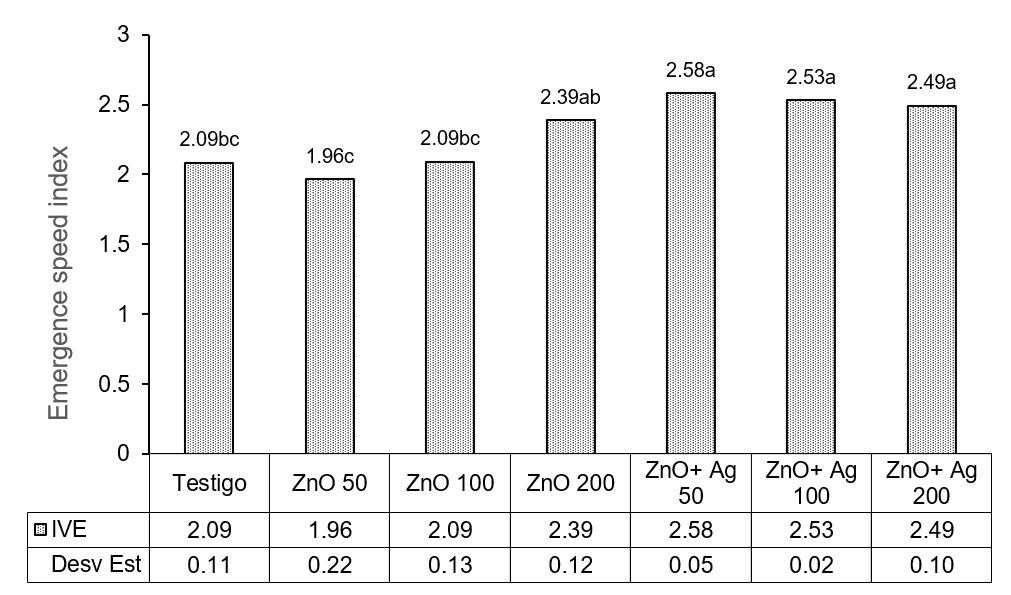
The analysis of variance showed statistically significant differences among treatments (p-value= 0.0001; α= 0.05). The control had the lowest values of this variable, with a mean of 2.09 ±0.11, indicating slower and less uniform emergence. Treatments with ZnO at 50 mg L-1 showed intermediate ESI values (1.78-2.22; mean 1.97 ±0.22), with no statistically significant differences compared to the control.
When the concentration of ZnO increased to 100 mg L-1, ESI increased significantly (2-2.24; mean 2.09 ±0.13), whereas ZnO at 200 mg L-1 reached significantly higher values (2.27-2.5; mean 2.39 ±0.12), representing an approximate increase of 14-20% compared to the control.
The ZnO+Ag combinations registered the highest ESI values in the study. ZnO+Ag 50 mg L-1 presented an average of 2.58 ±0.05, Zn+Ag 100 mg L-1 of 2.53 ±0.02 and ZnO+Ag 200 mg L-1 of 2.49 ±0.1, being statistically superior to the control and ZnO alone treatments (Tukey, p≤ 0.05) (Figure 4).
The results show faster, more uniform seedling emergence. Along with other elements, low concentrations of zinc can improve specific cellular functions in plants, such as photosynthesis, respiration and nitrogen fixation, among others (Shahid et al., 2015).
Imbibition of Agave salmiana Cv. Xaminí seeds with zinc oxide nanoparticles and their combination with silver promoted seedling emergence and initial growth under semi-controlled conditions.
It is confirmed that applying nanoparticles during seed imbibition represents a promising biotechnological alternative to improve initial establishment, strengthen sexual propagation and contribute to the conservation of A. salmiana.
Manh-Cuong, D.; Cong-Du, P.; Tung, H. T.; Ngan, H. T. M.; Luan, V. Q.; Phong, T. H.; Khai, H. D.; Phuong, T. T. B. and Nhut, D. T. 2021. Silver nanoparticles as an effective stimulant in micropropagation of Panax vietnamensis-a valuable medicinal plant. Plant Cell, Tissue and Organ Culture. 143(3)577-588. https://doi.org/10.1007/s11240-021-02095-2.
Nandhini, M. R.; Rajini, S. B., Udayashankar, A. C., Niranjana, S. R., Lund O. S.; Shetty, H. S. and Prakash, H. S. 2019. Biofabricated zinc oxide nanoparticles as an eco-friendly alternative for growth promotion and management of downy mildew of pearl millet. Crop Protection. 121:103-112. https://doi.org/10.1016/j.cropro.2019.03.015.
Noori, A.; Donnelly, T.; Colbert, J.; Cai, W.; Newman, L. A. and White, J. C. 2020. Exposure of tomato (Lycopersicon esculentum) to silver nanoparticles and silver nitrate: physiological and molecular response. International Journal of Phytoremediation. 22(1):40-51. https://doi.org/10.1080/15226514.2019.1634000.
Shaik, A. M.; David, R. M. and Rama, S. R. D. 2020. Green synthesis of zinc oxide nanoparticles using aqueous root extract of Sphagneticola trilobata Lin and investigate its role in toxic metal removal, sowing germination and fostering of plant growth. Inorganic and Nano-Metal Chemistry. 50(7):569-579. https://doi.org/10.1080/24701556.2020.1722694.
Shaikhaldein, H. O.; Al-Qurainy, F.; Nadeem, M.; Khan, S.; Tarroum, M. and Salih, A. M. 2020. Biosynthesis and characterization of silver nanoparticles using Ochradenus arabicus and their physiological effect on Maerua oblongifolia raised in vitro. Scientific Reports. 10:17569. https://doi.org/10.1038/s41598-020-74675-9.
Trejo, L.; Reyes, M.; Cortés-Toto, D.; Romano-Grande, E. y Muñoz-Camacho, L. L. 2020. Morphological diversity and genetic relationships in pulque production agaves in Tlaxcala, Mexico, by means of unsupervised learning and gene sequencing analysis. Frontiers in Plant Science. 11:524812. https://doi.org/10.3389/fpls.2020.524812.