elocation-id: elocation-id: e4197
The in vitro establishment of Persea americana is limited by microbial contamination and oxidation, both of which are genotype-dependent processes. This study evaluated disinfestation and oxidative control in ‘Velvick’ and ‘Duke 7’ rootstocks using two factorial experiments: a 2×2 experiment comparing silver nanoparticles (AgNPs) with a sequential chemical protocol (SCP) and a 2×4 experiment analyzing antioxidant systems with ultrasonic agitation. A third experiment evaluated meristematic apices of ~400 μm. SCP was the most effective treatment for ‘Velvick’, achieving 75% establishment and reducing fungal and bacterial contamination to 20%; by contrast, in ‘Duke 7’, establishment was 48%, with high bacterial contamination. AgNPs were less efficient in both rootstocks. In ‘Velvick,’ ascorbic acid (800 mg L-1) and L-cysteine (50 mg L-1) reduced oxidation from 82% to 20% and promoted greater growth, whereas in ‘Duke 7’, oxidation remained high (61%), with no improvement in development. Ultrasonic agitation enhanced SCP activity. However, more than 90% of the 400 μm apices darkened completely before 15 days. In conclusion ‘Velvick’ responds best to ultrasound-assisted chemical disinfestation and to antioxidants at 800 mg L-1 ascorbic acid or 50 mg L-1 L-cysteine, and ‘Duke 7’ requires additional adjustments.
chemical disinfestation, meristematic apices, silver nanoparticles, ultrasonic agitation.
Interest in the propagation of avocado (Persea americana Mill.) has increased due to global demand and the crop’s high economic and nutritional value (Esgrina, 2026). Nonetheless, sexual reproduction generates high genetic variability, making it difficult to obtain uniform plants (Bedoya-Ramírez et al., 2023; Martínez-Villagómez et al., 2025).
In this context, clonal rootstocks have become a fundamental tool to ensure genetic identity, improve yield, and facilitate agronomic management (Meza-Castillo et al., 2018; Castro-Garibay et al., 2023), as well as accelerate entry into production (Hiti Bandaralage et al., 2018). Despite its importance, avocado micropropagation presents significant challenges because of its recalcitrant nature, including the low rhizogenesis capacity and survival during acclimatization (Hiti Bandaralage et al., 2017).
Added to this is the high incidence of microbial contamination, especially when material comes from the field and contains endophytes that are difficult to remove (Turina and Bima, 2017; Alonso Fernández et al., 2019), as well as losses caused by contaminants introduced during handling (Hernández and González, 2010). Various disinfestation strategies have been used to reduce microbial contamination during the in vitro establishment of woody species.
The most commonly used treatments include fungicides, bactericides, sodium hypochlorite, ethanol and cupric compounds, which enabled the reduction of surface and endophytic microbial loads present in explants. Nevertheless, the efficiency of these methods depends on the species, genotype and origin of the plant material, so it is often necessary to combine different chemical agents to increase establishment percentages and reduce losses due to contamination (Leifert and Cassells, 2001; Castro et al., 2023).
Another limitation is explant oxidation, driven by the activity of enzymes such as polyphenol oxidase (PPO) and tyrosinases after tissue damage, which produce toxic quinones that reduce explant viability (Amente and Chimdessa, 2021). This process is closely related to the accumulation of reactive oxygen species (ROS) (García-Cabrera et al., 2025).
To mitigate these effects, strategies such as etiolation and antioxidants (activated charcoal, citric acid, and ascorbic acid) have been used, with ascorbic acid at 100 mg L-1 standing out for its high efficacy (Dobránszki and Teixeira-da Silva, 2010; Güler et al., 2021). Because conventional disinfection may be insufficient, the use of silver nanoparticles (AgNPs) represents a relevant alternative due to their biocidal activity and positive effect on morphogenesis (Andújar et al., 2020; Pérez-Caselles et al., 2023).
Their antimicrobial action reduces bacteria and fungi by altering essential cellular functions, helping maintain the health of in vitro cultures without causing significant phytotoxic effects on plant tissues. In addition, their mechanism of action reduces the likelihood of microorganisms developing resistance, compared with conventional antibiotic-based methods (Chávez-García et al., 2020). On the other hand, various chemical products with fungicidal or bactericidal activity have been used to improve explant establishment.
Among the most commonly used compounds are fungicides such as Captan and Mancozeb, as well as copper-based bactericides and specific antibiotics, which have shown varying levels of efficacy depending on the plant species and the type of contaminant present (Loyola-Vargas and Ochoa-Alejo, 2012). Likewise, when systemic contamination persists, meristem culture is key to obtaining pathogen-free plants and producing quality clonal material (Castro-Garibay et al., 2023; Ramírez-Mosqueda et al., 2025).
The avocado rootstocks ‘Velvick’ and ‘Duke 7’ show differential responses to in vitro establishment; therefore, combining sequential chemical disinfestation, antioxidants and ultrasonic agitation will enable higher establishment percentages and lower levels of contamination and phenolic oxidation compared with the use of silver nanoparticles alone.
Based on this problem, the present study evaluated the following for ‘Velvick’ and ‘Duke 7’ rootstocks: i) the efficacy of AgNPs against ultrasound-assisted chemical disinfestation; ii) different antioxidant systems to reduce phenolic oxidation; and iii) the feasibility of establishing meristems approximately 400 μm in size.
The study was conducted in the laboratory of fruit tree biotechnology and structure of Graduate Program in Genetic Resources and Productivity (PREGEP)-College of Postgraduates (Montecillo Campus, Texcoco, State of Mexico). Young scions (10-15 cm; 3-4 months) of ‘Velvick’ and ‘Duke 7’ rootstocks, from mother plants grafted onto native rootstock, were used.
The material was kept in solar thermotherapy (42 °C) in a glass greenhouse for one week before establishment, fertilized with 5% vermicompost, irrigated with Steiner solution + 10% leachate and received preventive applications of Amistar Gold® (Azoxystrobin and Difenoconazole), Tecto 60® (Thiabendazole) and Captan® 50 (N-(trichloromethylthio) cyclohex-4-en-1,2-dicarboximide).
In vitro establishment was performed through independent replications of the experiment in order to verify the reproducibility of experiments 1 and 2. The three-month-old scions were defoliated and washed for 5 min with running water + Axion® (2 ml L-1) + 10% commercial chlorine (Cloralex®) + 0.1 ml L-1 Tween 20, with gentle friction. They were sectioned into 1.5-2 cm segments with two buds from both rootstocks (mini-cutting); for ‘Velvick’, microapices (400-500 μm) were dissected.
Explants were cultured in Yashuda medium (Yashuda et al., 1985) for ‘Velvick’ and in Woody Plant Medium (WPM; Lloyd and McCown, 1981) for ‘Duke 7’. The use of different media was due to the rootstocks’ responses during the preliminary stages of establishment, as ‘Velvick’ showed better behavior in the Yashuda medium, while ‘Duke 7’ responded favorably to WPM, a medium widely used in the micropropagation of woody species; both media were supplemented with 0.5 mg L-1 N6-benzyladenine (BA), 0.05 mg L-1 naphthalene acetic acid (NAA), 30 g L-1 sucrose, and 4.5 g L-1 agar, and adjusted to pH 5.7.
For the microapices, activated charcoal (2 g L-1) was added to the culture medium. The media were sterilized at 120 °C and 1.5 atm for 20 min. Incubation was at 25 ±2 °C under a 16 h light/8 h dark cycle at a light intensity of 40.5 μmol m-2 s-1.
In order to mitigate phenolic oxidation throughout the experimental process, the following solutions were prepared. 1) control solution (sterile distilled water without antioxidants); 2) solution A (sterile distilled water containing 800 mg L-1 ascorbic acid); 3) solution B [(sterile distilled water containing 25 mg L-1 L-cysteine (Merck®)]; and 4) solution C [(sterile distilled water containing 50 mg L-1 L-cysteine (Merck®)].
The nanoparticles are spheroid in shape, with diameters of 35 ±15 nm and a metallic silver concentration of 1.2% (weight). The micro-cuttings were immersed in an antioxidant solution (A) plus Silver Nanoparticles (AgROVIT-CP®) at a concentration of 75 mg L-1 + 0.1 ml L-1 Tween 20 on a stir plate for 30 min, then rinsed twice with the sterile solution (A).
The SCP was applied to both rootstocks in a laminar flow hood using antioxidant solution A and a Baku BK9050 ultrasonic stirrer (50 W). The procedure consisted of three stages: stage 1) immersion of the explants in solution A + System Cu® (5.5% copper gluconate) at 1 ml L-1 + 0.1 ml L-1 Tween 20 for 15 min, followed by two rinses with solution A. Stage 2) immersion for 15 min in the base solution according to treatment, supplemented with Captan (2 g L-1) + Mancozeb® (2 g L-1, Manzeb® 80 WP) + 0.1 ml L-1 Tween 20, followed by two rinses with solution A. Stage 3) (surface disinfestation) rapid immersion in 70% ethanol + Tween 20 for 1 min, followed by a final wash with two rinses with solution A.
Fungal and bacterial contamination was recorded 27 days after establishment (DAE). Explant oxidation was assessed using a visual scale: degree 0= no oxidation; degree 1= oxidation less than 25%; degree 2= oxidation between 25 and 50%; degree 3= oxidation greater than 50% of the explant. Establishment was defined as oxidation less than degree 3 and more than 50% of green tissue in the explant.
The study included three experiments to evaluate the efficiency of disinfestation protocols, the effect of antioxidants and the feasibility of establishing apices in ‘Velvick’ and ‘Duke 7’ rootstocks.
The effectiveness of two disinfestation protocols was evaluated using a completely randomized design with a 2×2 factorial arrangement, with 60 replications per treatment and per rootstock (total= 240 experimental units). Each explant corresponded to an experimental unit. Factor A (rootstock): ‘Velvick’ and ‘Duke 7’. Factor B (disinfestation protocol): T1= silver nanoparticles (AgNPs, 75 mg L-1); T2= sequential chemical protocol (SCP) (system cu® + fungicides + ethanol).
The response of the explants to two antioxidants at different concentrations was evaluated with a 4×2 factorial arrangement, with 60 replications per treatment and per rootstock, for a total of 480 experimental units. Factor A (Genotype): ‘Velvick’ and ‘Duke 7’; Factor B (treatments): T0= control (sterile distilled water); T1= 800 mg L-1 ascorbic acid; T2= 25 mg L-1 L-cysteine; T3= 50 mg L-1 L-cysteine.
The experiments were repeated to verify the reproducibility of the results, so the data presented corresponds to the average values of the repetitions performed.
The microapices were evaluated during the first 27 days of culture. Because oxidation and mortality were high before 15 days, the results are presented descriptively from the final evaluation. A total of 120 axillary bud microapices (60 per genotype) were established; they were dissected using a stereoscope in a laminar flow hood and disinfected with SCP supplemented with L-cysteine (50 mg L-1).
Because 100% of explants showed severe oxidation (degree 3), the data were analyzed descriptively. Differences in bacterial and fungal contamination between genotypes were evaluated using a t-test after arcsine transformation.
The statistical analysis showed a significant interaction between genotype and disinfestation protocol (p≤ 0.05), which evidenced contrasting responses between ‘Velvick’ and ‘Duke 7’ during in vitro establishment (Table 1).
In ‘Velvick’ the sequential chemical protocol (SCP) exhibited higher efficiency, with 75% establishment and a simultaneous reduction in fungal and bacterial contamination up to 20%. In contrast, treatment with silver nanoparticles (AgNPs, T1) reached only 55% establishment, reflecting lower effectiveness.
In ‘Duke 7’, the efficiency was lower in both protocols, with a maximum of 48% in SCP and a bacterial incidence greater than 40%, with no statistical differences between treatments; bacterial contamination was observed 25 days after establishment, which suggests the presence of persistent endophytes difficult to eliminate by superficial disinfestation.
This more heterogeneous behavior coincides with the higher degree of recalcitrance and sensitivity of Mexican breed genotypes (Figure 1), a phenomenon widely reported in avocados (Harahap et al., 2025; Sánchez-Hernández et al., 2025).
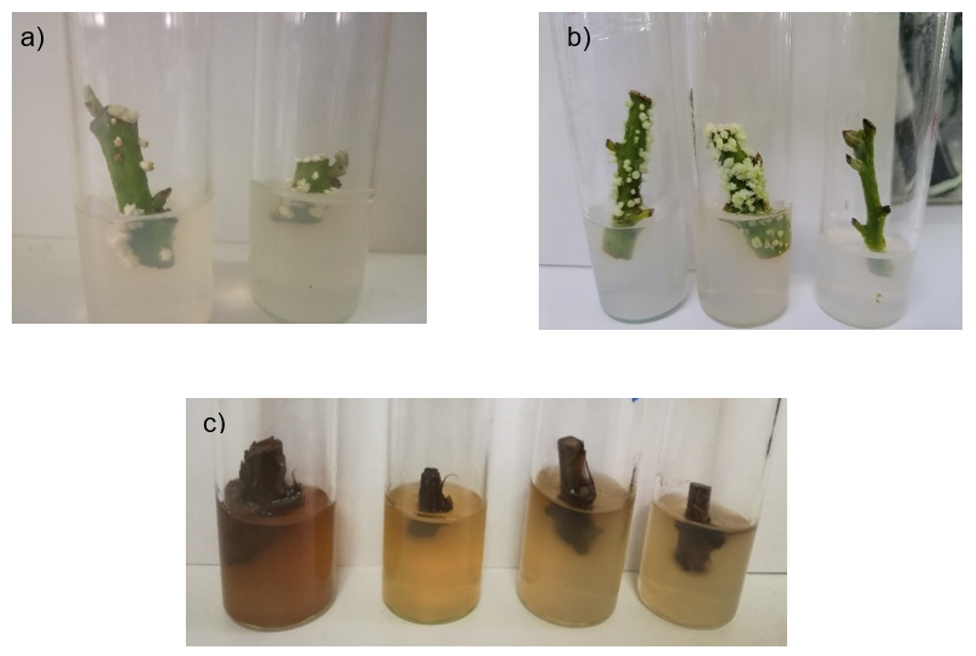
The superiority of SCP in ‘Velvick’ could be attributed to the synergy among fungicides, bactericides, and ethanol, together with the physical action of ultrasound, which increases the penetration of biocidal agents by breaking surface biofilms, as described in olive trees and other woody species (Turina and Bima, 2017), as well as in Xanthosoma sagittifolium, where 3 and 2% sodium hypochlorite plus 15 min of ultrasonic washing resulted in 77.8% establishment (Vilchez et al., 2011).
For their part, Király and Dobránszki (2025) also note that ultrasonication can improve micropropagation efficiency and modulate the physiological response of tissues, such as grape internodes and the middle part of the apple leaf blade.
The lower efficacy of AgNPs against internal contaminants is likely due to the thickness of the pathogen’s cell wall (Huaman et al., 2025) or to sublethal phytotoxic effects; for example, in olive trees, 100 mg L-1 for 60 minutes removed 100% of the contamination but killed most explants due to toxicity (Jan et al., 2026).
Factor analysis showed significant differences (p≤ 0.05) among the antioxidant solutions evaluated (Table 2). In ‘Velvick’, ascorbic acid (800 mg L-1) and L-cysteine (50 mg L-1) reduced phenolic oxidation, decreasing from 82% in the control to values of less than 20%, which also favored shoot growth up to 0.32 mm.
This response aligns with reports by Güler et al. (2021), who highlight the efficacy of reducing agents such as ascorbic acid plus citric acid at concentrations of 100 and 40 mg L-1, which neutralized phenols and quinones. These results are also similar to those reported by Restrepo-Osorio et al. (2018); García-Cabrera et al. (2025), who confirm that phenolic oxidation of tissues is one of the main obstacles to in vitro establishment of avocados.
In ‘Duke 7’, although L-cysteine (50 mg L-1) reduced oxidation by 17% compared with the control, this did not translate into greater growth, maintaining values < 0.21 mm. Likewise, the control showed >75% oxidation, similar to that of the low dose of L-cysteine (25 mg L-1).
These differences suggest that endogenous antioxidant capacity and phenol dynamics are strongly dependent on the rootstock; for instance, ‘Duke 7’ showed a greater tendency to oxidize than ‘Velvick’, consistent with previous reports identifying ‘Duke 7’ as one of the rootstocks most susceptible to oxidation during in vitro establishment.
In contrast, materials such as ‘Velvick’ and ‘Lula,’ and some native genotypes, show lower oxidation levels (García-Cabrera et al., 2025; Restrepo-Osorio et al., 2026). Avocados’ high sensitivity to oxidative stress, attributed to the high phenolic content, remains a major barrier to their in vitro establishment.
In recalcitrant woody species, browning control is usually achieved with low doses of antioxidants; however, in avocados, combined strategies are required, including etiolation reported in Hass avocado (Restrepo-Osorio et al., 2026), since it reduces chlorophyll synthesis and photosynthetic activity, which decreases ROS generation (López-Galé et al., 2024).
In contrast, enzymes involved in ROS elimination and low-molecular-weight antioxidants, such as ascorbic acid and tocopherol, have improved their activity after ultrasonic vibrations of tissues (Dobránszki et al., 2017; Pesti-Asbóth et al., 2022).
In microapices measuring 400 μm, no significant differences were observed between rootstocks for bacterial or fungal contamination (p≥ 0.05) (Figure 2); nevertheless, ‘Duke 7’ showed slightly higher values (8.33% fungal; 11.67% bacterial). Nonetheless, severe oxidation was absolute, with about 90% total darkening (degree 3) before 15 days in both rootstocks, resulting in no establishment.
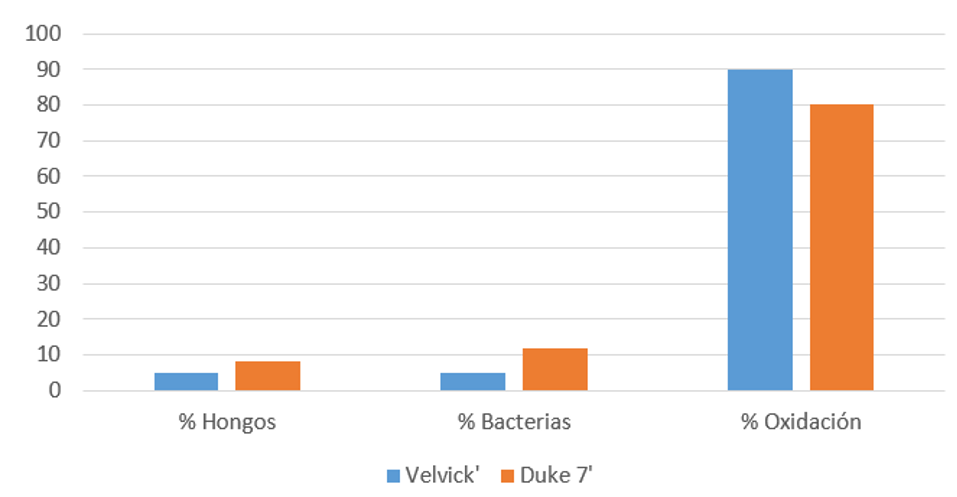
The high incidence of darkening observed in microapices suggests a high susceptibility to oxidative stress during in vitro establishment. Previous studies on avocado rootstocks have reported that the activity of antioxidant enzymes, such as peroxidase (POD), participates in the neutralization of reactive oxygen species (ROS) and may influence explant survival under in vitro culture conditions (García-Cabrera et al., 2025).
However, the present study did not evaluate antioxidant activity in the microapices of ‘Velvick’ and ‘Duke 7’; therefore, the physiological mechanisms associated with darkening require further investigation.
Although meristem culture is the most effective tool to eliminate systemic pathogens, its application in avocados requires complementary strategies, such as prior etiolation (Restrepo-Osorio et al., 2018; García-Cabrera et al., 2025), calcium supplementation (Hiti-Bandaralage et al., 2017), reduced atmospheres, or the use of slow-release antioxidants (Teixeira-da Silva et al., 2020), due to the high propensity for oxidation.
The efficiency in the in vitro establishment of avocado rootstocks was determined by the interaction among microbial contamination, explant oxidation and each rootstock’s specific response. The ultrasound-assisted sequential chemical protocol enabled the highest establishment in ‘Velvick,’ whereas ‘Duke 7’ showed limitations associated with greater bacterial contamination and oxidation.
Ascorbic acid (800 mg L-1) and L-cysteine (50 mg L-1) significantly reduced oxidation in the ‘Velvick’ rootstock but had a limited effect in ‘Duke 7’. Under the conditions of this study, the establishment of microapices measuring approximately 400 μm was null due to the high level of tissue oxidation.
The first author thanks SECIHTI for the doctoral scholarship awarded during the completion of his project.
Alonso-Fernández, M. A.; Beltrán-Olaya, A. B.; Gelvez-Delgado, J. y Martínez-Villarraga, J. P. 2019. Evaluación de dos protocolos de desinfección para establecimientos in vitro de portainjertos de aguacate (Persea americana) var. Criollo. II Simposio Nacional de Investigación en Ciencias Pecuarias y Agroempresariales del Magdalena Medio. 34-49 pp.
Bedoya-Ramírez, S. I.; Saavedra-Porras, S.; Loaiza-Ruíz, R. A.; Barrera-Sánchez, C. F., and Córdoba-Gaona, O. J. 2023. Physiological and morphological characterization of avocado creole (Persea americana Mill.) accessions for elite rootstocks. Revista Colombiana de Ciencias Hortícolas. 17(2):e15830. https://doi.org/10.17584/rcch.2023v17i2.15830.
Castro-Garibay, S. L.; Villegas-Monter, A.; Hernández-Nava, G. A.; Mendoza-Ramos, C.; Martínez-Villagómez, M.; Reyes Quiroz, C. and Aranda-Ocampo, S. 2023. Alternatives products in the in vitro disinfestation in rootstock explants duke-7 and identification of endophyte microorganisms. Tropical and Subtropical Agroecosystems. 27(1):1-12. https://doi.org/10.56369/tsaes.5005.
Chávez-García, J. A.; Andrade-Rodríguez, Ma.; Bello-Bello, J. J.; Rueda-Barrientos, Ma. C.; Guillén-Sánchez, D. and Sainz-Aispuro, M. J. 2020. Nanopartículas de plata en el establecimiento in vitro de ápices de gladiolo. Revista Fitotecnia Mexicana. 43(4-A):557. https://www.revfitotecnia.mx/index.php/RFM/article/view/834/794.
Dobránszki, J.; Asbóth, G.; Homoki, D.; Bíró-Molnár, P.; Teixeira-Da Silva, J. A. and Remenyik, J. 2017. Ultrasonication of in vitro potato single node explants: activation and recovery of antioxidant defence system and growth responses. Plant Physiology and Biochemistry. 121:153-160. https://doi.org/10.1016/j.plaphy.2017.10.022.
Esgrina, F. O.; Tan, R. J.; Baldo, N. B.; Dargantes, S. M. T.; Amper, C. D.; Marin, M. M.; Abello, Ma. J. M; Pedroso, M. L. and Alagos. A. L. C. 2026. Microclonal success of avocado using different scions and clonal rootstock varieties. Asia-Pacific Journal of Science and Technology. 31(1):1-9. https://doi.org/10.14456/APST.2026.14.
Harahap, A. M.; Agustini, K.; Nuralih, N.; Ningsih, S.; Widyastuti, Y. and Bahtiar, A. 2025. LC-HRMS profiling and in vitro total phenolics, total flavonoids, antioxidant and cytotoxicity evaluation on MCF7 breast cancer cell lines of the extracts and fractions of aerva sanguinolenta from Java, Indonesia. Journal of Applied Pharmaceutical Science. 15(06):265-276. https://doi.org/10.7324/JAPS.2025.227288.
López-Galé, Y. D.; Fernando-Martínez, M.; Palacios-Joya, L. P.; Murcia-Riaño, N. and García-Dávila, M. A. 2024. Uniformity in shoot development in avocado grafts and its importance in establishing levels of indirect resistance to Phytophthora cinnamomi. Revista Mexicana de Fitopatología. Mexican Journal of Phytopathology. 42(3):1-18. https://doi.org/10.18781/R.MEX.FIT.2311-1.
Meza-Castillo, E.; Barrientos-Priego, A. F.; Rodríguez-Pérez, J. E.; Reyes-Alemán, J. C.; Borys, M. W. y Espíndola-Barquera, M. de la C. 2018. Caracterización morfológica e histológica de ápices de raíz de portainjertos de aguacate y su resistencia a factores adversos en el suelo. Bioagro. 30(2):107-116.
Pérez-Caselles, C.; Burgos, L.; Sánchez-Balibrea, I.; Egea, J. A.; Faize, L.; Martín-Valmaseda, M.; Bogdanchikova, N.; Pestryakov, A. and Alburquerque, N. 2023. The effect of silver nanoparticle addition on micropropagation of apricot cultivars (Prunus armeniaca L.) in semisolid and liquid media. Plants. 12(7):1547. https://doi.org/10.3390/plants12071547.
Restrepo-Osorio, C.; Gil-Correal, A.; Saavedra-Porras, S.; Cárdenas-Ortiz, L.; Chamorro-Gutiérrez, L. and Villanueva-Mejía, D. 2026. An efficient protocol for clonal propagation of avocado (Persea americana Mill.) rootstocks via etiolation-enhanced micropropagation. Plant Cell, Tissue and Organ Culture (PCTOC). 164(3):1-16. https://doi.org/10.1007/s11240-026-03386-2.
Teixeira-Da Silva, J. A.; Nezami-Alanagh, E.; Barreal, M. E.; Kher, M. M.; Wicaksono, A.; Gulyás, A.; Hidvégi, N.; Magyar-Tábori, K.; Mendler-Drienyovszki, N.; Márton, L.; Landín, M.; Gallego, P. P.; Driver, J. A. and Dobránszki, J. 2020. Shoot tip necrosis of in vitro plant cultures: a reappraisal of possible causes and solutions. Planta. 252(3):1-35. https://doi.org/10.1007/s00425-020-03449-4.