elocation-id: e4194
Cucumber (Cucumis sativus L.) is a very important crop in Mexico and requires large amounts of nutrients for its development. As a result, synthetic fertilizers are used intensively. However, plants assimilate only a small fraction of the nutrients they contain, which increases environmental pollution. An alternative is using chelates in fertilizers. Therefore, this study evaluated the effects of liquid chelated calcium, potassium, and magnesium fertilizers on yield and fruit quality in cucumber crops, applied via fertigation under shade-net conditions in Culiacán, Sinaloa, during the autumn-winter 2021-2022 cycle. The experimental design consisted of homogenous plot pairs with two treatments, one with chelated fertilizers and a control with traditional fertilization applied by the cooperating producer, with five replications. The number of plants evaluated was determined by simple random sampling, yielding 113 plants per treatment, which were randomly selected in two steps: first, rows were selected, then the plants within each row. The response variables were fruit quality and yield. It was found that chelated fertilizers increased potassium, calcium and magnesium concentrations in stems, leaves and fruits, resulting in fruits with greater firmness and length and consequently, higher yield. Therefore, it is concluded that the application of chelated Ca, K and Mg makes fertilizer use more efficient and increases cucumber yield.
chelates, degrees brix, fruit firmness, nutrient translocation
Cucumber (Cucumis sativus L.) is a crop of great importance in Mexico (FAOSTAT, 2021). This vegetable is fast-growing and developing, so it demands a large amount of nutrients (Barraza, 2018; Valenzuela, 2025), which are supplied through chemical and synthetic fertilizers, but plants do not assimilate much of them, generating environmental pollution (Chittora et al., 2023). In addition, several fertilizers are non-renewable (Babcock-Jackson et al., 2023) and are in high demand in intensive agriculture.
Fertilizers must be used efficiently, which requires: a) adequate genetic material (Rueda et al., 2025); b) altering the physicochemical characteristics of the soil and of the interaction among the nutrients applied (Yang et al., 2024); and c) making the transport of nutrients within the plant more efficient using chelates (Fu et al., 2026). Nonetheless, they can also chelate some macronutrients, such as calcium, magnesium and potassium.
Based on their biochemical behavior and physiological function, Ca, Mg and K are part of a group of nutrients that can be chelated and are readily absorbed as ions from the soil solution (Mengel and Kirkby, 2000). The present research focuses on this group of nutrients. This is because these ions, being encapsulated by the chelating molecule, do not have adverse chemical reactions with other elements in the soil, such as phosphorus, and are more easily transported (Manik et al., 2023), generating synergies with organic matter and making fertilizer use more efficient (Fu et al., 2026).
The most common sources of Ca, Mg and K are highly soluble and can be lost more easily than chelated fertilizers; for this reason, if the latter are chosen, fertilization may be more efficient, as this enables them to be available for longer in the plant (Areche et al., 2023). Therefore, the present research aimed to evaluate the efficiency of chelates in the assimilation of K, Ca and Mg in cucumber plants and their effect on fruit quality and crop yield, under the hypothesis that chelated fertilizers will modify the concentrations of K, Ca and Mg in plant organs and influence crop yield.
The study was conducted in Culiacán, Sinaloa, during the autumn-winter cycle of 2021-2022, with a cooperating producer at the agricultural company El Porvenir, located along the Villa Benito Juárez-Navolato highway, at coordinates 24.654° north latitude, 107.506° west longitude and an altitude of 20 m. The site has a semi-arid, very warm climate with summer rainfall. The soil is silty loam according to the USDA texture triangle (Moreno-Maroto and Alonso-Azcárate, 2022).
The trial was established under shade-net conditions using an experimental design with homogeneous plot pairs, two treatments and five replications. Each replication consisted of five furrows with two plant rows. The experimental unit was 10 m long and contained approximately 325 plants.
The replications were systematically distributed every 20 m, starting 10 m from the furrow edge, with 5 m between replications. Each treatment was separated by two furrows within a 5 ha house. One treatment was the application of conventional synthetic fertilizers (CFT) used by the cooperating producer.
Treatment two consisted of the same fertilization, supplemented with chelated liquid fertilizers (ChFT). A white anti-aphid shade net with an opening size of 200 microns, 20% shade and a density of 130 g m was used.
The planting beds were mulched with black plastic. The plant material used was the American slicer-type cucumber hybrid named ‘Zeus’ from the commercial house ‘Semillas Fitó.’ The plants were placed in double rows in a zigzag pattern, 30 cm apart, yielding approximately 40 000 plants ha-1. Two fertilization treatments were evaluated: T1) chelated fertilizers and T2) conventional fertilization (Tables 1 and 2).
| Source | First stage | Second stage | Third stage |
|---|---|---|---|
| CaNO3 | 7 | 14 | 24 |
| KNO3 | 4 | 8 | 16 |
| KCl | 2.5 | 5 | 10 |
| MgSO4 | 7 | 14 | 28 |
| Phosphonitrate | 5.7 | 5.7 | 5.7 |
| MicroMix | 0.3 | 0.35 | 0.35 |
Fertilization was applied in three stages: a) establishment and vegetative development; b) flowering and fruit set; and c) flowering and harvesting. A drip irrigation system was used, placing two tapes per planting bed. Water needs were determined using humidity sensors at depths of 15 and 30 cm, and readings were taken with the Watermark digital meter. When pressure reached 35 kPa, irrigation was applied to bring it down to 15 kPa. This implied daily irrigation throughout the crop cycle.
To determine the sample size per treatment, a preliminary sampling was conducted to estimate the standard deviation. To do this, the height of 100 plants was randomly measured in each house one week after transplantation. Subsequently, the final sample size for each treatment was calculated using the following formula (Cochran, 1998).
= 1.96; = 1.68; S= standard deviation; d= margin of error (7.5%).
With the confidence level and the margin of error established, the sample size of plants to be sampled by treatment was determined and the plants were randomly selected. First, the furrows were defined, and then, in each one, the distance at which the plants would be located in each furrow was randomly determined.
Over six periods, the concentrations of K, Ca and Mg in leaves, fruits and stems were measured. K was determined by ammonium acetate extraction by flame photometry and Ca and Mg were measured by colorimetric determination using an atomic absorption spectrophotometer (Varian SpectrAA 220) (AOAC, 2006).
The collected data were used to generate absorption curves for these elements. In addition, the concentrations of these nutrients in leaves at three maturity stages-old, intermediate, and young-were evaluated. Quality was also assessed using the variables weight, length, firmness and Brix concentration in cucumber fruits.
The soluble solids content of the cucumber fruits was measured with an ANA Hi96801 digital refractometer; to do so, samples were taken by cutting pieces of the fruit and squeezing them into the refractometer, completely covering the measured surface with cucumber juice. Data was collected across 18 harvest events during the crop production cycle, which lasted 136 days after transplanting.
An analysis of variance was conducted on nutrient concentrations by plant organ. The data were previously tested for normality using the Shapiro test (Shapiro and Wilk, 1965) and for homoscedasticity using the Bartlett test (Zar, 2010). The method used to compare the means was Tukey’s test (p= 0.05). The XlStat statistical package (Addinsoft, 2023) was used.
To estimate fruit quality, fruits were classified into marketing quality categories. The weight categories were as follows: extra-large= >400 g; large= 300 to 400 g; medium= 200 to 300 g; small= 100 to 200 g. The length categories were as follows: large= >25.5 cm; super select= 24 to 25.5 cm; select= 22 to 24; small= 20 to 22 cm.
To analyze the proportion of categories, the Z-test was applied based on the following formula:
Where: Z= Z-statistic; X= category value; μ= population mean; σ= standard deviation.
Once the values for each category were obtained, contingency tables were constructed, with the categories on the vertical axis and the two treatments on the horizontal axis. Based on this, the chi-square test was applied to assess the independence of the categories with respect to the treatments, along with Fisher’s exact test where the differences were.
The percentage rate of variation (PRV) of the value obtained in the conventional fertilization treatment (CFT) relative to the treatment with chelated fertilizers (ChFT) was also calculated using the following formula:
Where: PRV= percentage rate of variation; Vch= value obtained in ChFT; Vc= value obtained in CFT.
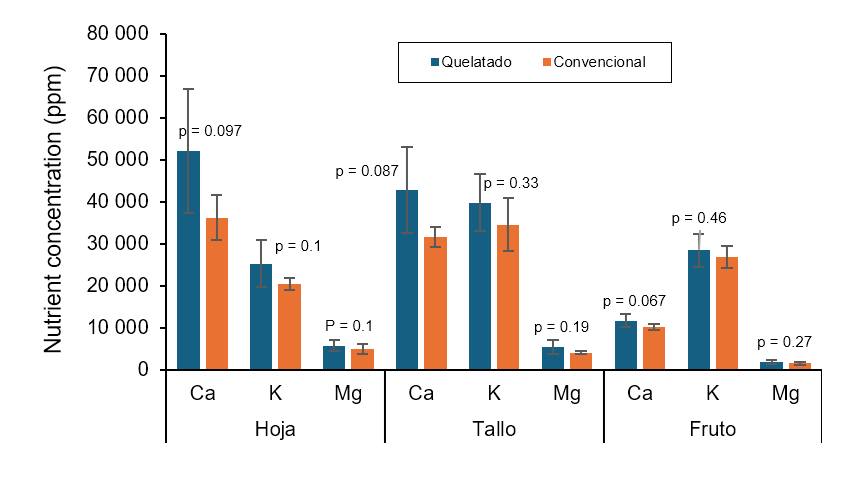
It was observed that ChFT led to higher concentrations of Ca, K and Mg in the evaluated plant organs at the end of the cucumber production cycle. A higher concentration of calcium was found in ChFT at the end of the production cycle, whereas a lower concentration was detected in fruits (Figure 1).
Regarding Ca, Navarro-León et al. (2022) reported that, in their study, levels of this element in leaves (intermediate and young) were also higher in chelated treatments than in non-chelated ones. Similarly, the results obtained align with Souri (2016), who found that applying amino acids and amino acid-chelated fertilizers positively influences growth and leaf mineral concentrations, improving Ca, K and Mg levels.
In the stem, nutrient concentrations were highest in ChFT plants (Figure 1). Because this part of the plant is green, it also contains chlorophyll and the processes of photosynthesis and transpiration occur there; consequently, Ca is transferred directly by the xylem to this organ of the plant (Díaz et al., 2007).
With respect to magnesium, this is an element that is part of chlorophyll, which is why it is required (Ishfaq, 2022), and because chelates facilitate its transfer, there is a higher concentration. This aligns with Abbas et al. (2020), who found a higher Mg concentration when this element was applied chelated, resulting in greater stem vigor, length and diameter. This also aligns with Souri (2016), who notes that calcium concentration in the stems improved with the application of chelated fertilizers.
For nutrient concentration in cucumber fruits, Ca is the element that differs between the treatments, although with a p= 0. 067 (Figure 1), with the highest concentration in ChFT fruits. In this regard, Navarro-León et al. (2022) found a higher Ca concentration in pepper fruits, which is reflected in fruit weight, length, size, firmness, and yield.
The higher concentrations of calcium, potassium, and magnesium in the different organs of the cucumber plant treated with chelated fertilizers are because these minerals had greater mobility and were more easily assimilated, as chelates are very stable and are capable of protecting the metal ion from the environment (Areche et al., 2023), avoiding adverse chemical reactions with other elements (Manik et al., 2023), generating synergies with organic matter, and making the use of fertilizers more efficient (Fu et al., 2026).
When analyzing calcium concentration in leaves classified by age, the two treatments showed similar behavior at the end of the cucumber production cycle, with a higher concentration of this element in ChFT and in old leaves than in intermediate and new leaves (Table 3).
[i] L-N= new leaf; L-I= intermediate leaf; L-O= old leaf; CFT= conventional; ChFT= chelated; N-CFT= new leaf with conventional; N-ChFT= new leaf with chelates; I-CFT= intermediate leaf with conventional; I-ChFT= intermediate leaf with chelates; O-CFT= old leaf with conventional; O-ChFT= old leaf with chelates. Means with different letters in the columns indicate significant differences (Tukey, p≤ 0.05).
The higher Ca concentration in old leaves is because one of the characteristics of calcium is its immobility in the phloem, which implies very limited translocation of this element from old leaves to young leaves, shoots and fruits (Marschner, 2012). In contrast, the high Ca concentrations in leaves in ChFT were due to these sources increasing nutrient concentrations in plant organs (Souri, 2016).
Potassium was concentrated in greater amounts in the new leaves in the two treatments. This is because K is an element in constant movement within the plant and is translocated from old leaves to young ones, since the latter are metabolically more active (Singh, 2021). Likewise, Cochrane and Cochrane (2009) indicate that when young leaves are potassium-deficient, the element is translocated from old leaves.
Comparing treatments, K concentration was higher in ChFT (Table 3) because chelates neutralize the element’s ionic charge, facilitating its transfer to the different organs of the plant (Sardans and Peñuelas, 2021). This statement is reinforced by the analysis of the interaction between treatment and leaf maturity: ChFT had a higher concentration of this element in newer leaves, whereas CFT plants had a lower concentration of this element in old and intermediate leaves.
At the three leaf-maturity levels, ChFT had higher potassium concentrations; for example, in old ChFT leaves, the concentration was 11 762 mg L-1, whereas in CFT, it was 10 009. It is possible that, in the latter case, there was greater translocation toward the young leaves, since it also had the lowest concentration of this element.
Magnesium concentration was higher in older ChFT leaves, whereas newer leaves in both treatments had a lower concentration of this element (Table 3). This result may be partly explained by the fact that this element is part of the structure of chlorophyll and is bound to the chloroplast, so translocation from old leaves is more difficult than that of potassium; in addition, old leaves have had more time to accumulate this element in their cells.
An imbalance in the Mg-K interaction may also occur due to excess K, hindering its transport to young leaves (Xie et al., 2021).
On most harvest dates, fruits weighed more under the chelated fertilizer treatment. In the extra-large and large categories, the chelated fertilizer treatment produced more fruits, with a percentage rate of variation (PRV) of 17.1 and 4.6%, respectively (Table 4). In contrast, CFT produced more medium and small fruits.
In ChFT, more fruits were developed in the long and super-select categories, with PRVs of 155.5 and 36.1%; respectively, compared with those obtained in CFT (Table 5). In contrast, the latter treatment produced the smallest fruits, since the select and small categories had PRVs of -18.1 and 47.6%, respectively, compared with the chelated treatment.
Higher fruit weight led to greater yield in the chelated fertilizer treatment. In this regard, Liu et al. (2021) obtained better yields in their crops with chelated fertilizer application, which also increased fruit quality and nutrient concentration. One reason is that amino acid chelates improve nutrient absorption, thereby increasing plant growth and yield (Souri, 2016). For example, potassium contributed to plant development by participating in osmotic adjustment, stomatal opening and closing, and enzymatic activation (Ahmad et al., 2018).
The greater number of fruits, along with the greater fruit weight and length in the chelated treatment, is reflected in higher crop yield, since ChFT plants had an average yield of 5.9 kg, whereas CFT had a yield of 5.4 kg (Table 6).
| Treatment | kg plant-1 | Standard deviation |
|---|---|---|
| CFT | 5.4 | 0.525 |
| ChFT | 5.9 | 0.498 |
This aligns with the results of Navarro-León et al. (2022), who reported a higher yield and better quality of pepper fruits in treatments using chelates. Likewise, our results align with Kim et al. (2013) and Liu et al. (2021), who obtained heavier cucumber fruits in the chelate treatment, thereby increasing crop productivity and improving quality.
The fruits developed in plants treated with chelates had an average firmness of 3.93 kg cm-1, which was higher (p= 0.001) than that of the fruits developed with CFT, which had an average firmness of 3.78 kg cm-1 (Table 7). The increase in firmness in the cucumber fruits treated with chelates could be caused by the high concentration of calcium that this treatment presented in the fruits, coinciding with the results obtained by Navarro-León et al. (2022), who found a higher concentration of this element in pepper fruits, resulting in an increase in fruit firmness and size.
| Treatment | Firmness (kg cm-2) | Soluble solids concentration (Brix) |
|---|---|---|
| CFT | 3.78 ±0.074 | 1.22 ±0.134 |
| ChFT | 3.93 ±0.066 | 1.34 ±0.063 |
| p-value | 0.004 | 0.001 |
The concentration of soluble solids was also higher (p= 0.003) in fruits with chelated fertilization, at 1.34 Brix, while fruits from plants developed in CFT had a concentration of 1.22 Brix. The increase in the concentration of soluble solids in cucumber fruits treated with chelates may be related to the high concentration of potassium that these fruits had, compared to those subjected to conventional fertilization, coinciding with the results presented by Alejo-Santiago et al. (2021), who found a positive correlation between the concentration of potassium in the nutrient solution applied and the content of total soluble solids (Brix) in cucumber fruits.
Applying chelated Ca, K and Mg fertilizers lead to higher concentrations of these elements in stems, leaves and fruits, mainly Ca and K in leaves, because their mobility in the plant is facilitated. This results in better plant development than with conventional fertilization, under shade-net conditions, reflected in greater weight, length, firmness and higher Brix concentration in fruit, as well as higher crop yield.
The first author thanks the Interinstitutional Master’s Program in Protected Agriculture of the Graduate Program of the Faculty of Agronomy of the Autonomous University of Sinaloa for the opportunity to pursue his studies in this program. Likewise, the author is grateful to the Secretariat of Science, Humanities, Technology and Innovation (SECIHTI), by its Spanish acronym, formerly the National Council of Humanities, Sciences and Technologies (CONAHCYT), by its Spanish acronym, for the scholarship awarded during his master’s studies.
Abbass, J. A.; Al-Zurfi, M. T. H.; Hnoosh, L. J. H.; Ahmed-Abdul, A. L. I. and Abbas, A. A. 2020. Roles of spraying amino acids and chelated magnesium on growth, flowering and production of corms of Fressia hybrida. Scientific Papers. Series B. Horticulture. 64(2):281-285. https://horticulturejournal.usamv.ro/pdf/2020/issue-2/art39.pdf.
Ahmad, Z.; Anjum, S.; Waraich, E. A.; Ayub, M. A.; Ahmad, T.; Tariq, R. M. S.; Ahmad, R. and Iqbal, M. A. 2018. Growth, physiology, and biochemical activities of plant responses with foliar potassium application under drought stress-a review. Journal of Plant Nutrition. 41(13):1734-1743. https://doi.org/10.1080/01904167.2018.1459688.
Alejo-Santiago, G.; Becerra-Venegas, S. G.; Bugarín-Montoya, R.; Aburto-González, C. A.; Quiñones-Aguilar, E. E.; Rincón-Enríquez, G. y Juárez-Rosete, C. R. 2021. Requerimiento nutrimental y nutrición potásica en pepino persa con poda a un solo tallo. Terra Latinoamericana.39:e906. https://doi.org/10.28940/terra.v39i0.906.
Areche, F. O.; Aguilar, S. V.; More-López, J. M.; Castañeda-Chirre, E. T.; Sumarriva-Bustinza, L. A.; Pacovilca-Alejo, O. V.; Camposano-órdova, Y. F.; Montesinos, C. C. Z.; Quincho-Astete, J. A.; Quispe-Vidalon, D.; Brito-Mallqui, C. H.; Camayo-Lapa, B. F.; Malpartida-Yapias, R. J.; Corilla-Flores, D. D. and Salas-Contreras, W. H. 2023. Recent historical developments in chelated fertilizers as plant nutritional sources, their usage efficiency, and application methods. Brazilian Journal of Biology.83:e271055. https://pubmed.ncbi.nlm.nih.gov/36995829/.
Babcock-Jackson, L.; Konovalova, T.; Krogman J. P.; Bird, R. and Lotti-Díaz L. 2023. Sustainable fertilizers: publication landscape on wastes as nutrient sources, wastewater treatment processes for nutrient recovery, biorefineries, and green ammonia synthesis. Journal of Agricultural and Food Chemistry. 71(22):8265-8296. https://doi.org/10.1021/acs.jafc.3c00454.
Chávez-Díaz, I. F.; Zelaya-Molina, L. X.; Cruz-Cárdenas, C. I.; Rojas Anaya, E.; Ruíz-Ramírez, S. y de los Santos-Villalobos, S. 2020. Consideraciones sobre el uso de biofertilizantes como alternativa agro-biotecnológica sostenible para la seguridad alimentaria en México. Revista Mexicana de Ciencias Agrícolas. 11(6):1423-1436. https://doi.org/10.29312/remexca.v11i6.2492.
Kim, M. S.; Kim, Y. H.; Kang, S. S.; Kong, M. S.; Hyun, B. K. and Lee, C. H. 2013. Effects of a chelate (DTPA) on cucumber growth and soil chemical properties in nutrient-accumulated soil of polytunnel greenhouse. Korean Journal of Soil Science and Fertilizer. 46(6):665-672. https://doi.org/10.7745/kjssf.2013.46.6.665.
Singh, V. K.; Dwivedi, B. S.; Rathore, S. S.; Mishra, R. P.; Satyanarayana, T. and Majumdar, K. 2021. Timing potassium applications to synchronize with plant demand. In: Murrell, T. S.; Mikkelsen, R. L.; Sulewski, G.; Norton, R. and Thompson, M. L. (Eds). Improving Potassium Recommendations for Agricultural Crops. Springer, Cham. 363-384 pp. https://doi.org/10.1007/978-3-030-59197-7-13.
Yang, M.; Zhou, D.; Hang, H.; Chen, S.; Liu, H.; Su, J.; Lv, H.; Jia, H. and Zhao, G. 2024. Effects of balancing exchangeable cations Ca, Mg and K on the growth of tomato seedlings (Solanum lycopersicum L.) based on increased soil cation exchange capacity. Agronomy. 14(3):629. https://doi.org/10.3390/agronomy14030629.