elocation-id: elocation-id: e4176
The study of mango production in Sinaloa (2000-2023) demonstrates that yield is not a contemporary stochastic event, but a trajectory-dependent process defined by the orchard’s inherited physiological state. The evidence indicates that the crop arrives at each cycle with an energy ‘memory’ accumulated from its recent production history, which conditions its capacity to respond to climate, management, and inputs. Modeling using ensemble algorithms enabled classification of the production regimes with 77%-79% accuracy, achieving a statistical robustness of R2= 0.84 by identifying that physiological memory dominates the hierarchy of predictors with a relative weight of 53%. This finding allowed us to reinterpret the variability in production. The drop in yield is not explained by structural failures or extreme climatic events but by physiological depletion accumulated after previous cycles of high biomass extraction. Similarly, years with favorable climatic conditions may not translate into high yields if the tree arrives energetically compromised. An induction ‘sweet point’ was identified, where the maximum yield (7.78 t ha-1) is only viable under a water stress index between 0.54 and 0.61; outside this threshold, the tree exhibits an inelastic response regardless of its previous load. Based on this logic, operational bioindicators were developed that allow anticipating the crop’s response and differentiating years to intensify production from |those where physiological recovery should be prioritized, optimizing intertemporal decision-making in perennial agricultural systems.
agricultural econometrics, economic physiology, mango, perennial crop, production function.
Mango production in Sinaloa ranks first nationally, with an annual volume of close to 475 000 t, representing a significant proportion of the Mexican supply of the crop. Internationally, Mexico is among the world’s leading producers and exporters, with its production mainly sent to the United States of America, Europe, Japan, and Canada (SADER and SIAP, 2024; FAOSTAT, 2024). The economic relevance of mangoes in the state makes the variability of their yield not only an agronomic problem but also an economic and strategic one for production planning and agricultural risk management (Antwi-Boasiako et al., 2024; Noordam, 2024; Ahmad et al., 2025).
In the agricultural economics literature, the production function has traditionally been specified within static frameworks-often of the Cobb-Douglas or translog type-in which yield is modeled as a contemporary result of productive inputs and climatic conditions of the same cycle (Cobb and Douglas, 1928; Christensen et al., 1973) and frequently incorporating stochastic specifications to capture the inherent uncertainty of the process (Aigner et al., 1977; Just and Pope, 1978; Chambers and Quiggin, 2000). These approaches have made it possible to estimate elasticities, measure technical efficiency, and evaluate total factor productivity (Coelli et al., 2005). However, their structure implicitly assumes intertemporal independence across production cycles, thereby transferring any cumulative effects from previous periods to the error term.
From agronomy, phenomena such as productive alternation (biennial bearing) have been widely documented in fruit trees, including tropical and subtropical species such as mango. The physiological literature has shown that annual yield depends on the balance between the accumulation and utilization of non-structural carbohydrates, as well as on the competition between vegetative and reproductive growth (Monselise and Goldschmidt, 1982; Goldschmidt, 2013; Vittal et al., 2023; Sharma et al., 2025). In mango, several studies have identified patterns of temporal dependence associated with partial depletion of reserves following years of high fruit load, generating alternating cycles of high and low production (Vittal et al., 2023; Sharma et al., 2025). These mechanisms suggest the existence of an inherited physiological state that influences the subsequent productive response (Liu et al., 2023; Sharma et al., 2025).
Nonetheless, despite agronomic evidence on alternation and trajectory dependence, these processes have rarely been explicitly incorporated into the econometric specification of the production function at the aggregate level. Most empirical models continue to treat interannual variability as a predominant result of exogenous climate shocks or contemporaneous variations in inputs, without formally integrating operational proxies of the cumulative biological state.
In this context, the research explores a dynamic specification of the production function for perennial crops, incorporating observable lagged yield variables as operational approximations of the crop’s cumulative physiological state. To this end, a combined architecture of econometric modeling and machine learning is used to identify patterns of temporal dependence and structural heterogeneity in mango production in Sinaloa during the 2000-2023 period (Izzati-Ulinnuha et al., 2024).
The study was conducted in the municipalities of Culiacán, Mazatlán, Rosario and Escuinapa the Sinaloa estate representative of the state’s mango (Mangifera indica L.) production, for the 2000-2023 period (24 cycles).
A panel-type database was constructed by combining: i) agricultural information from SIAP (area sown and harvested, production and yield), differentiated by varieties (Kent, Keitt, Ataulfo, Tommy Atkins) and water modality (SIAP, 2024a, 2024b); and ii) monthly climate variables from NASA POWER at a spatial resolution of 0.5° × 0.5°, including air temperature at 2 m (T2M-max, T2M-min, thermal range), precipitation (PRECTOTCORR), solar radiation (ALLSKY-SFC-SW-DWN), relative humidity (RH2M), wind speed (WS2M, WS10M) and surface and root soil moisture (GWETTOP, GWETROOT).
To model temporal dependence in perennial crops, yield lags were incorporated. The simple lag was defined as:
and the three-year moving average as:
.
Where: is the yield of the municipality-variety in the year .
The target variable was discretized by quantiles (q= 3):
, reducing stochastic noise and emphasizing productive regimes.The missing values were imputed by the median. The categorical variables (municipality, variety, cycle) were transformed using Label Encoding.
To reduce climatic collinearity, the following were applied: i) mutual information (MI) to detect nonlinear dependence on ; and ii) recursive feature elimination (RFE) with LightGBM and stratified cross-validation (k= 3), selecting predictors with greater information gain.
Continuous variables with asymmetry, , were normalized using the Yeo-Johnson transformation:
.
A two-level stacking classifier was implemented. Level 1: LightGBM, XGBoost and CatBoost as base models of gradient boosting. Level 2: logistic regression as a meta-classifier, integrating predicted probabilities:
.
Where: is the probability estimated by each base model and is the logistic function.
The ensemble architecture enabled evaluation of incremental predictive gain relative to individual models and the historical average, capturing nonlinear interactions and potential threshold effects between climatic and structural variables of the production system. This approach is linked to recent applications of deep learning in mango, where LSTM models have been used to forecast yield from historical series of climate, cultivated area, and previous production (Izzati-Ulinnuha et al., 2024).
Stratified cross-validation (k= 5) was used. Performance was evaluated using accuracy, precision, recall and weighted F1:
.
As a reference, a baseline historical-average model (Zero Rule) was estimated, quantifying the net predictive gain. Interpretability was addressed using SHAP values:
identifying the climatic and memory factors with the greatest marginal contribution to yield.
In order to capture the mechanics of alternation from a biophysical perspective, second-order metrics were developed that evaluate the interaction between the system’s internal state and environmental signals. The induction-phase water stress index (IWSI) for the critical October-December quarter was defined as:
Where: GWETROOT represents the moisture fraction in the root zone for municipality i in month m.
To quantify the system’s responsiveness to climatic stimuli, the concept of Bioclimatic Friction (Φ) was introduced. It is calculated from the yield anomaly relative to its energy memory:
where: Yi, t-1 is the energy memory index (EMI). This metric allowed identification of the crop’s ‘inelasticity’, that is to say, the inability of the climate signal (IWSI) to shift yield when reserves are depleted.
The threshold analysis was performed using LOWESS smoothing functions and core densities (KDE), which allowed locating the water saturation point where the physiological response begins to decrease. Finally, an importance decomposition was applied using SHAP values, formalized as:
.
This procedure allowed validating the hierarchy of the predictors, confirming the specific weight of energy memory relative to the environmental flow variables in the determination of the production regime.
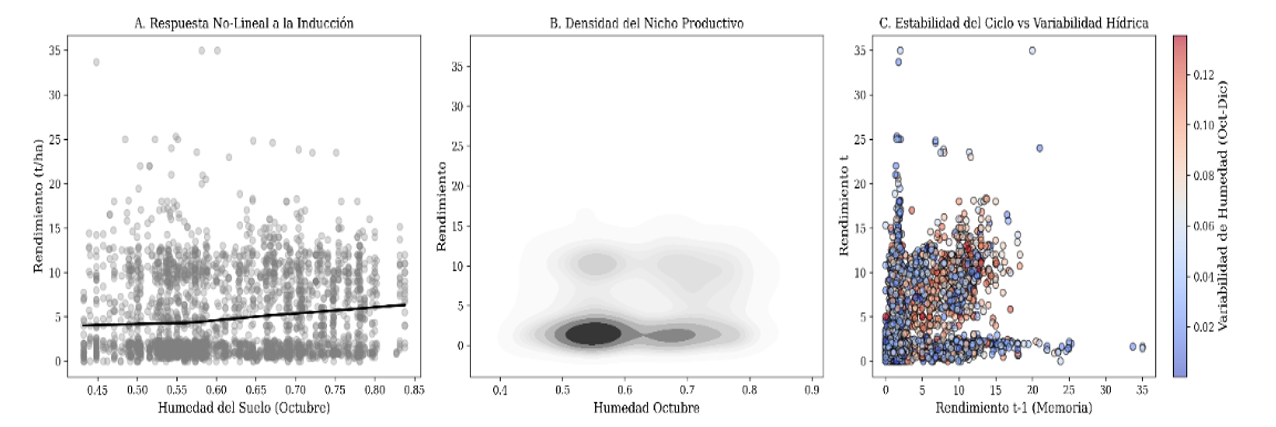
The need for these indicators stems from the nonlinear and stochastic nature of crop response. As illustrated in Figure 1, the relationship between soil moisture and yield (panel A) exhibits a dispersion pattern that prevents diagnoses by simple linear regressions. The density of the productive niche (panel B) reveals concentration nuclei associated with on/off regimes; in turn, the interaction between memory and water variability (panel C) confirms that higher yields require specific stability in the ambient signal.
The Stacking model exhibited outstanding statistical robustness, reaching a coefficient of determination (R2) of 0.849. This value indicates that the model manages to explain 84.9% of the total variability in mango yields across the analyzed municipalities, leaving only 15.1% associated with stochastic noise or unobserved factors. In the test set (n= 806), the classification accuracy was 93.67%, which shows that combining physiological memory and climatic thresholds consistently captures the central dynamics of the perennial production function. The goodness-of-fit and performance metrics of the ensemble model are presented in Table 1.
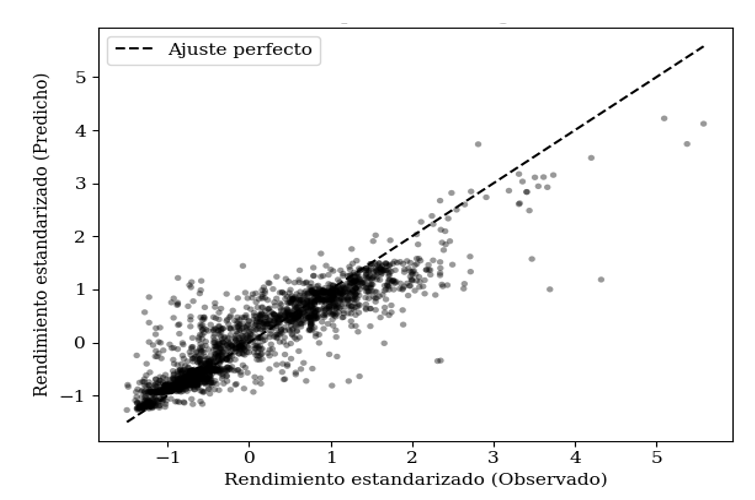
The decomposition of the explained variance confirms that physiological memory (EMI) is not only an additional predictor but also the central axis of the system, contributing 53.1% to the Shapley value. This implies that more than half of the model’s explanatory power (R2= 0.849) depends directly on the physiological load inherited from the previous cycle. The overall consistency between the observed and predicted values is shown in Figure 2, supporting the model’s ability to capture yield dynamics.
The remaining explained variance is mainly distributed between the induction window (IWSI), with a share of 23.4%, and the set stage (IHA), with 18.5%. These results suggest that climatic conditions have a relevant effect, although it is subordinate to the energy availability accumulated by the tree.
In physiological terms, the high R2 obtained confirms that the productive alternation, despite its apparent complexity, exhibits a highly predictable structure when the analysis incorporates the crop’s energy memory. In this way, climate does not act as an isolated determinant of production but as a modulator whose influence is conditioned by the physiological limits previously established by the tree.
The interaction between the energy memory and the water signal enables identification of the productive niche where crop efficiency is maximized. As shown in Figure 3, the maximum expected yield (7.78 t ha-1) occurs exclusively at the intersection of the upper quartile of memory (EMI> 1.623) and the third quartile of induction-phase water stress (IWSI between 0.545 and 0.616).
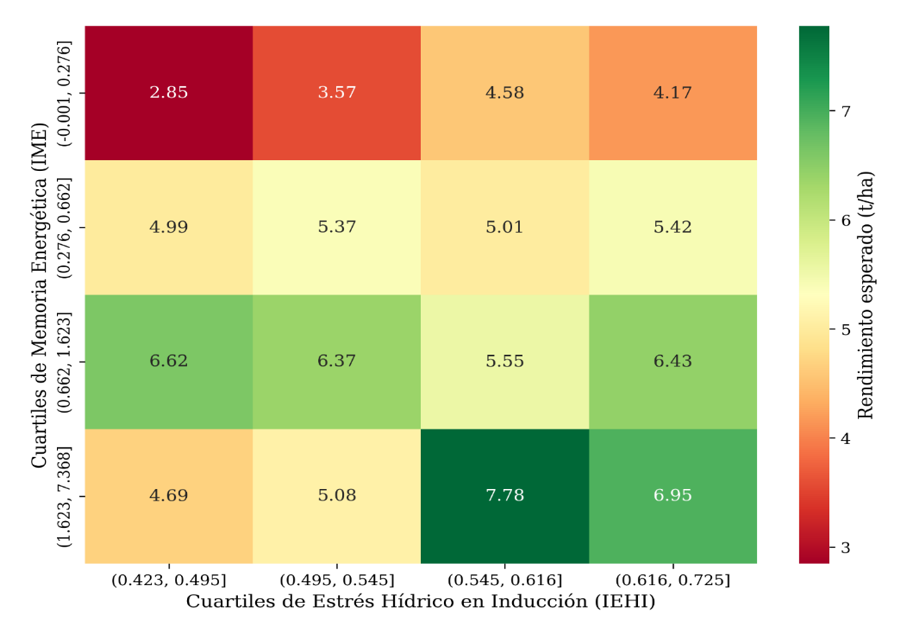
This result is fundamental, as it shows that even with optimal energy reserves, yield experiences a drop towards 6.95 t ha-1 when root moisture exceeds the threshold of 0.616, confirming the hypothesis of vegetative inhibition. Likewise, in low-memory states (upper quartile of the graph), the system exhibits structural rigidity, with yield not exceeding 4.58 t ha-1 regardless of water-stimulus optimization.
Under a scenario of high precipitation in February (150 mm; PRECTOTCORR-Mes-2), the model projected probabilities of 87.47% for high yield, 11.49% for medium and 1.03% for low, quantifying the crop’s positive sensitivity to water availability during the critical flowering/fruit-set stage.
The results question the traditional static specification , which assumes intertemporal independence. In mango, yield depends not only on structural capital and the contemporary climate but also on an inherited physiological state. The empirical dominance of and genetics confirms that the system has memory.
A trajectory-dependent production function is proposed:
.
Where: is the inherited energy state. Since is unobservable, production lags act as a proxy:
.
Thus, a year of high production can generate an energy debt that reduces the productive elasticity in . Part of what is attributed to ‘noise’ actually corresponds to unmodeled intertemporal structure.
SHAP analysis shows that climate does not act as a continuous, linear input but rather as a signal that activates processes in critical phenological windows (Liu et al., 2023; Antwi-Boasiako et al., 2024; Ahmad et al., 2025). The presence of thresholds (precipitation in February; thermal amplitude in November) implies that:
but it depends on the energy state:
.
The climatic response is conditional and asymmetric: with , the crop shows rigidity even under favorable climate; with restored reserves, it maximizes environmental energy conversion. Therefore, the optimal investment decision should be weighted by a crop memory index , not just by weather forecasts.
This conditionality is clearly observed in the induction-phase water stress index (IWSI). The results demonstrate that the climate signal is effective only within a root moisture threshold of 0.54 to 0.61 during the October-December quarter. Outside this range, yield elasticity becomes zero, confirming that excess moisture acts as an inhibitor of florigen signaling, keeping the tree in an inelastic vegetative state despite having energy reserves (Liu et al., 2023; Antwi-Boasiako et al., 2024; Ahmad et al., 2025).
Evidence of persistence in low-yield states suggests productive hysteresis, a phenomenon in which the system’s current state depends strongly on its historical trajectory (Blanchard and Summers, 1986). The system does not necessarily converge to the equilibrium determined by the average climate but can become trapped in energy deficits if there is no agronomic intervention, a behavior consistent with the metabolic balances described in the fundamental plant physiology literature (Taiz and Zeiger, 2010).
The dynamics of the state can be represented as:
Where: α is the rate of depletion by fruit extraction, and β is the rate of photosynthetic recovery. When αQt-1> βWt-1, a chronic deficit emerges. The ML model identifies these latent states and adjusts predictions without assuming automatic mean reversion (Vittal et al., 2023; Sharma et al., 2025).
The robustness of this interpretation is validated by the performance of the ensemble model, which achieved an R2= 0.849. This high coefficient of determination confirms that the observed variability is not stochastic noise (εt) but rather a deterministic structure in which physiological memory (EMI) explains 53.1% of the variance.
The model accurately detects ‘productivity traps’ by identifying that, when the EMI is low, the system enters a mandatory latency phase for starch restoration, during which climate sensitivity decreases drastically, empirically validating the crop’s path dependence. The ML model identifies these latent states and adjusts predictions without assuming automatic reversion to the mean.
The determination of the production function in perennial systems goes beyond the analysis of contemporary exogenous variables, suggesting a trajectory dependence in which the accumulated energy balance dictates the crop’s metabolic response capacity.
This internal dynamic is manifested in the sensitivity of the fruit to technical management, observing that the mineral regulation of the respiratory rate by calcium, the hormonal management of ripening by ethylene control, the resilience of tissues to extreme physical stressors, and the photosynthetic efficiency of new genetic materials or specific regional varieties such as Ataulfo (Infante et al., 2011) operate under a pre-existing structure of biological homeostasis that enhances or limits the effectiveness of postharvest interventions and the kinetic processes of agro-industrial transformation (Ocampo, 2006).
Consequently, commercial viability, nutritional or pharmacological value (Wall-Medrano et al., 2015; Masud, 2016), and final yield are not stochastic events but the result of physiological programming conditioned by previous biomass extraction cycles (Romero-Gomezcaña et al., 2006; Osuna-García et al., 2007; Vargas-Ortiz et al., 2013; Piedragil-Ocampo, 2018).
The evidence obtained suggested that the productive variability of mangoes in Sinaloa cannot be interpreted solely as a contemporary response to the climatic conditions of the current agricultural cycle. The relative importance observed in the production lags and in the indicators associated with the induction-phase water status indicates that yield incorporates cumulative components linked to the crop’s internal dynamics.
In functional terms, this implies that annual production simultaneously reflects present biomass allocation processes and physiological effects inherited from previous cycles.
The interaction between the energy memory index (EMI) and the induction-phase water stress index (IWSI) indicates that the system’s response is not homogeneous with respect to the environmental signal. Even under favorable water conditions, high yields were observed only when the crop maintained a previous physiological condition compatible with high reproductive response capacity.
Conversely, states of low memory limited productive expression even under relatively favorable climate scenarios. This behavior suggests that the elasticity of yield with respect to climate depends on the orchard’s accumulated biological state, not exclusively on the intensity of the meteorological stimulus.
In this context, root moisture during the floral induction stage becomes relevant not because of its isolated magnitude but because of its interaction with the physiological load inherited by the system. The results indicate the existence of specific moisture ranges associated with higher levels of expected yield, whereas conditions of water saturation tended to reduce the productive response, even in states of high energy availability.
This is consistent with the hypothesis that excess moisture during induction favors vegetative activity at the expense of floral differentiation, thereby altering the balance between growth and reproduction.
On the other hand, the persistence observed between lagged and contemporary yields provides evidence compatible with processes of productive alternation on a regional scale. The permanence of high- and low-production trajectories between consecutive cycles suggests that the crop exhibits physiological recovery mechanisms that operate beyond a single agricultural period.
From an economic perspective, this implies that some of the year-on-year variability traditionally attributed to exogenous shocks could correspond to cumulative biological constraints not explicitly incorporated into conventional agricultural specifications.
Overall, the information generated supports a dynamic interpretation of the production function in perennial crops, in which yield depends on the interaction among physiological memory, environmental signals and the structural conditions of the production system. Under this logic, climate acts as a modulator of pre-existing physiological processes rather than as an independent determinant of agricultural performance (Izzati-Ulinnuha et al., 2024; Noordam, 2024).
The results obtained show that mango yield in Sinaloa from 2000 to 2023 presents a dynamic, trajectory-dependent behavior. Productive variability is explained not only by the climatic conditions of the current cycle but also by the interactions among climate, productive history, and structural characteristics of the crop, such as the municipality and the variety. In this sense, incorporating lagged variables allowed us to improve the interpretation of agricultural performance and showed that historical information contains relevant elements for explaining the productive response between consecutive cycles.
The evidence also indicates that variables associated with root moisture, solar radiation, thermal amplitude, and maximum temperature were more relevant than conventional aggregate climate indicators, especially when analyzing specific phenological windows. Overall, the findings suggest that perennial crop modeling can be strengthened by dynamic approaches that integrate climate information, structural variables, and productive background, as mango yield responds to both contemporary environmental conditions and cumulative processes observable in its historical trajectory.
Ahmad, M.; Shabbir, M.; Ali, H.; Hashmi, M. B. F.; Ahmed, M.; Ahmad, S. and Malik, A. 2025. Climate-induced changes in mango production: phenological impacts, pest threats, and mitigation approaches. In: Naqvi, S. A. H.; Ahmad, S. and Ahmed M. (Eds.), climate change and mango production. 773-802 pp. Springer. https://doi.org/10.1007/978-3-031-87035-4-30.
Antwi-Boasiako, A.; Amponsah, P.; Opoku, J. A.; Coulibaly, D. and Mintah, P. 2024. Increasing mango production efficiency under the fast-changing climate. In: Hasanuzzaman, M. and Nahar, K. (Eds.), abiotic stress in crop plants: ecophysiological responses and molecular approaches. IntechOpen. https://doi.org/10.5772/intechopen.112951.
Liu, X.; Xiao, Y.; Zi, J.; Yan, J.; Li, C.; Du, C.; Wan, J.; Wu, H.; Zheng, B.; Wang, S. and Liang, Q. 2023. Differential effects of low and high temperature stress on pollen germination and tube length of mango (Mangifera indica L.) genotypes. Scientific Reports. 13(1):611-614. https://doi.org/10.1038/s41598-023-27917-5.
Osuna-García, J. A.; Cáceres-Morales, I.; Montalvo-González, E.; Mata-Montes de Oca, M. y Tovar-Gómez, B. 2007. Efecto del 1-metilciclopropeno (1-MCP) y tratamiento hidrotérmico sobre la fisiología y calidad del mango ‘Keitt’. Revista Chapingo Serie Horticultura. 13(2):157-163. https://doi.org/10.5154/r.rchsh.2007.02.014.
Romero-Gomezcaña, N. R.; Saucedo-Veloz, C.; Sánchez-García, P.; Rodríguez-Alcázar, J.; González-Hernández, V. M.; Rodríguez-Mendoza, M. N. y Báez-Sañudo, R. 2006. Aplicación foliar de Ca(NO-3)2: fisiología y calidad de frutos de mango `Haden´. Terra Latinoamericana. 24(4):521-527. http://www.redalyc.org/articulo.oa?id=57324410.
Sharma, N.; Vittal, H.; Dubey, A. K.; Sharma, R. M.; Singh, S. K.; Sharma, N.; Singh, N.; Khandelwal, A.; Gupta, D. K.; Mishra, G. P.; Meena, M. C.; Pandey, R. and Singh, N. K. 2025. Physiological and molecular insights into alternate bearing in mango using next-generation sequencing approaches. Journal of Experimental Botany. 76(6):1585-1606. https://doi.org/10.1093/jxb/erae403.
Vargas-Ortiz, M. A.; De la Cruz-Medina, J.; Oliart-Ros, R. M.; Rebolledo-Martínez, A.; Ramírez, J. A. y García, H. S. 2013. Efecto de las altas presiones hidrostáticas sobre los cambios poscosecha de mango ‘Manila’ en madurez fisiológica. CienciaUAT. 8(1):52-63. https://doi.org/10.29059/cienciauat.v8i1.10.
Vittal, H.; Sharma, N.; Dubey, A. K.; Shivran, M.; Singh, S. K.; Meena, M. C.; Kumar, N.; Sharma, N.; Singh, N.; Pandey, R.; Bollinedi, H.; Singh, B. P. and Sharma, R. M. 2023. Rootstock-mediated carbohydrate metabolism, nutrient contents, and physiological modifications in regular and alternate mango (Mangifera indica L.) scion varieties. Plos One. 18(5):e0284910. https://doi.org/10.1371/journal.pone.0284910.
Wall-Medrano, A.; Olivas-Aguirre, F. J.; Velderrain-Rodríguez, G. R.; González-Aguilar, A.; de la Rosa, L. A.; López-Díaz, J. A. y Álvarez-Parrilla, E. 2015. El mango: aspectos agroindustriales, valor nutricional/funcional y efectos en la salud. Nutrición Hospitalaria. 31(1):67-75. https://doi.org/10.3305/nh.2015.31.1.7701.