elocation-id: elocation-id: e4175
The fall armyworm, Spodoptera frugiperda , is one of the main pests of corn in Ecuador, causing significant yield losses. The intensive use of chemical insecticides for its control poses environmental and human health risks. As a sustainable alternative, this study evaluated the efficiency of biological and botanical insecticides under laboratory conditions. The research was conducted from May to July 2025 using a completely randomized design with four treatments [BotaniGard® ES ( Beauveria bassiana ), Dipel® WG ( Bacillus thuringiensis ), NeemAzal® T/S (neem oil), and Delegate® 250 WG (spinetoram, as a chemical control)], which were applied to third-instar larvae via the leaf immersion technique, with evaluations at 24, 48, 72 and 96 h. Results showed that B. thuringiensis achieved 100% mortality at 96 h, followed by neem oil and B. bassiana , both with 97.5%. Spinetoram produced immediate and sustained mortality of 100% from 24 h. In contrast, neem showed a low initial mortality rate (17.5%) that progressively increased over time. Overall, the biological and botanical insecticides evaluated are effective alternatives for managing S. frugiperda under laboratory conditions, helping reduce dependence on conventional chemical insecticides.
bioinsecticides, dosage, entomopathogens, mortality, substitution.
Corn ( Zea mays L.) originated and was domesticated in Mesoamerica from teosinte through processes of genetic mixing and introgression that favored its diversification and adaptation ( Yang et al ., 2023 ; Berube et al ., 2024 ). In addition to constituting a biocultural legacy of Mexico’s indigenous communities for more than 10 000 years ( Yasin et al ., 2024 ), this crop represents a strategic source of raw materials for agribusiness and human food. In Ecuador, its productive importance is significant; in 2016, 485 696 ha were cultivated, with a production of 1 667 704 t and an average yield of 3.17 ha-1( Analuisa et al ., 2023 ).
Corn yield can be significantly affected by factors such as weeds, diseases, and insect pests, which limit crop growth and development ( Loot et al ., 2023 ). Among these threats, the fall armyworm ( Spodoptera frugiperda ) is one of the most important corn pests worldwide, including in Ecuador, due to its high impact on productivity. Uncontrolled infestations have been reported to cause yield losses ranging from 21% to 53%, reaching up to 67% in specific regions of West Africa; even the Food and Agriculture Organization of the United Nations (FAO) reports reductions of up to 73% in severe scenarios. Although these data pertain to other regions, they demonstrate the pest’s high destructive potential and its importance in productive systems in Latin America.
Spodoptera frugiperda primarily affects corn during its early stages of development, damaging the foliage and whorl; however, it can persist throughout the crop cycle and increase its destructive potential ( Wan et al ., 2021 ). Its management includes physical, mechanical, cultural, biological and chemical methods ( Akeme et al ., 2021 ). Nonetheless, chemical control can generate environmental impacts and affect beneficial organisms ( Vásquez et al ., 2024 ; Zhou et al ., 2025 ); in contrast, biological control based on entomopathogens represents an alternative for integrated pest management ( Sala et al ., 2023 ; Kinyanjui et al ., 2025 ). Nevertheless, its effectiveness against S. frugiperda in Ecuador remains variable due to environmental and agronomic factors.
This research aimed to evaluate the efficacy of biological and botanical insecticides for controlling Spodoptera frugiperda larvae in corn ( Zea mays ) under laboratory conditions, as sustainable alternatives to reduce dependence on conventional chemical insecticides ( Mascarin et al ., 2016 ). It was hypothesized that these insecticides have an efficacy comparable to chemical products in terms of larval mortality, although with differences in the speed and dynamics of response. This study seeks to provide scientific evidence to strengthen integrated management strategies for one of the main pests that affect corn yield.
This study was conducted from May to July 2025 in the Entomology Laboratory of the Faculty of Agricultural Sciences of the Technical University of Babahoyo. The research was carried out at the ‘San Pablo’ Experimental Farm, located at km 7.5 of the Babahoyo-Montalvo highway. The geographical coordinates are 79° 32’ west longitude and 01° 49’ south latitude, with an altitude of 8 m.
The present research evaluated four insecticides for commercial use: a botanical insecticide based on neem ( Azadirachta indica ), two biological insecticides formulated with entomopathogenic microorganisms and a synthetic insecticide serving as a positive control.
The botanical insecticide was the commercial product NeemAzal® T/S (Trifolio-M GmbH, Germany), whose active ingredient is azadirachtin (10 g L-1), and was applied at a concentration of 1.95 ml per 0.39 L of water, according to the manufacturer’s recommendations (batch: NA-2024-EC01).
The biological insecticides used were Dipel® WG (Valent BioSciences, USA), based on Bacillus thuringiensis var. kurstaki (HD-1 strain; 16 000 IU mg-1), and BotaniGard® ES (Laverlam International Corp., USA), formulated with Beauveria bassiana (GHA strain; 1×10⁷ml-1conidia). Both products were purchased from authorized distributors in Ecuador and applied at the recommended doses to control lepidopteran larvae (batches: BT-EC2024-07 and BB-EC2024-05, respectively).
The synthetic insecticide used as a positive control was Delegate® 250 WG (Corteva Agriscience, USA), whose active ingredient is spinetoram (250 g kg-1), belonging to the spinosyn group (IRAC group 5), applied at a dose of 0.39 cc per 0.78 L of water (batch: SP-EC2024-03).
The strains of Bacillus thuringiensis (HD-1) and Beauveria bassiana (GHA) were commercial isolates widely used in the biological control of insects, ensuring stability, viability, and standardized concentration of colony-forming units (CFUs) and conidia, respectively. All products were used to control third-instar larvae of Spodoptera frugiperda , ensuring reproducible and comparable experimental conditions.
The material used was the corn ( Zea mays L.) variety INIAP H-550, grown under controlled conditions at the ‘San Pablo’ Experimental Farm of the Technical University of Babahoyo. Leaves for the bioassays were collected from plants 30-35 days after planting, corresponding to phenological stages V6-V8. Fully expanded, tender leaves from the middle part of the plant, free of damage or infestations, were selected. A total of 160 homogeneous leaf fragments measuring approximately 5×5 cm were used.
Each treatment consisted of four replications, with 10 leaf fragments, distributed under a completely randomized design. The fragments were immersed in insecticide solutions for 10 s to ensure uniform coverage, then dried on absorbent paper at room temperature for 20-30 min to remove excess moisture. Finally, they were fed to third-instar Spodoptera frugiperda larvae under controlled laboratory conditions (25 ±2 °C, 70 ±5% relative humidity and a 12:12 h light/dark photoperiod), ensuring standardized conditions for evaluating larval mortality.
The treatments were applied via the foliar immersion technique using 2×3 cm fragments of corn leaves, immersed for 10 s in 250 ml of insecticide solution to ensure uniform coverage. The fragments were then dried at room temperature for 20-30 min and fed to 10 third-instar larvae of Spodoptera frugiperda per experimental unit. The bioassays were conducted under controlled laboratory conditions (25 ±2 °C, 70 ±5% relative humidity, and a 12:12 h light/dark photoperiod), using independent containers to prevent cross-contamination. The treated plant material was renewed every 24 h during the experimental period ( Real and Paiba, 2023 ).
The efficacy of each product and dose was evaluated in the percentage of relative and cumulative mortality of each treatment.
Insecticide efficacy was determined by the mortality percentage of Spodoptera frugiperda larvae evaluated at 24, 48, 72 and 96 h after application. Dead larvae were defined as those that did not move when mechanically stimulated. The observed mortality was adjusted for the natural mortality recorded in the control in order to avoid overestimating the effects of the treatments.
Relative mortality was the percentage of mortality at each evaluation time, whereas cumulative mortality was calculated as the progressive total during the experimental period. The most efficient treatment was considered to be the one that achieved the highest mortality percentage in the shortest time, and the most effective dose was the one that produced the highest cumulative mortality. Since the response variable consisted of proportional data, a binomial distribution was assumed for statistical analysis.
The experiment was established under a completely randomized design with an A×B factorial arrangement and an additional control. Factor A included four insecticides (neem oil, Beauveria bassiana , Bacillus thuringiensis and spinetoram) and factor B comprised three dose levels (high, medium and low), with ten replications per treatment (10 larvae per experimental unit), totaling 130 experimental units.
Mortality was recorded at 24, 48, 72 and 96 h. Binomial data were analyzed using a generalized linear mixed model (Glimmix, Sas), with insecticide, dose, time and their interactions as fixed effects, replications as a random effect. Means were compared using Tukey’s test (p≤ 0.05).
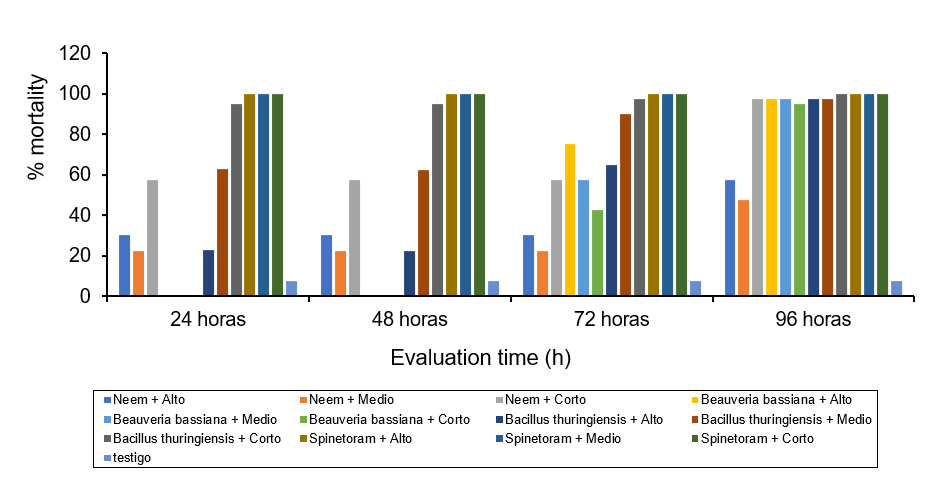
The temporal evaluation showed significant differences among treatments ( Figure 1 ). Spinetoram achieved rapid and sustained 100% mortality from the first hours. In contrast, neem showed a progressive response, whereas Bacillus thuringiensis and Beauveria bassiana presented a delayed effect, with low initial mortalities that increased toward 96 h. These differences reflect their mechanisms of action. The low mortality rates of the control confirm that the effects are due to the treatments.
Insecticide efficacy varied over time. Spinetoram stood out for presenting immediate and sustained 100% mortality. Neem showed low initial efficacy (10.83%), which progressively increased until reaching 67.5% mortality at 96 h. By contrast, Beauveria bassiana and Bacillus thuringiensis showed a delayed effect, with mortalities exceeding 98% by the end of the evaluation period.
Spinetoram was the most effective insecticide for controlling Spodoptera frugiperda under laboratory conditions, as it obtained mortalities of 100% at 24 h and showed highly significant differences compared with the rest of the treatment alternatives (p< 0.0001), so it can be considered a useful option for rapid control in the early stages of the crop.
Dose analysis determined that high doses did not significantly improve efficacy compared with the medium dose, whereas low doses significantly reduced the level of control at 48 and 96 h. These results highlight the importance of adequate dosing to optimize treatment efficacy.
The tests showed significant differences between the evaluated treatments and the control group (p≤ 0.05), as observed in Table 1 . The control recorded minimal mortality (between 5% and 7.5%), attributed to natural factors or handling stress. In contrast, insecticide treatments showed progressive increases in larval mortality over time.
Spinetoram exhibited the highest efficacy, achieving 100% mortality from 24 h and remaining constant until 96 h. On the other hand, Bacillus thuringiensis and Beauveria bassiana showed delayed effects, with mortalities below 10% in the first 24 h, but increasing significantly to values close to or above 95% at 96 h.
The neem-based botanical insecticide showed a progressive response, with initial mortality rates near 17.5% that gradually increased to approximately 97.5% by the end of the evaluation period. The analysis of the statistical model showed a significant interaction among the factors insecticide, dose and time (p≤ 0.05), indicating that the larval mortality response is conditioned by the combination of the type of insecticide, the dose applied and the exposure time.
The efficacy of the neem-formulated insecticide observed in this study, with mortality rates approaching 97.5% at 96 h, confirms its potential as a tool for controlling Spodoptera frugiperda under laboratory conditions. This behavior responds to the progressive action of azadirachtin, which acts as a growth regulator, feeding inhibitor and disruptor of the molting process ( Mordue and Nisbet, 2000 ).
Recent studies also report the toxicity of Azadirachta indica extracts against this pest, although differences in mortality can be attributed to formulation, concentration, and experimental conditions ( Saleem et al ., 2024 ). Azadirachtin also interferes with the endocrine system of insects by altering the regulation of the ecdysone hormone and juvenile hormone, affecting molting and developmental processes and acts as an antifeedant that reduces foliar consumption and causes a progressive weakening of larvae ( Wen et al ., 2013 ).
Likewise, neem extracts exhibit significant insecticidal activity against lepidopterans, with effects dependent on dose and exposure time ( Martínez et al ., 2016 ); they also have a short residual effect that induces alterations in molting, growth inhibition and progressive death ( Isman, 2020 ).
These results are higher than those reported by González et al . (2015) , who obtained mortality rates of 86.66% and by Rodríguez et al . (2018) , who reported values close to 50%, which can be explained by differences in formulation and experimental conditions. Similarly, Martinez and Emden (2001) noted that neem can affect the juvenile stages for several days, ultimately causing larval death.
Treatment with Bacillus thuringiensis achieved 100% mortality at 96 h, attributable to the action of δ-endotoxins that cause intestinal damage in larvae ( Bravo et al ., 2011 ). This behavior coincides with that described by Butt et al . (2016) regarding its efficacy after prolonged periods of exposure, as also indicated by Palma et al . (2024) on the wide biocidal activity.
The insecticidal effect of Bacillus thuringiensis is due to the production of crystalline (Cry) proteins, which damage the intestinal epithelium of larvae after ingestion, causing the death of the insect ( Palma et al ., 2024 ).
By comparison, González et al . (2015) reported mortalities of 70.66%, whereas Amezcua et al . (2023) reported an LC50of 189.53 μg ml-1, indicating that its efficacy may vary with concentration, strain, and experimental conditions.
The Beauveria bassiana formulation showed a mortality close to 97.5% at 96 h, attributed to its ability to penetrate the cuticle and cause progressive systemic infections ( Zimmermann, 2007 ). This behavior is consistent with what Idrees et al . (2022) describe, who highlight its cumulative effect over time.
However, studies such as that by Amezcua et al . (2023) report lower mortalities (49.33%), suggesting that factors such as strain virulence and formulation significantly influence its efficacy ( Iwanicki et al ., 2023 ).
The mechanism of action of Beauveria bassiana involves the adhesion of conidia to the insect cuticle, followed by their germination and penetration by hydrolytic enzymes such as chitinases and proteases. The fungus then colonizes the hemolymph and produces toxic metabolites that alter essential physiological functions, causing host death.
Spinetoram exhibited the highest efficacy in terms of speed, reaching 100% mortality from the first 24 h, in contrast to neem (17.5%) and biological insecticides, which showed no initial effect. This behavior aligns with what was reported by Kulye et al . (2021) , who highlight its high efficacy in the first 24-48 h, demonstrating its immediate action compared with biological and botanical insecticides.
The neem-based botanical insecticide demonstrated high efficacy in controlling Spodoptera frugiperda larvae under laboratory conditions, reaching mortalities close to 97.5% at 96 h of evaluation, evidencing a progressive effect over time. The biological insecticides Bacillus thuringiensis and Beauveria bassiana also showed high levels of larval mortality, especially in late evaluations, confirming their efficacy as sustainable alternatives, albeit with slower action than the synthetic insecticide.
Spinetoram presented rapid and sustained action, achieving 100% mortality from the first 24 h, standing out as the treatment with the greatest immediate efficacy. Regarding dosage, the results suggest that medium and low doses of the evaluated insecticides can achieve control levels comparable to higher doses under controlled conditions, highlighting the potential for optimization in the use of these products within integrated pest management programs.
Akeme, C.; Ngosong, C.; Sumbele, S.; Aslan, A.; Tening, A.; Krah, C.; Kamanga, B.; Denih, A. and Nambangia, O. 2021. Different controlling methods of fall armyworm ( Spodoptera frugiperda ) in maize farms of small- scale producers in Cameroon. IOP Conference Series: Earth and Environmental Science. 911(1):1-21. https://doi.org/10.1088/1755-1315/911/1/012053.
Amezcua, L. G.; Fuentes, L. T.; Gutiérrez, J. M.; Sánchez, J. C.; Hernández, H. A. and Castrejón, J. E. 2023. Eficacia insecticida de spinetoram, Bacillus thuringiensis Berliner y clorpirifos contra Spodoptera frugiperda (J.E. Smith, 1797) en maíz. Avances en Investigación Agropecuaria. 27(1):208-2018. https://doi.org/10.53897/RevAIA.23.27.71.
Berube, B.; Ernst, E.; Cahn, J.; Roche, B.; de Santis Alves, C.; Lynn, J.; Scheben, A.; Grimanelli, D.; Siepel, A.; Ross-Ibarra, J.; Kermicle, J. and Martienssen, R. A. 2024. Teosinte pollen drives maize diversification and domestication by RNAi. Nature. 633(1):380-388. https://doi.org/10.1038/s41586-024-07788-0.
Iwanicki, N. S.; Lopes, E. C.; De Lira, A. C.; Poletto, T. B.; Fonseca, L. Z. and Delalibera, J, I. 2023. Comparative analysis of Beauveria bassiana submerged conidia with blastospores: yield, growth kinetics and virulence. Biological Control. 185(1):1-16. https://doi.org/10.1016/j.biocontrol.2023.105314.
Kulye, M.; Mehlhorn, S.; Boaventura, D.; Godley, N.; Venkatesh, S.; Rudrappa, T., Charan, T.; Rathi, D. and Nauen, R. 2021. Baseline susceptibility of Spodoptera frugiperda populations collected in India towards different chemical classes of insecticides. Insects. 12(8):1-11. https://doi.org/10.3390/insects12080758.
Sala, A.; Barrena, R.; Meyling, N. V. and Artola, A. 2023. Conidia production of the entomopathogenic fungus Beauveria bassiana using packed-bed bioreactor: Effect of substrate biodegradability on conidia virulence. Journal of Environmental Management. 341(1):1-10. https://doi.org/10.1016/j.jenvman.2023.118059.
Saquee, F. S.; Norman, P. E.; Saffa, M. D.; Kavhiza, N. J.; Pakina, E.; Zargar, M.; Diakite, S.; Stybayev, G.; Baitelenova, A. and Kipshakbayeva, G. 2023. Impact of diffent types of green manure on pest and disease incidence and severity as well as growth and yield parameters of maize. Heliyon. 9(6):1-10. https://doi.org/10.1016/j.heliyon.2023.e17294.
Wan, J.; Huang, C.; Li, C.; Zhou, H.; Li, Z.; Xing, L.; Zhang, B.; Qiao, X.; Liu, B.; Liu, C.; Liu, W.; Wang, W.; Qian, W.; Makrdy, S. and Wan, F. 2021. Biology, invasion and management of the agricultural invader: Fall armyworm, Spodoptera frugiperda (Lepidoptera:Noctuidae). Journal of Integrative Agriculture. 20(3):646-663. https://doi.org/10.1016/S2095-3119(20)63367-6.
Yang, N.; Wang, Y.; Liu, X.; Jin, M.; Vallebueno-Estrada, M.; Calfee, E.; Chen, L.; Dilkes, B. P.; Gui, S.; Fan, X.; Harper, T. K.; Kennett, D. J.; Li, W.; Lu, Y.; Ding, J.; Chen, Z.; Luo, J.; Mambakkam, S.; Menon, M. and Ross-Ibarra, J. 2023. Two teosintes made modern maize. Science. 382(6674):1-40. https://doi.org/10.1126/science.adg8940.