elocation-id: elocation-id: e4170
During the first half of 2025, the physicochemical properties of three soil types Acrisol, Cambisol and Regosol cultivated with coffee under tree shade following traditional schemes in Motozintla, Chiapas, were evaluated to determine their current state after several decades of cultivation. A total of 27 soil samples were analyzed and the results were contrasted using an analysis of variance at 95% confidence. It was found that phosphorus (P), copper (Cu) and iron (Fe) presented statistical differences among soils; in contrast, bulk density (BD), electrical conductivity (EC), acidity (pH), organic matter (OM), nitrogen (N), potassium (K), calcium (Ca), magnesium (Mg), manganese (Mn) and zinc (Zn) were similar. According to recommendations for coffee crops, BD, EC, pH, P, K, Ca, Mg, Mn and Fe exhibited adequate levels, whereas OM, N, Cu and Zn were deficient. It is concluded that the studied soils exhibited few physicochemical differences.
agroforestry, coffee farming, soils.
Soil is the basis of all terrestrial ecosystems and a key resource for the well-being of society ( Ndukwe et al ., 2023 ), as it is the medium in which up to 95% of food is grown ( FAO-UN, 2015 ). Due to the increasing pressure on this resource, sustainable management, restoration, and protection actions are needed at the landscape scale ( FAO, 2017 ) to avoid the degradation of its physicochemical properties.
Agroforestry systems, such as the traditional cultivation of coffee under tree shade, are examples of a scheme that seeks to articulate societal needs and ecosystem integrity ( Guhl, 2009 ). In these production models, soils have been found to retain their physicochemical properties ( Villarreyna et al ., 2020 ). Nonetheless, the intrinsic characteristics of each soil type make some more prone to degradation than others ( Hincapie and Ramírez, 2010 ).
This study was conducted in the Sierra Madre region of Chiapas to know the current state of soils cultivated with coffee by small producers in a traditional scheme under tree shade since the beginning of the twentieth century ( Bartra et al ., 2011 ; Venegas Sandoval et al ., 2020 ). To this end, it was hypothesized that the physicochemical characteristics differ among the soil types found in the study area. The information obtained is important for restoring and conserving the integrity of coffee soils.
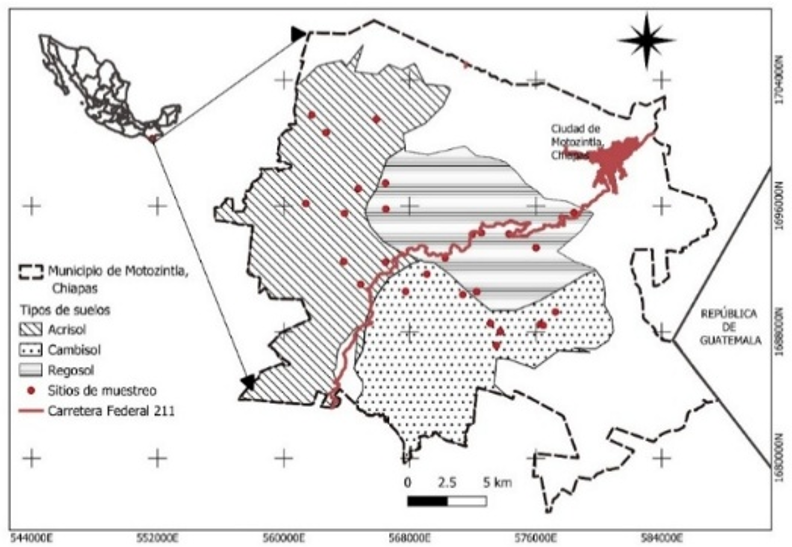
The studied coffee plantations ( Coffea arabica L.) are located in the municipality of Motozintla de Mendoza, Chiapas ( Figure 1 ) (15.300218°, -92.380043°), between 700 and 2 000 masl. Coffee plantations in the lowlands overlap with tall tropical evergreen forest; those at intermediate altitudes overlap with dry tropical forest and pine-oak associations; and those in the highlands overlap with cloud forest and pine forest ( INEGI, 2005 ; INEGI, 2017 ).
In the area, the soil types present are Acrisol, Cambisol, and Regosol ( INEGI, 2015 ); the average annual rainfall ranges from 3 000 to 3 500 mm; temperatures range from 20 to 24°C ( INEGI, 2007 ) and the slopes are steep ( INEGI, 2024 ). Coffee is classified as traditional polyculture; that is to say, it is grown under the regulated shade of trees and combined with other plants of agricultural interest ( Verdugo-Morales et al ., 2025 ).
A stratified sampling was implemented, and nine plots per soil type (Acrisol, Cambisol and Regosol) were randomly selected. In each plot, a 25 x 25 m2site was delimited ( Rosas et al ., 2008 ) and 10 soil subsamples were randomly collected from the first 15 cm of depth, at the level of the drip line of the plants and at the upper part of the slope. One kilogram was taken from the mixed subsamples and labeled with a code for identification.
The samples were air-dried, screened with a 2 mm sieve, and processed at the Faculty of Forestry Sciences of the Autonomous University of Nuevo León. In Table 1 describes the variables and methods used.
| Variable | Method |
|---|---|
| BD= bulk density (g cm-3) | Cylinder method ( Woerner, 1989 ) |
| pH= potential of hydrogen | pH in water ( SEMARNAT, 2000 ) |
| CE= electrical conductivity (µS cm-1) | 1:5 soil-water suspension ( Woerner, 1989 ) |
| MO= organic matter (%) | Walkley and Black ( SEMARNAT, 2000 ) |
| N= nitrogen (%) | Micro-Kjeldahl ( SEMARNAT, 2000 ) |
| K= potassium (mg kg-1) | Atomic absorption spectrophotometry ( SEMARNAT, 2000 ) |
| P= phosphorus (mg kg-1) | Colorimetry ( SEMARNAT, 2000 ) |
| Ca= calcium (cmol(+) kg-1) | Atomic absorption spectrophotometry ( SEMARNAT, 2000 ) |
| Mg= magnesium (cmol(+) kg-1) | Atomic absorption spectrophotometry ( SEMARNAT, 2000 ) |
| Mn= manganese (mg kg-1) | DTPA-TEA-CaCl2 ( SEMARNAT, 2000 ) |
| Fe= iron (mg kg-1) | DTPA-TEA-CaCl2 ( SEMARNAT, 2000 ) |
| Zn= zinc (µg g-1) | DTPA-TEA-CaCl2 ( SEMARNAT, 2000 ) |
| Cu= copper (mg kg-1) | DTPA-TEA-CaCl2 ( SEMARNAT, 2000 ) |
Once the results met the assumptions of parametric statistics ( West, 2022 ), including Shapiro-Wilk normality (Shapiro and Wilk, 1965) and Levene’s homogeneity of variances ( Levene, 1960 ), they were contrasted using an analysis of variance according to a randomized block design at a significance level of 95%.
The soils studied are very similar, except for their phosphorus, iron, and copper contents ( Table 2 ).
Bulk density and electrical conductivity were similar among soils. The average bulk density is 0.96 g cm-3, similar to that of organic and volcanic soils ( SEMARNAT, 2000 ). These values of less than 1 g cm-3found in coffee-growing soils are similar to those found in forest soils ( Acevedo et al ., 2010 ; Vázquez et al ., 2015 ; Gema et al ., 2022 ).
Similarly, the electrical conductivity is classified as negligible, at 167.1 μS cm-1(0.167 dS m-1) ( SEMARNAT, 2000 ), and is lower than the critical value for coffee crops, which is 1.1 dS m-1( Sadeghian and Zapata, 2014 ). This is explained by abundant rainfall ( INEGI, 2006 ), as increased rainfall promotes greater salt leaching from the soil ( Mata et al ., 2014 ).
pH and organic matter showed no statistically significant differences among soil types. An average pH of 5.2 is considered moderately acidic ( SEMARNAT, 2000 ) and is within the optimal range for coffee crops, which is between 5 and 5.5. ( Sadeghian, 2016 ).
Tropical soils are naturally acidic ( Rodriguez et al ., 2020 ); however, a process of increased acidification can occur as one transitions to intensive agriculture, leading to nutrient assimilation problems ( Cruz et al ., 2020 ). OM registered an average of 6.05%, which, according to the classification of SEMARNAT (2000) , is considered low. For coffee crops, 8-16% OM is recommended for optimal production ( Sadeghian, 2019 ).
Despite the constant flow of plant residues from tree cover, the incorporation of organic matter into the soil may be primarily conditioned by land slope and the lack of conservation works ( Andrade and Rodríguez, 2002 ). Nonetheless, it is also noted that the OM found in these coffee plantations is higher than that reported in soils with intensive crops, such as corn with 1.7, 2.58, and 3.45% ( Lopez et al ., 2019 ; Martinez et al ., 2020 ), sugarcane with 3.93 and 4.28% ( Retureta et al ., 2020 ), or in mango with 2.83% ( Ordaz et al ., 2020 ).
Nitrogen and potassium did not show significant differences, but phosphorus did (p= 0.0004). The average nitrogen was 0.3%, classified as intermediate ( SEMARNAT, 2000 ), and is similar to that reported by Rosas et al . (2008) in the same region (0.33%); both results are below the recommended range, which is between 0.34 and 0.58% of N ( Sadeghian, 2019 ). Cristóbal et al . (2019) found N values of 1.4% in the soils of a cloud forest, 0.73% in a traditional coffee plantation and 0.3% in a sun-grown coffee plantation.
The available phosphorus content exhibited significant differences, with Cambisols registering the highest values (213 mg kg-1), compared to Acrisols (46.03 mg kg-1) and Regosols (41.7 mg kg-1); nevertheless, from a nutritional standpoint, all three values are considered high ( SEMARNAT, 2000 ). The differences in phosphorus are determined by the content of apatites and phosphates derived from the bedrock and, to a lesser extent, by the biotic fraction ( Cerón and Aristizábal, 2012 ).
Young soils have high phosphorus contents ( IUSS Working Group WRB, 2015 ) due to constant leaching from the bedrock; however, only a reduced or labile fraction is available to plants ( Tapia and García, 2012 ).
Potassium did not differ among soil types and averaged 236.47 mg kg-1, considered a high level ( SEMARNAT, 2000 ), above the recommended values for coffee production, which range from 78 to 156 mg kg-1( Sadeghian, 2019 ). This nutrient is primarily associated with clays ( Rodriguez et al ., 2023 ) and bedrock leaching ( Borges et al ., 2005 ).
Calcium and magnesium did not show statistical differences. Their average concentrations were 9.84 cmol(+) kg-1and 2.14 cmol(+) kg-1, respectively, and are classified as medium levels ( SEMARNAT, 2000 ). Calcium is an abundant element in soils and is rarely the limiting factor ( Rincón et al ., 2003 ).
For coffee crops, the recommended range is 1.5 to 3 cmol(+) kg-1( Sadeghian, 2019 ). Magnesium is a nutrient of mineral origin, and its presence is due to dolomite rocks, silicates, or clays such as chlorite, illite, montmorillonite or vermiculite ( Ferreira et al ., 2023 ). The recommended optimal concentration for coffee production is between 0.6 and 0.9 cmol(+) kg-1( Sadeghian, 2019 ). Both nutrients are above the level recommended for coffee crops.
Manganese and zinc did not differ among soil types, and their averages were 21.01 mg kg-1and 1.19 μg g-1, being adequate and deficient, respectively ( SEMARNAT, 2000 ). The recommended levels for coffee crops should be between 5 and 10 mg kg-1of Mn and 1.5 to 3 μg g-1of Zn; therefore, the soils are adequate in manganese and deficient in zinc ( Sadeghian, 2019 ). It has been documented that sandy, calcareous and organic soils have the lowest zinc values ( Noulas et al ., 2018 ).
Copper and iron showed significant differences (p= 0.029 and 0.039). Copper was 0.51 mg kg-1in Regosols, 0.16 mg kg-1in Cambisols and 0.38 mg kg-1in Acrisols. According to the classification of SEMARNAT (2000) , these levels are considered sufficient for Regosols and deficient for the other soils. Nonetheless, for the specific needs of coffee, Sadeghian (2019) reported that the soil must contain between 1 and 3 mg kg-1of Cu; therefore, the soils studied are deficient in this aspect.
Iron averaged 30.8 mg kg-1in Acrisols, 44.18 mg kg-1in Cambisols and 51.3 mg kg-1in Regosols, all of which are considered adequate levels by SEMARNAT (2000) . In coffee-growing soils, between 25 and 50 mg kg-1are recommended ( Sadeghian, 2019 ).
The soils of the agroforestry systems of coffee under shade, traditionally cultivated, with minimal management and inputs, do not present compaction or salinity problems; the acidity throughout the study area is moderate and is within the tolerable range for coffee crops; however, the use of agricultural amendments to reduce acidity is necessary to improve productivity. Similarly, no differences were found in phosphorus, copper and iron contents.
The primary and secondary macronutrients in the soil of the studied region are found in concentrations recommended for coffee crops, except for nitrogen. Organic matter, although it did not have the recommended levels for this crop, remains at a high level compared with intensive agricultural crops.
The micronutrient (Zn and Cu) deficiencies are explained by the parent material rather than by the management of the agroforestry system. This confirms the importance of agroforestry schemes in soil conservation.
Cristóbal-Acevedo, D.; Tinoco-Rueda. J. A.; Prado-Hernández, J. V. y Hernández-Acosta, E. 2019. Carbono y nitrógeno del suelo en los sistemas bosque mesófilo de montaña, agroforestal y monocultivo de café. Revista Chapingo Serie Ciencias Forestales y del Ambiente. 25(2):169-184. Doi: https://doi.org/10.5154/r.rchscfa.2018.09.070.
Cruz-Macias, W. O.; Rodríguez-Larramendi, L. A.; Salas-Marina, M. A.; Hernández-García, V.; Campos-Saldaña, R. A.; Chávez-Hernández, M. H. y Gordillo-Curiel, A. 2020. Efecto de la materia orgánica y la capacidad de intercambio catiónico en la acidez de suelos cultivados con maíz en dos regiones de Chiapas. México. Revista Terra Latinoamericana. 38(3):475-480. Doi: https://doi.org/10.28940/terra.v38i3.506.
Martínez, A. F. B.; Guevara H. F.; Aguilar J. C. E.; Rodríguez, L. L. A.; Reyes S. M. B. y O-Arias, M. A. 2020. Caracterización físico-química y biológica del suelo cultivado con maíz en sistemas convencional, agroecológico y mixto en la Frailesca, Chiapas. Revista Terra Latinoamericana. 38(4):871-881. Doi: https://doi.org/10.28940/terra.v38i4.793.
Ordaz G. J.; Rodríguez, M. M. N.; García, C. J. L. y Pimentel, E. J. L. 2020. Estrategias de manejo en huertas de mango y su efecto en la calidad del suelo y productividad en Los Cajones, Michoacán. Revista Mexicana de Ciencias Agrícolas. 11(5):1057-1068. Doi: https://doi.org/10.29312/remexca.v11i5.2127.
Verdugo-Morales, E. G.; Yáñez-Díaz, M. I.; Alanís-Rodríguez, E.; González-Rodríguez, H.; Garza-Ocañas, F. y Rodríguez-Larramendi, L. 2025. Riqueza de especies, estructura horizontal y diversidad arbórea en un gradiente altitudinal en cafetales de Chiapas. Revista Mexicana de Ciencias Forestales. 16(88):148-173. Doi: 10.29298/rmcf.v16i88.1506.