elocation-id: elocation-id: e4168
The agroecological transition at the territorial level must promote reconnection between the production of agricultural products, food, goods and waste in the environments where they are generated, so it is necessary to understand their potential for reintegration into agroecosystems. In 2023, territories with greater agricultural diversity were identified within the rural development districts of the state of Veracruz, and the availability of agricultural waste for territorial reintegration was estimated through the analysis of statistical information and knowledge from key informants. The rural development districts of Fortín, Coatepec and Martínez de la Torre showed high agricultural diversity (3.45, 2.83 and 2.53, respectively), associated with a greater variety of agricultural waste; in contrast, productive diversity (3.05, 2.52 and 2.28) is related to the potential for agricultural waste production. The rural development districts of Coatepec and Martínez de la Torre showed greater territorial potential to generate agricultural waste. Estimates of losses in Coatepec for coffee crops range from 3 to 5%; for its part, Martínez de la Torre showed 1.5-5% agricultural waste generation in lemon. This methodology represents a first step to identify the potential of agricultural waste in territories for its reintegration through agroecological practices.
agricultural diversity, agroecological practices, territorialization.
In agricultural systems (AS), diversification, defined as the increase in crops and other productive components that coexist in the system, is considered a key strategy to improve socioeconomic and ecological aspects; nevertheless, this increase in crop diversity is associated with greater production of agricultural waste (AW) generated directly from crops ( Gutiérrez-Briceño et al ., 2025 ). In 2025, global AW production exceeds 1.9 million tonnes, whereas in Mexico, more than 286 t of AW are estimated to be generated annually ( Xu et al ., 2025 ).
Faced with this scenario, the transition from conventional agricultural models to agroecological models is proposed as an alternative to reintegrate AW into the same AS from which it is generated, based on the central agroecological principle of recycling ( Wezel et al ., 2020 ).
The agroecological transition at the territorial level requires two structural principles: 1) participation by farmers and advisors in acquiring agroecological knowledge and techniques in situ; and 2) territorialization, the reconnection of agricultural production with local food through the integration of AW ( Magrini et al ., 2019 ). Veracruz represents one of the states with the greatest agricultural diversity in Mexico ( Landeros-Sánchez et al ., 2011 ).
Therefore, in order to design territorial AW strategies in Veracruz, it is necessary to identify the territory with the potential for AW generation and, through agroecological practices that promote its recycling into the soil, to promote its territorial reintegration. This research aimed to identify the rural development districts (DDRs), by their Spanish initialism, with the greatest agricultural diversity in the state of Veracruz, through the analysis of official statistical information, and to estimate the potential for generation and reintegration of AW, through interviews with key informants and the consultation of secondary sources, as a basis for designing agroecological transition strategies.
The DDRs, technical-administrative regions, of the Secretariat of Agriculture and Rural Development (SADER), by its Spanish acronym were considered as the unit of analysis. The information was obtained from the statistical yearbook of agricultural production of the state of Veracruz from the Agrifood and Fisheries Information Service ( SIAP, 2023 ); to analyze crop distribution, the type of report selected was by crop-variety and flower crops were excluded as a selection criterion.
The variables of planted area (PA, ha) and production (P, t) by DDR were considered without distinguishing among cycles (cyclical-perennial) or modalities (irrigation + rainfed). The data were systematized in Excel® (V.18.0): 1) to determine the percentage of statewide distribution of PA and P; and 2) to use both variables as indicators of agricultural diversity and production by DDR.
This research employed the agricultural diversity index proposed by Gallardo-López et al . (2002) , based on Shannon’s model of biological diversity ( Shannon and Weaver, 1963 ). To obtain the agricultural diversity index of the DDRs, the index is as follows:
To calculate agricultural diversity (AD); ni= planted area by crop; N= total area by district; and for production diversity (PD); ni= production by crop; N= total production by district. Subsequently, the AW potential generated by DDR is described.
According to methodologies for global estimation of food losses ( Romero et al ., 2020 ), no methodology that included the producer’s role in generating AW from their own crops was identified.
Therefore, two types of key informants (KIs) were interviewed, based on the regions with the highest AD: 1) district chiefs and SADER technicians from the DDRs of Coatepec and Martínez de la Torre; and 2) eight producers in the territory (four for each district and for the crop with the highest production), to identify, based on their knowledge, the percentage of loss in the links of the value chains (VCs) (primary and agro-industrial production), type of management and revaluation routes.
The information was then analyzed by data triangulation (district chiefs, technicians, producers and scientific literature) ( Page-Reeves et al ., 2025 ). In this sense, qualitative research, such as that carried out in this section, is not determined by large sample sizes but by capturing key information within the territory studied ( Gutiérrez-Briceño et al ., 2025 ).
A total of 140 crops were identified, distributed across 12 DDRs; of these, only 10 crops accounted for more than 80% of the state of Veracruz’s territory ( Table 1 ). Corn crops account for the largest planted area, mainly destined for self-consumption ( Monroy-Sais et al ., 2024 ); likewise, sugarcane registered the highest production, due to its high industrial demand in relation to the presence of 17 of the 50 sugar mills in the country in Veracruz ( Solano et al ., 2023 ).
Regarding AD, the DDRs of Fortín, Coatepec, and Martínez de la Torre showed high crop diversity, which is associated with a greater variety of AW ( Table 2 ). In Fortín, sugarcane (34.97%), coffee (32.38%), corn (23%), beans (2.9%) and lemon (1.58%) predominate, and only 5.13% of the territory is planted with potatoes, chayote, oats, avocados and other crops.
In the DDR of Martínez de la Torre, corn (29.66%), oranges (25.06%), lemon (16.3%), coffee (11.17%), dominico bananas (2.65%), grapefruit (2.17%), tangelo (2.13%), plantain (1.31%), and giant dwarf bananas (1.28%) predominate; the remaining 7.68% comprises tangerine, sugarcane, beans, pepper, lychee, and watermelon.
In the DDR of Coatepec, the area is distributed as follows: corn (44.87%), coffee (25.08%), sugarcane (7.19%), broad beans (4.82%), potatoes (3.28%), beans (2.90%), manila mango, (1.65%), lemon (1.40%) and the remaining 7.59% corresponds to apple, wheat, avocado etc. The DDRs with low planted AD are La Antigua (1.7), Huayacocotla (1.66), and Tuxpan (1.65), because most of their territories are concentrated in sugarcane, corn, and orange crops, respectively.
Fortín presented the highest PD (3.05), followed by Coatepec (2.52) and Martínez de la Torre (2.28). This indicates that DDRs with high PD are associated with a possible diversification in tonnes of AW ( Table 2 ). In Fortín, 96.81% of its production is concentrated in sugarcane (87.9%), chayote (2.23%), coffee (1.98%), lilium (1.65%), gladiolus (1.51%) and corn (1.51%). The productive relevance of Fortín is linked to increased sugarcane production driven by the mills, and to regional flower markets that supply wholesale markets in other states ( Pérez and Aguilar, 2019 ; Linares-Gabriel et al ., 2021 ).
In Martínez de la Torre, second in PD, production is concentrated in orange (21.7%), lemon (17.74%), grapefruit (5.31%) and parlor palm (31.76%), and 19.68% corresponds to bananas (giant dwarf, dominico and plantain varieties), tangelo, sugarcane, coffee, tangerine, mandarin and pineapple, among others. This district stands out as Veracruz’s largest producer of lemons and oranges, consolidating its position as the nucleus of national citrus activity ( Franco-Valderrama et al ., 2021 ).
In the DDR of Coatepec, production is dominated by sugarcane (60%), followed by potatoes (10.75%), corn (8.24%), coffee (4.44%), agave (2.33%), oats (1.59%), lemon (1.39%), broad beans (1.2%), cane seeds (1.2%), red tomatoes (1.15%), and bananas (1.02%). The district’s relevance is associated with coffee growing as a strategic activity, as it integrates production chains and livelihoods for small producers ( Pérez and Aguilar, 2019 ). The DDRs of Tuxpan (1.57) and Huayacocotla (1.42) have lower PD indices, with a high concentration of production in a few crops: citruses in Tuxpan (94.63%) and corn and oranges in Huayacocotla (74.26%).
The DDRs of Fortín, Coatepec, and Martínez de la Torre are identified as having high AD and PD; however, Fortín is excluded as a priority district for AW generation because 96.8% of its production is concentrated in four crops (sugarcane, chayote, coffee and corn) and two flower crops (lilium and gladiolus). Consequently, Coatepec and Martínez de la Torre have the greatest territorial potential for the reintegration of AW, based on the AD (variety) and PD (production) of crops.
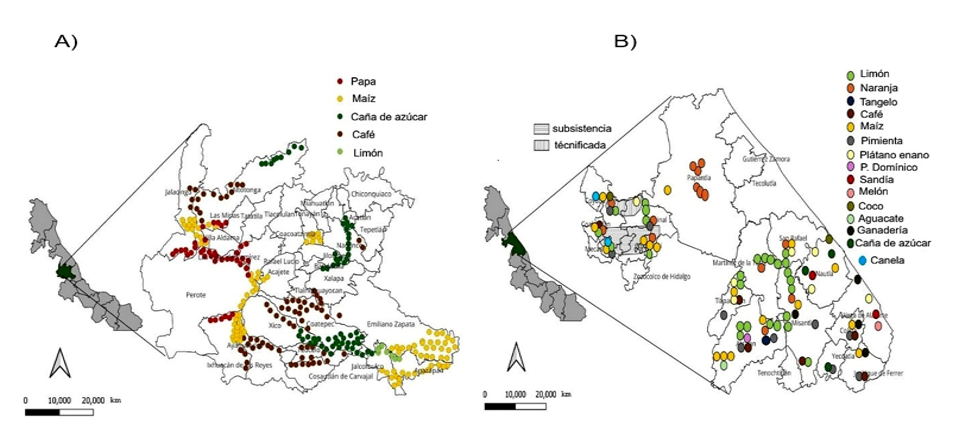
According to the district chief of Coatepec, coffee is grown in two areas, Altotonga-Jalacingo and Coatepec ( Figure 1 ), which differ in processing methods. In Coatepec, coffee is processed as cherries, with on-farm selection and agroecological management, whereas in the municipalities of Altotonga-Jalacingo, it is processed as parchment.
The technicians indicated that AW is produced at two stages: 1) primary production, pruning waste (branches and leaves) and fruits (dry, semi-dry and green); and 2) agro-industrial stage, husk and mucilage residues. The coffee producer from Coatepec pointed out that the management is mixed; that is, they apply chemical fertilizers and compost processing waste. In this sense, the management of AW, incorporated into their farms, is highlighted, and their capacity for territorialization experiences is evidenced ( Magrini et al ., 2019 ; Widiastuti et al ., 2024 ).
The coffee producer commented: ‘crop losses are estimated between 3 and 5%, and during the pulping process, 16 kg of cherry coffee is needed to obtain one kilogram of roasted coffee’. In other words, more than 90% of waste is generated at the coffee processing stage. This indicates that coffee has potential for utilization with agroecological practices ( Tamilselvan et al ., 2024 ).
Regarding sugarcane, the technicians reported a decrease in the planted area from the 2022-2023 period, associated with the transition to Persian lime and soil deterioration. This situation has driven the mill’s operational expansion to more distant territories; in this process, the municipalities of Jalcomulco, Apazapan and Tuzamapan reoriented their land use toward lemon cultivation ( Figure 1 ).
The district chief indicated that sugarcane is not a representative crop of the district, since its production is destined to the Mahuixtlán mill, and its management includes burning the crop to facilitate extraction. The producer from the municipality of Naolinco reported conventional management, in which the main AW is sugarcane stubble, which is collected by cutters from the same mill. The producer also estimated that between 20 and 30% of the foliage is burned to facilitate cutting; this pattern aligns with reports indicating that stubble and foliage represent 28% of the crop’s biomass ( Asava et al ., 2026 ).
Likewise, the producer pointed out the absence of information on agro-industrial losses along the VC and the lack of alternatives for managing AW in the crop. In this context, it is evident that producers do not reintegrate AW because they act according to the mill’s own guidelines ( Linares-Gabriel et al ., 2021 ).
As for corn, the technicians mentioned that it is used for self-consumption, with two types of management: 1) long cycle, in the highlands (Ixhuacán de los Reyes, Ayahualulco, Perote and Jalacingo), with planting in February and harvesting in November; and 2) short cycle, in the lowlands (Emiliano Zapata, Jalcomulco and Apazapan) with planting and harvesting in a period of four months ( Figure 1 ).
A producer from San Isidro Calzontepec reported that the AW from corn is used as forage, as plant cover for the soil, and for crushing foliage to reintegrate it into the agroecosystem. Regarding crop management, the producer mentioned mixed fertilization. In estimating the AW generated, none of the KIs established a specific percentage at any stage of the VC. Castillo-González et al . (2021) estimated that 50% of the production is harvested as grain, and the remaining 50% consists of residues such as stems, leaves, husks and panicles.
Potato crops. The technicians identified potatoes as one of the crops that has generated the greatest environmental impact in the DDR of Coatepec, with two management modalities: 1) commercial and agrochemical-intensive production; and 2) native potatoes for self-consumption. Nonetheless, they indicated that they did not know the percentage of AW generated.
The producer from the municipality of Perote described a similar context and reported intensive management with fungicides, insecticides, nematicides and rooting agents to optimize plant growth. The producer estimated that the AW generated during harvest is less than 5% and is limited to dry plant residues incorporated into the soil. This estimate contrasts with the literature, which reports a waste percentage of 12-20% of the total crop volume during harvest ( Chauhan et al ., 2023 ).
It is important to consider that the AW reintegration strategies of producers in the district of Coatepec (coffee and corn) arise as a response to the protection of their natural resources ( Linares-Gabriel et al ., 2021 ). Unlike other crops (sugarcane and potatoes), producers align their management with sugar mill standards and market demands.
In practice, the district chief and technicians highlighted the importance of citrus farming in the DDR, focused on lemon and orange crops, which predominate in the municipalities of Martínez de la Torre and Papantla; lemon is the most extensive crop in the municipalities of San Rafael, Misantla, Tlapacoyan, Atzalan and Espinal. Waste is used for food and non-food applications ( De Medina-Salas et al ., 2020 ).
In the municipalities of Espinal, Coxquihui and Mecatlán, the technicians noted that the distribution consists of small plots, with intercropped systems of corn and citruses, conditioned by the accessibility of rural areas. In the municipality of Coyutla, producers enrolled in the Sowing Life program, which promoted the diversification of crops such as cinnamon, coconut and pepper in backyard units under agroecological management. In this way, the relevance of links built around agroecological management by a government program became visible ( Long, 2007 ; Wezel et al ., 2020 ).
In the Tlapacoyan area, banana-coffee and banana-corn systems are interspersed. In Atzalan, production is divided into three regions: a region adjacent to Martínez de la Torre with citruses (tangelo and soursop) and, to a lesser extent, corn; an intermediate zone with bananas (dominico and dwarf) and coffee; and a lowland zone, where corn is the main crop. The technicians did not identify crop loss percentages or the types of AW generated in primary production; however, they noted that, in citrus farming, waste is minimal because citrus growers optimize their sales by quality standards: ‘first-grade and second-grade fruits are for international and local sale and third-grade fruits for agribusiness’.
For lemon, orange, grapefruit and tangelo crops, the four producers from Martínez de la Torre stated that lemon requires more careful management compared to the other crops, which require less soil care. The orange producer reported transitioning to agroecological practices, incorporating compost and mycorrhizal fertilization, aimed at soil regeneration.
Regarding the AW percentage, the lemon producer indicated that, in order to maintain the crop’s profitability, losses must be kept below 5%. For grapefruit and lemon crops, producers mentioned that losses are linked to price volatility, which can lead to the product not being harvested or marketed, even when it is in adequate condition.
This indicates that citrus farmers prioritize the commercial value of their product; according to Long (2007) , an AW reintegration strategy is not a specific problem of the territory, although there is evidence of experience of AW reintegration in some municipalities.
In the VC of citruses, the district chief, technicians and producers recognized that the greatest generation of waste occurs at the agro-industrial stage, which aligns with the literature indicating that about 50% of the fruit’s weight is transformed into juice and the other 50% corresponds to peel and seed ( De Medina-Salas et al ., 2020 ). At the plot level, producers estimated losses of 5%, which contrasts with what has been reported in the literature for primary production (1.5%) due to harvesting and fruit detachment ( Romero et al ., 2020 ).
The research allowed us to identify the DDRs of Coatepec and Martínez de la Torre as territories with potential for the generation and reintegration of AW, as they presented the highest AD and PD values.
It is suggested that, in future studies, the role of KIs be considered a key element in gathering information for designing territorial strategies for the reintegration of AW, along with a more detailed analysis at the municipal level to integrate direct measurements of AW and to evaluate the technical feasibility of its agroecological use.
Gutiérrez-Briceño, I.; Pérez-Ramírez, I.; Yacamán-Ochoa, C.; Lucantoni, D.; Vizuete, B.; Hevia, V.; González, J. A.; Schwarz, G. and García-Llorente, M. 2025. Unravelling agroecological transitions: a multidimensional study of the horticultural sector in Madrid. International Journal of Agricultural Sustainability. 23(1):2551423. https://doi.org/10.1080/14735903.2025.2551423.
Long, N. 2007. Sociología del desarrollo: una perspectiva centrada en el actor. In: una sociología del desarrollo orientada al actor. Horacia-Fajardo, V. M. y Rodríguez, P. (Eds.). Centro de Investigaciones y Estudios Superiores de Antropología Social (CIESAS) y el Colegio de San Luis (COLSAN). México. 33-73 pp.
Magrini, M. B.; Martin, G.; Magne, M. A.; Duru, M.; Couix, N.; Hazard, L. and Plumecocq, G. 2019. Agroecological transition from farms to territorialized agri-food systems: issues and drivers. In: agroecological transitions: from theory to practice in local participatory design. Bergez, J. E.; Audouin, E. and Therond, O. (Eds.). Springer: Cham. Switzerland. 69-98 pp. https://doi.org/10.1007/978-3-030-01953-2-5.
Monroy-Sais, A. S.; Tobin, D.; Bellon, M. R.; Astier, M.; Cibrián-Jaramillo, A.; Gálvez-Reyes, N.; Mastretta-Yanes, A; Ruiz-Arocho, J.; Wegier, A. and Chen, Y. H. 2024. Smallholder farmers’ diverse values in maize landrace conservation: a case study from Chiapas, Mexico. Journal of Rural Studies. 110 (1):103347-103359.
Page-Reeves, J.; Rivera, M.; Lozano, E.; Regino, L.; Tellez, M.; Mendivil-Aguayo, P.; Moore, M.; Rodríguez, D. P.; Kalves, A.; Crocker, R.; Aragon, A.; Vasquez, C.; Perez, J.; Thomas, R. J.; Bearer, E. L. and Murray-Krezan, C. 2025. Interpreting discordant results in mixed-method research: data triangulation, participant voices, and epistemic issues in health research. International Journal Of social research methodology. 1(1):1-22. https://doi.org/10.1080/13645579.2025.2569682.
Wezel, A.; Herren, B. G.; Kerr, R. B.; Barrios, E.; Gonçalves, A. L. R. and Sinclair, F. 2020. Agroecological principles and elements and their implications for transitioning to sustainable food systems. A review. Agronomy for Sustainable Development. 40(1):1-13. https://doi.org/10.1007/s13593-020-00646-z.
Widiastuti, Y.; Koestiono, D.; Setiawan, B. and Riana, F. D. 2024. Sustainability analysis of the robusta coffee supply chain in banyuwangi regency: a multidimensional approach with rap-robusta coffee method. Nongye Jixie Xuebao/transactions of the Chinese Society of Agricultural Machinery. 55(2):28-48. https://doi.org/10.62321/issn.1000-1298.2024.02.03.