elocation-id: elocation-id: e4154
Livestock farming largely depends on the supply of forage that allows animals to maintain production year-round. This research aimed to evaluate the effect of the cut day on the dry matter yield, structural characteristics, and bromatological analysis of Camello grass (hybrid Urochloa ) during the rainy and dry seasons. The variables evaluated were dry matter yield, structural characteristics, and bromatological analysis. The treatments were cuts at 10, 20, 30, 40, 50 and 60 days during the rainy and dry seasons. The data were analyzed using a completely randomized block design. The highest dry matter (DM) yield was obtained at 50 days after cutting during the rainy season, at 2 905 kg ha-1DM and the lowest at 10 days after cutting, at 34 kg ha-1DM during the rainy season (p< 0.05). On the other hand, the highest crude protein (CP) content was observed during the rainy season, regardless of the day after cutting (p< 0.05). On the contrary, the results of neutral detergent fiber and acid detergent fiber tended to increase as the age of the plant advanced. The highest yield, highest leaf growth and acceptable bromatological quality in Camello grass are obtained 50 days after cutting.
forage, grass, production, tropics.
Tropical livestock farming largely relies on the supply of grasses that allow animals to maintain production throughout the year, and they are the most economical and sustainable source in livestock units, being a fundamental part of animal feed ( Hernández et al ., 2012 ; Rojas et al ., 2017a ).
In this sense, forage grasses constitute the backbone of animal feeding systems, thanks to their ability to produce biomass efficiently, adapt to varied agroclimatic conditions, and contribute to the production system’s sustainability ( Hernández-Canul et al ., 2024 ; Medrano-Escobar et al ., 2024 ; Rojas et al ., 2024 ).
The low nutritional value of forage grasses in tropical regions is mainly due to the plant’s genetic characteristics ( Torres et al ., 2020 ) and poor management of the pastures, which limits the production of grazing ruminants ( Da Silva et al ., 2015 ; Rojas et al ., 2017b ). These plants have a high content of cell walls and low concentration of crude protein; consequently, forage digestibility and voluntary consumption of animals are affected ( Aguirre et al ., 2025 ).
Authors such as Rojas-García et al . (2018) , when evaluating the Cobra grass (hybrid Urochloa BR02/1794), obtained a yield of 1 200 kg ha-1DM in leaf with 21% CP at 35 days of regrowth and at an intensity of 15 cm. In a study conducted by Maldonado-Peralta et al . (2024) , when evaluating different hybrid Urochloa grasses, they obtained the highest yield at 49 days after cutting in Mulato II and Convert 330 grasses, with 5 450 and 3 900 kg ha-1DM, respectively, and for the Convert 431 grass, the highest value occurred on day 56, with 3 000 kg ha-1DM.
Nevertheless, in Mexico, there is limited research on the management and hybrids of Urochloa under the conditions of the dry tropics; therefore, the objective of the present study was to evaluate the effect of the cut day on dry matter yield, stem dynamics, tissue replacement and bromatological analysis of Camello grass (hybrid Urochloa ) during the rainy and dry seasons, to determine the optimal time for use. The hypothesis was that the best structural and quality characteristics will be obtained when Camello grass is harvested at 50 days of regrowth.
The study was conducted from August 10, 2024, to August 10, 2025, in Iguala de la Independencia, in the northern region of the state of Guerrero, located at 18° 21’ 55.5” north latitude and 99° 34’ 35.3” west longitude, at 930 masl, with a warm subhumid climate (Aw; García, 2004 ). The soil had a sandy clay texture, a pH of 5, and was deficient in organic matter, with 1.5%.
The bromatological analyses were carried out from August to September 2025 at the experimental unit of the Pinotepa Technological Institute, located at kilometer 26 of the Pinotepa Nacional, Oaxaca-Acapulco, Guerrero highway, in the locality of San José Estancia Grande, Oaxaca, at 16° 21’ 35.55” north latitude and 98° 14’ 59.51” west longitude, at 60 masl ( García, 2004 ).
The average annual temperature during the study period was 26.9 °C. Rainfall was 1 075 mm during the rainy season (August to December 2024) and 51 mm during the dry season (January to July) ( Figure 1 ), for a total annual rainfall of 1 126 mm. During the dry season, gravity irrigation was applied to field capacity every tres days.

Climatic data were obtained from the Conagua agrometeorological station, located 1 000 m from the experimental site ( Conagua, 2025 ). During the dry season, sprinkler irrigation was applied every eight days, for a total of 24 irrigations, with a net irrigation sheet of 748 mm, given that the annual accumulated rainfall was 1 874 mm.
The hybrid Urochloa grass Camello was sown on August 10, 2024, at a density of 8 kg ha-1of viable pure seed. The plants were then allowed to grow for 60 days before the uniformization cut. Six experimental plots, each measuring 5 × 5 m, were established. Given the 10% slope of the uneven terrain, the design was a randomized complete block design with three replications.
The factor evaluated was the number of days of pasture growth, with cuts at 10, 20, 30, 40, 50 and 60 days after planting (DAS). At each age, the following variables were measured: dry matter yield (DMT; kg ha-1), tissue replacement, leaf:stem ratio, weight per stem, CP, NDF and ADF.
Two applications of chemical fertilizer were made: one during the rainy season and the other during the dry season, at the time of the uniformization cut. The fertilizer contained 18N-8P-8K and its commercial name was sugarcane mixture. It was applied in a localized manner at a rate of 10 g plant-1, providing a total of 400 kg ha-1for the two applications.
Sampling was conducted during the rainy season on October 10 and during the dry season on March 30, 2025. Ten days before starting the evaluation cuts, a homogenization cut was made at a residual height of 15 cm.
During each sampling period, after the uniformization cut, two 50 × 50 cm squares were harvested from each experimental plot at 10-day intervals until 60 days of regrowth, leaving a residual area of 15 cm. The harvested forage was washed and then dried in a forced-air oven at 55 °C until a constant weight was reached and the weight was recorded. This value subsequently served as a basis for estimating the dry matter yield per hectare ( Rojas et al ., 2019 ).
Total growth, net growth and leaf senescence were evaluated in a 2 m long transect, where five stems of each plant were randomly selected and identified with wire rings of different colors. On the selected stems, the length of the leaf blade was measured from the base of the ligule to the apex in green leaves or to the base of the chlorotic tissue in senescent leaves ( Rojas et al ., 2024 ).
To estimate the leaf:stem ratio, two 50 × 50 cm quadrants were taken per experimental plot every 10 days, leaving a residual height of 15 cm. The collected material was manually separated into leaves and stems, then dried in a forced-air oven at 55 °C until a constant weight was obtained. The leaf:stem ratio was calculated as the quotient of the leaf dry weight and the stem dry weight.
To determine the weight per stem, 10 stems from each plot were randomly selected every 10 days until day 60. They were cut at ground level, then dried in a forced-air oven at 55 °C until a constant weight was reached, and their weight was recorded. The reported value was the average of the 10 harvested stems. The average weight per stem was calculated by dividing the total weight by the number of stems harvested.
The dry samples used to determine dry matter yield were also used to determine CP content using the method described by the AOAC (2005) . NDF and ADF were determined using the method of Van Soest et al . (1991) . All laboratory analyses were performed in triplicate.
The data collected were analyzed using a completely randomized block design with split-split plots, with three replications. The procedure used for the analysis was the PROC GLM of SAS (2011) , in which the effects of cut frequency and season of the year were treated as fixed effects, and a linear regression analysis was used for the dry matter yield variable. Multiple comparisons of treatment means were performed using Tukey’s test (α= 0.05).
The dry matter yield of Camello grass is shown in Figure 2 , with differences among cut days and seasons of the year (p< 0.05). The highest yield was obtained at 50 days during the rainy season, at 2 905 kg ha-1DM, while the lowest value occurred at 10 days after cutting, at 234 kg ha-1DM (p< 0.05). Notably, the yield was low until day 30, increased from day 40 to day 50 and then decreased (p< 0.05).

The increase in yield with regrowth age can be explained by leaf expansion ( Hernández et al ., 1997 ; Aniano-Aguirre et al ., 2022 ), stem thickening, and greater photosynthetic efficiency of the plant in advanced developmental stages ( Lucio-Ruiz et al ., 2023 ), as observed in this research from 30 day after cutting.
Similarly, in the study by Rojas et al . (2024) on Mulato II grass, the dry matter yield was higher for cuts during the rainy season and when the remaining height after harvest was 15 cm. The study reported the highest yields at 49 days of regrowth during the rainy season, at 1 800 kg DM ha-1and at 63 days in the dry season, at 1 560 kg DM ha-1.
For its part, the study by Rojas-García et al . (2018) , when evaluating the hybrid Urochloa grass ‘Cobra’, reported similar overall behavior and outcomes: growth increased with regrowth age, peaked and then decreased. The highest dry matter yield was obtained at 56 days at 2 550 kg ha-1DM, and the lowest at 8 days of cutting, at 250 kg ha-1DM (p< 0.05).
Figure 3 shows the leaf growth, leaf:stem ratio, and weight per stem of Camello grass as the day of cut and the season of the year vary. Regarding leaf elongation, it was higher on average during the rainy season and lower during the dry season; both reached the highest elongation value on day 50 after cutting, at 290 and 280 cm stem-1, respectively (p< 0.05). Net growth followed a similar pattern, with the highest values on day 50, at 340 and 319 cm stem-1for the rainy and dry seasons, respectively (p< 0.05).
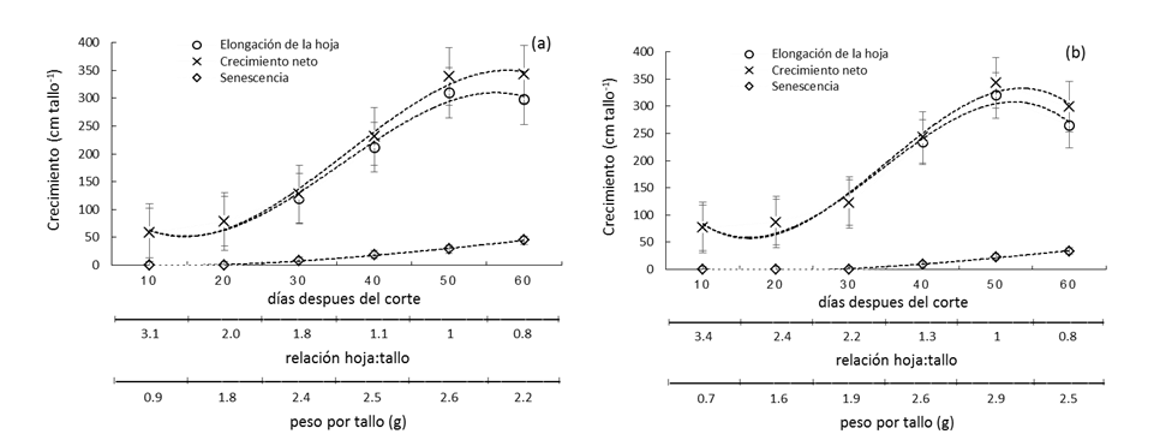
During the rainy season, senescence began at 30 days after the homogenization cut; for the dry season, it began at 40 days after, with no differences between them, with an average of 32 cm stem-1. The leaf:stem ratio was slightly higher during the dry season, with an average of 1.9, and lower during the rainy season, with 1.8 (p< 0.05).
In contrast, the highest leaf:stem ratio was obtained at the cut on day 10, with values of 3.4 and 3.1 for the dry and rainy seasons, respectively, and the lowest on day 60, with an average of 0.8 (p< 0.05). As for the weight per stem, it varied with the season of the year, tending to increase to 2.8 g until day 50 and then decrease to 2.4 g by day 60 (p< 0.05).
Rojas et al . (2024) , when evaluating Mulato II grass, found that the highest net growth was obtained at 49 days and behaved as follows: 15 cm-rainy seasons ˃15 cm-dry season ˃10 cm-rainy season ˃10 cm-dry season, with 340, 290, 270 and 240 cm stem-1, respectively (p< 0.05). In this same study, they reported the highest leaf:stem ratio for regrowth ages between 7 and 21 days, with an average of 6.1 (p< 0.05), and an average stem weight of 2.9 g, which increased with regrowth age up to 49 days after harvest.
The higher temperatures and precipitation during the rainy season result in a higher rate of tissue replacement ( Cruz et al ., 2017a ), greater weight per stem, and active growth of pastures, primarily due to the availability of moisture ( Cámara-Acosta et al ., 2022 ; Garay-Martínez et al ., 2022 ).
The contents of CP, NDF and ADF in the whole Camello grass plant, as the cut days and season of the year progressed, are observed in Table 1 . Regarding CP, it tended to decrease as regrowth age increased, in both seasons of the year (p< 0.05). On the other hand, the highest CP content was obtained during the rainy season, regardless of the day after the cut (p< 0.05).
In contrast, NDF and ADF tended to increase as the days of regrowth progressed. NDF exhibited slightly higher values during the dry season than during the rainy season. Conversely, ADF values were slightly higher in the rainy season than in the dry season, regardless of the cut days.
For their part, in Urochloa grasses, Maldonado-Peralta et al . (2024) reported that the Convert 330 and Mulato II grasses obtained the highest CP value in the whole plant, with 16% crude protein and the Convert 431 grass obtained the lowest value, with 15% crude protein (p< 0.05). Previous research ( Cruz et al ., 2017b ; Godína-Rodríguez et al ., 2025 ) found that protein contents in tropical cultivars are affected by the redistribution of nitrogen towards morphological structures, causing a constant decrease over time.
Similarly, in growth curves in Mulato II grass ( Urochloa ), Rojas et al . (2024) reported behavior similar to that of the present research in the contents of NDF and ADF, which tended to increase as the regrowth age advanced, with slightly higher values of NDF being observed during the dry season than during the rainy season.
The best yield, leaf growth, weight per stem and leaf:stem, combined with an acceptable crude protein, neutral detergent fiber and acid detergent fiber in Camello grass, both during the rainy and dry seasons, are obtained when the regrowth is 50 days old; however, between seasons, the one with better yield and quality characteristics was the rainy season.
It is recommended to continue evaluating this grass over a longer evaluation period to broaden the range of decisions in the dry tropics of Mexico.
Aguirre, H. A.; Maldonado-Peralta, M. Á.; Rojas-García, A. R.; Lozano-Aguirre, E. T.; Hernández-Marín, J. A. y Castañeda, L. J. 2025. Pastoreo de becerros en pradera de estrella de África (Cynodon plectostachyus) suplementados con alimento comercial. Ecosistemas y Recursos Agropecuarios. 12(1):e4042. Doi: doi.org/10.19136/era.a12n1.4042.
Aniano-Aguirre, H.; Maldonado-Peralta, M. Á.; Gasga-Pérez, L.; Pelaez-Estrada, U. V.; Hernández-Marín, J. A. y Rojas-García, A. R. 2022. Características estructurales de pastos: Mulato II, Convert 330 y Convert 431 (Urochloa híbrido). Revista Mexicana de Ciencias Agrícolas. 13(5):863-872. https://doi.org/10.29312/remexca.v13i5.3230.
Cámara-Acosta, J.; Enríquez-Quiroz, J. F.; Rueda-Barrientos, J. Á.; Ortega-Jiménez, E.; Ramírez-Bribiesca, J. E. y Guerrero-Rodríguez, J. D. 2022. Dinámica de tallos del pasto Urochloa híbrido cv. Cobra en respuesta al tiempo de corte. Revista Fitotecnia Mexicana. 45(3):303-311. Doi: https://doi.org/10.35196/rfm.2022.3.303.
Cruz, A.; Hernández, A.; Chay, A. J.; Mendoza, S. I.; Ramírez, S.; Rojas, A. R. y Ventura, J. 2017b. Componentes del rendimiento y valor nutritivo de Brachiaria humidicola cv Chetumal a diferentes estrategias de pastoreo. Revista Mexicana de Ciencias Agrícolas. 8(3):599-610. Doi: 10.29312/remexca.v8i3.34.
Garay-Martínez, J. R.; Estrada-Drouaillet, B.; Martínez-González, J. C.; Joaquín-Cancino, S.; Guevara-Costles, H. P.; Acosta-Jácome, M. V. y Cienfuegos-Rivas, E. G. 2022. Rendimiento y digestibilidad de forraje de cultivares de Urochloa spp. a tres edades de rebrote en épocas de lluvias y seca. Revista Mexicana de Ciencias Pecuarias. 13(1):297-310. https://doi.org/10.22319/rmcp.v13i1.5265.
Godina-Rodríguez, J. E.; Lucio-Ruiz, F.; Garay-Martínez, J. R.; Orzuna-Orzuna, J. F. y Joaquín-Cancino, S. 2025. Producción y valor nutritivo de forraje de pasto Mulato II cosechado a diferente intervalo e intensidad de corte. Revista Bio Ciencia. 12(e1902):1-16. https://doi.org/10.15741/revbio.12.e1902.
Hernández, A.; Martínez, P. A.; Zaragoza, J. L., Vaquera, H.; Osnaya, F.; Joaquín, B. M. y Velasco, M. E. 2012. Caracterización del rendimiento de forraje de una pradera de alfalfa-ovillo al variar la frecuencia e intensidad de pastoreo. Revista Fitotecnia Mexicana. 35(3):259-266. Doi: 10.35196/rfm.2012.3.259.
Hernández-Canul, D.; Cruz-Hernández, A.; Gómez-Vázquez, A.; Govea-Luciano, A.; Ramírez-Bribiesca, J. E.; Placencia-Jorquera, A.; Cordoba-Izquierdo, A. and Martínez-Martínez, R. 2024. Production and quality of meat from hair sheep grazing on Tanzania grass and supplemented with different protein levels. Agroproductividad. 16(12):3-12. https://doi.org/10.32854/agrop.v16i12.2762.
Maldonado-Peralta, M. Á.; Aniano-Aguirre, H.; Rojas-García, A. R.; García-Montalvo, I. A.; Ortega-Acosta, S. A. y Martínez-Vázquez, J. 2024. Rendimiento y valor nutritivo de pastos Urochloa híbrido en el trópico seco de México. Ecosistemas y Recursos Agropecuarios. 11(4):e4032. Doi:10.19136/era.a11nIV.4032.
Medrano-Escobar, A. R.; Martínez B. C. C.; Martínez, A. Y.; Verdecia, A. D. M. and Herrera, R. S. 2024. Nutritive quality of Cenchrus purpureus (Schumach.) Morrone cv. Cuba CT-115 under edaphoclimatic conditions of Honduras. Cuban Journal of Agricultural Science. 58:1-10. https://cu-id.com/1996/v58e03.
Rojas, G. A. R.; Hernández, A.; Rivas, M. A.; Mendoza, S. I.; Maldonado, M. A. y Joaquín, S. 2017b. Dinámica poblacional de tallos de pasto ovillo (Dactylis glomerata L.) y ballico perenne (Lolium perenne L.) asociados con trébol blanco (Trifolium repens L.). Revista Facultad de Ciencias Agrarias. 49(2):35-49. https://www.redalyc.org/pdf/3828/382853527003.pdf.
Rojas, G. A. R.; Maldonado, P. M. Á.; Ortega, A. S. Á.; Palemón, A. F.; Pérez, H. H. y Ventura, R. J. 2024. Dinámica de formación de tallos, rendimiento y análisis bromatológico del pasto Mulato II (Urochloa híbrido) en el Trópico Seco de México. Tropical Grasslands-Forrajes Tropicales. 12(1):1-10. Doi: https://doi.org/10.17138/tgft(12)1-10.
Rojas, G. A. R.; Torres, S. N.; Maldonado, P. M. A.; Herrera, P. J.; Sánchez, S. P.; Cruz, H. A.; Mayren, M. F. y Hernández, G. A. 2019. Rendimiento de forrajes y sus componentes en variedades de alfalfa en el Altiplano de México. Revista Mexicana de Ciencias Pecuarias. 10(1):239-253. http://dx.doi.org/10.22319/rmcp.v10i1.4631.
Rojas, G. A. R.; Ventura, J.; Hernández, A.; Joaquín, S.; Maldonado, M. A. y Reyes, I. 2017a. Dinámica poblacional de tallos de ovillo (Dactylis glomerata L.) solo y asociado con ballico perenne (Lolium perenne L.) y trébol blanco (Trifolium repens L.). Revista Mexicana de Ciencias Pecuarias. 8(4):419-428. Doi: 10.22319/rmcp.v8i4.4646.
Rojas-García, A. R.; Torres-Salado, N.; Maldonado-Peralta, M. de los Á.; Sánchez-Santillán, P.; García-Balbuena, A.; Mendoza-Pedroza, S.; Álvarez-Vázquez, P.; Herrera-Pérez, J. y Hernández-Garay, A. 2018. Curva de crecimiento y calidad del pasto cobra (Brachiaria Hibrido BR02/1794) a dos intensidades de corte. Agroproductividad. 11(5):34-38.
Torres, S. N.; Moctezuma, V. M.; Rojas, G. A. R.; Maldonado, P. M. A.; Gómez, V. A. y Sánchez, S. P. 2020. Comportamiento productivo y calidad de pastos híbridos de Urochloa y estrella pastoreados con bovinos. Revista Mexicana de Ciencias Agrícolas. 24:35-46. https://doi.org/10.29312/remexca.v0i24.2356.