elocation-id: elocation-id: e4150
Paclobutrazol (PBZ) is a growth retardant that, in addition to reducing plant height, may increase stomatal density and pore area. This research evaluated the effects of five PBZ concentrations on the number of stomata, stomatal pore area, plant height, and the visual appearance of Chenopodium quinoa cv. Suyana and Tunkahuan. The experiment was conducted from July to December 2024 at the Iztacala Faculty of Higher Studies, UNAM. Sowing was carried out in 50 pots containing 2.5 L of peat moss:expanded perlite (1:1). After 25 days, thinning was performed, and the following treatments were applied foliarly: 0, 25, 50, 100 and 200 mg L-1 of PBZ. Single-factor analysis of variance and mean comparison tests (Tukey, p≤ 0.05) were applied to the number of stomata and pore area. The results showed that the epidermal cells of both leaf surfaces had anticlinal walls with sinuous contours and anomocytic stomata. ‘Suyana’ had greater height (109.25 cm), more stomata mm-2 (98.4), and larger pores (21.28 μm2) than ‘Tunkahuan’. The application of PBZ increased the number of stomata and the opening of the stomatal pore starting at 25 mg L-1, and its effect was more pronounced at 100 or 200 mg L-1. PBZ also reduced the height of the plants and made them more colorful for possible ornamental use.
epidermal cells, number of stomata, stomatal pore area, Suyana, Tunkahuan.
Chenopodium quinoa Willd. (Amaranthaceae Juss.) is native to the Andean region, has lanceolate or rhomboidal leaves and its grains are rich in proteins, lipids and carbohydrates, with values ranging from 9.1 to 15.7, 4 to 7.6 and 48.5 to 69.8%, respectively (Nowak et al., 2016; Martínez-Villaluenga et al., 2020). The height of quinoa plants fluctuates from 0.9 to 1.8 m, which, added to the length of their panicles (0.4 m), exceeds 2 m. This condition makes it difficult to harvest the grains (Espitia et al., 2021).
On the other hand, González et al. (2014); Hussain et al. (2022) mention that quinoa species with amphistomatic leaves and wide pores may have greater efficiency for CO2 fixation, as occurs in Ch. quinoa ‘CICA-17’ or ‘Pichaman’. In these, the density of stomata mm-2 on the adaxial and abaxial surfaces ranges from 161.9 to 183.5 and from 217.5 to 233.9, respectively. In ‘Pichaman’, the opening of the stomatal pore has also been reported to range between 14.5 and 15.4 μm2.
In this regard, growth retardants have been used to reduce plant height and facilitate harvesting, or to increase stomatal number and stomatal pore opening to favor CO2 fixation. One of these retardants is paclobutrazol (PBZ) (Rademacher, 2000). PBZ is a triazole that inhibits gibberellin biosynthesis by blocking the action of the ent-kaurene oxidase enzyme and preventing the oxidation of ent-kaurene into ent-kaurenoic acid (Taiz and Zeiger, 2010).
Thus, PBZ not only shortens the length of the internodes and makes the plants more compact and striking, but it also alters the density and opening of the stomatal pore by increasing the concentration of abscisic acid in the guard cells (Waqas et al., 2017; Xia et al., 2018; Torres-Pio et al., 2021).
For example, in Beta vulgaris, the number of stomata in control plants was 5.6 mm-2 and increased to 350.1 with the application of 500 mg L-1 of PBZ (Shevchuk et al., 2019). In Paeonia lactiflora, the pore area increased from 4.07 to 7.34 μm2 with 100 mg L-1 PBZ (Xia et al., 2018). Research on the application of PBZ as an enhancer of the visual appearance and stunting of plants, with no effect on flowering, has been reported in Lilium ‘Arcahon’, ‘Armandale’, ‘Tresor’, and ‘Litouwen’, among others (Torres-Pio et al., 2021; Rios-Florida et al., 2022; Velasco-Lara et al., 2024).
In these cultivars, height decrease, and their potential for ornamental use increases. However, in Lilium or Ch. quinoa cultivars, the effect of PBZ on stomatal anatomy or density has not been evaluated, which could be relevant if its relationship with CO2 fixation and possible grain yield is considered.
Therefore, this research aimed to evaluate the effects of five PBZ concentrations on the description, number of stomata, stomatal pore area, plant height, and visual appearance of Ch. quinoa ‘Suyana’ and ‘Tunkahuan’.
The seeds of ‘Suyana’ and ‘Tunkahuan’ were harvested in November 2023 from the experimental plots of the National Institute of Forestry, Agricultural and Livestock Research (INIFAP, by its Spanish acronym). For this research, cultivation was carried out in a greenhouse with a plastic cover from July to December 2024 at the Iztacala Faculty of Higher Studies, UNAM. Sowing was carried out in 50 pots containing 2.5 L of peat moss:expanded perlite (1:1) brought to 100% usable moisture with 1.25 L of tap water.
At 25 days after sowing, the plants were thinned to one plant per pot. The experimental units consisted of a pot containing 2.5 L of substrate and a ‘Suyana’ or ‘Tunkahuan’ plant, which were randomly placed inside the greenhouse (Figure 1).
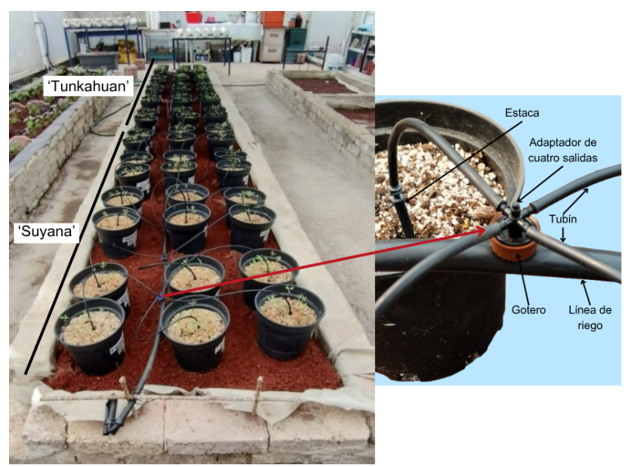
From this moment until 76 days after sowing, on Tuesdays and Fridays each week, between 10 am and 12 pm, the following treatments were applied foliarly with five replications: 0 (control), 25, 50, 100 and 200 mg L-1 of PBZ (2RS, 3RS)-1(4-chlorophenyl-4,4-dimethyl-2(1H1, 2,4-triazol-1-yl)-pentan-3-ol (Cultar® 23.42%, Syngenta, Switzerland).
Moisture was recorded every third day using a tensiometer (Irrometer® Co, USA), and when it had values of 56 cbars (equivalent to 80%), it was restored with Steiner solution (1961) applied at 8, 14 and 18 h via a semi-automated system with 4 L h-1 drippers (Figure 1). The pH and electrical conductivity of the nutrient solution were 6.2 and 2 dS m-1, respectively. To prevent salt accumulation, moisture was restored every 15 d with acidulated water (pH, 6.1), and plants were monitored to prevent deficiencies, diseases or pests.
The following were evaluated: epidermal anatomy: description, number of stomata, and pore area. In the middle part of each plant, samples of leaves were taken and fixed in FAA (10% formaldehyde, 5% acetic acid, 50% absolute ethanol, and 35% distilled water), and epidermal scrapings were taken and placed on slides to obtain semi-permanent preparations (Aguilar-Rodríguez, 1998).
These preparations were used to perform the anatomical description of the epidermal cells and stomata on the adaxial and abaxial surfaces of the control treatments. An optical microscope (Nikon, E200) coupled with an image analyzer (NIS-Elements, BR5.21.01, Nikon Instruments) was used to evaluate the anatomy, stomatal number and stomatal pore area.
The height was recorded with an FH-5M tape measure (Truper®), using the substrate surface and the apex of each plant as references. The visual appearance was obtained by taking pictures with a Nikon D3500 digital camera. The images were processed using the free software GIMP v. 3.0.4 (http://www.gimp.org.es/).
The results were tested for normal distribution (Anderson-Darling, p> 0.05) and homogeneity of variances (Bartlett, p> 0.05) before being analyzed with one-factor analysis of variance and mean comparison tests (Tukey, p≤ 0.05). The analysis was performed using SAS® 9.0 for Windows (SAS Institute Inc., 2013).
In the surface view, the adaxial epidermal cells of ‘Suyana’ and ‘Tunkahuan’ showed smooth, thin anticlinal walls with slightly sinuous to straight contours; in contrast, deeper undulations were observed in the abaxial epidermis. Both cultivars have amphistomatic leaves with anomocytic stomata on both surfaces, That is to say, there are no differentiated cells around the guard cells (Figure 2).
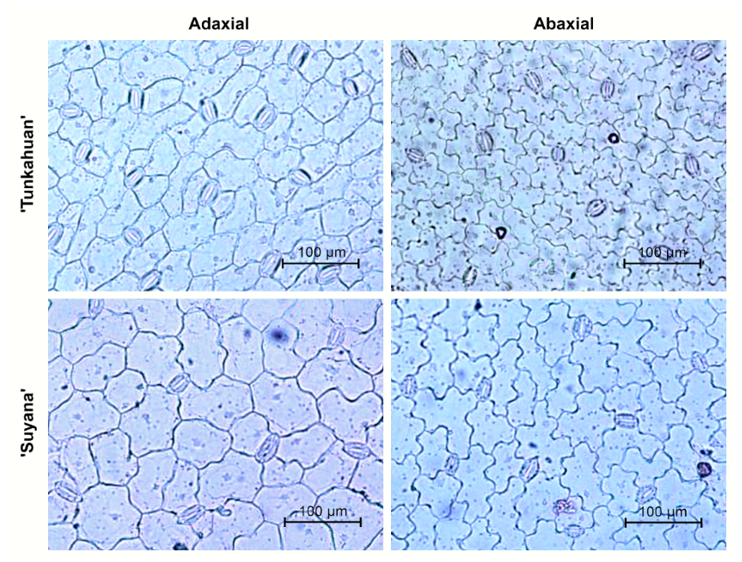
Anomocytic stomata on both surfaces are present in different species of Ch. (Gaafar, 2019; Buedo et al., 2024) and in cultivars such as ‘CICA-17ʹ and ‘Real’ (González et al., 2022), as well as in other Amaranthaceae such as Atriplex halimus and Aerva javanica (Tantawy et al., 2023). Nonetheless, anisocytic stomata have also been described for the genus Chenopodium; that is, the guard cells are surrounded by three epidermal cells, one of which is smaller than the other two (Gaafar, 2019).
From a taxonomic perspective, there were no qualitative anatomical differences in the leaf that are evident to distinguish ‘Suyana’ from ‘Tunkahuan’, but the quantitative characters do contribute to the separation of other cultivars of Ch. quinoa.
Undulations in the anticlinal walls of abaxial epidermal cells, present in ‘Suyana’ and ‘Tunkahuan’, may contribute to resistance to shaking by predators or environmental conditions. According to Vőfély et al. (2019), this trait is common in many dicots, and its function is to improve the contact surface between adjacent cells for greater structural resistance to mechanical stresses in the leaves (Sapala et al., 2018; Panteris and Adamakis, 2022).
Both cultivars have amphistomatic leaves. Nevertheless, ‘Suyana’ had a higher number of stomata on the adaxial and abaxial surfaces of the leaf (75.3 and 98.4) than ‘Tunkahuan’, which had 48.1 and 70.8, respectively. These numbers increased with the application of PBZ, being more noticeable with 100 or 200 mg L-1 treatments.
A similar response was observed for pore area, since ‘Suyana’ had greater adaxial and abaxial areas (18.06 and 21.08 μm2) than ‘Tunkahuan’, which had 12.79 and 15.89 on the upper side and underside of the leaf, respectively. This area increased with the doses of PBZ applied (Table 1).
In ‘Suyana’, the number of stomata (98.4 mm-2) fell within the range reported by Rasouli et al. (2023); García-Parra et al. (2024) for Chenopodium quinoa ‘Q20’ and ‘Titicaca’, with 85 and 153 stomata mm-2 on the abaxial surface. In ‘Tunkahuan’, this number (70.8 mm-2) was below the three cultivars; however, starting at 25 mg L-1 of PBZ, it matched ‘Q20’, and at 200 mg L-1, it was slightly below ‘Titicaca’; this shows that, in ‘Suyana’ and ‘Tunkahuan’, the number of stomata increases with the application of PBZ.
It is important to note that the higher density of stomata on the abaxial surface is a protective response to desiccation and saving water (Taiz and Zeiger, 2010). Regarding the stomatal pore area, Waqas et al. (2017); Waqas et al. (2021) observed that, in Ch. quinoa ‘2 Want’ and ‘Pichaman’, the pore opening was 10.78 and 15.36 μm2, respectively, which is below what is reported here for ‘Suyana’ (21.28 μm2) or ‘Tunkahuan’ (15.89 μm2) without PBZ.
Nonetheless, at 200 mg L-1 of PBZ, the pore area increases to 30.9 μm2, corroborating that PBZ has an effect that favors crop physiology. The increase in stomatal number and pore opening favors stomatal conductance, which facilitates CO2 capture and improves photosynthetic efficiency for a potential increase in grain yield (Gaafar, 2019; Xiong and Flexas, 2020).
Plant height was greater in ‘Suyana’ (109.25 cm) than in ‘Tunkahuan’ (61.58 cm). In addition, in ‘Suyana’, height decreased proportionally with PBZ concentration, whereas in ‘Tunkahuan’, the decrease was similar at any concentration of the retardant (Figure 3).
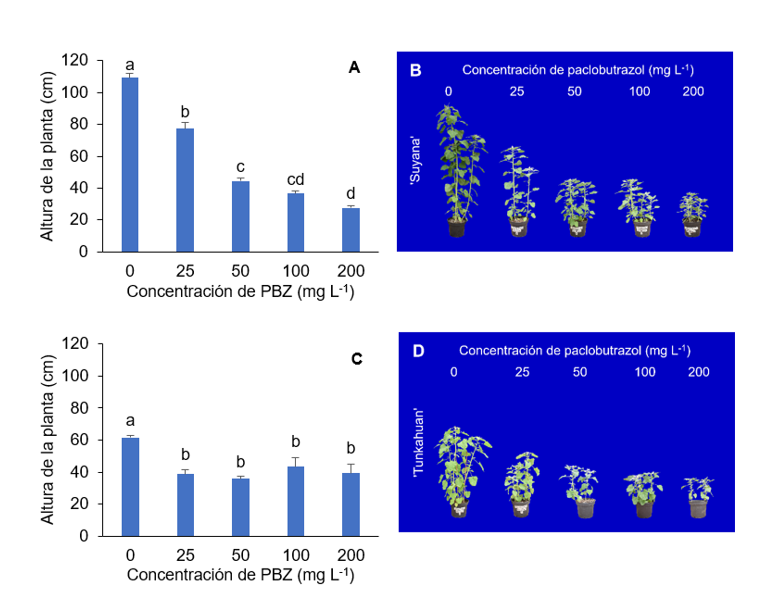
Both cultivars had a more striking visual appearance, giving them potential use as ornamental plants in addition to the proven contribution of their grains to food security (Romero-Benavides et al., 2023). The improving effect that PBZ has on the visual appearance of plants has been reported by Torres-Pio et al. (2021); Rios-Florida et al. (2022) in Lilium ‘Arcachon’, ‘Armandale’ and ‘Tresor’.
In these cultivars, height decreases while the number of flower buds is maintained or increased, giving them a very striking appearance for marketing as cut flowers or potted plants.
In Ch. quinoa and other Amaranthaceae, such as Celosia and Amaranthus, the concentration of pigments such as betalains is increased by the effect of PBZ by 1.6 to 6 times (Srinivasan, 2017; Xie et al., 2025), giving the leaves more striking colors, not only for possible ornamental use but also for protection against environmental stress due to its antioxidant capacity or as a natural colorant due to its concentration of betacyanins (Martínez et al., 2024).
The leaves of ‘Suyana’ and ‘Tunkahuan’ are amphistomatic with anomocytic stomata. On both leaf surfaces, ‘Suyana’ had a greater number of stomata with larger pores than ‘Tunkahuan’. Paclobutrazol increases the number of stomata and the opening of the pore starting at 25 mg L-1, having its limit at 100 mg L-1; that is, higher concentrations will no longer increase the stomatal conductance for possible CO2 fixation.
‘Suyana’ had a larger size than ‘Tunkahuan’ and with paclobutrazol, its height decreased proportionally with the doses applied. ‘Tunkahuan’ is more sensitive to paclobutrazol; applying 25 mg L-1 is sufficient to have a significant reduction in plant height and to facilitate cultivation work. In addition, due to the intensity of color conferred by paclobutrazol, both cultivars improve their visual appearance to be used as ornamental plants or as sources of vegetable dyes.
We are grateful to the Iztacala Faculty of Higher Studies for the annual funding it provides to carry out projects in the research units.
Buedo, S. E.; Mercado, M. I. y González, J. A. 2024. Caracterización fotosintética y anatomía foliar de Chenopodium album y Ch. hircinum (Chenopodiaceae) en un valle de altura del noroeste Argentino. Boletín de la Sociedad Argentina de Botánica. 59(1):13-25. https://doi.org/10.31055/1851.2372.v59.n1.42881.
García-Parra, M. A.; Amado-Rodríguez J. L. and Hernández-Criado, J. C. 2024. Photosynthetic capacity, phenology, yield and chemical composition of seeds of three cultivars of quinoa (Chenopodium quinoa Willd.). Revista Colombiana de Ciencias Hortícolas. 18(2):e17524. https://doi.org/10.17584/rcch.2024v18i2.17524.
González, J. A.; Mercado, M. I.; Martínez-Calsina, L.; Erazzú, L. E.; Buedo, S. E.; González, D. A. and Ponessa, G. I. 2022. Plant density effects on quinoa yield, leaf anatomy, ultrastructure and gas exchange. The Journal of Agricultural Science. 160(5):349-359. https://doi.org/10.1017/S0021859622000533.
González, J. A.; Ponessa, G. I.; Buedo, S.; Mercado, M. I. and Prado, F. E. 2014. Asimilación fotosintética máxima en variedades de quinoa (Chenopodium quinoa) de diferentes orígenes geográficos y su relación con la morfología foliar. Lilloa. 51(2):177-193. https://ri.conicet.gov.ar/handle/11336/12428.
Martinez, R. M.; Melo, C. P.; Pinto, I. C.; Mendes-Pierotti, S.; Vignoli, J. A.; Verri, W. A. and Casagrande, R. 2024. Betalains: a narrative review on pharmacological mechanisms supporting the nutraceutical potential towards health benefits. Foods. 13(23):3909. https://doi.org/10.3390/foods13233909.
Rasouli, F.; Kiani-Pouya, A.; Movahedi, A.; Wang, Y.; Li, L.; Yu, M.; Pourkheirandish, M.; Zhou, M.; Chen, Z.; Zhang, H. and Shabala, S. 2023. Guard cell transcriptome reveals membrane transport, stomatal development and cell wall modifications as key traits involved in salinity tolerance in halophytic Chenopodium quinoa. Plant and Cell Physiology. 64(2):204-220. https://doi.org/10.1093/pcp/pcac158.
Romero-Benavides, J. C.; Guaraca-Pino, E.; Duarte-Casar, R.; Rojas-Le-Fort, M. and Bailon-Moscoso, N. 2023. Chenopodium quinoa Willd. and Amaranthus hybridus L.: ancestral Andean food security and modern anticancer and antimicrobial activity. Pharmaceuticals. 16(12):1728. https://doi.org/10.3390/ph16121728.
Sapala, A.; Runions, A.; Routier-Kierzkowska, A. L.; Gupta, M. D.; Hong, L.; Hofhuis, H.; Verger, S.; Mosca, G.; Li, C. B.; Hay, A.; Hamant, O.; Roeder, A. H.; Tsiantis, M.; Prusinkiewicz, P. and Smith, R. S. 2018. Why plants make puzzle cells, and how their shape emerges. Elife. 27(7):e32794. https://doi.org/10.7554/eLife.32794.
Torres-Pio, K.; De la Cruz-Guzmán, G. H.; Arévalo-Galarza, M. D. L.; Aguilar-Rodríguez, S.; Grego-Valencia, D.; Arriaga-Frías, A. and Mandujano-Piña, M. 2021. Morphological and anatomical changes in Lilium cv. Arcachon in response to plant growth regulators. Horticulture, Environment, and Biotechnology. 62(3):325-335. https://doi.org/10.1007/s13580-020-00319-6.
Waqas, M.; Yaning, C.; Iqbal, H.; Shareef, M.; Rehman, H. and Bilal, H. M. 2021. Synergistic consequences of salinity and potassium deficiency in quinoa: Linking with stomatal patterning, ionic relations and oxidative metabolism. Plant Physiology and Biochemistry. 159:17-27. https://doi.org/10.1016/j.plaphy.2020.11.043.