elocation-id: elocation-id: e4136
Phytopathogenic fungi in staple cereals can affect not only productivity but also the health of those who consume them. The objective of this research was to determine the antifungal activity of Trichoderma harzianum and Bacillus subtilis , as well as the hydroalcoholic extracts of Larrea tridentata and Argemone mexicana against Fusarium verticillioides under laboratory and field conditions. In vitro inhibition in dual cultures against the phytopathogen ranged from 82 to 86% for T. harzianum , B. subtilis , and L. tridentata ; in contrast, for A. mexicana , it was 18%. The treatments reduced the incidence in the harvested grain by more than 70% in treated plants compared to the control. The application of treatments with T. harzianum , B. subtilis , A. mexicana , L. tridentata and a combination of T. harzianum and B. subtilis achieved a significant increase in plant height, which is directly related to the leaf area index; this resulted in optimal grain filling compared to the control; as a result, the yield potential of the Hernán Cortés hybrid was significantly expressed, with the botanical extracts outperforming the control and the microorganisms themselves, resulting in greater ear weight. Molecular corroboration of the phytopathogenic strain indicated 99% identity with F. verticillioides contained in the GenBank database.
Zea mays L., antagonists, biocontrol, biostimulation, incidence.
Corn has great genetic diversity, resulting from centuries of human selection to adapt it to different environments or uses, allowing the generation of materials that meet both traditional and new needs ( González-Santos et al ., 2023 ). Mexico is one of the largest consumers of corn in the world, as it is the basis of its diet. In addition, it is the most-produced crop in the country, making it the fourth-largest producer worldwide ( González and Ávila, 2014 ).
Mexico produces 27 million tons ( FIRA, 2024 ) and has a deficit of 11 million tons per year; the latter results from losses caused by pest infestations, mainly fungi, whose presence is favored by intense rainfall or drought ( Peña, 2017 ). In regions of tropical and subtropical climates, the production of this cereal is seriously affected by Fusarium verticillioides , the agent responsible for rotting the stems, ears and roots of corn ( Figueroa-López et al ., 2016 ).
Contamination of corn by F. Verticillioides extends beyond agronomic damage, making it a critical public and animal health challenge due to fumonisin synthesis. Recent studies underscore that these mycotoxins not only compromise the productivity and sustainability of the global agrifood chain ( Hofstetter, 2025 ) but also act as potent neurotoxic and carcinogenic agents. In humans, chronic exposure has been linked to disruption of sphingolipid metabolism, increasing the risk of esophageal cancer and birth defects, including neural tube defects ( Singh, 2025 ; Asiya et al ., 2026 ). Given this situation, rational control of the pathogen is imperative to mitigate the accumulation of these heat-stable toxins that persist in processed products.
This fungus is a plant pathogen transmitted through the soil, causing losses in grain quality ( Einloft et al ., 2021 ). The commercial and sanitary qualities of cereals are important and determine the destination of the grain; in this context, colonization of cereals by F. verticillioides is frequently associated with the accumulation of fumonisins produced in the field or during storage, which poses a threat to their consumption as food for both people and livestock ( Ferrigo et al ., 2023 ).
Developing a sustainable agricultural system that can meet the food demand of future generations requires integrating biological strategies that respect the environment and health ( Jhariya et al ., 2019 ). The use of microorganisms, whether fungi such as Trichoderma spp. or bacteria such as Bacillus spp. , has been widely studied; although their inoculation has a positive effect on various crops, their combination could offer greater potential as growth promoters and biocontrol agents ( Poveda, 2022 ).
In agriculture, these microorganisms can promote plant growth, improve tolerance to abiotic stresses and act as biological control agents, both directly and indirectly ( Zin and Badaluddin, 2020 ). These microorganisms exhibit strong antagonistic activity against phytopathogens such as Ralstonia solanacearum and Fusarium oxysporum , under both laboratory and greenhouse conditions ( Cao, 2018 ). Biological control also includes the use of plant-derived compounds, called plant extracts, which are characterized by their biodegradability and low toxicity ( Hernández et al ., 2007 ).
Larrea tridentata , also called ‘gobernadora’, possesses active molecules with biocidal activity ( Pañuelas et al ., 2015 ). Among these is a powerful antioxidant identified as nordihydroguaiaretic acid (NDGA), which has fungicidal properties ( Arteaga et al ., 2005 ). Argemone mexicana or ‘chicalote,’ is an endemic Mexican species rich in alkaloids, terpenoids, flavonoids, phenolic compounds, long-chain aliphatic compounds and certain aromatic compounds, which are believed to generate antifungal activity ( Soto, 2022 ).
Due to their biological activity against phytopathogenic fungi, secondary metabolites with fungicidal properties found in plants are considered a viable option for controlling these fungi ( Madariaga-Mazón et al ., 2019 ). On the other hand, by altering essential and structural processes, these substances can promote plant growth, strengthen tolerance to abiotic stresses, and enhance grain yield and quality ( Mrid, 2021 ).
The research expected that at least one of the used treatments would have an effective response against the phytopathogenic fungus Fusarium verticillioides , both in vitro and in the field. The study aimed to determine the antifungal activity of Trichoderma harzianum and Bacillus subtilis , as well as the hydroalcoholic extracts of Larrea tridentata and Argemone mexicana , against Fusarium verticillioides under laboratory and field conditions.
The research was conducted from June 2024 to November 2025 at the facilities of the Antonio Narro Autonomous Agrarian University (UAAAN), by its Spanish acronym, located in Saltillo, Coahuila, Mexico. The experimental site is located at coordinates 25° 21’ 20.7” north latitude and 101° 01’ 51.2” west longitude, at an altitude of 1 742 m. The climate is classified as Cfb according to Köppen. The average annual temperature is 16.4 °C, with an annual rainfall of 610 mm.
The Hernán Cortés hybrid corn seed was provided by the Mexican Corn Institute, located within the UAAAN facilities. It is a three-cross material with semi-dented white grain, adapted to altitudes of 1 000 to 1 800 m. This genotype has a maturity cycle of 160-170 days and a plant height of 2.8-3 m. It was specifically selected because it is in the release phase for the Mexican Bajío region and has previously shown susceptibility to F. verticillioides , making it imperative to develop biological and botanical control strategies to mitigate the impact of this pathogen. On the other hand, the Bacillus subtilis and Trichoderma harzianum strains were obtained from the microorganism collection of the phytopathology laboratory of the aforementioned university. For the botanical material, plants of Larrea tridentata and Argemone mexicana were collected in the locality of La Encantada, municipality of Saltillo, Coahuila.
The phytopathogenic fungus F. verticillioides was isolated from Hernán Cortés hybrid seed that was not chemically treated and exhibited rot symptoms. Based on its morphological and phenotypic characteristics, it was identified in PDA and Carnation Agar culture media ( Leslie and Summerell, 2006 ).
The F. verticillioides strain was cultured on PDA medium for 12 days and incubated at 26 °C. The extraction of genomic DNA and the sequencing of the ITS1 and ITS4 regions were performed by the laboratory of the San Luis Potosí Institute of Scientific and Technological Research (IPICYT), by its Spanish acronym. The sequences obtained were compared with those reported in the GenBank NCBI database.
Extracts of L. tridentata and A. mexicana were obtained from leaf tissue collected in Coahuila, Mexico. The leaves were washed, disinfected and dried for subsequent pulverization. From each species, 49 g of plant material was taken and processed by constant magnetic stirring at room temperature (25 ±2 °C) with 70% methanol (v/v) for seven days. The macerate was then centrifuged in Falcon tubes and filtered to obtain the final crude extract.
Dual confrontation assays were established with ten replications, in which the degree of antagonism was determined using the scale of ( Bell et al ., 1982 ) for T. harzianum . For B. subtilis , this measure was calculated using the equation: PI= 100-[(Gr*100)/Rp], where: PI= inhibition of fungal growth; Gr= mycelial growth of the fungus; and Rp= radius of the plate ( Hernández-Castillo et al ., 2008 ). In the case of L. tridentata and A. mexicana , tests were conducted with poisoned media in quintuplicate, where a biological window was opened and the concentrations of 750, 1 250, 1 500, 2 000, 2 500, 3 000, 3 500, 4 000, 4 500, 5 000, 5 500, 6 000 and 6 500 ppm were evaluated in order to determine the IC90of both extracts.
The Hernán Cortés corn crop was grown under open-field conditions with natural pathogen infection in an area of 100 m2. Rows were 6 m long, spaced 74 cm apart and plants were spaced 25 cm apart. To this end, the seed was inoculated one day in advance with the treatments, using carboxymethyl cellulose as a fixative and dye for identification. A second application was made with 15 ml of treatments when the plants were in the V2 stage, followed by a third application in the V4 stage (20 ml) directed at the base of the stem, and a fourth application in the anthesis stage by sprays directed at receptive stigmas.
The treatments evaluated were T. harzianum at a concentration of 1x10⁸conidia ml-1, B. subtilis at 1x10⁷CFU, A. mexicana at an IC90of 13 000 ppm, L. tridentata at an IC9 at 13 000 ppm, a combination of T. harzianum at 1x10⁸conidia ml-1and B. subtilis at 1x10⁷CFU and an absolute control. The experiment was set up in a randomized block design with four replications per treatment. The incidence of the disease was evaluated as a percentage (Rivas et al., 2011).
F. verticillioides was isolated from Hernán Cortés hybrid corn seed and was identified based on the formation of macroconidia, chain microconidia, and the absence of chlamydospores ( Leslie and Summerell, 2006 ). Molecular corroboration showed a 99% match with F. verticillioides sequences contained in GenBank, identifying it as the causal agent of root and stem rot during vegetative stages, and of grain rot in the postharvest stage, which coincides with previous reports made by Gai et al. (2018); Czembor et al. (2019).
The antifungal activity of the treatments is shown in Figure 1 , which depicts the growth of F. verticillioides in dual cultures evaluated at 11 days of incubation. Each panel shows the pathogen’s growth under the influence of the antagonist or extract, contrasted with the control growth adjacent to it.
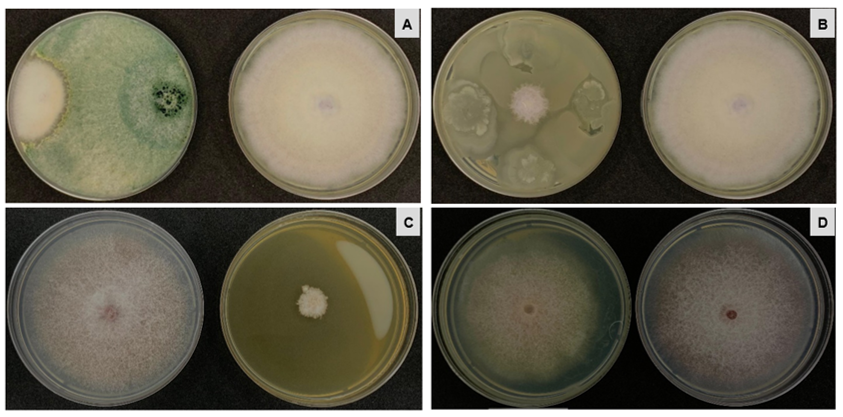
Radial growth inhibition differed significantly among treatments; the highest efficacy was obtained with B. subtilis (86%), followed by T. harzianum (82%) and L. tridentata extract (82%) at a concentration of 6 500 ppm; in contrast, A. mexicana exhibited the lowest inhibitory activity at 18% at 20 000 ppm. The antagonistic action of B. subtilis and T. harzianum is mainly related to their ability to compete effectively for space and nutrients in the pathogen’s environment. In addition, they can synthesize various compounds with antimicrobial activity, as well as volatile metabolites.
They are also capable of producing hormones that modify plant physiology and activate systemic resistance mechanisms ( Pedraza et al ., 2020 ). Alternatively, they can directly damage the pathogen through mycoparasitism, as in the case of Trichoderma ( Elamathi et al ., 2018 ). Thus, the use of antagonistic microorganisms yields outstanding results, as those reported by Castro-del Ángel et al . (2020) .
As for so-called botanical fungicides, numerous studies have shown that plant-derived phytochemicals have fungicidal effects. Plants can be considered perfect organisms with the potential to supply organic substances that can be classified as primary metabolites (proteins, carbohydrates, and fats) or secondary metabolites (terpenes, steroids, anthocyanins, anthraquinones, phenols, alkaloids, etc.) (Bahandari et al., 2021).
Treatments with T. harzianum , B. subtilis , and L. tridentata significantly reduced the incidence of the phytopathogenic fungus (p< 0.0001). T. harzianum had a 5% incidence, whereas B. subtilis , A. mexicana and L. tridentata had an incidence of 8%, 25% and 10%, respectively, compared to the control (57%) ( Figure 2 ).
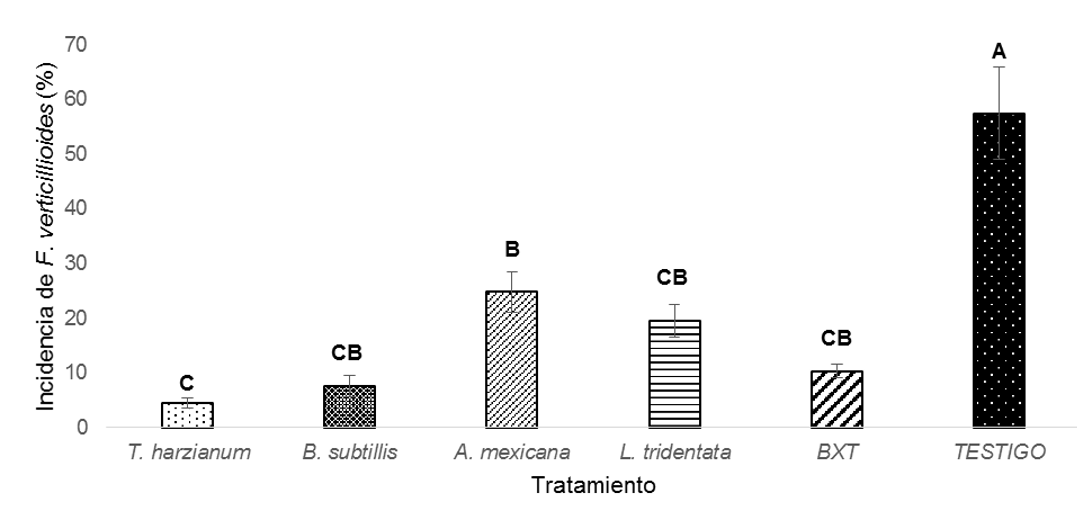
The susceptibility observed in the Hernán Cortés hybrid highlighted not only the risk of yield losses but also the potential accumulation of mycotoxins, such as fumonisins, produced by F. verticillioides . Reducing the incidence of the fungus by employing T. harzianum and B. subtilis (or L. tridentata extracts) represents an essential preventive measure to ensure food safety in highly productive yet vulnerable genetic materials.
The presence of F. verticillioides in corn crops not only implies a reduction in grain yield and quality but also carries the latent risk of accumulation of mycotoxins, particularly fumonisins (FB1and FB2). These toxins are associated with serious pathologies in animals and are considered possible carcinogens to humans ( Robledo Gutiérrez et al ., 2017 ).
In this context, the results obtained take on greater relevance, as the decrease in fungal incidence through the use of biocontrol agents and botanical extracts of L. tridentata suggests an indirect reduction in mycotoxin levels. This is critical for the Hernán Cortés genotype, whose susceptibility to this pathogen could compromise grain safety in the regions where it will be commercially released.
The efficacy observed in this work by using T. harzianum and L. tridentata extracts is not limited to suppressing mycelial growth but also projects a crucial benefit for grain safety. In this regard, Gong et al . (2024) point out that rational control using biological agents can inhibit the expression of genes responsible for fumonisin synthesis, which would explain how reduced fungal incidence translates into a lower toxic load.
For their part, the results align with those reported by Wang et al . (2024) , who argue that using bioactive botanical compounds is an eco-friendly strategy capable of compromising the pathogen’s integrity and mitigating the accumulation of FB1. As stated by López-Nicora et al . (2025) , integrating these preventive tools is the most effective way to ensure that corn complies with public and animal health standards, thereby avoiding the persistence of toxins that affect global food security.
In this regard, Castro-del Ángel et al . (2020) reported a treatment formulation using beneficial microorganisms capable of controlling F. verticillioides , achieving significant reductions in colonization; likewise, Sebayang et al . (2021) obtained similar results using bacteria of the genus Bacillus in combination with botanical extracts.
In addition to the above, it can be affirmed that the strains of the antagonists studied and the plant extracts are promising in reducing the incidence of F. verticillioides . The observed efficacy of biocontrol agents is partly attributed to the strains’ origin. As these isolates are kept in the UAAAN’s microorganism collection, they have been previously characterized, ensuring their viability and aggressiveness against soil phytopathogens.
The ability of B. subtilis and T. harzianum to reduce the incidence of F. verticillioides in the Hernán Cortés hybrid demonstrates that these microorganisms exhibit broad adaptive plasticity, which allowed their successful application in regions other than those of their original isolation, as in the areas evaluated for this new hybrid.
The analysis of treatment activity against the phytopathogenic fungus F. verticillioides showed a significant increase in yield, a variable that is also directly affected by its presence, with higher weights compared to the control ( Figure 3 ). It should be noted that the experiment was conducted free of chemical fertilization.
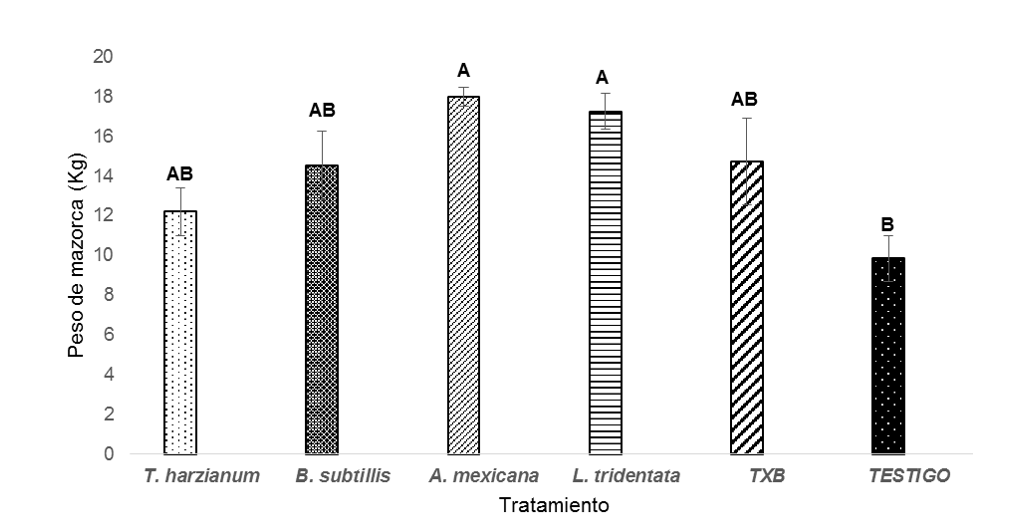
The leaf area index is extremely important for the plant because it determines the photosynthetic area and the accumulation of photosynthates ( Mendoza et al ., 2017 ). The fixation of the treatments to the seed and post-emergence applications positively influenced the good development of leaf area and plant height, leading to more vigorous plants. The use of botanical treatments or species of the genus Trichoderma has the ability to visibly improve leaf area development, including the number of fruits in horticultural species or harvest yield ( Hassan et al ., 2021 ).
On the other hand, the application of beneficial bacteria has been shown to improve growth in cereal crops such as wheat, with increased photosynthesis and water-use efficiency, which shows positive effects on aboveground biomass ( Li et al ., 2022 ).
Among the benefits of antagonistic microorganisms, such as T. harzianum and B. subtilis , or plant extracts, such as those of A. mexicana and L. tridentata , is biostimulation, which favors plant growth; therefore, the plants subjected to the aforementioned treatments exhibited better development of the aboveground part, resulting in greater height ( Table 1 ) and better ear weight compared with the control.
Notable differences (p= 0.0006) were observed in the longitudinal development of corn plants in response to the different biological treatments following F. verticillioides infection. All the treatments evaluated exceeded the control in height, which had the lowest growth at 2.39 ±0.054 m.
The treatment based on A. mexicana extract was the most effective, reaching a maximum height of 2.78 ±0.01 m. This result not only represents the largest increase over the control (16.3%) but also shows the greatest experimental stability, as evidenced by the study’s lowest standard deviation (0.01). On the other hand, the L. tridentata extract showed a similar behavior with a height of 2.7 ±0.135 m.
Regarding microbial biological control agents, the Bacillus + Trichoderma consortium (2.62 ±0.12 m) slightly exceeded the individual performance of B. subtilis (2.59 ±0.156 m) and T. harzianum (2.51 ±0.047 m). Notably, although treatments with Bacillus (alone and in consortium) increased height, they exhibited greater variability than plant extracts and the antagonistic fungus T. harzianum .
In this regard, the genus Bacillus shows biochemical properties, including phosphate solubilization, indoleacetic acid production and ACC deaminase activity, that are associated with plant growth promotion ( Chávez-Ambriz et al ., 2016 ). As for the genus Trichoderma , this effect on the plant results from the activity of potent fungal signaling metabolites with hormone-like activity that are distributed in the soil, including indole compounds such as indole-3-acetic acid (IAA) and volatile organic compounds such as sesquiterpene isoprenoids and ethylene ( Contreras-Cornejo et al ., 2024 ). In the case of plant extracts, growth stimulation has been linked to flavonoid content and antioxidant enzymes, providing a balanced nutrient supply for growth ( Ei et al ., 2024 ).
F. verticillioides were isolated and identified as the causal agent of root, stem and ear rot in corn crops. Treatments with T. harzianum , B. subtilis , and L. tridentata showed high antagonistic activity against F. verticillioides in dual cultures during in vitro bioassays.
The incidence of F. verticillioides in the harvested grain was considerably reduced after the field bioassay with the treatments of T. harzianum , B. subtilis , A. mexicana , and L. tridentata , as well as the combination of T. harzianum with B. subtilis .
Treatments with T. harzianum , B. subtilis , A. mexicana , L. tridentata and the combination of T. harzianum with B. subtilis had a positive effect on the induction of growth and development of the corn crop and improved the expression of the yield potential of the Hernán Cortés hybrid, with the extracts of A. mexicana and L. tridentata being significantly superior.
Chávez-Ambriz, L. A.; Hernández-Morales, A.; Cabrera-Luna, J. A.; Luna-Martínez, L. y Pacheco-Aguilar, J. R. 2016. Aislados de Bacillus provenientes de la rizósfera de cactus incrementan la germinación y la floración en Mammillaria spp. (Cactaceae). Revista Argentina de Microbiología. 48(4):333-341. Doi: 10.1016/j.ram.2016.09.001.
Contreras-Cornejo, H. A.; Schmoll, M.; Esquivel-Ayala, B. A.; González-Esquivel, C. E.; Rocha-Ramírez, V. and Larsen, J. 2024. Mechanisms for plant growth promotion activated by Trichoderma in natural and managed terrestrial ecosystems. Microbiological Research. 281(1):127621. Doi: 10.1016/j.micres.2024.127621.
Czembor, E.; Waśkiewicz, A.; Piechota, U.; Puchta, M.; Czembor, J. H. and Stȩpień, L. 2019. Differences in ear rot resistance and Fusarium verticillioides -produced fumonisin contamination between Polish currently and historically used maize inbred lines. Frontiers in Microbiology. 10(1):449. Doi: 10.3389/fmicb.2019.00449.
Elamathi, E.; Malathi, P.; Viswanathan, R. and Sundar, A. R. 2018. Expression analysis on mycoparasitism related genes during antagonism of Trichoderma with Colletotrichum falcatum causing red rot in sugarcane. Journal of Plant Biochemistry and Biotechnology. 27(3):351-361. Doi: 10.1007/s13562-018-0444-y.
Figueroa-López, A. M.; Cordero-Ramírez, J. D.; Martínez-Álvarez, J. C.; López-Meyer, M.; Lizárraga-Sánchez, G. J.; Félix-Gastélum, R.; Castro-Martínez, C. and Maldonado-Mendoza, I. E. 2016. Rhizospheric bacteria of maizewith potential for biocontrol of Fusarium verticillioides . SpringerPlus. 5(1):124. Doi: 10.1186/s40064-016-1780-x.
Hassan, H. S.; Mohamed, A. A.; Feleafel, M. N.; Salem, M. Z. M.; Ali, H. M.; Akrami, M. and Abd-Elkader, D. Y. 2021. Natural plant extracts and microbial antagonists to control fungal pathogens and improve the productivity of zucchini ( Cucurbita pepo L.) in vitro and in greenhouse. Horticulturae. 7(11):470. Doi: 10.3390/horticulturae7110470.
Ji, C.; Chen, Z.; Kong, X.; Xin, Z.; Sun, F.; Xing, J.; Li, C.; Li, K.; Liang, Z. and Cao, H. 2022. Biocontrol and plant growth promotion by combined Bacillus spp. inoculation affecting pathogen and AMF communities in the wheat rhizosphere at low salt stress conditions. Frontiers in Plant Science. 13(1):104317. Doi: 10.3389/fpls.2022.1043171.
Peñuelas, O.; Arellano, M.; Vargas, I.; Lares, F.; Cantú, E. U.; Hernández‑Rodríguez, S. E.; Gutiérrez, M. A. y Mungarro, C. 2017. Bioactividad in vitro de extractos de gobernadora ( Larrea tridentata ) sobre la inhibición de hongos poscosecha: Alternaria tenuissima , Aspergillus niger , Penicillium polonicum y Rhizopus oryzae . Polibotánica. 40(1):183‑198. Doi: 10.18387/polibotanica.40.13.