elocation-id: elocation-id: e4135
This study proposes a methodology for analyzing the agroecological transition towards sustainable agricultural systems, addressing the need for methodological procedures that link conceptual advances to their practical application. A systematic review was conducted based on 47 academic sources from Google Scholar, Scopus and ScienceDirect, followed by a comparative analysis of the scientific literature, which identified historical milestones, criticisms, and methodological contributions that allowed defining five key dimensions: environmental perspective, food security and sovereignty, scope, justice, equity and method. From the analysis, a five-phase methodology emerges as a route to transform conceptual complexity into a practical guide that facilitates the addressing of problems in the transition from agroecology to sustainable agriculture.
agroecology, interdisciplinary analysis, systems approach.
Agroecology has established itself as a multidimensional field that integrates scientific, cultural, and social approaches to understand and transform agrifood systems. Throughout its evolution, it has shifted from unidisciplinary definitions to inter- and transdisciplinary proposals that combine ecological, agronomic and traditional knowledge to address complex problems such as environmental degradation, food insecurity and inequalities associated with food production (Wezel et al., 2020).
Agriculture cannot be analyzed solely in terms of crop yield; it is also marked by historical, institutional, and cultural factors that shape agrifood systems (Mouratiadou et al., 2024). Based on this indication, this paper treats agroecology as an important part of sustainability, with the intention of opening spaces for interdisciplinary dialogue among producers, intermediaries, industrialists, consumers and contextual actors.
This work aims to propose a methodology for analyzing the processes of agroecological transition towards sustainable agricultural systems. To establish the aforementioned methodology, a systematic review of 47 academic sources from the Google Scholar, Scopus, and ScienceDirect databases was conducted and organized into three axes: agroecology as a science, as a method and as a proposal for a transition to sustainability. This analysis allowed us to recognize the conceptual and methodological evolution that enables us to address the different agroecological expressions.
It is in this context that agroecology is conceived from a systemic and articulating logic, capable of linking its foundations to the ethical principle of sustainable development. In this framework, we understand agroecology as a complex and ethical concept, based on sustainability, security and food sovereignty. Based on this, a methodological procedure for analyzing agroecological systems is proposed.
Agroecology emerged at the beginning of the twentieth century as the application of ecological principles to agriculture, defined by Bensin and others as the use of ecological methods in cash crops (Terán et al., 2025). Between the 1930s and 1970s, it maintained a technical, plot-based approach focused on yield and pest control, a precursor to the need for more comprehensive visions (Altieri et al., 2021).
In the 1960s and 1970s, critiques of the Green Revolution and the incorporation of systems thinking transformed its scope: from the plot to the agroecosystem, integrating socioenvironmental dimensions and inter- and transdisciplinary approaches (Hecht, 1995; Casanova et al., 2016; Tittonell, 2023).
Currently, agroecology integrates economic, political, cultural, and ethical dimensions, and promotes participatory approaches that enhance scalability, territorial governance and resilience, while incorporating peasant communities, indigenous peoples and women into decision-making (Bezner et al., 2022).
Today, agroecology is emerging as a way to move towards global sustainability; however, this transition requires articulation among academic, social, and institutional actors that allows the construction of a sustainable agrifood system (Wezel et al., 2020; Tittonell, 2023).
The historical evolution of the concept of agroecology, from its beginnings and foundations to its scaling, inter and transdisciplinarity. Contemporary agroecology is intrinsically associated with food sovereignty, understood as the right of peoples to access healthy, culturally relevant food produced through sustainable practices (Galt et al., 2024).
The conceptual evolution recognizes the incorporation of social justice and gender equity principles as guides for agrifood systems towards sustainability (Bezner et al., 2022). This conceptual review shows that agroecology has ceased to be merely a set of practices and has become a unifying approach in which science, ethics and social movement converge.
Other authors have also incorporated concepts such as the resilience of agrifood systems (Anderson et al., 2021; Quispe-Ojeda, 2022) and systems thinking (Schatte and Meyer, 2023). These are the elements that allow agroecology to be configured as a unifying approach.
The growing complexity of the obstacles faced by agroecology, such as 1) environmental problems, related to the use and management of natural resources; 2) food security and sovereignty; 3) scope, corresponding to the applicability and limits of the approach; 4) justice and equity system; and 5) method, focused on its epistemological validity and disciplinary coherence (Table 1), limits the agroecological transition towards sustainability.
|
Arguments against (✗) |
Arguments in favor (✓) |
|---|---|
|
1. Environmental perspective |
|
|
✗ Land use change and landscape modification (Carlile and Garnett, 2021) ✗ Alteration of natural evolutionary processes and changes in native species (Phalan, 2018) |
✓ Ecosystem evolution (Tudge, 2014) ✓ Efficient use of water and soil nutrients (Altieri, 2018) ✓ Carbon capture and climate change mitigation (Bezner et al., 2021) ✓ Ecological restoration of degraded soils (Ntamwira et al., 2023) |
|
2. Food security and sovereignty |
|
|
✗ Limitations for sustained high yields (IPES-Food, 2016) ✗ Lower productivity and efficiency compared to intensive systems (IPES-Food, 2016) ✗ Difficulties in supplying large-scale urban markets (Tittonell, 2023) |
✓ Participatory approaches adapted to the local context (IPES-Food, 2016) ✓ Efficiency potential with supports equivalent to intensive models (Giraldo and Rosset, 2018) ✓ Improvement in crop diversity, diet, and food security (Bezner et al., 2021) ✓ Strengthening the resilience of small producers (Dagunga et al., 2023) |
|
3. Scope |
|
|
✗ Risk of extensive monocultural practices (Anderson and Anderson, 2020) ✗ Perception of an anti-capitalist political agenda (Zaruk, 2023) |
✓ Clear definition and differentiation between production systems (Anderson and Anderson, 2020) ✓ Adaptability to different territorial contexts and scalability towards public policies (Wezel et al., 2020; Anderson et al., 2021) |
|
4. Justice and equity system |
|
|
✗ Labor intensity and consumer costs (Poux and Aubert, 2018) ✗ Tensions between social justice and agricultural productivity (Zaruk, 2023) |
✓ Generation of rural employment and reduction of migratory flows (Van der Ploeg et al., 2019) ✓ Inclusion of indigenous communities and minority groups (Van der Ploeg et al., 2019) ✓ Equitable and inclusive food system (Bezner et al., 2022) ✓ It favors gender equity and participation in territorial governance (Fiore et al., 2024) |
|
5. The method |
|
|
✗ Lack of standardized methodologies (Ebel, 2020) ✗ Disciplinary complexity (Zaruk, 2023) |
✓ Frameworks based on historical, socioeconomic, and ecological principles (Dumont et al., 2021) ✓ Consolidation of its own theoretical frameworks and methodologies that integrate traditional and scientific knowledge (Anderson et al., 2021) |
From an environmental perspective, agroecology has been the subject of debate regarding its ability to reconcile biodiversity conservation with large-scale food production (Phalan, 2018; Carlile and Garnett, 2021), yet it has also been valued for regenerating ecosystems, optimizing resource use and mitigating climate change (Tudge, 2014; Altieri, 2018; Bezner et al., 2021; Ntamwira et al., 2023).
In terms of food security and sovereignty, improvements in crop and diet diversity, the strengthening of small producers’ resilience, and the potential for efficiency with support equivalent to those of intensive models are recognized (IPES-Food, 2016; Bezner et al., 2021; Dagunga et al., 2023).
While some critiques point to the risk of monocultural practices and a supposed political agenda, other studies highlight their flexibility in adapting to different territorial contexts and scaling up to public policies (Wezel et al., 2020; Anderson et al., 2021).
In terms of justice and equity, limitations are noted arising from labor intensity, costs for the consumer and tensions with agricultural productivity. Faced with this, agroecology is valued for generating rural employment, reducing migratory flows and including indigenous communities and minority groups (Van der Ploeg et al., 2019; Bezner et al., 2022).
In the method, the absence of standardized frameworks and certain disciplinary complexity are recognized; however, the progressive consolidation of its own principles and methodologies that integrate traditional and scientific knowledge is also recognized (Anderson et al., 2021). The literature analysis shows that environmental concerns were the first to receive attention, while issues of food security, justice and equity have recently gained greater relevance.
This evolution reflects a shift in the scientific agenda towards broader dimensions of governance, territorial resilience and gender equity (Van der Ploeg et al., 2019). Thus, agroecology transcends the nature-society dichotomy and is oriented towards the comprehensive transformation of food systems (Bezner et al., 2021; Dagunga et al., 2023).
Currently, agroecology faces methodological challenges that require integrative explanatory frameworks. Caporali (2007) proposes employing systemic perspectives to address complex problems and strengthen the theoretical-conceptual foundation, while Anderson et al. (2021); Dumont et al. (2021) suggest incorporating the sociopolitical dimension of agroecology, which involves processes of collective action, governance, social justice and food sovereignty for the transformation of agrifood systems.
This is important for consolidating its scientific identity and supporting innovative methodological proposals. This overview highlights the need to establish clear conceptual boundaries when analyzing agroecology from the perspective of a complex system.
To create the methodological proposal, we start from the concept of agroecology of Anderson et al. (2021); Gliessman (2014); Wezel et al. (2009); Wezel et al. (2020). These authors consider it an inter-, intra- and transdisciplinary, systemic approach whose scales must support production systems aligned with the principles of sustainability, sovereignty, and food security.
To establish clear conceptual boundaries, it is necessary to articulate scientific and traditional knowledge in a vision of complex systems. With this background, four fundamental approaches are proposed: the first is the transdisciplinary approach, which seeks collaboration among disciplines and non-academic actors to understand the diversity of functions of agrifood systems (Gliessman, 2014).
The second is the interdisciplinary approach, which proposes expanding agricultural frameworks to include ecological, economic, cultural and political dimensions, thereby favoring the creation of resilient and just food systems (Anderson et al., 2021).
A third approach is that proposed by Wezel et al. (2020), which emphasizes integrating systems that harmonize scientific knowledge, traditional practices and learning from key actors. Finally, the ethical approach orients practices towards environmental respect, human health care, social equity, and intergenerational responsibility, considering scale and long-term impacts (Vizuete et al., 2024).
To apply these concepts, it is necessary to resort to a unifying approach, in this case, the systems approach, understood not only as a comprehensive vision but also as a framework that articulates the ecological, social, economic and cultural dimensions. It is proposed to start with the consumer subsystem to guide agroecological processes towards fairer and more sustainable systems.
From the industrial economy, key variables are identified (Shepherd and Shepherd, 2003): 1) geographical space; 2) product type; and 3) consumer characteristics. In addition to economic indicators, social and ecological dimensions are incorporated to assess the sustainability of the system as a whole (Gliessman, 2014). This involves complex technical and methodological considerations, detailed below.
Technique: qualitative and quantitative methods, such as semi-structured interviews and participatory observations, useful for identifying patterns of equity, access to healthy food, and social justice (Rosset and Altieri, 2017).
Instruments: mixed approaches and specialized software to systematize findings and combine qualitative and quantitative variables through multivariate analyses (correlations, clusters, neural networks, among others) that link agroecological practices to productive indicators (Rosset and Altieri, 2017).
In this framework, agroecology is proposed as an inter-, intra-, and transdisciplinary approach, based on sustainable production systems and aligned with sovereignty and food security.
This view coincides with Altieri (1989; 2018); Gliessman (1998); Quispe-Ojeda (2022) and with recent studies that delineate the scopes, scales and variables that differentiate it from sustainable agriculture (Schatte and Meyer, 2023; Terán et al., 2025). With these conceptual bases, a methodological proposal is suggested to address specific problems of agrifood systems in the transition from agroecology to sustainable agriculture.
The methodological proposal is developed in five phases (Figure 1).
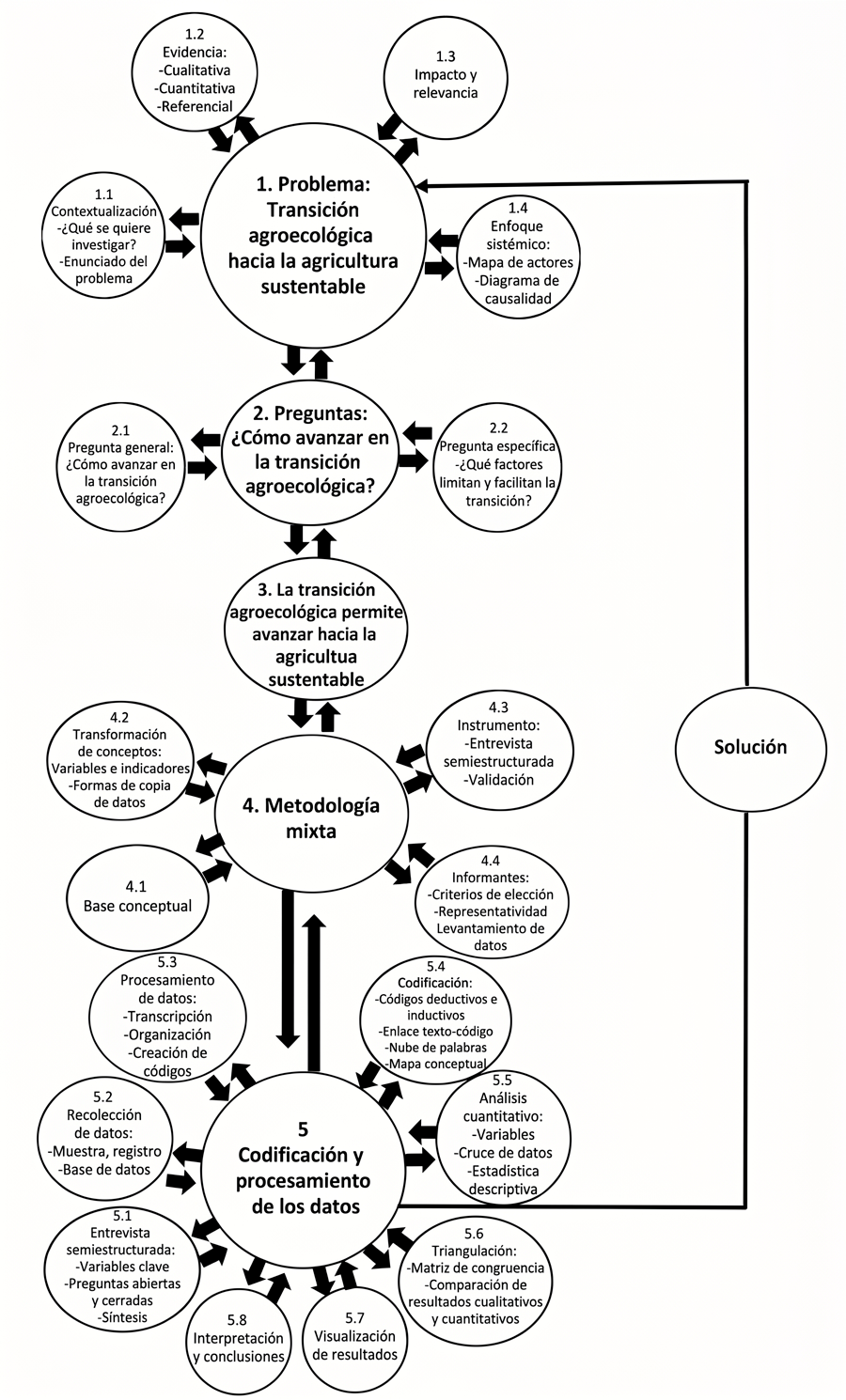
Phase 1. Contextualization and delimitation: the problem and its territorial, social and environmental relevance are clearly defined in order to build a broad, situated diagnosis.
Phase 2. Integration of evidence: combines quantitative and qualitative data, as well as historical references, to assess the problem’s dimensions.
Phase 3. which corresponds to the impact analysis and the systemic approach: a study of the problem’s relevance is conducted. Here, tools such as stakeholder maps and causality diagrams are used to identify interdependencies and critical points.
Phase 4. Questions and hypotheses are formulated and mixed methods are selected: this allows concepts to be transformed into variables and indicators, using validated instruments to ensure quality and representativeness.
Phase 5. the triangulation and application are carried out: integration and continuous analysis of qualitative and quantitative data, through key matrices and relationships, transform conceptual complexity into a useful guide for decision-making, territorial planning, social innovation and sustainability-oriented public policies.
The methodological proposal presented in this paper modifies the complexity of agroecology in a practical and adaptable path.
Starting with the consumer subsystem and integrating environmental, social, economic and ethical dimensions, it offers tools to diagnose, plan and guide processes towards sustainability.
With this, it reinforces the scientific validity of agroecology and provides useful inputs for decision-making, social innovation and the formulation of public policies that promote equity and territorial resilience.
Anderson, C. R and Anderson, M. D. 2020. Resources to inspire a transformative agroecology: a curated guide. En H. R. Herren, B. Haerlin and IAASTD. A. G. (Eds.), transformation of our food systems: the making of a paradigm shift. Zukunftsstiftung Landwirtschaft. Foundation on Future Farming. 169-180 pp.
Casanova, L.; Martínez, J.; López, S. y López, G. 2016. De von Bertalanffy a Luhmann: deconstrucción del concepto ‘agroecosistema’ a través de las generaciones sistémicas. Revista del Magíster en Análisis Sistémico Aplicado a la Sociedad. 35(2):60-74. Doi: https://doi.org/10.5354/0719-0527.2016.42797.
Poux, X. and Aubert, P. M. 2018. An agro-ecological Europe in 2050: multifunctional agriculture for healthy eating. Findings from the ten years for agroecology (TYFA) modelling exercise. Iddri-AScA, Study N°09/18. https://www.iddri.org/en/publications-and-events/study/agroecological-europe-2050-multifunctional-agriculture-healthy-eating.
Terán-Samaniego, K.; Robles-Parra, J. M.; Vargas-Arispuro, I.; Martínez-Téllez, M. Á.; Garza-Lagler, M. C.; Félix-Gurrola, D.; Maycotte-de la Peña, M. L.; Tafolla-Arellano, J. C.; Espinoza-López, P. C. and García-Figueroa, J. A. 2025. Agroecology and sustainable agriculture: conceptual challenges and opportunities- a systematic literature review. Sustainability. 17(5):1-21. https://doi.org/10.3390/su17051805.
Van der-Ploeg, J. D.; Barjolle, D.; Bruil, J.; Brunori, G.; Costa-Madureira, L. M.; Dessein, J.; Drąg, Z.; Fink-Kessler, A.; Gasselin, P.; Gonzalez-Molina, M.; Gorlach, K.; Jürgens, K.; Kinsella, J.; Kirwan, J.; Knickel, K.; Lucas, V.; Marsden, T.; Maye, D.; Migliorini, P.; Milone, P.; Noe, E.; Nowak, P.; Parrott, N.; Peeters, A.; Rossi, A.; Schermer, M.; Ventura, F.; Visser, M. y Wezel, A. 2019. The economic potential of agroecology: empirical evidence from Europe. Journal of Rural Studies. 71:46-61. Doi: https://doi.org/10.1016/j.jrurstud.2019.09.003.
Wezel, A.; Herren, B. G.; Kerr, R. B.; Barrios, E.; Gonçalves, A. L. R. and Sinclair, F. 2020. Agroecological principles and elements and their implications for transitioning to sustainable food systems. A review. Agronomy for Sustainable Development. 40(6):1-13. https://doi.org/10.1007/s13593-020-00646-z.