elocation-id: elocation-id: e4087
The study focuses on analyzing the yellow and white corn markets in Mexico during the period 2010-2023 to understand the current situation of both grains and to generate a background that allows the development of studies differentiated by corn variety rather than treated as a homogeneous crop. Distinguishing between corn varieties allows us to understand the productive, price and trade dynamics, where white corn is intended for food diets and yellow corn for livestock consumption. This study aimed to estimate and identify asymmetries in competitiveness, trade balance and prices, using indices of self-sufficiency and import dependence, as well as the relative prices proposed by FAO and the World Bank. The results showed significant differences; on the one hand, yellow corn is dependent on imports, has limited domestic production and has relative prices that, although competitive as of 2020, show a loss of profitability; on the other hand, white corn has productive self-sufficiency and a strengthened national production; however, it is not present in the international market (exports and imports) and relative prices, while showing a growing trend in competitiveness, are also losing profitability. In conclusion, it is recommended that the State intervene through differentiated agricultural policies that include contract farming for yellow corn and technological improvements and fertilizer subsidies for white corn, in order to improve profitability and thereby promote national production.
agricultural policy, relative prices, self-sufficiency and dependence.
Corn is one of the most important crops worldwide because there are different varieties that are important in human consumption, the biofuel industry, the livestock industry and the starch industry, among others; in Mexico, the production and consumption of two corn varieties predominate, which are the most used in the different industries. At the global level, according to SIAVI (2025), the trade balance of corn in Mexico establishes that the main trading partner is the United States, which contributes the largest amount of imports of yellow corn, which represents 80% of imports of this grain; on the other hand, in the case of white corn, although the trade balance is smaller, approximately 80% of Mexico’s exports are sent to Venezuela.
In addition, the recent evolution of the asymmetries observed between white corn and yellow corn must be interpreted in the institutional framework of the United States-Mexico-Canada Agreement (USMCA), in force since 2020. This agreement consolidated North America’s agrifood trade integration and provided certainty for the exchange of staple grains through market access disciplines, sanitary and phytosanitary measures, and regulatory cooperation mechanisms.
In this context, Mexico’s high dependence on imports of yellow corn from the United States of America is not only due to internal production limitations, but also to a regional specialization and cross-border supply scheme favored by the current trade regime. Likewise, the regulatory environment associated with agricultural biotechnology and the production standards considered in the USMCA has had a differentiated impact on corn markets, particularly on the forage and industrial segments (Gobierno de México, 2023; Office of the United States Trade Representative [USTR], 2018).
According to SIAP (2024), the two most used varieties in Mexico are white corn and yellow corn; the first is destined for human consumption with 58.5%, the second is destined for the livestock industry with 78.5%, followed by industrial use with 14.7% and to a lesser extent for human consumption with 2.3%. On the other hand, Lopez et al. (2021) determined that yellow corn production is deficient; nevertheless, the northern part of the country is the region that produces the most nationally.
In this context, Ayllón-Benítez and Cardoso-Jiménez (2025) conducted a study that focuses on corn, but in a general way, without differentiating between yellow and white corn varieties; the authors highlight that the functioning of the corn market in Mexico is determined by marketing, supply and demand behaviors, trade balance, and production in the case of white corn. In the market, a fundamental concept is competitiveness, which, according to Ramírez-Vásquez et al. (2020), is the ability to enter a market and have the ability to generate economic gains; however, in agriculture, it is difficult to achieve competitiveness due to low innovation, small production unit size, or limited access to markets.
On the other hand, one way to be competitive is to achieve self-sufficiency through agricultural policies; according to FAO (2002), self-sufficiency is achieved when consumption is met by national production. Cruz Herrera et al. (2021) noted that Mexico’s dependence on imports has increased over these decades due to economic integration, leading markets to be regulated by international prices.
In the studies, distinguishing corn varieties allows us to identify differences present in both white and yellow corn, which enables us to determine whether any of these varieties exhibit productive self-sufficiency or dependence on imports, and to understand whether internal and external prices influence farmers’ decision-making to determine national production.
The research is justified because it is essential to understand the dynamics of production, trade balance, and national and international prices of yellow corn and white corn in Mexico, since analyzing corn by variety rather than as a general crop allows us to obtain better interpretations of its indicators. The importance of this study lies in characterizing the behavior of yellow corn and white corn in Mexico, as previous studies have examined corn in an aggregate manner, without accounting for their market differences.
The study hypothesizes that each corn variety exhibits asymmetries in its relative prices, trade balance and competitiveness, leading one variety to be self-sufficient in production and the other to be dependent on imports. The objective of this research is to estimate and identify asymmetries in competitiveness and changes in the national and international markets for yellow and white corn in Mexico from 2010 to 2023 on relative prices, productive self-sufficiency, and dependence on imports.
To meet the objective, it was decided to use the dependence and self-sufficiency indices proposed by FAO (2001) and thus determine the situation in which both yellow and white corn are found. To determine these indices, it is necessary to calculate the national apparent consumption (NAC) to use it within the calculation of the indices and the NAC is calculated using the following formula:
Equation 1:
Equation 1 is used as the denominator in equations 2 and 3, which in turn are used to determine the self-sufficiency and dependence indices.
Equation 2:
Equation 3:
Where: SI= self-sufficiency index; DI= dependence index; NAC= national apparent consumption.
According to FAO (2025), national apparent consumption enables us to determine the amount of product, in this case corn, available for effective consumption and to identify the main variable that makes up national consumption. Following the guidelines established by FAO, a country, in this case Mexico, is self-sufficient if the self-sufficiency index is at least 75%; if a lower result is obtained, the crop is import-dependent.
In the case of relative prices, the methodological equation proposed by the World Bank was used, which defines the relative price as the ratio of the domestic price to the border price (Banco Mundial, 1980). Adapting the formula for this research, the relative price equation is established as follows:
Equation 4:
To adjust it within the Mexican market, the variables of deflation and exchange rate must be added to the domestic and external prices, respectively; therefore, the equation is established as follows:
Equation 5=
Where: RP= relative prices; Pdom= domestic price (rural average price); Pint= international price; NPPI= national producer price index, corn subindex; Er= exchange rate. The results obtained from the relative price equation allow competitiveness to be analyzed and are interpreted as follows: RP= 1, it is when domestic prices are equal to international prices. RP> 1, the domestic price is higher than the international price, which means that there is no competitiveness in the international market. RP< 1, the domestic price is lower than the international price, which indicates that there is competitiveness in the international market.
Nonetheless, if costs remain constant and do not decrease, it indicates a loss of profitability for producers. The data for the variables used to determine the equations of national apparent consumption, self-sufficiency and dependence indices and relative prices were obtained from official sources on an annual basis and then deflated; they are specified in Table 1.
| Nacional prices (rural average price) | (SIAP, 2025) in Mexican pesos |
| Production | SIAP (2025) in tons |
| Exports | SIAVI (2025) in tons |
| Imports | SIAVI (2025) in tons |
| Exchange rate | Federal Reserve Bank of ST Louis (2025a) |
| International price | Federal Reserve Bank of ST Louis (2025b) in US |
| NPPI corn (base 2019) | INEGI (2025) |
These data enabled us to estimate the values of the established equations, provided that the methodology is coherent and in accordance with the research, to determine the current context of corn in Mexico within the international market. To make the collection of indicators transparent and avoid the methodological procedure being stated solely, an illustrative numerical example is presented.
In the case of white corn, the year 2023 was considered, which has the following figures: production of 24.43 million tonnes, imports of 428 000 t, and exports of 7 000 t; national apparent consumption (NAC) is obtained as the sum of production and imports minus exports, resulting in 24.5 million tonnes.
From this value, the self-sufficiency index is calculated as the ratio of production to NAC, obtaining a value of 0.98 (98%); by contrast, the dependence index is approximated as the ratio of imports to NAC, with a value of 0.02 (2%). According to FAO guidelines, self-sufficiency values of 75% or higher indicate independence from external supply (FAO, 2001, 2025).
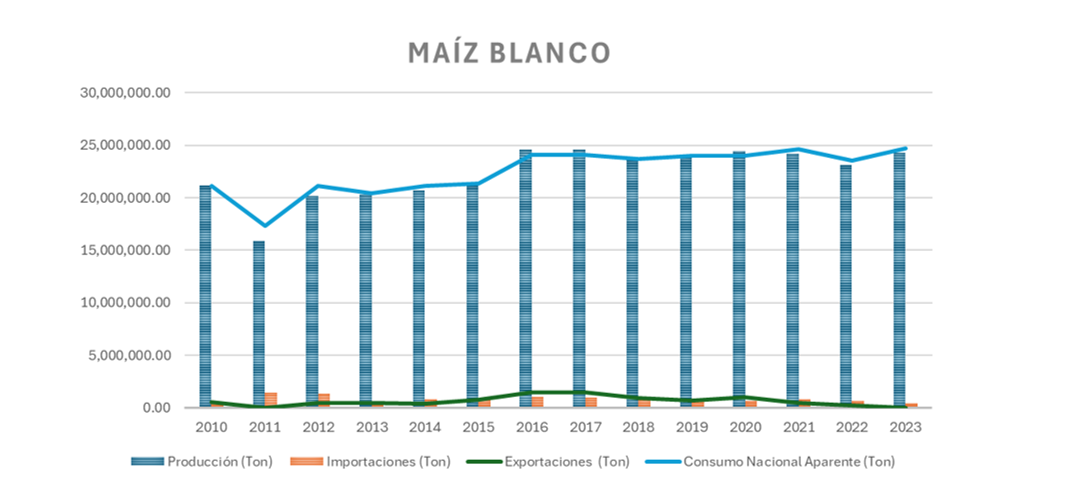
The results show totally different conditions in terms of dependence, self-sufficiency and relative prices between these two crops. The NAC of white corn in Mexico, which is observed in Figure 1, shows that production is the main variable to meet consumption, and exports and imports are not significant, indicating that international trade is not fundamental to this market.
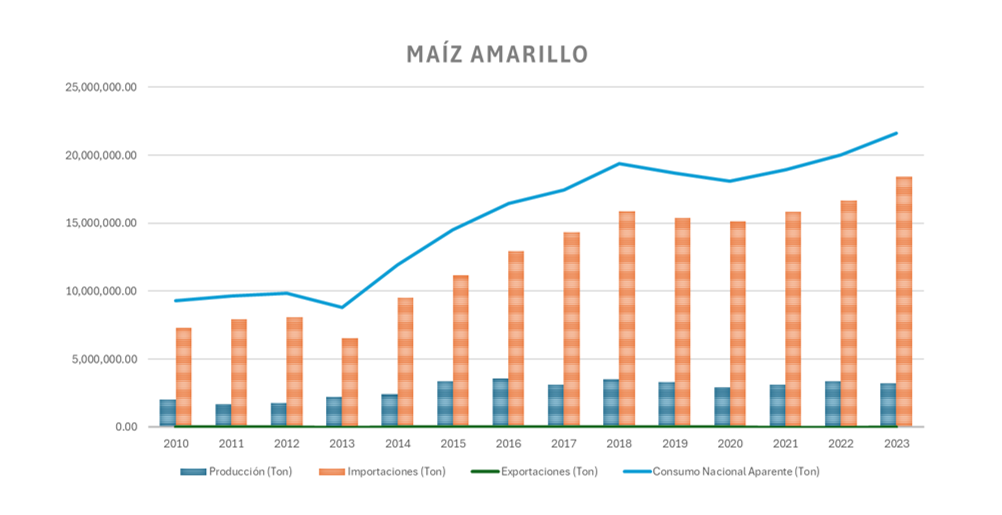
Figure 2 shows that the NAC of yellow corn differs structurally from that of white corn in Mexico (Figure 1). In contrast to white corn, the predominant variable in yellow corn is imports from the United States of America. As for national production, its contribution to NAC is very limited, as very few states produce yellow corn, with Chihuahua being the notable exception, as it concentrates on the largest national production of yellow corn.
On the other hand, the variable of yellow corn exports is practically zero in all the years marked in Figure 2, which means that international trade, especially in the variable of imports, is essential to be able to cover Mexico’s national consumption.
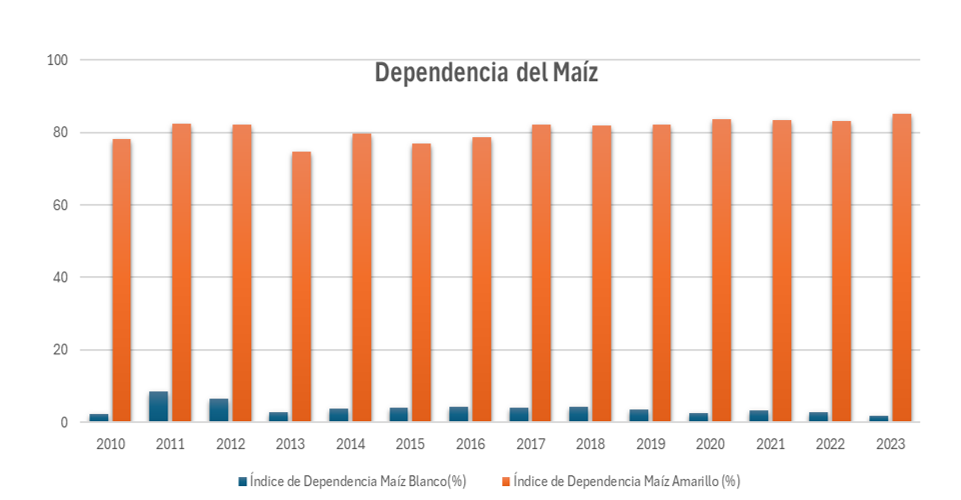
The Figure 3 shows the white and yellow corn dependence index, reflecting significant differences, with dependence on yellow corn imports being the most important, as it exceeded 70% from 2012 to 2023; by contrast, in the same period, white corn shows that imports are not as necessary to cover consumption.
This behavior was explained by the fact that, at the national level, the production of white corn is present in all states, which means that it is not necessary to resort to imports; on the other hand, yellow corn is not produced in all states, and given that its demand has increased in recent years, imports are required to meet the demands of these industries.
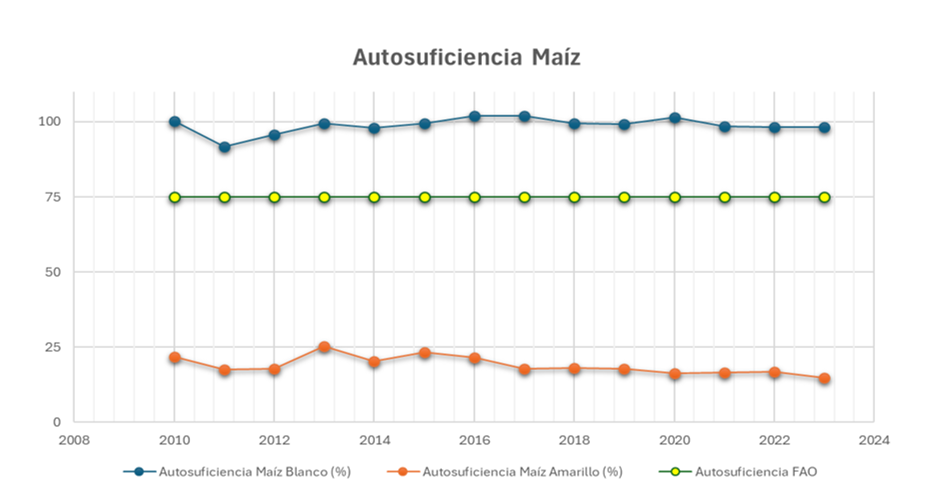
FAO establishes that for a country to be self-sufficient, it needs consumption to come from at least 75% of national production; in this context, in Figure 4, from 2010 to 2023, it is observed that white corn meets this criterion, even having values above 90%; on the other hand, yellow corn has values even lower than 30% and comparing it with Figure 3, it shows a dependence on the foreign market.
Figure 3 reaches the same conclusion as Reyes-Santiago et al. (2022), where four states of the republic concentrate 80% of Mexico’s yellow corn production, with Chihuahua being the largest producer and to a lesser extent, Jalisco, Tamaulipas and Chiapas. Therefore, combining Figure 3 and 4, it is argued that yellow corn is dependent on imports, which are greater than 70% and white corn has productive self-sufficiency.
Nevertheless, it is also necessary to compare prices to comprehensively understand the behavior of the international corn market (white and yellow) and the asymmetries that arise from its trade balance between national production, exports and imports. To complement the analysis of relative prices and facilitate their interpretation, a table is included that presents the evolution of the rural average price of corn (deflated) and the international price adjusted by the exchange rate for both varieties (Table 2).
This exercise enabled us to directly observe the levels and trends of each price series, as well as the episodes of divergence between domestic and foreign prices. According to the methodology proposed by the World Bank and subsequently developed by FAO, the joint analysis of domestic and border prices is essential to assess the economic incentives faced by agricultural producers (Banco Mundial, 1980; FAO, 2014).
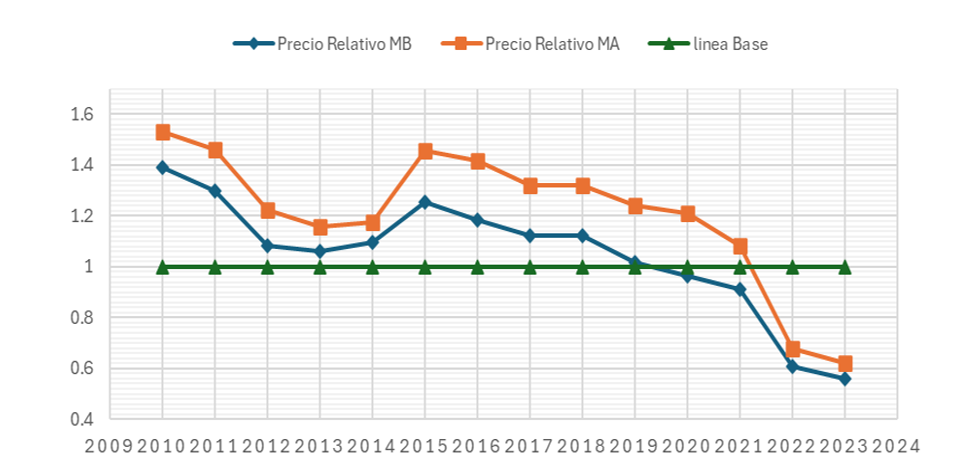
Figure 5 shows the relative prices of yellow and white corn; to this end, the domestic price was deflated to see its effects without inflation and the international price was multiplied by the exchange rate according to the year indicated. Following FAO guidelines, the impact of prices on the agricultural market from the producer’s point of view is represented as follows.
The estimated relative prices confirm the existence of asymmetries between white corn and yellow corn in Mexico (Figure 5). In the case of white corn, the indicator values remain close to one throughout most of the analysis period, with specific episodes of international competitiveness, reflecting a market predominantly oriented to domestic supply and with limited exposure to foreign trade. On the other hand, yellow corn has relative prices above one before the USMCA, evidencing a systematic loss of competitiveness against the international price and reinforcing its structural dependence on imports.
These results are consistent with the patterns observed in the self-sufficiency and dependence indices, as well as with the dynamics of national apparent consumption and show that the evolution of prices has not been sufficient to reverse the productive asymmetries between the two varieties. The interpretation of competitiveness based on relative prices must be nuanced by considering the structure of production costs, since agricultural profitability depends on the margin between the price received and the unit cost.
Even if relative prices suggest greater international competitiveness, this does not guarantee improvements in producers’ net income if production costs remain high or increase, particularly in strategic inputs such as fertilizers, energy, and transportation. This phenomenon is consistent with empirical evidence documenting a high regional and technological heterogeneity in Mexican agriculture, where differences in yields and production scales generate significantly different cost structures between regions and producers.
In this regard, international literature stresses that price differentials should be analyzed alongside transaction costs and productive organization in order to comprehensively assess the effects on the profitability and competitiveness of the agricultural sector (World Bank, 1991; FAO, 2014). According to De Luis-Peralta et al. (2025), the main agricultural policy implemented for corn at the national level was PROCAMPO, which responded to the implementation of NAFTA and failed to generate comparative advantages, profitability, or competitiveness, so national farmers could not stand out against farmers from the United States of America.
If agricultural policies are aimed at increasing prices, they could generate greater profitability for producers; however, if policies are aimed at reducing costs, such as fertilizers or transportation, they favor both the competitiveness and profitability of the sector. This study differs because it analyzed the different varieties of white and yellow corn rather than treating them as a homogeneous crop; this approach allows us to identify differences in the dynamics of production and their trade balance, and to identify the main variables of their consumption.
In a study that analyzed imports and food prices, Valencia-Romero et al. (2019) determined that NAFTA deteriorates food sovereignty and that corn is food dependent; nevertheless, when separating the varieties in this study, it is determined that white corn, mainly intended for human consumption, does not present such food dependence.
In his findings, Jaime-Vargas (2024) agrees that the trade balance of yellow corn depends on imports; however, when comparing our results on indicators of dependence and self-sufficiency, the analysis is extended, demonstrating that yellow corn does not directly influence food sovereignty. Regarding prices, the study by García-Hernández et al. (2023) coincides with the fact that the yellow corn market is influenced by the volatility of the international price, which affects the producer’s income.
White and yellow corn crops present asymmetries derived from their behavior within the price system and national and international markets; in terms of production, white corn has productive self-sufficiency and yellow corn is dependent on imports; in terms of prices, it is determined that international prices of yellow corn are more competitive than national ones, causing consumers to prefer to purchase imported corn and thus generating a loss in the profitability of national farmers.
To address market asymmetries of white and yellow corn, it is suggested that the State intervene through the implementation of differentiated, focused agricultural public policies that manage to reduce these asymmetries, especially those focused on improving farmers’ profitability by seeking to reduce production costs.
In yellow corn, the recommended agricultural policies include contract farming, where its main scheme is that the farmer and the buyer establish in advance the price and the quantity purchased, reducing uncertainty and improving import logistics to reduce the final price; in the case of white corn, it is proposed that agricultural policies should be aimed at improving productivity and reducing production costs to through technological innovation, agricultural extension, and technological infrastructure.
De Luis-Peralta, A.; Vega-Valdivia, D. D.; Garza-Bueno, L. E. y Barrios-Puente, G. 2025. Análisis de la política agrícola en México: rentabilidad, competitividad y autosuficiencia alimentaria en granos básicos. Agricultura, Sociedad y Desarrollo. 22(1):107-122. https://doi.org/10.22231/ASYD.V22I1.1693.
López-López, C.; Tadeo-Robledo, M.; García-Zavala, J. J.; Espinosa-Calderón, A. y Mejía-Contreras, A. J. 2021. Aptitud combinatoria general y específica de híbridos varietales de maíz amarillo de baja endogamia. Revista Mexicana de Ciencias Agrícolas. 12(4). https://doi.org/https://doi.org/10.29312/remexca.v12i4.2786.
World Bank. 1991. The political economy of agricultural pricing policy: Volume 1. (A. O. Krueger; M. Schiff & A. Valdés, Eds. Vol. 1). The Johns Hopkins University Press. 1-12 pp. https://documents1.worldbank.org/curated/en/865231468000281262/pdf/Latin-America-The-political-economy-of-agricultural-pricing-policy-volume-1.pdf.