elocation-id: elocation-id: e4073
The study was conducted from 2023 to 2024 in order to fully utilize spring onion (Allium cepa L.) due to its nutraceutical and functional value and the need to generate agro-industrial ingredients from plant byproducts. Flours were made from roots, bulbs and stem/leaves and they were subjected to proximate and granulometric analyses. The samples used were dehydrated at 38 °C by convection, and then ground to obtain the flours. Granulometry, moisture, ash, protein, lipids and carbohydrates were determined using official techniques. The results obtained showed significant differences (p < 0.05). Roots and stem/leaves showed the lowest lipid content (1-4.1%) and high fiber content (30.1% and 35.2%), respectively; bulbs presented the highest concentration of lipids (7.5%) and roots presented the highest amount of ash (11.4%). The three flours had a moisture content lower than the 7% required by Mexican regulations (0.7-5.2%). Therefore, the spring onion (Allium cepa L.) can be utilized in its entirety by producing added-value flours with applications in the food industry, thereby reducing the amount of residues obtained by reducing waste and generating an additional source of income for producers and self-sustaining value chains.
physicochemical characterization, utilization, vegetable flour.
Onion (Allium cepa L.) is one of the most important and widely consumed vegetables worldwide due to its culinary value, nutritional properties, and health benefits (Bamba et al., 2020). Its cultivation exceeds 100 million tons per year worldwide; Mexico is the tenth-largest producer of this vegetable, contributing 1 800 000 t, and the third-largest exporter (FAO, 2025). Onion consumption is linked to functional benefits associated with antioxidant activity, antimicrobial properties, and metabolic regulation, due to the presence of sulfur compounds, flavonoids, minerals and fiber (Pareek et al., 2018; Griffiths et al., 2002).
In Mexico, onions are classified based on their stage of maturity: spring onions, which are harvested in a young state between 45 and 60 days after transplanting (dat) and white or ripe onions, which are harvested between 90 and 150 dat. The spring onion is characterized by having a small bulb, tender leaves and developed roots. However, its consumption is restricted almost exclusively to the bulb, while stems and roots are usually considered residues, resulting in losses and limiting the comprehensive use of the plant.
In the context of modern agribusiness, the generation of large volumes of byproducts with limited use and their associated environmental impact make sustainability and the comprehensive use of these materials a priority, so this situation represents a strategic opportunity for innovation and the development of value-added alternatives (Siddiq et al., 2013; Kakkar et al., 2021; Báez et al., 2023). On the other hand, the transformation of vegetables into dehydrated flours has gained relevance due to its potential to extend shelf life compared to fresh produce (Bamba et al., 2020), facilitate their incorporation into food matrices, and generate functional ingredients with applications in baking and instant mixing, while preserving their nutritional properties (Bedrníček et al., 2020; Sagar and Pareek, 2021; Wang et al., 2025).
Based on the above, the objective of this research was to compare the proximate composition and granulometry of flours of different fractions (bulbs, stem/leaves and roots) of spring onion (Allium cepa L.) for possible use in the food industry.
The onions used were spring onions (Allium cepa L.) harvested at a young stage from a plot in the locality of El Con, Salinas, San Luis Potosí, Mexico (22.607153° north latitude, -101.725608° west longitude). The samples were selected for uniformity of size with a bulb diameter of 20-30 mm and a total length (bulb and aerial part) of 15-20 cm; they exhibited a uniform external coloration, with cream-white bulbs and intense green leaves, free of visible mechanical or phytosanitary damage.
Three batches of 30 onions each were selected and washed with drinking water to remove residues of dirt and foreign matter. They were then disinfected by immersion in a chlorinated solution at 200 ppm chlorine, prepared from food-grade sodium hypochlorite, for 15 min. Disinfection was carried out in sanitized plastic containers for food use, keeping the samples completely submerged at room temperature and under controlled hygienic conditions.
After disinfection, the onions were rinsed with distilled water to remove chlorine residues, then placed on stainless steel trays to drain before being processed. Later, they were cut, and the bulbs, stems/leaves and roots were separated. The fractions previously placed in trays were subjected to drying using a She Lab forced-air oven (model CE3F-2) at a temperature of 38 ±2 °C for 166.5 h, until the weight remained constant for at least two consecutive determinations. Once this point was reached, the samples were removed from the oven, and their temperature stabilized with that of the environment. The dry material was ground in a Hamilton Beach mill (model 80350r), obtaining the corresponding flour. For each fraction, this procedure was performed in triplicate.
The granulometry and proximate content of the flours obtained from bulbs, stems/leaves, and roots of spring onion were determined in triplicate. The results are expressed on a dry basis. The granulometry was obtained by placing 100 g of each flour in a set of sieves, with mesh sizes 300, 210, 177, 149, 104, 75 and 33 μm, as well as a collector for particles smaller than 33 μm.
The moisture content of the flours was determined using the thermogravimetric method by drying in an oven at 105 ±2 °C, according to the AOAC 925.10 method (AOAC, 2005). The moisture percentage was calculated using the following equation:
Where: W1= the weight of the empty dish at constant weight (g); W2= the weight of the dish with sample (g); and W3= the weight of the dish with dehydrated sample (g).
Ash determination was performed by muffle incineration at 550 °C, according to the AOAC 923.03 method (AOAC, 2005). The inorganic residue was calculated using the following equation:
Where: W1= the weight of the empty crucible at constant weight (g); W2= the weight of the crucible with sample (g); and W3= the weight of the crucible with ash sample (g).
The protein determination was performed by the Kjeldahl method described in the standard NOM-068-S-1980 (SCFI, 1980), using the following equation:
Where: VHCl= volume of hydrochloric acid spent in the titration; NHCl= normality of hydrochloric acid; MeqN= equivalent weight of nitrogen= 0.014; a= weight or volume of the sample; and factor= 6.25 for vegetables.
Lipid content was quantified using the Soxhlet method as described in the AOAC 920.39 method (AOAC, 2005) and using the following formula.
Where: BeOB= weight of the aluminum beaker plus the extracted oil plus three borosilicate beads (g); BeB= weight of the aluminum beaker plus three borosilicate beads (g); and Flr= weight of the onion flour sample (g).
Total dietary fiber was determined by the enzymatic-gravimetric method described by the AOAC 985.29 method (AOAC, 2005), by which soluble and insoluble dietary fiber in the sample were determined, with total dietary fiber being the sum of both fractions. The determination of carbohydrates present in the flours was carried out based on what is described in the standard NOM-F-312-1978 (SCFI, 1978) and the following equation.
Where: %TRS= percentage of total reducing sugars; T= titer (g of invert sugar per 10 ml of Fehling’s solution A+B); V= sample volume spent on titration (ml); and W= weight of the sample (g).
The results were expressed as mean and standard deviation. The statistical significance of the effect of fractions on physicochemical variables was determined using the corresponding Anova, followed by a comparison of means by Tukey (α= 0.05) (r-project® 4.4.2, in the RStudio® 2025.09.2 interface).
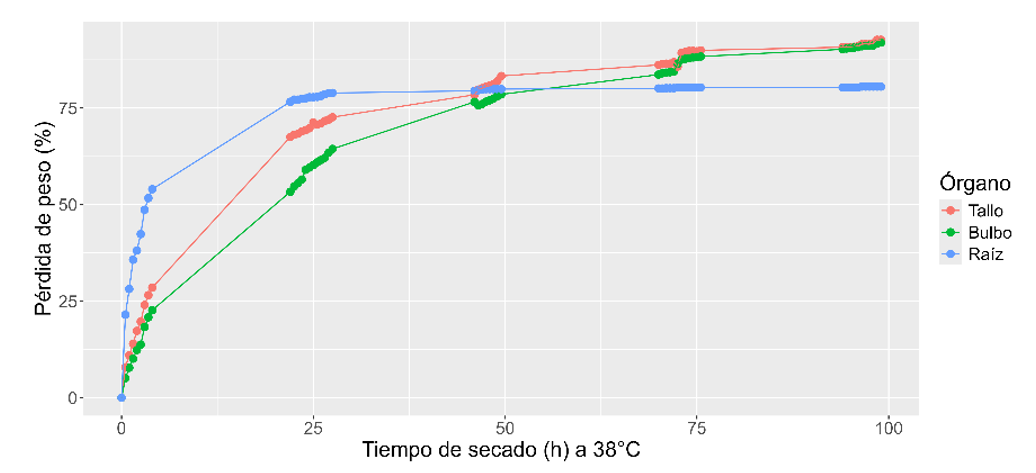
The fresh and dry weights of the onion samples were concentrated in the bulb (57.87 ±3.82% and 59.03 ±3.6%), followed by the stems/leaves (40.83 ±3.64% and 37.81 ±3.25%) and the rest was found in the root (1.29 ±0.18% and 3.16 ±0.41). The weight loss of the samples (Figure 1) showed a behavior typical of plant products, which lose moisture due to external diffusion, a characteristic of porous biological materials (Fellows, 2000; Bamba et al., 2020).
The highest rate of moisture loss occurred in the first five hours, due to the evaporation of free water, where the root lost almost 50% of its initial weight. Between the 5th and 20th hour, a constant water-loss rate is observed; this behavior indicates a constant evaporation rate. In the case of the bulb, the loss of moisture was slower than that observed in the stem and root, because the bulb is composed of parenchymal tissue, which is made up of large compact cells, which limits the transport of moisture from the internal tissues to the surface due to the smaller volume of the intracellular spaces (Koménan et al., 2020).
Additionally, the high sugar content in the bulb increases internal osmotic pressure, retaining water more strongly and reducing vapor diffusion (Alam and Islam, 2015; Griffiths et al., 2002). In contrast, stem and root tissues, which are more fibrous and vascularized, have greater porosity, which favors the migration of water vapor, resulting in faster dehydration. According to Fellows (2000), materials with a porous or fibrous structure dry more quickly than those with a compact texture. The root presented a shortening of this stage because the amount of free water available for evaporation is lower, and the amount of fiber is high.
Subsequently, between 20 and 80 h, a decreasing drying speed was observed; this is because, at this point, the water present in the food is in the inner layers, so it is necessary to carry out a diffusion from the inside to the outside to later evaporate from the food (Fellows, 2000). After more than 166 hours, the bulb presented the lowest percentage of residual moisture, followed by the stem/leaves and the root; these results are consistent with those obtained by oven drying, which represent the cumulative moisture loss, where the bulb and stem had losses of 92-92.7%, reaching residual moisture of 0.7 ±0.2% and 3.1 ±0.2%, respectively; in contrast, the root, with a lower total loss of 80.4% and a residual moisture of 5.2±1.7%.
The three fractions comply with the provisions of NMX-F-233-1982 (SCFI, 1978), which establishes the specifications that dehydrated onions must meet. The standard indicates that the samples must contain less than 7% moisture, a requirement that ensures they will have high stability during storage. A significant difference (p < 0.05) was found in ash content, where root flour had the highest content (10.2 ±0.5%) compared to those from bulbs (4.9 ±0.4%) and stem/leaves (4.6 ±0.6%). These results can be attributed to the fact that the main function of this structure is the absorption and accumulation of nutrients from the soil, which are retained within the fibrous structure even after the drying process (Bello et al., 2013).
The crude protein content showed a significant difference (p < 0.05), where bulb flour had the lowest content (15.6 ±0.7%) (Table 1). The higher protein content of stem/leaves and roots can be attributed to their metabolic function, as these tissues are responsible for the synthesis, accumulation and transport of nitrogenous compounds within the plant.
Because the spring onion is harvested at an early stage, the amount of nitrogenous compounds is high; as the onion ripening process progresses, the amount of protein compounds decreases as they are transported to the bulb. On the other hand, the bulb in this growth stage has a lower concentration of nitrogenous compounds since its main function is to store energy reserves (Jaime et al., 2002; Brewster, 2008; Bello et al., 2013).
There was a significant difference (p < 0.05) in lipid content, where bulb flour stands out with a higher percentage (7.5 ±1.1%) (Table 1); this is attributed to the fact that it acts as a storage organ, and its structure favors intracellular lipid retention even after drying (Fennema et al., 2019). These values coincide with what was reported by Borrego (1989); Montes and Holle (1970) for dehydrated onions, who indicate fat concentrations between 1.3% and 7.8%; likewise, they are comparable to the results reported by Everardo-Zamora (2016), who observed a lower concentration of lipids in stems compared to the bulb, which is characteristic of vegetables (Badui-Dergal, 2006).
The results obtained show that lipid content depends on the structure and function of the plant tissue, and on the degree of maturity of the spring onion. From a functional point of view, the low fat content in the stem and root represents an advantage to prolong the oxidative stability of flours during storage and therefore their shelf life (Labuza and Tannenbaum, 1972).
The total carbohydrate content did not show a significant difference (p > 0.05), with an average value of 76.4%, with a similar behavior in the content of reducing sugars (47.7%) (Table 1). The bulb presented 54.2 ±5.7% of reducing sugars, due to its role as the main reserve organ of soluble carbohydrates, which support the metabolic processes that occur during development and postharvest storage (Bello et al., 2013).
In contrast, a statistical difference was found in dietary fiber content (p < 0.05), where bulb flour had the lowest content (20.9 ±3.8%) (Table 1). This is due to the lower proportion of structural tissues in the bulb compared with the more fibrous composition of the leaf and root fractions. The values reported by Ros-Berruezo et al. (2010) show a dietary fiber content of 17.2%, a value comparable to that obtained for the bulb in this study, with a predominance of simple carbohydrates (Brewster, 2008). On the other hand, Bello et al. (2013) point out that leaves and roots accumulate more indigestible structural carbohydrates.
The results obtained showed that the functional and structural differences of the tissues have an impact on the proportion of sugars and fiber present; the bulb is distinguished by its high concentration of energy compounds, in contrast to the stem/leaves and root, which are rich sources of dietary fiber, characteristic behavior of onions in a young state (Brewster, 2008).
A heterogeneous particle distribution was found, showing a higher proportion of particles smaller than 33 microns (Table 2). This distribution classifies them as flours with medium particle size. In particular, the root had the highest retention in mesh 300 μm (17.5%), whereas the bulb and stem had the highest amount of retained matter with size ≤104 μm, with 72.5% and 80.3%, respectively.
Based on the granulometric specifications described in the NMX-F-233-1982 standard, the flours obtained can be classified as products with an intermediate particle size between type I and II, since in type I flour (powder), 95% of the product must pass through the 250 mesh, and type II flour (granulated) must be retained mostly in the 250 mesh. The current global trend, as well as in the food industry through agribusiness, is to utilize and revalue plant byproducts for their contribution of bioactive compounds and fiber.
In this context, spring onion flours position themselves as a competitive and viable alternative because they have a high content of proteins, fiber, and sugars, and promote sustainability as the bulb, stem and root are fully utilized. Previous studies have shown that including onion skin flour in various products improves antioxidant capacity, nutraceutical profile and water retention capacity in bakery products (Gawlik-Dziki et al., 2013).
The comprehensive use of this vegetable also represents a strategy that minimizes waste and generates value-added ingredients. Its potential applications include bakery products, additives for instant soups and healthy snacks, powdered seasonings or self-dispersing solid mixtures, thereby meeting the growing demand for functional foods (Siddiq et al., 2013; Balakrishnaraja et al., 2021).
The present study shows that the spring onion (Allium cepa L.) in its young state can be fully utilized by transforming it into bulb, stem, and root flours. The flours obtained had low moisture content, which guarantees microbiological and oxidative stability, a high protein content, mainly in the stem/leaves and roots (19.6-18.9%), and a high sugar concentration in the bulb (54.2%), directly related to desirable functional properties.
They also presented high fiber content in the stem and root (35.2% and 30.1%, respectively), as well as high mineral content in the root (10.2% ash). These attributes allow spring onion flour to be classified as a viable functional ingredient for food addition or formulation. From an agro-industrial perspective, the comprehensive use of this vegetable contributes to reducing post-harvest losses, diversifying products, and strengthening self-sustaining value chains.
Baéz, J.; Marra, G.; Olt, V.; Fernández-Fernández, A. M. and Medrano, A. 2023. Potential of onion byproducts as a sustainable source of dietary fiber and antioxidant compounds for its application as a functional ingredient. Biology and Life Sciences Forum. 26(1):67-72. https://doi.org/10.3390/Foods2023-15046.
Bamba, B. B. S.; Komenan, A. C. A.; Kouassi, K. K. P. and Soro, D. 2020. Effects of onion bulb processing conditions on drying characteristics, physicochemical and functional properties profile of onion (Allium cepa L.) powder. Journal of Food Sciencie. 85(10):3346-3354. https://doi.org/10.1111/1750-3841.15415.
Bedrníček, J.; Jirotková, D.; Kadlec, J.; Laknerová, I.; Vrchotová, N.; Tříska, J.; Samková, E. and Smetana, P. 2020. Thermal stability and bioavailability of bioactive compounds after baking of bread enriched with different onion by-products. Food Chemistry. 319(1):1-9. https://doi.org/10.1016/j.foodchem.2020.126562.
Jaime, L.; Mollá, E.; Fernández, A.; Martín-Cabrejas, M. A.; López-Andréu, F. J. and Esteban, R. M. 2002. Structural carbohydrate differences and potential source of dietary fiber of onion (Allium cepa L.) tissues. Journal of Agricultural and Food Chemistry. 50(1):122-128. http://doi.org/10.1021/jf010797t.