elocation-id: e4070
Strawberries are a strategic crop in Mexico due to their economic and social importance, with more than 640 000 t produced in 2023, concentrated in Michoacán, Guanajuato, and Baja California. Their high perishability requires efficient logistics systems. The study aimed to estimate the optimal strawberry distribution routes for the 2023 cycle, using a linear programming model that minimizes the total distance transported, comparing closed- and open-economy scenarios. To do this, linear programming was applied using the simplex method in Lingo 18.0, considering distance as a cost variable. In the first scenario (closed economy), 4 of the 16 producers concentrated 95% of the supply and supplied the 28 demanding destinations; in the second (open economy), a surplus of 158 000 t was exported, mainly via Mexicali, Tijuana, and Matamoros. The model allowed us to minimize the variable of travel distance; however, limitations were identified, such as the absence of monetary costs, seasonality and a lack of storage infrastructure. In conclusion, strengthening these areas will increase the competitiveness of the strawberry sector and improve national food security.
strawberry consumption, strawberry distribution, strawberry export
Strawberries are one of the most important fruit and vegetable crops in Mexico, both in terms of their production volume and their economic, social, and cultural impact. In 2023, approximately 641 552 t were harvested on 15 267 ha, with a national average yield of 42 t ha-1 (SIAP, 2024). Production is mainly concentrated in Michoacán, which not only leads in volume but also in economic value; in 2023, it registered 326 191 t with yields close to 44.7 t ha-1, which represented more than 73% of national production (SIAP, 2024). Guanajuato reached yields of 58.8 t ha-1, while Baja California, particularly the San Quintín Valley, stood out for the quality of its production and its orientation toward the export market, due to North American capital (Garrapa, 2019).
In the international arena, Mexican strawberries have established themselves as a strategic crop. Nevertheless, the perishable nature of strawberries poses significant logistical challenges. Their high sensitivity to temperature variations and transport time requires efficient distribution chains. The producing areas, located in Michoacán, Guanajuato and Baja California, must supply both the domestic and foreign markets, which generates complexities in terms of distance, costs and delivery times (León-López et al., 2018).
To face these difficulties, linear programming has been successfully used in the design of transport models, particularly through the simplex method; this technique allows defining an objective function that minimizes the cost of transport from the producing areas to the demand centers, considering the constraints of supply and capacity (Moncayo-Martínez and Zhang, 2013). In this context, the present study aimed to estimate the optimal strawberry distribution routes for the 2023 cycle, using a linear programming model that minimizes the total distance transported, comparing with closed- and open-economy scenarios. The central hypothesis holds that route optimization through linear programming significantly reduces the total transport distance compared to non-optimized distributions, which translates into expected improvements in the logistics efficiency of the national strawberry system.
In this research, a linear programming model was applied using the simplex method (Ariza and Llinás, 2015) to two scenarios: a closed and an open economy, and with the specialized software Lingo 18.0. Under the assumption of considering the deficit or surplus in strawberry production, to identify suppliers and demanders. The data used corresponded to the national and state strawberry production from the Agricultural Closure reported by the Agrifood and Fisheries Information Service (SIAP, 2023), the national population reported by the National Population Council (CONAPO) in 2023 and the imported volumes recorded by FAOSTAT (2023).
It was necessary to define apparent national consumption, national consumption per capita, and apparent state consumption; then, the basic elements were defined: the objective function, formulated from the distances between each origin and destination, the supply and demand constraints; the surplus not used in a closed economy is considered stagnant product.
Apparent national consumption (ANC), apparent national consumption per capita (ANCP), and apparent state consumption (ASC) were obtained according to the following formulas (Castillo-Altamirano et al., 2025):
With this, if production exceeded consumption, the state was considered a supplier; otherwise, it was classified as a demander.
For the case of a closed economy, the objective function proposed was:
Where: Z= objective function to be minimized; Cij= distance between origin i and destination j; Xij= quantity of product transported to be solved with origin at i and destination at j.
Valid for producers of origin (i)= 1, 2, m; the destination consumer regions (j)= 1, 2,… n. For all origins (i)= 1, 2,… m; destination regions (j)= 1, 2,… n.
The distance between origin (i) and customs (k) to the destination (j), the point-to-point routes of the Secretariat of Infrastructure, Communications, and Transport (SICT, 2025) were used.
The supply constraints (Ei) of each (i) to the m-th origin were:
The demand constraints (Dj) of each (j) to the n-th destination were:
In the case of the open economy, 19 border customs were incorporated in the northern zone due to the proximity to the United States of America (US), Mexico’s main trading partner. The objective function considered the basis of the domestic market by incorporating the restrictions represented by customs, symbolized by the letter w, as shown below:
Where: Z= the objective function to be minimized; Cij= distance between the origin i and the destination j (state); Bik= distance between origin i and destination k (customs); Xij= quantity transported to be solved that has origin at i and destination at j; Mik= quantity exported and transported to be solved with origin at i and destination at j.
For all origins (i)= 1, 2,… m; customs of destination (k)= 1, 2,… w; destination states (j)= 1, 2,… n. The distance between origin (i) to customs (k) and states (j), the point-to-point routes of the Secretariat of Infrastructure, Communications and Transport (SICT, 2025) were used.
The restriction of the total quantity supplied by origin (Ei) of each (i) up to the m-th origin incorporating foreign trade by customs of destination:
In the case of the open economy, in addition to the 31 states and Mexico City, 19 customs offices on the northern border were considered, given the intense trade with the United States, as an exit for the surplus of supply.
The apparent national consumption (ANC) of strawberries in Mexico in 2023 was 482 778.6 t, the total national production was 641 552.22 t, exports were 184 772.42 t, and imports were 25 998.8 t. Based on the ANC and considering a total population of 126 014 024 inhabitants in the same year, the estimated per capita consumption of strawberries was 0.0038 t; that is, 3.8 kg per inhabitant per year, which allowed us to estimate the total consumption by state. In this way, the supplying (surplus) and demanding (deficit) states were identified.
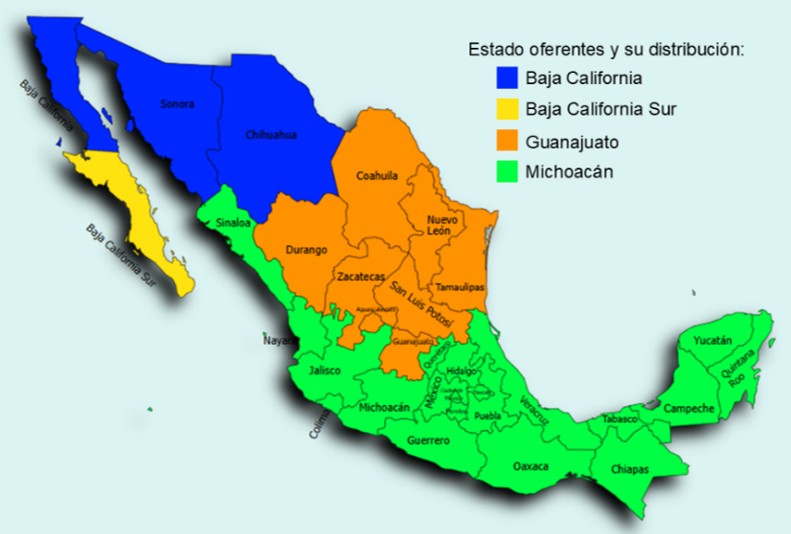
Four states were self-sufficient in strawberries: Baja California, Baja California Sur, Guanajuato and Michoacán, representing 12.9% of the states. These states supplied the remaining 28 states, which depended on external supply. Table 1 shows how Baja California and Guanajuato shipped to nine demanding states, evidencing their role as key suppliers in the national distribution of strawberries. In contrast, Baja California Sur made no shipments, reflecting its limited participation in the domestic market. For its part, Table 2 details the wide coverage of Michoacán, which supplied the demand of the remaining 19 states, consolidating itself as the primary production and distribution center at the national level.
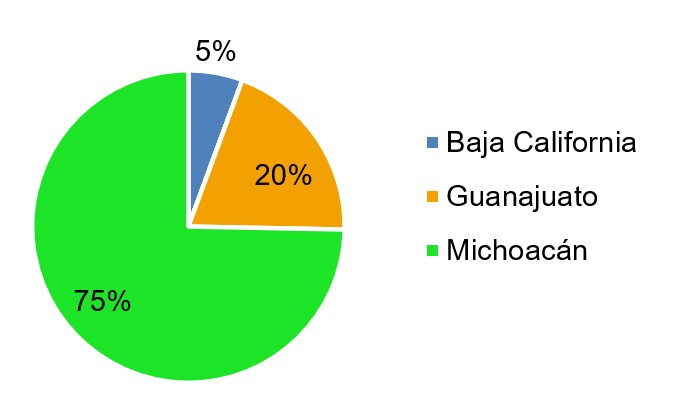
Michoacán played a central role, covering much of the country’s south and southeast. The shipments were concentrated in states with high population density, such as the State of Mexico, Mexico City, Veracruz and Puebla. In total, the four main producing states generated 610 924.19 t, equivalent to 95.2% of national production in 2023. Total demand was 392 831.93 t, while total supply reached 551 605.55 t, indicating sufficient coverage; however, there was a national surplus of 160 772.72 t unallocated, which is the result of adding the total surpluses of Tables 1 and 2. Figure 1 illustrates the share of supplying states in the national distribution of surpluses.
Geographically, Figure 2 shows the states that present surpluses in strawberry production, as well as the distribution of these volumes to state that register requirements not covered by their local supply. This flow shows the internal dynamics of the national market, where producing regions supply deficit areas to balance fruit availability.
The optimal distribution of strawberries in Mexico reflects not only the productive capacity of surplus states, but also the structural, technological and competitive conditions that determine their insertion in national and international markets. This dynamic confirms Michoacán’s central role in the national distribution system, consolidating itself as the leading supplier to meet domestic and foreign demand. Nonetheless, it also shows historical problems related to organization and concentration in a few decision-making actors, which limit the sector’s competitiveness and slow the adoption of innovations that could improve its performance (Zarazúa-Escobar et al., 2011).
At the production level, technological systems, such as hydroponic crops, have been shown to increase yield and fruit quality, reducing the use of resources and optimizing production. The incorporation of these innovations would not only strengthen the efficiency of the distribution chain but also contribute to the sustainability of the agricultural system by reducing the pressure on natural resources such as water and soil (Alvarado-Chávez et al., 2020). In this context, technological modernization and improvements in the organization of the sector are key factors to guarantee Mexico’s competitiveness and permanence in global markets.
The relevance of Mexican strawberries is also understood in a framework of specialization and international competitiveness. Mexico has consolidated itself as a net exporter, with comparative advantages over the United States, which has favored the sector’s growth; nevertheless, it is still necessary to promote strategies that increase producers’ profitability (Bustamante-Lara et al., 2020). In this logic, the case of Michoacán, particularly in the Zamora Valley, illustrates how competitiveness depends not only on land, capital, and labor, but also on intangible factors such as business organization and government support programs (Zamora y Riveros, 2016). These elements are added to the modernization processes initiated since the arrival of foreign capital, which transformed production, rural employment, and consumption habits, making strawberries a strategic crop, but strongly oriented towards exports to the United States of America (Soto-Mora and Fuentes-Aguilar, 1992).
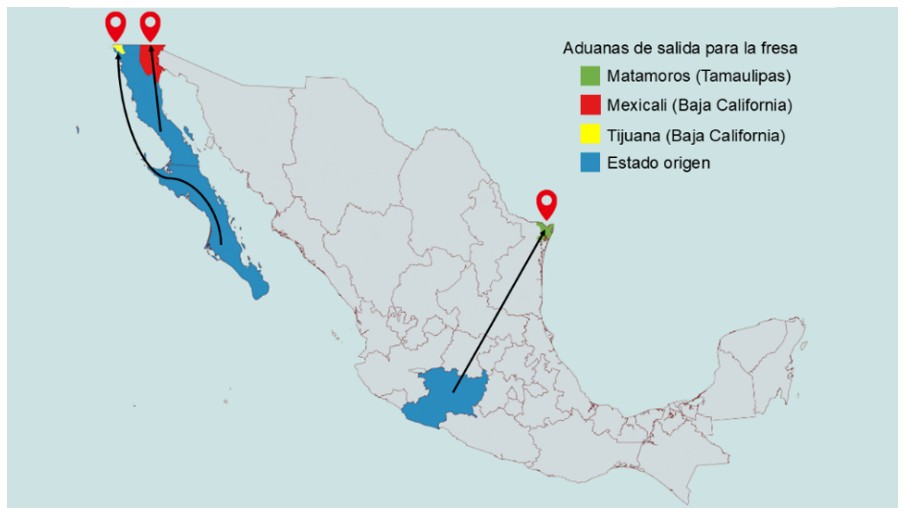
Three of the 19 customs located on the northern border were selected to channel a total of 158 773.62 t of strawberries to the US market, as indicated in Table 3, due to their proximity to that market.
These three selected departure customs channeled the volume of strawberries destined for export, thanks to their strategic location near the main producing states. This feature allowed an efficient and rapid mobilization of volume to the US market, reducing transportation costs and ensuring the preservation of product quality, which reinforces their role as key nodes in the export chain. Figure 3 shows that customs not only serve as exits for their own producing states, but also consolidate themselves as strategic logistics points, facilitating the efficient channeling of the national surplus to Mexico’s primary export market.
The results show that the export of surplus strawberries in Mexico is concentrated in three strategic customs: Mexicali, Tijuana and Matamoros, which channel more than 158 000 t to the United States. This data confirms the relevance of this country as a priority destination for national production, consolidating a commercial relationship that has been key to the sector’s growth. The choice of these customs is not accidental, as their geographical location near the main producing states, such as Baja California and Michoacán, together with their logistics infrastructure, allows an efficient mobilization of the product. This helps minimize transportation costs and reduce travel times, both essential factors for maintaining quality and competitiveness in international markets.
This finding is linked to Mexico’s global positioning as the third-largest producer and exporter of strawberries in the world, which reflects a clear specialization and comparative advantage over other countries (Ramírez-Padrón et al., 2020). Nonetheless, this strength also implies a high dependence on the US market, explained by economic determinants such as the United States’ GDP and high demand for strawberry imports. According to Terrones-Rodríguez et al. (2022), both price and income are inelastic, which means that Mexican strawberries remain stable in this market even in the face of variations in these factors. This characteristic gives certainty to producers; however, it also poses challenges related to the diversification of destinations and the reduction of risk in the face of possible changes in trade policies or macroeconomic conditions. In this context, the consolidation of infrastructure and logistics strategies will continue to be decisive in sustaining the sector’s international competitiveness.
Nevertheless, the profitability analysis indicates that producing strawberries for export to the United States is highly profitable in states such as Baja California and Michoacán, where benefit/cost ratios of 2.1214 and 2.0365, respectively, are recorded. These values indicate that for each peso invested, more than double the profits are obtained, which explains the consolidation of these regions as leaders in production destined for the international market. In contrast, in Guanajuato, this activity is not very viable, with an index of 0.9975, implying that costs practically equal income, reducing the economic attractiveness for local producers (Hernández-Soto et al., 2021).
In the same vein, Arana-Coronado et al. (2019) highlight that, although Mexican strawberry exports have grown with the trade opening and the entry into force of the free trade agreement with the United States and Canada, this sector faces competitive pressures that could limit its commercialization, in addition to the tariff changes brought about by the USMCA. Its projections confirm that the volume of exports will continue to increase, although at a decreasing rate, which coincides with the slowdown observed in recent years.
On the other hand, in addition to economic and commercial factors, it is essential to consider the biophysical limits faced by strawberry production. Peniche-Camps and Ávila-García (2018) warn that the productive model implemented in regions such as the agricultural valley of Zamora, Michoacán, has generated intense pressure on groundwater reserves, evidencing intensive exploitation of natural resources. This situation reflects the appropriation of essential elements to sustain competitiveness in the world market, where the growing demand for crops such as berries drives practices that prioritize productivity over sustainability. The constant and high use of water resources compromises aquifer recharge and pose environmental risks that require more responsible strategies to ensure the sector’s future viability.
Similarly, previous studies show that 96% of Mexican exports were historically channeled to the United States, consolidating this country as the leading trading partner (Arroyo-Cossío and Hernández-Flores, 2021). Nonetheless, this concentration of destinations poses risks to the sector’s sustainability; depending on a single market makes the strawberry industry vulnerable to changes in trade policies, tariff barriers or fluctuations in demand. Therefore, logistics efficiency in strategic customs and regional profitability must be strengthened, in addition to addressing environmental challenges and moving towards market diversification, exploring opportunities in Europe and Asia.
The primary variable in the study was the distance between strawberry-producing centers and demanding states, used as an approximation of the cost of transportation. Through linear programming and the specialized software Lingo 18.0, the optimal routes were estimated in terms of distance, determining the allocation of quantities to be distributed. It was determined that the supplying states in both open and closed economies whose production is in surplus were Michoacán, Guanajuato, Baja California and Baja California Sur, whereas the main consumption centers were the State of Mexico, Mexico City and Veracruz.
To channel the surplus of the national supply of 158 773.62 t, the border customs of Mexicali, Tijuana and Matamoros play a crucial role in exporting strawberries that cannot be placed in the national demand to the United States. Based on the results, the central hypothesis is accepted: route optimization minimizes the distances between the supplying (origin) and demanding (destination) states, thus reducing unnecessary costs in the distribution of this product.
Alvarado-Chávez, J. A.; Gómez-Gonzales, A.; Lara-Herrera, A.; Díaz-Pérez, J. C. y García-Herrera, E. J. 2020. Rendimiento y calidad de fruto de fresa cultivada en invernadero en sistema hidropónico piramidal. Revista Mexicana de Ciencias Agrícolas. 11(8):1737-1748. https://doi.org/10.29312/remexca.v11i8.2460.
Hernández-Soto, D.; Mejía-Ramírez, R. e Hilario-Méndez, L. 2021. Determinación de la rentabilidad de producir fresa en México para exportar a Estados Unidos. Entorno Udlap. 14(5):44-48. https://entorno.udlap.mx/determinacion-de-la-rentabilidad-de-producir-fresa-en-mexico-para-exportar-a-estados-unidos/.
León-López, L.; Guzmán-Ortíz, D. L. A.; García-Berumen, J. A.; Chávez-Marmolejo, C. G. y Peña-Cabriales, J. J. 2018. Consideraciones para mejorar la competitividad de la región ‘El Bajío’ en la producción nacional de fresa. Revista Mexicana de Ciencias Agrícolas. 5(4):673-686. https://doi.org/10.29312/remexca.v5i4.929.
Terrones-Rodríguez, A. I.; Caamal-Cauich, I.; Pat-Fernández, V. G.; Ávila-Dorantes, J. A.; Martínez-Luis, D. y Caamal-Pat, Z. H. 2022. Análisis de las variables económicas que determinan las exportaciones de fresa de México a Estados Unidos de América. Revista Mexicana de Ciencias Agrícolas. 13(4):631-640. https://doi.org/10.29312/remexca.v13i4.2532.