elocation-id: elocation-id: e4037
For dehydrated products to access new markets and for their production to generate economic development opportunities in rural production units, it is necessary to understand consumer demands. The objective was to analyze consumer behavior and identify the main attributes that lead consumers to make the decision to purchase dehydrated fruits and vegetables in Mexico in 2023. A survey was administered to 704 households nationwide and analyzed using Pearson correlation, cluster analysis and the analytic hierarchy process (AHP). It was identified that the most valued attributes were flavor (46.28%), being a national product (40.13%), biodegradable packaging (38.04%), and supporting environmental conservation (35.42%). In addition, four groups of consumers were identified who differed in the attributes valued when purchasing dehydrated products; however, flavor was the most important across all groups. Companies that produce dehydrated fruit and vegetable products can create generic promotion strategies that highlight the attributes of health, environmental care, product quality and social responsibility.
conservation, demand, analytic hierarchical process.
The consumption of dehydrated fruits and vegetables has become popular among people seeking foods that are low in calories, high in fiber content, free of chemical additives, with nutritional and organoleptic properties, attractive in appearance and ready for immediate consumption (Anigstein, 2019; Moreno-Colom and Boràs-Català, 2021).
In addition to the above, the consumption of dehydrated foods is associated with the benefits that these products bring to human health, as they are foods with high nutritional value and are supplements in the diet (Vega et al., 2006). This is mainly because the consumption of fruits and vegetables influences the reduction of the risk of developing cardiovascular diseases, some types of cancer, diabetes mellitus, overweight, and obesity, which are the main causes of death worldwide (Mora et al., 2023).
Therefore, dehydrated foods are an alternative to expand the consumption of fruits and vegetables among a high percentage of the population (Tarancón et al., 2020). The preferences for, and the decision to purchase a food, depend on various factors that influence the quality perceived by consumers; among them are the intrinsic attributes, which are the physical, organoleptic, or nutritional factors of the products, such as variety, flavor, smell, color and nutrients, among others.
There are also extrinsic attributes, which are characteristics by which a product can be differentiated, without being physically part of them, such as price, brand, packaging, and environmental and sociocultural connotations, among others (Torres et al., 2025). In addition, Siró et al. (2008) mention other factors, such as consumers’ socioeconomic characteristics, opinions, attitudes, objectives, the sociocultural environment, and the level of information consumers possess.
According to Tabares and Lochmuller (2013), the factors that lead consumers to make choices that meet their nutritional, social, environmental and emotional needs must be analyzed. There is research that has determined the attributes of dehydrated products, such as tubers, fruits, and vegetables (López et al., 2019; Da Silva et al., 2019; Sánchez-Toledano et al., 2024, Monaco et al., 2024), where the authors point out that intrinsic and extrinsic attributes must be considered in business and commercial strategies.
From the above, the following questions arise: What attributes of dehydrated products are valued by consumers, and what should the cooperative consider making its products? What aspects should be considered in the design of commercial strategies? To respond, the objective was to analyze consumer behavior and identify the main attributes that lead consumers to make the decision to buy dehydrated fruits and vegetables in Mexico.
A questionnaire was administered to consumers of dehydrated products nationwide from July to September 2023. The questionnaire included 36 multiple-choice questions, organized into three sections: 1) sociodemographic characteristics and consumption habits; 2) product knowledge; and 3) important attributes when buying dehydrated foods.
The confidence level of the instrument was evaluated using Cronbach’s alpha reliability coefficient, yielding a value of 0.944 (Al-Makhroumi et al., 2022). The survey was created on the Google Apps server via Drive® and pilot tests were conducted to ensure question clarity and minimize errors (n= 25). Once validated, the survey was distributed online.
The sample size was estimated using finite population sampling. The formula was that used by Rodríguez (2003):
Where: N= 35 219 141 households in Mexico in 2022 (INEGI, 2023); Z= confidence level (99%) 2.57; p= probability of success 0.5; q= probability of failure 0.5; d= maximum error (5%). The sample size was 661; however, during the application of the survey, 704 valid surveys were recorded, which were considered for analysis.
The selection of respondents was carried out with convenience sampling, justified by the participants’ willingness to answer.
The degree of correlation between the variables was calculated using Pearson correlation (Hernández et al., 2018). Consumption habits were assessed with a five-point Likert scale: not at all (1); rarely (2); occasionally (3); almost always (4); and always (5). The descriptive statistical analysis was carried out using the methodology of Gould (1988). The scores of the statements were calculated, evaluating for each individual i, a total score (Pi), adding the scores assigned to each of the items j (Pi,j):
Then, the mean, standard deviation, and variance were calculated.
A cluster analysis was performed using the K-means method as the clustering technique and Euclidean square distance as a measure of similarity. Finally, through the analytic hierarchical process (AHP) consumer preferences were identified and the relative importance of the attributes they consider when purchasing dehydrated products was estimated. The information obtained from the survey was concentrated in Excel 2016 spreadsheets, and the statistical analyses were performed using SPSS software, version 27.
Age and income showed a positive relationship (Table 1), indicating that the older people are, the greater the economic possibility to purchase food that satisfies specific preferences and needs. The level of education and income had a positive relationship, indicating that when schooling and income are high, consumption preferences may differ from those of people with lower levels of education and income.
The relationship between sociodemographic variables in purchasing decisions is consistent with studies conducted in Italy (Massaglia et al., 2019); Bulgaria and Moldova (Pocol et al., 2020) and Romania (Barbu et al., 2023), where per capita income was a relevant variable when deciding what to buy.
The relationship between the consumption of dehydrated products and income and education was negative, indicating a lower probability of purchasing these products when the consumer has a higher level of schooling and income. Miramontes-Escobar et al. (2020) highlighted that consumers with higher incomes follow a low-carbohydrate, high-protein diet and consume more fresh fruits and vegetables. In addition, an educated consumer is a more rational and freer being when making purchases (Castillejo et al., 2011), which makes them prefer fresh fruits and vegetables over dehydrated ones.
In this regard, Yuting and Liang (2020) noted that consumers with a strong health motivation prefer to eat dried fruits occasionally as a snack rather than change their eating routine in the long term. Additionally, Monaco et al. (2024) pointed out that intrinsic attributes, such as color and texture, affect the preference of dehydrated products over consumer perceptions, which is based on the value associated with the product and the preservation of its nutrients, giving greater preference to fresh fruits and vegetables.
In a study conducted in Mexico (Sánchez-Toledano et al., 2024) on consumers’ perceptions of dehydrated fruits and vegetables, the authors mentioned that the country has a wide variety of fruits and vegetables at affordable prices year-round, and that the trend is to consume them fresh. In turn, dehydrated foods are considered as ‘snacks’ or ingredients for preparing dishes, so their acquisition is occasional. Mexicans prefer to buy these products in large and open-air markets, in supermarkets, traditional stores, and online, since this depends on the prices of the products, the convenience of the location, and the consumer’s familiarity with the use of technology.
In consumption habits, there is concern for health and food, evidenced by scores in the consumption of fruits and vegetables (Table 2). According to Mora et al. (2023), consuming fruits and vegetables is synonymous with good eating habits, better health, and disease prevention.
The results indicate concern for sustainability and the environment (Table 2), associated with the benefits perceived by consumers when purchasing products whose production and composition involve elements that help the planet, such as saving natural resources and raw materials (Arroyave-Ramírez and Arrubla-Zapata, 2018).
There was also interest in food innovation that benefits health, rural people and indigenous communities. These attributes in dehydrated foods can trigger product quality and market acceptance, where consumers prioritize quality over quantity and seek products with a clear history and origin (Gutiérrez and Martín, 1998; Matiz, 2025).
Four groups of consumers were identified: group one (31.68% of the sample), consisting of men aged 20 and 24, with a monthly income of less than $5 000.00 and between $5 001.00 and $10 000.00, with a university education and households of four to six members. The consumption of dehydrated foods consisted of aromatic herbs, seeds, chilis and teas.
Group two (16.62%), made up mostly of women, with a monthly income of more than $30 000.00, aged between 35 and 39, with postgraduate degrees, and households of one to three people. The consumption of dehydrated foods consisted of aromatic herbs and flour.
Group three (14.77%), made up of men with incomes between $10 001.00 and $15 000.00, aged 25 to 29, with a university education and households made up of one to three people. They consume dehydrated seeds, chilis, aromatic herbs and flours.
Group four (36.93%), mainly made up of men with incomes between $15 001.00 and $20 000.00 and between $20 001.00 and $30 000.00, aged 35 to 39 years, with postgraduate degrees, and households of one to three people. They consume dehydrated foods such as aromatic herbs, fruits, seeds, and flour.
Sensory attributes were the most important, followed by origin, brand and social goals (Figure 1). Consumers had a greater preference for flavor (46.28%) and it is an attribute that determines the acceptance of dehydrated foods in the market. The origin had a significant influence, and this is due to the reliability of national products.
The preference for the national over the regional could be due to the limited availability of local brands. To take advantage of these attributes, companies that produce dehydrated foods must create brands with an emotional connection, which stimulates consumer engagement and loyalty (Carroll and Ahuvia, 2006; Anggraeni and Rachmanita, 2015; Ríos et al., 2025).
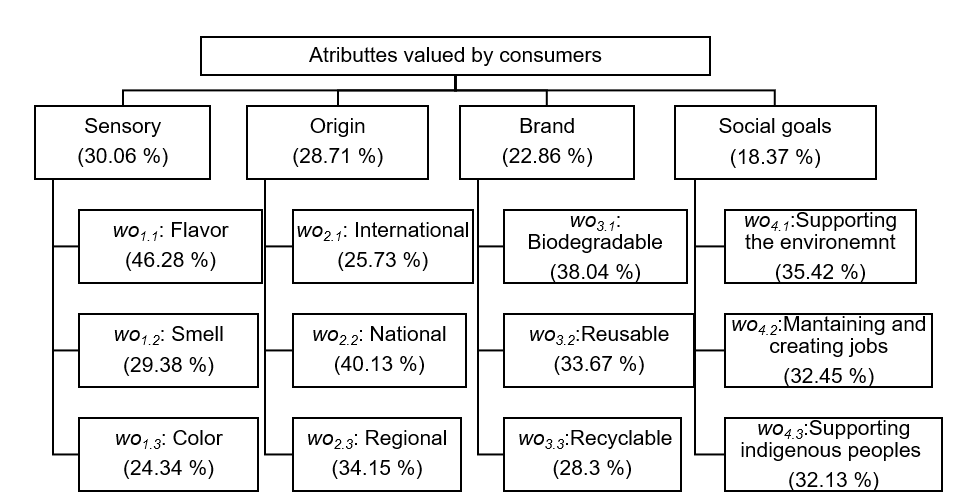
Consumers of dehydrated foods preferred biodegradable packaging, highlighting a commitment to sustainability, as it is made of materials designed to decompose naturally by the action of microorganisms (Rivera et al., 2019). This result is similar to that of Estrada-Domínguez et al. (2020), who found that brand and ecolabeling are factors that positively influence the purchase of products, as they do not represent damage to the environment.
In their study, Acosta-Medina et al. (2023) point out that, in the long term, biopackaging can have more economical results by reducing waste disposal costs and complying with environmental standards, in addition to consumers being willing to pay more for products with biodegradable packaging.
Mohd-Suki (2016) mentions that if consumers know about the environmental impact caused by products, they tend to increase their purchases towards those that cause less harm. Currently, there is a concern for the care of the environment, which is why there is a growth in the use of biodegradable and eco-friendly packaging that supports the conservation of the environment, as it is made of recycled materials, reducing the emission of pollutants and using limited resources and energy (Acosta-Medina et al., 2023; Salinas y Vílchez, 2024).
In the social sphere, the three attributes showed similar importance (Figure 1), and a growing awareness of social responsibility was observed; therefore, products must demonstrate a solid commitment in this area, as it is an element that affects consumer acceptance (Barragán-Hernández et al., 2021). One of the factors that determines responsible purchasing is information about social responsibility issues and the image that the company projects on the subject (Leyva-Hernández et al., 2024).
In the assessment of attributes by consumer segments (Table 3), it was observed that group one prioritized the social aspect, whereas the other groups prioritized environmental care. Groups one and three exhibited equal preferences between national and regional origin. Group four balanced their preferences between support for the environment and indigenous peoples.
Se destacó la necesidad de estrategias diferenciadas en cada grupo de consumidores, esta acción abre la puerta para explorar el potencial de influir en la creación de nuevos alimentos deshidratados que generen un impacto económico en pequeños productores.
Los resultados de este estudio muestran que una variable sociodemográfica decisiva en la adquisición de productos deshidratados de frutas y verduras es el ingreso. Se distinguen cuatro segmentos de consumidores en frutas y verduras deshidratadas, los cuales están diferenciados por rangos de edad, nivel de ingreso, nivel educativo, tamaño de hogar y el tipo de productos deshidratados que adquieren.
Los atributos mejor valorados son el sabor, que sea un producto nacional, con empaque biodegradable. Los cuatro segmentos de consumidores de productos deshidratados tienen preferencias diferentes en lo ambiental, social, económico y sensorial. Por lo tanto, las estrategias de promoción deben estar diferenciadas para cada tipo de consumidor y destacar los atributos de salud, cuidado ambiental, calidad del producto y responsabilidad social.
Una de las limitaciones del estudio fue que contempló un sondeo general para productos deshidratados de frutas y verduras, por lo que la información obtenida solo da nociones generales sobre las características sociodemográficas de los consumidores y los atributos intrínsecos y extrínsecos asociados a ellos.
En futuras investigaciones se recomienda realizar estudios sobre productos específicos de frutas y verduras deshidratadas, que considere segmentos de consumidores y aspectos particulares del producto. Se sugiere hacer análisis comparativos entre regiones del país, para ello se puede aplicar el instrumento de medición considerando consumidores diferenciados por poder adquisitivo, nivel de estudios, edad, entre otras.
Al-Makhroumi, N.; Al-Khusaibi, M.; Al-Subhi, L.; Al-Bulushi, I. and Al-Ruzeiqi, M. 2022. Development and validation of a food safety knowledge, attitudes, and self-reported practices (KAP) questionnaire in Omani consumers. Journal of the Saudi Society of Agricultural Sciences. 21(7):485-492. https://doi.org/10.1016/j.jssas.2022.02.001.
Hernández, J. G.; Espinosa, C. F.; Rodríguez, J. E.; Chacín, R. J. G.; Toloza, S. C. A.; Arenas, T M. K.; Carrillo, S. S. M. y Bermúdez. P. V. J. 2018. Sobre el uso adecuado del coeficiente de correlación de Pearson: definición, propiedades y suposiciones. Archivos Venezolanos de Farmacología y Terapéutica. 37(5):587-601.
Matiz, J. D. Á. 2025. Marketing 4.0: la clave de la transformación comercial para pequeños productores agrícolas en Colombia. In: los agronegocios y sus transiciones hacia la sostenibilidad. Correa, A. G. y Regino, V. J. (Eds.). Primera edición. Ediciones Unisalle. Bogotá, Colombia. 151-176 pp. https://doi.org/0000-0001-9090-3411.
Miramontes-Escobar, H. A.; Prado-Guzmán, G. A.; Toledo-Palomera, M. J.; Báez-García, J. E. y Sáyago-Ayerdi, S. G. 2020. Perfil nutricional según niveles socioeconómicos y menús proporcionados en un comedor social de México. Universidad y Salud. 22(3):203-212. https://doi.org/10.22267/rus.202203.192.