elocation-id: e4030
In Mexico, the extraction of forest soil for the production of ornamental plants causes a negative ecological impact; this material represents the primary substrate used for the production of ornamental plants. This study aimed to characterize and validate different proportions of three raw materials obtained from waste and residues from other economic activities. To this end, various mixtures of garden waste (GW), pine sawdust (PS) and pine bark (PB) in different proportions, and a control substrate were physically characterized as potential substrate substitutes in ornamental plant production. Granulometry, bulk density, total and aeration porosity, water retention capacity, hydrogen potential (pH) and electrical conductivity (σ) were evaluated as main properties in the selection of substrates. The results of this study demonstrate the possible substitution of (unsustainable) forest soil with regional substrates of low production cost in the preparation of substrates for ornamental production. Substrates S3 (25GW+25PB+50PS), S4 (20GW+30PB+40PS), and S5 (50GW+25PB+25PS) are within the convenient ranges for plant production, based on their physical properties.
alternative substrates, bark, pruning remains, sawdust, sustainability
A substrate is any porous material, used pure or in a mixture, to grow plants in a container, that provides anchorage and sufficient levels of water and oxygen for optimal plant development (Vence, 2008). The importance of knowing these properties lies in the fact that proper management of fertilization and irrigation depends on them (Pérez, 2009).
The production of ornamental plants is a sector that consumes a wide range of substrates, made from different mixtures of materials available in each region or according to the requirements of each species (Abad et al., 2004). In 2001, Mexico required about 500 000 m3 of substrate for the production of container-grown ornamental plants, and the value of this demand has now tripled. Among the crops with the highest demand in the market, according to the Agrifood and Livestock Information System (SIAP, 2022), are geranium (Pelargonium spp.) with a production value greater than 100 thousand pesos, rose (Rosa spp.), and daisy (Dimorphotheca spp.) as cut flowers.
There is a notable concern about the excessive extraction of soil and leaf litter from forest areas of the country, which leads to the search for alternative substrates; the raw materials are frequently mixed according to specific, defined doses. These doses are determined empirically based on the experience accumulated by producers (Campos et al., 2025); in addition to that, the inadequate formulation of substrates for ornamental plant production generates low productivity and high plant mortality due to the non-optimal properties of the different mixtures of raw materials (Ruiz et al., 2008), resulting in an economic loss for producers (Prisa and Caro, 2023).
The high cost of imported substrates highlights the need for a locally produced, stable, safe, and proven-quality substrate, which opens new expectations for native materials that were not considered until recently. Attention has been paid to the classification, recycling, reuse and reduction of organic materials for the sustainable development of ecosystems and recovery of organic waste for use in agriculture (López, 2011).
Currently, in the ornamental and academic productive sector, it is essential to obtain and recommend new growing media that help to obtain ornamental plants of better quality and at a lower cost, due to the comparison of the production costs of substrates made from garden waste, pine sawdust and pine bark ($45.35) with imported commercial substrates ($528.00) and with forest soil ($90.00) (price according to the area of acquisition); therefore, this study aimed to establish, characterize and validate proportions of three raw materials for the preparation of ornamental substrates made from composted material from the wood industry and waste from the urban gardening sector.
The study was conducted at the Chemistry Laboratory of the Higher Technological Institute of Salvatierra, located in Janicho, Salvatierra, Guanajuato, at 20.197044° north latitude, -100.90635° west longitude and 1 902 masl (Google Earth, 2017). In the laboratory, the physical and chemical properties of different substrate mixtures were determined in triplicate.
The experimental design was completely randomized. Before performing the analysis of variance, the assumptions of normality and homogeneity of variances were verified using the Shapiro-Wilk test, and the comparison of means was made with Tukey’s test (p ≤ 0.05). Variables that do not meet the requirements of normality and homogeneity of variances were analyzed using nonparametric tests, employing the Kruskal-Wallis method (Bracho et al., 2009).
The materials implemented for the formulation of an alternative container-grown ornamental plant substrate were garden waste (GW), pine sawdust (PS), and composted pine bark (PB). After collecting garden waste (pruning remains of branches and leaves), it was moved to an area for waste management, where GW and PB were ground using a hammer mill No. 16, of 14.91 kW, with a screen corresponding to a particle size < 2 cm; these ground materials were composted and protected from the action of winds, keeping them moist and covered with plastic separately in piles less than 1.5 m high (Pérez and Martínez, 2008). The remaining materials did not require any further processing.
Mixtures of garden waste (GW), pine sawdust (PS), and pine bark (PB) were made in different proportions (vol/vol) (Table 1). The proportions of the substrates (S2, S3, S5) modified by González et al. (2018).
| Substrate | Mixtures |
|---|---|
| S1R2* | 40% S + 40% FS+ 20% SS |
| S1M2* | 25% S+ 50% FS + 25% CP |
| S2 | 30% GW + 20% PB + 50% PS |
| S3 | 25% GW + 25% PB+ 50% PS |
| S4 | 30% GW + 30% PB + 40% PS |
| S5 | 50% GW +25% PB + 25% PS |
The physicochemical characterization of the different mixtures used as experimental treatments was carried out in the laboratory of the Higher Technological Institute of Salvatierra, following the techniques described by Acosta-Durán (2012); Tello and Vega (2015). The following properties were determined: water retention by rapid testing; porosity (% pore space) under dry conditions; bulk density, calculated with the solid particle-to-volume ratio method; and electrical conductivity and pH, measured directly on the substrate with a portable conductivity meter and an Ohaus® ST20M pH meter.
The granulometry was obtained using sieves of 71, 40, 32, 13 and 4 NHI (number of holes per inch), placed in descending order. The air-dried material was manually stirred for three minutes (Quesada, 2014).
The physical properties of a substrate are the most important because they are difficult to modify once the crop is established; therefore, their prior characterization is imperative (Cabrera, 2003). In the production of container-grown ornamental plants under nursery conditions, the roots are the most exposed to fluctuations in the conditions of the physical environment of the plants, since the area/volume ratio of the containers is high, resulting in low buffering capacity against environmental variations.
The substrate used in plant production should promote physical support while also providing water, air, and nutrients to the plant for the proper functioning of the roots (Pire and Pereira, 2003).
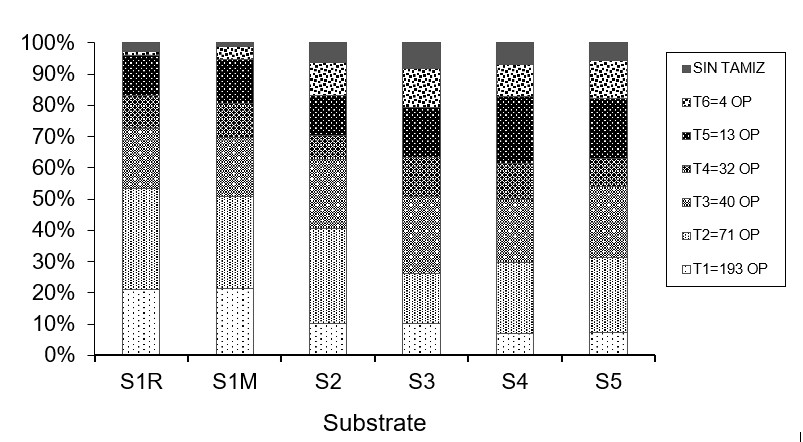
The sieves of this research that provided useful particles in the retention of moisture and nutrients are the following: T1, with 193 HI (holes per inch) (dust < 0.3 mm); T2, with 71 HI (< 0.5 mm); and T3, with 40 HI (> 0.5 to < 1 mm); the rest of the sieves (T4 to T10) with particle size greater than 1 mm correspond to the coarse particles responsible for providing a greater pore space, which consequently increases the aeration capacity, increasing drainage; therefore, a high percentage of fine particles affects the aeration capacity and increases water retention.
After determining the particle size distribution of the substrates studied, expressed as the percentage by weight of each fraction, the results were presented as stacked columns (Figure 1). The cumulative percentage of fine particles (dust < 0.3 to > 1 mm) by volume was 70% for the control substrates and greater than 50% for substrates S2, S4 and S5.
The granulometric analysis (Table 2) indicated statistical differences between the origins of the fine fraction (T1, T2 and T3) and the coarse fraction (T4, T5 and T6), noting a greater difference between S1R and S1M with S2, S3, S4 and S5, which presented greater heterogeneity, with a particle size distribution of S3, S4 and S5. Consequently, the proposed substrates had a higher accumulated percentage of coarse particles, indicating an increase in macropore content, thus facilitating oxygen exchange in the root zone.
Coarse-textured materials, with particle size greater than 0.9 mm, with large pores, greater than 0.1 mm, retain small amounts of water, but are well aerated. Fine materials, with particles smaller than 0.25 mm and pore sizes less than 0.03 mm, retain large amounts of water that is difficult to access and that promotes anoxic conditions (Ballester, 1993). The best substrate is defined as a material with a medium-to-coarse texture, a pore-size distribution between 0.03 mm and 0.3 mm, equivalent to a particle-size distribution between 0.25 mm and 2.5 mm, that retains sufficient readily available water and has an adequate air content (Ballester, 1993).
The homogeneity of the substrate, both within the same batch and between different batches over time, is an essential factor in guaranteeing commercial quality, standardization and reliability for producers (Prisa and Caro, 2023; Campos et al., 2025). Water retention is very sensitive to variations in substrate granulometry (Hernández et al., 2014; López, 2016).
Essentially, there must be an appropriate balance between the retained water that the plant will absorb and the macropores to allow air exchange with the external environment (Pire and Pereira, 2003). Total porosity (TP) is the difference between the total volume and the volume occupied by solids (Schafer and Lerner, 2022). The reference value of this property is 85% of the volume of the substrates, with drainage, after saturation irrigation, which allows aeration of at least 10% of the volume of the substrate.
Valenzuela et al. (2014); López et al. (2016) establish 20 to 50% TP as acceptable, depending on the crop; however, other authors recommend 60 to 80% TP as an adequate range for the development of forest and ornamental species (García et al., 2001).
Granulometry (particle size distribution) and particle size are important factors in plant substrates as they influence the air and water dynamics of the growing medium, which are critical and often cannot be modified once the crop is established (Campos et al., 2025). The substrates evaluated had a total porosity (TP) greater than 50%; no statistical differences were detected in this variable due to the effect of the substrate type. Nevertheless, S5 had 57.2% in TP (Table 3) with a composition of 25% pine bark, which is a material that provides long-term drainage and aeration, necessary for the optimal root development of the plant, 50% garden waste, which contributes to drainage in its initial stage of use, and 25% pine sawdust, which is a moisture retention material.
| Substrate | Chemical properties | |
|---|---|---|
| pH | σ (dS m-1) | |
| S1M | 6.45 abc | 1.1 abc |
| S1R | 6.83 ab | 0.73 abc |
| S2 | 6.14 c | 0.41 c |
| S3 | 6.14 c | 0.58 bc |
| S4 | 6.33 bc | 1.29 ab |
| S5 | 6.68 ab | 1.51 a |
| p * | 0.0003 | 0.0056 |
| CV | 2.21 | 32.61 |
On the other hand, S2, composed of 50% PS and the lowest percentage of PB (20%), presents the highest TP with 72.79% and the lowest AP with 46%; despite these results, López (2016) assures that substrates with lower porosity are advantageously used in crops with higher water requirements or in times of scarcity. In sum, the total porosity (TP) of substrates S3, S4 and S5 and the controls are within the recommended range (60-80% TP).
It is defined as the total amount of water retained by the substrate once saturated and drained, in the absence of evaporation; in most substrates, the recommended ranges vary from 55 to 70% (Abad et al., 2004; Barrón, 2013) and from 25 to 55% (Landis et al., 1990). The results of the characterization showed highly significant differences between the control substrates and the proposed substrates; the latter had the highest MRC, as established by Patrón (2014).
In the characterization of substrates based on pine sawdust with 53% MRC, by presenting optimal ranges of MRC, it does not give the mixtures adequate properties for crop development, making it necessary to combine other physical characteristics to obtain optimal results. In their research, González et al. (2018) obtained values of 41.8% and 44.8% in substrates with 30% moss peat + 20% pine bark + 50% pine sawdust and 25% peat moss + 25% pine bark + 50% pine sawdust, respectively, ratifying that increasing the percentage of sawdust increases moisture retention, derived from the absorption capacity of sawdust.
On the contrary, regarding pine bark, authors such as Hernández-Zarate et al. (2014) obtained similar figures (40% and 41%) in substrates with 40% composted bark + 60% sawdust and 60% composted bark + 40% sawdust. The substrates evaluated obtained ranges higher than the recommended optimal values, with S4 having a moisture retention capacity of 175.8%.
There were statistical differences between the different mixtures (Table 3); the optimal range for this characteristic is 0.15 to 0.6 g ml-1 (García et al., 2001). In other words, the substrate must be heavy enough to keep the plant in an upright position, avoiding tipping over, without being so heavy that it makes handling or transporting the plant difficult. It was observed that the proposed substrates based on garden waste, pine bark and pine sawdust (S2, S3, S4 and S5) are within the optimal ranges for this important parameter; to qualify a good substrate, it must demonstrate a low bulk density (Murciano, 2013) that is within the established range, since densities that are too low are unwanted in ornamental substrates used in nursery (Cabrera, 1999).
The physical properties of a substrate, such as pH and fertility, are a key part of the development of container crops (Yong, 2004). An excellent hydrogen potential in the substrate makes it possible for nutrients to be available to plant roots. In soilless crops, the ideal pH ranges between 5.5 and 7 (Acosta-Durán, 2012). After chemical analysis of the different mixtures composed of PS, PB and GW, it was verified that, statistically, there is variation in the pH of all substrates, including controls (p = 0.0089), due to the different proportions of each raw material. The obtained pH of the proposed substrates is slightly acidic, below 7, so S2 and S3 are the most suitable for the establishment of ornamental crops, considering that the edaphic requirements of different species vary, so it is stated that the substrates provide adequate nutrient availability.
The concentration of soluble salts present in the solution of a substrate is the measure of the ability of a material to conduct electric current; in general, values less than 1 dS m-1 are recommended, which facilitates fertilization management and avoids phytotoxicity (Bárbaro et al., 2014); on the other hand, the acceptable values for most container-grown ornamental crops vary from 0.76 to 1.25 dS m-1 (Acosta-Durán, 2012). The results observed for electrical conductivity were statistically different (p = 0.011); S2 and S3 were shown to have low electrical conductivity compared to the control substrates.
The substitution of forest soil, sand, and nutrient-rich sediment soil is feasible in the preparation of substrates for ornamental production, based on the results shown, replacing them with recycled or reused regional materials, such as the waste of maintenance activities of urban green areas and the wood industry (garden waste, pine sawdust and pine bark) in the evaluated and validated proportions. Although the physical characterization of the substrates (granulometry, BD, MRC and TP) is essential for understanding the growth processes of plants grown in containers, it is difficult to obtain a raw material that meets all the desirable characteristics.
In this research, the physical properties derived from potential mixtures (S3= 25% GW + 25% PB + 50% PS; BD= 0.42 g cm-3, MRC= 172.67%, TP= 75.16%, S4= 30% GW + 30% PB + 40% PS; BD= 0.35 g cm-3, MRC= 175.83%, TP= 79.5% and S5= 50% GW + 25% PB + 25% PS; BD= 0.34 g cm-3, MRC= 165.3%, TP= 80.72%) are within the convenient ranges (BD= < 0.04 g cm-3, MRC= 55-70%, TP= > 85%) to be used for plant production.
In turn, in terms of chemical properties, pH and electrical conductivity, although they are very variable properties in the mixtures detailed here, the values presented by the substrates S2= 30% GW + 20% PB + 50% PS and S3= 30% GW + 30% PB + 40% PS are located within the reference values; however, the remaining mixtures evaluated have acceptable and adjustable values in the production of ornamental plants in containers.
González-Orozco, M. M.; Prieto-Ruíz, J. Á.; Aldrete, A. M.; Hernández-Díaz, J. C.; Chávez-Simental, J. A. y Rodríguez-Laguna, R. 2018. Sustratos a base de aserrín crudo con fertilización y la calidad de planta de Pinus cooperi Blanco en vivero. México. Revista Mexicana de Ciencias Forestales. 9(48):203-225.