elocation-id: elocation-id: e4020
The new bread wheat variety Albatros M2025 was formed at the Bajío Experimental Field of the National Institute of Forestry, Agricultural and Livestock Research. The segregating generations were subjected to the modified mass selection method. The yield assessment was conducted in 10 agricultural cycles from 2015-16 to 2024-25. Albatros M2025 was registered and protected in the National Catalog of Plant Varieties (CNVV, by its Spanish acronym) with the number TRI-214-030725. The Albatros M2025 variety is resistant to yellow rust, with a maximum severity of 2%, compared with older varieties such as Cortazar S94 and Luminaria F2012, which showed severity levels of 40% and 80%, respectively. Under normal irrigation, the new variety surpassed Cortazar S94, Alondra F2014, Faisán S2016 and Cisne F2016 by 19.4, 11.1, 9.7 and 1.6%, respectively. Under restricted irrigation (two irrigations), Albatros M2025 obtained a yield of 4 324 kg ha-1, which was 15, 12.4, 1.5 and 1.8% higher than that of Cortazar S94, Alondra F2014, Faisán S2016 and Cisne F2016, respectively. With three irrigations, it achieved a yield of 5 726 kg ha-1, higher than that of Alondra F2014, Cortazar S94, Faisán S2016 and Cisne F2016 by 8.3, 6.9, 1.4 and 0.1%, respectively. It has the allelic combinations of high-molecular-weight glutenins 0, 7+9 and 5+10 and is of medium-strong gluten.
artisan bread, resistance, yield.
Grain yield is one of the main selection traits in wheat breeding programs. This explains the increase in production, which is three times higher than the 1950 yield in Guanajuato (1.1 kg ha-1), the state that produces the most wheat (Triticum spp.) in El Bajío and the yield recorded in 2024 (6.75 kg ha-1) (SIAP, 2025). In this region, improvements have also led to a genetic advance in water-use efficiency, as the Cisne F2016 variety, released in 2016, exceeded the yield of Cortazar S94 by 20.2 and 17.1% under two and three irrigations, respectively (Ledesma-Ramírez and Solís-Moya, 2024).
The breeding method used in the Wheat Program of the Bajío Experimental Field of the National Institute of Forestry, Agricultural and Livestock Research (INIFAP) has led to genetic advances for grain yields of 26.3, 41.6 and 37.6 kg ha-1 year-1, with two, three and four irrigations, respectively (Ledesma-Ramírez et al., 2024). This program has released 17 bread wheat varieties since 1975, with Salamanca S75 and Cortazar S94 standing out, which have been planted for more than 20 years on 80% of the region’s territory.
These varieties are characterized by their early growth cycle, which gives them advantages in this area, where two crops are planted each year: corn (Zea mays L.) or sorghum (Sorghum bicolor L. Moench.) in the spring-summer cycle and wheat or barley (Hordeum vulgare L.) in the autumn-winter cycle (Ledesma et al., 2024). To contribute to the sustainability of wheat production in El Bajío, INIFAP has recently presented the bread wheat (Triticum aestivum L.) variety Albatros M2025, which was registered and protected in the National Catalog of Plant Varieties (CNVV) with the number TRI-214-030725.
The line that gave rise to the variety was obtained through hybridization, derived from a single cross including 14 genotypes, five in the female parent and nine in the male parent. Its cross and pedigree are as follows: ENE/ZITA/3/WBLL4/KASOS//PASTOR/8/TACUPETO/6/CNDO/R143//ENTE/WlEXI-2/3/AEGILOPS SQUARROSA (TAUS)/4/WEAVER/5/PASTOR/7/ROLF07; TR11CS152-0R-0C-0R-0C-9R-0C-0R.
The cross was carried out in the autumn-winter (A-W) 2011-2012 cycle in Celaya, Guanajuato; the F1 generation was planted in A-W 2012-2013 in Celaya, Guanajuato and was identified with the number 152. In the segregating generations, the methods of mass selection and individual selection were applied. The population of the F2 generation was identified with the number 2 140 and was planted in Chapingo, Texcoco, State of Mexico, under rainfed conditions in the spring-summer (S-S) 2013 cycle; 50 plants were selected for disease resistance and agronomic type, and the harvested seed was used to make a balanced compound.
The F3 generation was planted in A-W in 2013-2014 in Roque, Celaya, Guanajuato; sowing was done in a spaced manner; selection was made for resistance to yellow stripe rust and agronomic type; the best 50 plants were selected and used to make a balanced compound. F4 was evaluated in S-S 2014 in the locality of Chapingo, Texcoco, State of Mexico, and was selected for resistance to leaf rust and yellow stripe rust and for agronomic type; seeds from 50 plants were used to make a balanced compound.
F5 was planted in the A-W 2014-2015 cycle in the locality of Roque, Celaya, Guanajuato, with the number 5054, where 10 spikes of the best 10 plants were selected based on agronomic type and disease resistance and harvested individually. F6 was sown in a row per spike in S-S 2015 in Chapingo, State of Mexico; from them, line nine was selected and harvested. The line was evaluated in preliminary yield tests in the A-W 2015-2016 cycle in Roque, Celaya, Guanajuato.
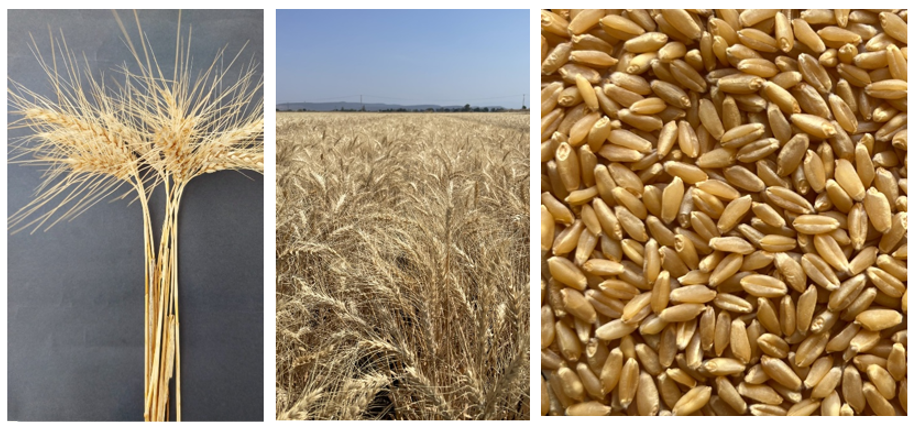
Since the 2016-2017 cycle, it has been evaluated in experiments of planting dates and irrigation calendars, as well as in nurseries for disease evaluation. The seed is white (1) (Figure 1), with a clear reaction to phenol (3), the pigmentation of the coleoptile is null or very clear (1) and the size of the plant is medium (5). The anthocyanin pigmentation of the auricles is null or very weak (1), the glaucosity of the flag leaf sheath and that of the spike neck are of medium level (5), and that of the spike is strong (7).
The density and length of the spike are medium (5), the color is white (1), and its shape is pyramidal (1). The shoulder width of the glume is medium (5), the shape of the shoulder is slightly inclined (3), the length of the glume tip is medium (5), and the tip shape is moderately curved (5), with very little pubescence on the inner surface (1).
Albatros M2025 has an early cycle, with 72 and 124 days to spike emergence and physiological maturity, respectively. Its cycle is one day shorter than that of Cortazar S94 and three to four days earlier than that of Ibis M2016 and Elia M2016 (Table 1).
| Variety | Days to spike emergence | Days to maturity | Plant height |
|---|---|---|---|
| Albatros M2025 | 72 | 124 | 91 |
| Elia M2016 | 75 | 127 | 89 |
| Ibis M2016 | 76 | 126 | 89 |
| Cortazar S94 | 73 | 125 | 82 |
Albatros M2025 is resistant to yellow stripe rust, with a maximum severity of 2% compared to older varieties such as Cortazar S94 and the susceptible variety Luminaria F2012, which reach severity levels of 40% and 80%, respectively. In adult plants, the presence of Yr29 was determined by using molecular markers (PstAAGMseCTA-1); this gene is linked to the leaf rust gene Lr46 (William et al., 2003).
The Albatros M2025 variety was compared with four commercial wheat varieties planted in El Bajío on planting dates during the A-W cycles from 2018-2019 to 2024-2025, across 27 environments or production conditions for El Bajío, Mexico; the control varieties were Cortazar S94, Alondra F2014, Faisán S2016, and Cisne F2016. In this series of environments, the new variety surpassed Cortazar S94, Alondra F2014, Faisán S2016, and Cisne F2016 by 19.4, 11.1, 9.7 and 1.6%, respectively.
Albatros M2025 was evaluated under restricted irrigation during eight agricultural cycles from 2017-18 to 2024-25, excelling when two irrigations were applied (0-45 days) and outperforming all control varieties. With this calendar, the new variety obtained a yield of 4 324 kg ha-1, which is 15, 12.4, 1.5 and 1.8% higher than that of Cortazar S94, Alondra F2014, Faisán S2016 and Cisne F2016, respectively. With three irrigations, it reached a yield of 5 726 kg ha-1, which is higher than that of Alondra F2014, Cortazar S94, Faisán S2016 and Cisne F2016 by 8.3, 6.9, 1.4 and 0.1%, respectively.
The industrial quality characteristics of the new variety Albatros M2025 were compared with those of the medium-strength gluten varieties Ibis M2016 and Elia M2016. In hectoliter weight, which is related to flour yield, it presented a value of 80 kg hl-1, higher than those of Ibis M2016 and Elia M2016, which were 78 and 79 kg hl-1, respectively, indicating that high flour yields will be obtained during milling.
The percentage of grain hardness of the new variety is similar to that of durum or crystalline wheats, which is appropriate for bread wheats, since its hardness reflects the strong packing between starch and protein (main constituents of wheat grain); that is, during the process of crushing the grain and reducing the flour, it will produce damaged starch, which allows greater absorption of water from the flour and favors the quality of crumbs (Ma et al., 2016).
Albatros M2025 has an average protein percentage of 11.2 and 9.2% in grain and flour, respectively, which are very similar to those obtained by the Ibis M2016 and Elia M2016 varieties; these percentages can be increased with agronomic management by increasing nitrogen fertilization to 300 units per hectare and dividing it into three application seasons, 100 kg in the sowing irrigation and the same amount in the first two supplemental irrigations.
Based on the strength value of its flour (W of 264 x 10-4 AM), Albatros M2025 was classified as a medium-strong gluten variety, with a PL of 2.7 for the toughness-extensibility ratio. The average bread volume is 750 ml, similar to that of the control varieties, which presented values of 655 and 740 cc.
It has the allelic combinations of high-molecular-weight glutenins 0, 7+9 and 5+10, which have been associated with wheats of medium-strong and strong gluten; these wheats have an adequate dough strength for producing bread in the small and medium-scale artisanal industry and as an improver of tenacious doughs (Martínez-Cruz et al., 2007).
The new variety Albatros M2025 is recommended for the region called El Bajío, which includes parts of the states of Guanajuato, Michoacán, Jalisco and Querétaro, with altitudes of 1 500 to 1 800 m, an average temperature of 20 °C, and rainfall of 450 to 650 mm. The basic seed will be available at INIFAP-Bajío Experimental Field for sale to seed producing companies that request it starting in December 2026.
The new variety Albatros M2025 has an early cycle, is medium-sized, is resistant to yellow stripe rust, has the adult plant resistance gene Yr29 and is recommended for El Bajío during the A-W cycle. Under normal irrigation conditions, it reaches 9 t ha-1; with two and three irrigations, it obtains yields of up to 4.6 and 6.3 t ha-1, respectively. Its gluten is medium-strong, suitable for the artisanal industry.
We are grateful to INIFAP for the partial financing to conclude the study through the project: ‘national genetic improvement program to generate rust-resistant, high-yielding, and high-quality varieties for sustainable wheat production in Mexico’, with the SIGI number 153335532.
FAO. 2023. Guía práctica para la aplicación de las normas para bancos de germoplasma de recursos fitogenéticos para la alimentación y la agricultura: conservación mediante cultivo in vitro. Comisión de Recursos Genéticos para la Alimentación y la Agricultura. Roma. 120 p. https://doi.org/10.4060/cc0025es.
Gonzales-Arteaga, J. J.; Rodríguez-Layza, J. Romero-Rivas, L. C.; Párraga-Quintanilla, A. and Olivera-Soto, J. A. 2023. Role of BA and IAA on regeneration and shoot proliferation in vitro of three strawberry (Fragaria x ananassa Duch.) varieties. Agroindustrial Science. 13(2):93-102. http://doi.org/10.17268/agroind.sci.2023.02.05.
Pillco-Tancara, H. C. y Quezada-Portugal, J. Á. N. 2017. Establecimiento de un protocolo eficiente de micropropagación y aclimatización de fresa (Fragaria × ananassa Duch.) variedad ‘Aroma’. Journal of the Selva Andina Research Society. 8(1):53-64. http://www.scielo.org.bo/pdf/jsars/v8n1/v8n1-a05.pdf.
Romero-Rivas, L. C.; Gonzales-Arteaga, J. J.; Rodríguez-Layza, J.; Párraga-Quintanilla, A. y Olivera-Soto, J. A. 2023. Multiplicación y enraizamiento in vitro de Fragaria x ananassa Duch. Var. ‘Aromas’. Revista de Investigaciones Altoandinas-Journal of High Andean Research. 25(4):205-212.https://doi.org/10.18271/ria.2023.563.