elocation-id: e4015
Mezcal is a regional distillate that has gained recognition in the alcoholic beverage market. Its acceptance is linked to its authenticity, process and use of natural resources, which give it typical sensory attributes. In this context, consumers play a central role in valuing these attributes. Discrete choice experiments are a helpful tool for identifying consumer preferences and their willingness to purchase various products. The purpose of this study was to identify the attributes that influence consumer preference and willingness to pay for a mezcal produced in the state of Puebla, as well as to determine consumer characteristics, using an experimental design based on discrete choice. Two hundred eighty-two online surveys were applied during 2024, which included sociodemographic data of the participants and 16 cards organized in eight pairs, generated using a fractional factorial design. Participants chose between two options or neither. The data were analyzed using a multinomial logit model. The results indicate that the most valued attributes are place of origin, variety and type of agave, type of production, designation of origin, and price. In addition, the marginal willingness to pay for each significant attribute with a positive sign was estimated. Consumers value attributes in mezcal related to the geographical origin, traditional process and authenticity of mezcal; however, they are not willing to pay for mezcal produced in the state of Puebla.
attributes, origin, price
Mezcal has emerged as one of the most popular beverages in the global alcoholic beverage market; it forms part of the identity of the producing regions, is rooted in their daily lives and knowledge, and represents their culture. Its acceptance is due to its aura of exoticism and the appreciation of its authenticity and artisanal process, which gives it distinctive characteristics in its production and marketing, differentiating it from other similar beverages, such as tequila (Camacho et al., 2021).
Puebla stands out as the second largest producer of mezcal nationwide; in recent years, its production has become a benchmark for the state’s rural family economy (Benítez et al., 2024). In Puebla, mezcal is part of the state’s cultural identity and tradition; its production has ancestral roots. Nevertheless, despite its economic and cultural importance, there is limited information on the factors that determine acceptance of mezcal from Puebla and the attributes that consumers value when choosing it, which hinders its positioning and valorization in the market.
Not all consumers choose and consume products similarly; they vary in product preferences, in the places where they shop, in the way they communicate, and in sensitivity to factors such as price or promotions (Kim, 2021). Understanding these consumer preferences is essential to promoting the recognition of the mezcal from Puebla as a product with territorial and cultural identity. In addition, it provides empirical evidence on the valorization of traditional products through experimental economics methodologies.
In this sense, in recent years, several studies have been developed that have used discrete choice experiments (DCE) as a tool to analyze consumer preferences and estimate the willingness to pay for different attributes towards various products, such as meat (Lauterbach et al., 2023), raicilla (Pablo et al., 2024), and cheese (Martínez et al., 2025).
The present study is framed within the applied quantitative research and aims to identify the attributes that influence consumer preference and willingness to pay for a mezcal made in the state of Puebla, as well as to determine consumer characteristics, using an experimental design based on DCE, based on the assumption that consumers would prefer and pay more for mezcals originating in Puebla, made by women in an artisanal way with wild agave Papalometl.
A survey was designed and administered to 282 mezcal consumers, selected considering the following criteria: being over 18 years old, being a mezcal consumer and being willing to participate. The sample size was determined by assuming an infinite population, a reliability coefficient of 95% (z= 1.96), a probability of success of 50% (p = 0.5), a probability of failure of 50% (q= 0.5) and an estimated margin of error of 5% (e= 0.058) (equation 1).
The questionnaire was disseminated virtually through Google Forms to facilitate the participation of consumers from different regions, limiting to one response per person; non-probabilistic sampling, snowballing, was used for the recruitment of participants, a methodology similar to that reported by Martínez et al. (2025).
The survey was applied in 2024 and consisted of three sections. The first section showed the description and importance of mezcal: mezcal from Puebla is an alcoholic beverage known for its smoky flavor and its cultural and economic importance. The second section questioned about sociodemographic aspects of the consumer: age, sex, education, occupation, and income. The third section consisted of the valorization of mezcal attributes through discrete choice experiments.
Continuing with the methodology of discrete choice experiments, the attributes and levels to be evaluated were defined, which were selected according to information from studies with similar products and information collected directly from mezcal producers in Puebla; it is worth mentioning that the levels refer to the specific values that each attribute can take (Lauterbach et al., 2023).
Table 1 presents the established attributes and levels; the origin refers to the mezcal production region (Puebla and other states).
According to NOM-070-SCFI-2016, the production process includes three levels: ancestral, artisanal and industrial. The designation of origin (DO) distinguishes whether or not the product has official recognition of origin. The type of society considers whether mezcal is made by mezcal masters or by mezcal women. The agave variety included two levels: wild, which grows naturally and cultivated, which is produced under controlled conditions.
The type of agave focused on the most common varieties in Puebla: Papalometl (Agave potatorum), Pichomel (A. marmorata), Espadín (A. angustifolia), and others. Finally, the price attribute was evaluated at four levels: $350.00, $650.00, $850.00 and $1 000.00, based on information provided by producers, commercial establishments, and online sales platforms.
A fractional factorial orthogonal design was applied to generate a theoretical matrix of experimental combinations in order to define the most representative combinations among the levels of the evaluated attributes. The design was generated with IBM SPSS Statistics® v.23.0, which minimized the correlation between levels and ensured balanced scenarios.
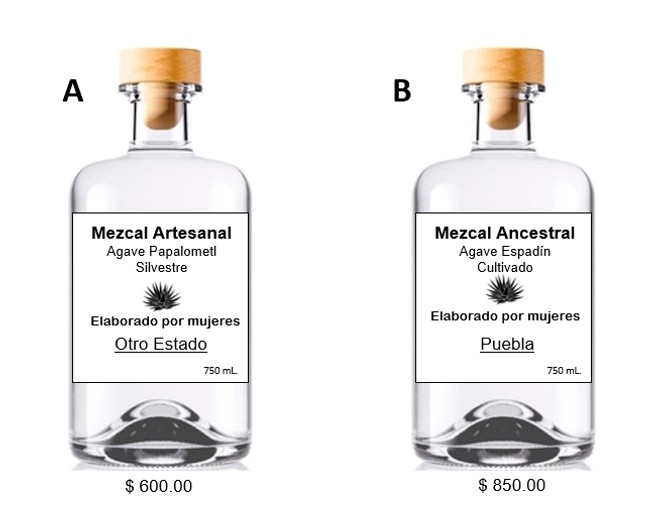
Sixteen combinations were obtained and presented to the consumer in eight choice sets, each with three alternatives (Figure 1): option A, option B and none; the latter was included as an opt-out option to avoid forced choices (Pablo et al., 2024; Thies et al., 2024).
Discrete choice experiments (DCE) are based on random utility theory (equation 2) (McFadden, 1973), which argues that the utility of a good is divided into an observable component, which depends on attributes and characteristics of the individual, and an error, modeling the choice through a logistic distribution (Cerda, 2011):
Where: Uij = the utility function; Vij = the deterministic component of the indirect utility function for each alternative j of the choice set; Zij = the attributes; Si = the sociodemographic characteristics; and ∈ij = the error.
A multinomial logit model, one of the most widely used models in DCE (Hauber et al., 2016), was employed to analyze the relationship between the probability of choice and mezcal attributes and consumer characteristics. The estimated empirical model is shown in equation 3. Where: Vij = the perceived utility of each alternative; β0 = the intercept; β1 = the price; β2, 3, 4, 5, 6, 7 = the attributes and levels evaluated in the experiment; and βs = the characteristics of the consumer.
The econometric analysis to estimate the coefficients and identify the effect of each attribute was carried out with the statistical package XLSTAT® v.2019.3. According to Melo et al. (2020), to evaluate the fit of the model, the Pseudo-R2 statistic (McFadden’s R2) and the coefficients of the variables with the expected and significant signs are measured.
Based on the estimated coefficients of the model, the marginal willingness to pay (MWTP) for each attribute was determined, which measures how much more a consumer is willing to pay for an additional unit of a specific attribute. The MWTP was calculated using Microsoft Excel (Microsoft Corporation, 2021), substituting values into equation 4. Where: βα = the coefficient of the attribute; and γ = the price coefficient in the choice experiment (Thies et al., 2024).
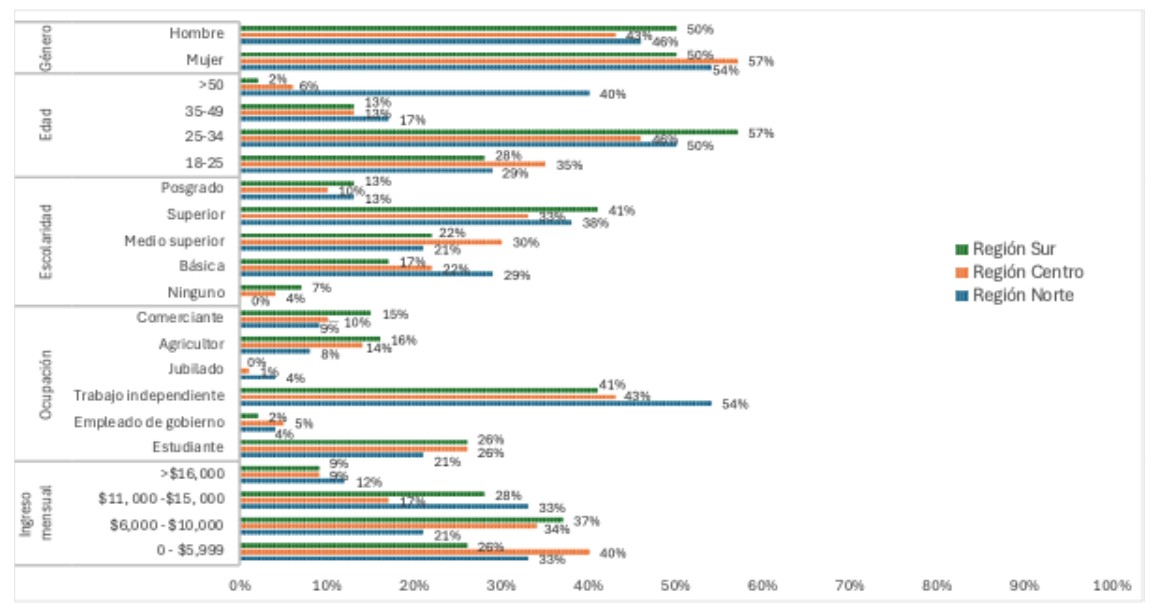
The sociodemographic characteristics of consumers (n= 282) are summarized in Figure 2. They were divided into three regions according to their place of residence: North (Sonora, Coahuila, Durango, and Nuevo León), Center (Aguascalientes, Mexico City, Jalisco, and Puebla) and South (Oaxaca, Chiapas, Guerrero, Veracruz and Yucatán).
In the North, 54% of the participants were women, with a predominance of people between 25 and 34 years old (50%), higher education level (38%), independent occupation (54%), and a monthly income between $11 000.00 and $15 000.00. In the Center, women also predominate (57%), with similar ages (25-34 years, 46%), higher (33%) and upper secondary (30%) education levels, most with independent occupation (43%), and incomes from $0 to $5 999.00. In the South, participation by gender was equitable, with the majority also between 25 and 34 years old, 41% have higher education, and 37% reported a monthly income between $6 000.00 and $10 000.00.
Previous studies support these findings; Garcés et al. (2021) report that the demand for mezcal is concentrated among young people (18-29 years old) and adults (30-49 years old) with professional training and high incomes. According to Balogh et al. (2016), a higher educational level positively influences the preference for traditional products, as people are more informed about their differential attributes.
In addition, it was found that women are the largest consumers of mezcal. Tarín et al. (2021) attribute this phenomenon to gender equity and changes in social roles, which have modified female consumption patterns, especially in alcoholic beverages. Consumer behavior is complex and responds to multiple factors, such as needs, tastes, age, culture, and social context (Kotler and Armstrong, 2023).
The results of the multinomial logit analysis are presented in Table 2. The model has a goodness-of-fit R2 (McFadden) of 0.2. According to Melo et al. (2020), in the statistical analysis of DCEs, Pseudo-R2 values that correspond to well-adjusted models vary between 0.2 and 0.4, so the model used aligns with what has been reported.
Although an orthogonal fractional factorial design was used to reduce correlation among attribute levels, the analysis revealed multicollinearity in the type of industrial process, man-made mezcal, cultivated agave and another agave variety. While this may affect the accuracy of the coefficients, it does not invalidate the model. This result can be attributed to the fact that participants associate these attributes as part of the same concept; for example, the industrial process is usually related to the use of cultivated agaves or to production profiles linked to gender, which generates statistical dependence.
In the attribute place of origin, it is observed that the attributes Puebla and other states are statistically significant (p > 0.05); Puebla has a negative sign and the second has a positive sign, indicating a greater preference for mezcals from states such as Oaxaca or Guerrero. This coincides with Thøgersen (2023), who points out that the origin gives the product distinctive characteristics, increasing its attractiveness and choice.
Regarding the process type, the ancestral and artisanal attributes were statistically significant, indicating that consumers value these production methods. Rosas and Ortega (2016) highlight that artisanal mezcals offer greater sensory richness, which favors their preference over industrial mezcal, and that they are also the most chosen in preference studies.
The Papalometl and Espadín agave varieties are statistically significant in the model, both with positive signs, showing their positive influence on consumer choice, as was the case with the wild agave variety. The model included socioeconomic variables to evaluate their possible impact. Although slight variations in the coefficients were observed, the logit analysis showed that none of these variables were statistically significant (p > 0.05), and their coefficients were very low. As a result, they are not shown in the table.
Table 3 shows the marginal willingness to pay for the attributes analyzed. It is worth noting that the MWTP was estimated only for those significant attributes with positive coefficients, since they are the ones that consumers prefer. In contrast, a negative and insignificant coefficient indicates that consumers do not prefer this attribute.
Consumers are willing to pay up to $586.50 more for mezcals from other states with greater recognition. In contrast, the marginal willingness to pay (WTP) was negative for mezcals made in Puebla. This suggests that familiarity and confidence in origin influence consumer choice (Ursu et al., 2024). Although Puebla is one of the current leading producers, many consumers still do not associate this state with mezcal production, so they do not prefer it.
However, mezcals from other states, such as Oaxaca, not only have a more established presence in the market but also have historical and cultural backing, significantly influencing consumer purchasing decisions. Consumers showed a greater willingness to pay for mezcals made through ancestral processes ($71.00) compared to artisanal ones ($10.00). This can be explained by the perception of authenticity, exclusivity and cultural bond that the ancestral process represents.
This appreciation is not only linked to the cultural heritage and local knowledge passed down from generation to generation but also to the traditional tools used in production and the distinctive sensory characteristics of mezcal. This confirms the growing valorization of traditional methods, which are closely linked to cultural heritage and a differentiated sensory experience (De-Insight, 2024).
As for certification, consumers would pay $448.00 more for mezcals with a designation of origin, which reinforces perceptions of quality and authenticity by increasing confidence and product safety. The participation of women in the production of mezcal has been increasing; this is reflected in the results obtained, where a marginal willingness to pay of $99.00 was found (Table 3). Mezcal women play a key role in preserving traditional knowledge by adopting sustainable practices and transmitting knowledge (Swinbank, 2021).
For this reason, organizations such as Women of Mezcal and Maguey of Mexico emerge, which seek to promote the work of women in the conservation and production of mezcal. On the other hand, the Papalometl and Espadín varieties, widely grown in Puebla, generated a WTP of between $25 and $40. Papalometl, in particular, is highly valued for its flavor and cultural roots, being up to three times more expensive than other agaves (Martínez et al., 2013). Complementary studies highlight those extrinsic attributes, such as origin, packaging and labeling, influence purchase decisions (Barrera et al., 2019) and that the product’s presentation reinforces its authenticity (López et al., 2020).
The results suggest that this group of consumers values attributes related to the geographical origin, traditional production, and authenticity of mezcal. Nevertheless, it was observed that consumers are unwilling to pay an additional price for mezcals made in Puebla, reflecting the limited recognition and positioning of this origin in the national market.
Even so, attributes such as certification (designation of origin), specific wild agave varieties and female participation positively influence acceptance and willingness to pay. Together, these findings highlight the importance of strengthening territorial identity and communicating authenticity as key strategies to increase the symbolic and economic value of mezcal from Puebla, thereby promoting its differentiation in an increasingly competitive market oriented towards the valuation of products with attributes.
The work was carried out thanks to funding from the Secretariat of Science, Humanities, Technology and Innovation (SECIHTI), by its Spanish acronym and the General Directorate of Research and Postgraduate Studies, through funding from Project 24013-EI. Chemical and sensory characterization and authenticity in traditional Mexican beverages linked to their geographical origin as a tool for valorization, sustainability, and the improvement of producers’ living conditions to improve food self-sufficiency.
Garcés, W. E.; Avitia, J. A. y Ramírez, H. J. 2021. Determinación del perfil del consumidor y evaluación de atributos intrínsecos y extrínsecos del destilado de agave del sur del Estado de México. En: Wong, G. P.; Isaac, E. J. E.; Morales, E. R. y Treviño, A. A. (Coords.). La dimensión global de las regiones y sus reconfiguraciones económicas y urbanas. Vol. II. Universidad Nacional Autónoma de México, Instituto de Investigaciones Económicas y Asociación Mexicana de Ciencias para el Desarrollo Regional. 113-131 pp. https://ru.iiec.unam.mx:80/id/eprint/5472.
Hauber, A. B.; González, J. M.; Groothuis, C. M.; Prior, T. B.; Marshall, D. A.; Cunningham, C. I.; Jzerman, M. J. and Bridges, J. F. 2016. Statistical methods for the analysis of discrete choice experiments: a report of the ISPOR conjoint analysis good research practices task force. Value Heal. 19(4):300-15. https://doi.org/10.1016/j.jval.2016.04.004.
Tarín, E. L.; Porras, F. A. y Leyva, C. N. 2021. El rol de la mujer en el enoturismo. Tendencias en el consumo de vino. En: Rózga, L. R.; Serrano, S. O. y Mota, F. V. (Coords.). Innovación, turismo y perspectiva de género en el desarrollo regional. Vol. V. Universidad Nacional Autónoma de México, Instituto de Investigaciones Económicas y Asociación Mexicana de Ciencias para el Desarrollo Regional. 489-501 pp. https://ru.iiec.unam.mx/5619/.