elocation-id: e3959
The use of rootstocks in citrus has been shown to improve agronomic and physicochemical characteristics of the fruit. In Mexico, the ‘Agrio’ orange tree (Citrus aurantium L.) remains the most widely used rootstock despite its phytosanitary limitations. In Quintana Roo, the production and the area planted with citrus increased by 6.3% and 12.1%, respectively, in the last decade. In contrast, the average annual yield decreased by 5%. This research was conducted in 2024 at the Chetumal Experimental Field of the National Institute of Forestry, Agricultural and Livestock Research, with the aim of evaluating the effect of six rootstocks on the physicochemical characteristics of the Persian lime (Citrus latifolia T.) fruit. The weight and equatorial and longitudinal diameters of the fruit, peel color, number of carpels, juice volume, total soluble solids and pH of the juice of Persian lime grafted onto six rootstocks were recorded. To determine the color and total soluble solids, the methodology proposed by the CIE and AOAC was used. The statistical analysis consisted of an analysis of variance (Anova) using a univariate general linear model, under a completely randomized experimental design and Tukey’s test for mean comparison (p ≤ 0.05). The results indicate that the ‘Macrophylla’ and ‘Volkameriano’ rootstocks have a higher weight and equatorial diameter of the fruit; in contrast, the ‘Troyer’, ‘Carrizo’, and ‘C-35’ rootstocks are distinguished by inducing a higher content of total soluble solids and higher pH values in the juice.
fresh weight, fruit color, total soluble solids
In 2022, world production of lemons and limes was 21.5 million tons, of which Mexico contributed 3.1 million, which places it as the second-largest producer globally, with 14% of the total (FAOSTAT, 2025). This position reflects the importance of citrus growing as one of the country’s main agricultural activities, both for its economic contribution and for the generation of employment in various producing regions. Three lemon species are grown in the country, each with different morphological and market characteristics.
The Mexican lime (Citrus aurantifolia L.) is distinguished by its small green fruits, presence of seeds, round shape, intense and acidic flavor, used in the food industry and national gastronomy; the Italian lemon (Citrus limon L.) produces medium-sized yellow fruits and high juice content and aromatic peel, and is demanded for both fresh consumption and industrial processing; on the other hand, the Persian lime (Citrus latifolia T.) generates medium to large green fruits, absence of seeds, oval shape, mild flavor that is characterized by its high volume of juice and appreciated in the production of concentrates and derivatives, as well as in exports to international markets. The diversity of these species allows the country to serve different market niches and contributes to the stability and competitiveness of Mexican citrus growing.
These species contributed 44%, 5% and 51% of the national lemon production in 2024 (SIAP, 2025). Between 2013 and 2023, the Persian lime crop in Mexico had an average annual growth of 4.51% in production, 2.86% in planted area and 0.53% in yield, which shows an expansion of the crop to new regions and its consolidation as a species of high economic value.
In Quintana Roo, production and planted area increased by 6.3% and 12.1%, respectively, whereas the average yield decreased by 5%, indicating that, although the cultivated area increased, yields per hectare were affected by possible edaphoclimatic factors, agronomic management and poor selection of plant material. For 2023, the state yield was 11.06 t ha-1, which is 28% lower than the national average yield (SIAP, 2025).
In this context, the choice of rootstock acquires a key role in citrus plantations, as it has a decisive influence on the morphological, physiological and productive characteristics of the graft (Aguilar-Hernández et al., 2021). It has been shown that the rootstock significantly affects tree growth, yield and fruit quality, modifies morphological traits, such as size and weight, as well as qualitative traits, such as juice content, total soluble solids, acidity, vitamin C, phenolic compounds and antioxidant capacity (Martínez-Nicolas et al., 2022). It also influences the tree’s tolerance to biotic and abiotic stress conditions (Liu et al., 2023) and the absorption efficiency of essential elements (Hayat et al., 2022).
In Mexico, the ‘Agrio’ orange tree (Citrus aurantium L.) remains the most widely used rootstock, despite its high susceptibility to citrus tristeza virus, constituting a considerable phytosanitary risk (Rivas-Valencia et al., 2017). In view of this situation, it is essential to evaluate rootstock alternatives that offer greater resistance to diseases, physiological compatibility with the graft and a favorable effect on the fruit’s internal and external characteristics.
As the Persian lime crop expands across various regions of the country, particularly the Yucatán Peninsula, the need to identify rootstocks that express better agronomic performance and fruit quality increases. However, knowledge of the behavior of alternative rootstocks to the ‘Agrio’ orange tree is still limited, especially under the edaphoclimatic conditions of the state of Quintana Roo, where calcareous soils and a humid tropical climate predominate, which can influence the optimal development of the crop. For this reason, this research aimed to assess the effect of six rootstocks on the physicochemical characteristics of Persian lime fruit, in the agroecological conditions of the state of Quintana Roo. With this, it is intended to identify the rootstock or rootstocks that contribute to achieving a fruit with the quality required by the regional and national industry.
The study was conducted in the Persian lime production research module of the Chetumal Experimental Field of the National Institute of Forestry, Agricultural and Livestock Research (INIFAP, by its Spanish acronym), Quintana Roo, Mexico, in an area with a warm subhumid climate with rainfall in summer, with 1 329 mm of annual rainfall concentrated from June to October, and average temperatures of 24.4 °C in winter and 28.2 °C in summer. The physicochemical characteristics of the soil in the experimental plot are detailed in Table 1.
[i] Data obtained in accordance with NOM 021 (SEMARNAT, 2002).
It consisted of Persian lime fruits randomly collected from three-year-old trees grafted onto six rootstocks, which were the following: a) ‘Macrophylla’ (C. macrophylla); b) ‘Volkameriano’ lemon (C. volkameriana); c) ‘Agrio’ orange tree (C. aurantium); d) ‘Troyer’ citrange (C. sinensis x P. trifoliata); and e) ‘Carrizo’ citrange (C. sinensis x P. trifoliata) and ‘C-35’ citrange (C. sinensis x P. trifoliata). The plants come from the Vivero Xamantún citrus propagative material production unit, located in the state of Campeche.
The module was established in a rectangular planting system with a spacing of 6 m × 4 m, obtaining a density of 416 plants ha-1. Irrigation was applied by micro-sprinkling at a frequency of 5 h week-1. Mineral fertilization was applied at an annual dose of 140 g N, 32 g P2O5, 40 g K2O per tree, fractionated into four applications, using urea (46% N), diammonium phosphate (18% N, 46% P2O5), and potassium chloride (60% K2O) as sources. Weed management was carried out mechanically, whereas pests and diseases were controlled through chemical applications (INIFAP, 2017).
To evaluate the physical and chemical characteristics of the fruit, the following variables were considered: the fresh weight (g) of each fruit was determined with an Ohaus digital scale, model Pioneer (Switzerland). The equatorial and longitudinal diameters were measured with a Steren digital vernier caliper, model Her-411 (China). The diameter ratio was also calculated
The external color of the fruit was evaluated with a 3nh digital colorimeter, model NR10QC (China), considering the average of five readings; three taken at different points around the equatorial plane and two on the longitudinal plane of the fruit. Measurements were made at constant ambient temperature (22 ± 2 °C). The color was determined in accordance with the International Commission on Illumination (CIE, by its French acronym) and expressed as color values L*, a* and b* (Robertson, 1977). The coordinates L*, a* and b* describe different aspects of color: L* represents lightness, where a value of zero corresponds to black and one hundred to white; a* indicates the position of the color between green and red, the negative values being associated with green and the positive values with red; in contrast, b* indicates the position between blue and yellow, with negative values corresponding to blue and positive values to yellow (Pauli, 1976).
Color saturation
, hue angle
and color index
were also calculated. The number of carpels was determined by cutting the lime fruits transversely and the juice volume (ml) was extracted with a stainless-steel manual juicer and a graduated cylinder. The pH of the juice was determined with an Ohaus potentiometer, model Starter300 (Switzerland). Total soluble solids (°Brix) were determined using an Atago digital refractometer, model Pal-3 (Japan), with a scale from 0 to 93 ±0.1%, according to the AOAC 983.17 method (AOAC, 2023); for each sample, 0.3 ml of juice at 20 °C was used.
The statistical analysis was performed with SAS OnDemand for Academics Software. An analysis of variance (Anova) was performed with a univariate general linear model in a completely randomized experimental design with six treatments and three replications. Each replication was integrated with a sample of 10 fruits taken from a tree, which was considered an experimental unit. To separate the means, Tukey’s test (p ≤ 0.05) was used.
Fruit weight. Trees grafted onto ‘Macrophylla’ and ‘Volkameriano’ produced fruits of greater mass, with values of 124.02 and 107.23 g, respectively, compared to those grafted onto ‘Carrizo’ citrange and ‘C-35’ citrange, which generated lighter fruits, of 83.72 and 77.34 g, respectively (Figure 1). This is consistent with studies that indicate that vigorous rootstocks, such as the Rangpur lime and ‘Volkameriano’ lemon, tend to produce larger fruits (Cantuarias-Avilés et al., 2011). In contrast, dwarfing or trifoliate rootstocks reduce graft vigor, as they develop trees with more compact structures and lower height, which is reflected in the production of smaller fruits (Liu et al., 2015).

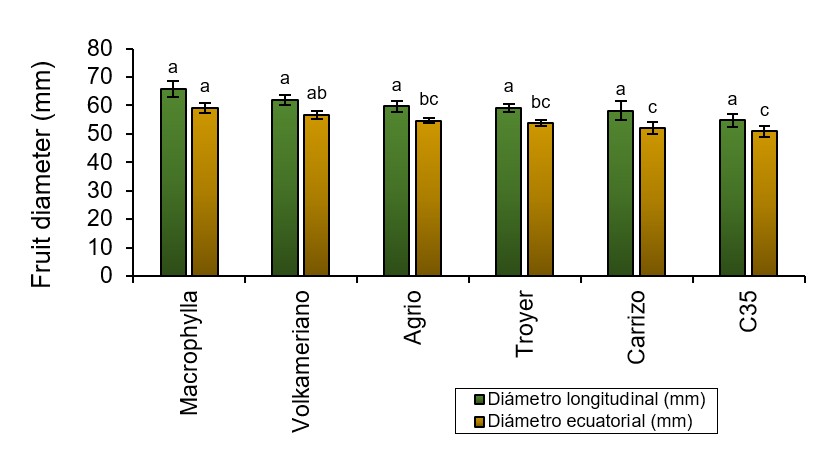
Longitudinal and equatorial diameters of the fruit. No significant differences were found in longitudinal diameter, which aligns with Liu et al. (2015) when comparing the vertical diameter of two rootstocks: Canton lemon and a trifoliate orange tree. Nevertheless, the ‘Macrophylla’ rootstock had the largest equatorial diameter, with 59.08 mm, while the smallest corresponded to ‘C-35’ citrange, with 50.83 mm (Figure 2). This result is consistent with what was reported by Berdeja-Arbeu et al. (2016), who observed that fruits of Persian lime grafted onto ‘Troyer’ citrange and ‘C-35’ citrange had smaller diameters compared to ‘Agrio’, ‘Volkameriano’, and ‘Macrophylla’.
Color. There is insufficient evidence to affirm that rootstocks evaluated under the agroecological conditions of the state of Quintana Roo significantly modify the color characteristics of the peel of Persian lime fruits (Table 2).
The Persian lime fruits grafted onto ‘Volkameriano’ lemon and ‘Agrio’ orange showed lightness (L*) and color saturation (C*) values between 8% and 15% higher than those obtained with ‘Macrophylla’, ‘Carrizo’, and ‘C-35’ rootstocks. These results suggest that vigorous rootstocks could promote more intense, brighter peel coloration due to vegetative vigor and better nutrient translocation. These findings are consistent with those reported by Raddatz-Mota et al. (2019), who observed that Persian lime fruits grafted onto ‘Volkameriano’ lemon presented greater lightness and color saturation values compared to those grafted onto ‘Agrio’ orange, ‘C-35’ citrange, Flying Dragon trifoliate, and Swingle citrumelo.
The diameter ratio did not show significant differences between the rootstocks evaluated, with values ranging from 1.08 to 1.12 (Table 3).
This uniformity indicates that the rootstock did not differentially influence the external conformation of the fruit; the similarity between vigorous rootstocks and those considered dwarfing suggests that the vigor transmitted to the tree is not reflected in appreciable morphological changes in the fruit’s shape. Likewise, the number of carpels did not show a significant difference between the rootstocks evaluated, with values ranging from 9.6 to 10.4 (Table 3). This stability indicates that the rootstock does not exert an influence on this characteristic, which is considered a trait conserved by the cultivar’s genetics; this result coincides with Martínez-Nicolas et al. (2022), who pointed out that the number of carpels in Verna lemon fruits was not affected by the rootstocks evaluated.
Juice content is a key parameter in determining the quality and commercial value of acid limes. According to NMX-FF-077-1996, Persian lime fruits destined for the market must contain a minimum of 42% juice in relation to the total mass of the fruit (SEECO, 1996). This attribute is related to the rootstock’s genetics and the water and nutrient absorption capacity of its root system. Citrange rootstocks, such as ‘Troyer’, ‘Carrizo’, and ‘C-35’, have more restrictive roots that limit absorption; in contrast, vigorous lemon rootstocks, such as ‘Macrophylla’ and ‘Volkameriano’, have more extensive roots that are more efficient in capturing water and nutrients.
The results obtained showed significant differences in juice content between the rootstocks evaluated (Table 3). Fruits from trees grafted onto ‘Macrophylla’ and ‘Volkameriano’ registered the highest volumes of juice, with 62.02 and 50.54 ml, respectively, whereas those grafted onto ‘C-35’ presented the lowest value, with 32.05 ml. These results are consistent with what was reported by López-Fortoso et al. (2021), who noted that the morphological diversity and quality of the Persian lime fruit are related to the type of rootstock used during its propagation. Likewise, these authors highlight those internal characteristics, such as the amount of juice, tend to be higher when ‘Macrophylla’ is used as the rootstock.
Regarding total soluble solids (TSS), all fruits exceeded the minimum of 6.8 °Brix established by NMX-FF-077-1996, confirming that they reached adequate physiological maturity for fresh consumption (Table 3). Trees grafted onto ‘Macrophylla’ and ‘Volkameriano’ lemon rootstocks had lower TSS values compared to those grafted onto citranges, which suggests a dilution effect associated with the higher juice content observed in these rootstocks. This behavior coincides with what was reported by Barry et al. (2004), who pointed out that Persian lime fruits grafted onto ‘Carrizo’ citrange exhibit a higher concentration of soluble solids, although with reduced juice volume.
Finally, the pH values showed significant differences between the rootstocks evaluated. The fruits obtained from trees grafted onto ‘Troyer’, ‘Carrizo’, and ‘C-35’ registered a higher pH, around 5%, compared to the fruits developed on ‘Macrophylla’, ‘Volkameriano’, and ‘Agrio’, which refers to a lower accumulation of organic acids in dwarfing or trifoliate rootstocks (Table 3). This behavior is consistent with what was reported by Lado et al. (2014), who associated the increase in the pH of fruits obtained on citrange with lower organic acid accumulation, attributed to restrictions in solute transport to the fruit.
The ‘Macrophylla’ and ‘Volkameriano’ rootstocks promoted a higher weight and equatorial diameter of the fruit, whereas the ‘Troyer’, ‘Carrizo’ and ‘C-35’ rootstocks stood out for inducing a higher content of total soluble solids and higher pH values, attributes that can be preferred in specific markets according to quality requirements.
The authors thank the National Institute of Forestry, Agricultural, and Livestock Research (INIFAP), by its Spanish acronym for the authorized financing, from fiscal and own resources, for the execution of the SIG project: 1081035383, entitled ‘production of citrus buds’.
López-Fortoso, F.; González-Arnao, M. T.; Bulbarela-Marini, J. E.; Pastelín-Solano, M. C.; Guevara-Valencia, M.; Rascón-Díaz, P.; Cruz-Cruz, C. A. and Castañeda-Castro, O. 2021. Characterization in clonal selections of Citrus x latifolia Tanaka ex Q. Jiménez. Agro Productividad. 14(3):11-16. https://doi.org/10.32854/agrop.v14i3.1798.
Raddatz-Mota, D.; Franco-Mora, O.; Mendoza-Espinoza, J. A.; Rodríguez-Verástegui, L. L.; León-Sánchez, F. and Rivera-Cabrera, F. 2019. Effect of different rootstocks on Persian lime (Citrus latifolia T.) postharvest quality. Scientia Horticulturae. 257:1-10. https://doi.org/10.1016/j.scienta.2019.108716.
Rivas-Valencia, P.; Loeza-Kuk, E.; Domínguez-Monge, S. and Lomas-Barrié, C. T. 2017. Chronic infection of the citrus tristeza virus in Citrus sinensis, C. aurantium trees in a restrictive thermal regime in Yucatán. Revista Chapingo Serie Horticultura. 23(3):187-202. https://doi.org/10.5154/r.rchsh.2016.11.028.