elocation-id: e3930
Granadilla (Passiflora ligularis Juss.) production in Colombia faces severe limitations due to “wilting disease” caused by Fusarium solani f. sp. passiflorae, leading to losses of over 90%. Given the limited genetic resistance of commercial cultivars, this study evaluated Passiflora alata Curtis as a tolerant rootstock through grafting. The objective was to determine the tolerance of P. alata to F. solani, its graft compatibility with P. ligularis, and agronomic performance under field conditions. The research was conducted between 2022 and 2024 in the municipalities of Rionegro and San Vicente Ferrer, Antioquia, Colombia. Seed-derived seedlings were used for inoculation trials in a greenhouse, compatibility testing with two grafting techniques (splice and cleft) and field evaluations of grafted and non-grafted plants over 15 months. Results showed P. alata exhibited high tolerance to F. solani infection with only 8% incidence, compared to 96% in P. ligularis. The cleft grafting technique had a higher success rate (92%) compared to splice (84%). In the field, grafted plants had higher survival (95% vs 78%), more vigorous vegetative growth, and earlier flowering (210 vs 375 days). These findings suggest that using P. alata as a rootstock is a potential strategy for managing F. solani and improving granadilla crop establishment and performance in affected areas.
disease tolerance, fusarium wilt, graft compatibility, Passifloraceae, rootstock.
In South America, the genus Passiflora stands out for including species of high relevance to the food industry, particularly in the production of pulps and derivatives, as well as in local markets for the consumption of fresh fruit (Fischer and Miranda, 2021). In addition, certain species of this genus contain bioactive compounds with applications in the pharmaceutical industry due to their antioxidant properties (Barbosa et al., 2021) and in the cosmetics industry, where flavonoids, phenolic acids and volatile aromatic compounds have been identified in various plant organs (Pardo-Solórzano et al., 2024).
Passiflora ligularis Juss, commonly known as granadilla, is distributed from Mexico to Bolivia, with greater prevalence in the tropical Andes between 1 500 and 2 500 masl (Ocampo et al., 2021). In 2024, the global passion fruit market was valued at approximately USD 3.9 billion and is projected to reach USD 5.85 billion by 2032, reflecting a compound annual growth rate of 5.2% (Data Bridge Market Research, 2024). Production of P. ligularis is primarily concentrated in the Andean highlands of Colombia, Ecuador, and Peru, where suitable agroecological conditions exist between 1 500 and 2 000 masl. Colombia currently stands as the leading producer, with more than 3 000 ha cultivated for domestic markets and export (CABI, 2024).
In granadilla cultivation, one of the most limiting factors is collar rot, caused by Fusarium solani f. sp. passiflorae (Tamayo et al., 1999; Salazar-González et al., 2022), a pathogen capable of causing losses greater than 90% (Torres et al., 2000). The fungus penetrates through the roots, colonizes the vascular bundles, and blocks the translocation of water and nutrients (Castaño-Zapata, 2015). It also degrades xylem fibers and amyloplasts in the parenchyma cells and produces gels that reduce plant productivity (Schmildt et al., 2017).
Patiño-Pacheco and Pérez-Cardona (2021) reported that Passiflora ligularis and P. quadrangularis exhibit extreme susceptibility to Fusarium solani f. sp. passiflorae, with complete plant mortality occurring within 10 to 30 days posinoculation. In contrast, a particular accession of P. alata displayed only moderate symptom expression and slower disease progression, indicating a partial resistance response. This intermediate level of susceptibility suggests that P. alata possesses inherent physiological or anatomical traits-such as enhanced root lignification or restricted vascular colonization-that may confer tolerance, thereby supporting its potential use as a resilient rootstock for susceptible Passiflora species.
The use of rootstocks derived from wild species tolerant to soil-borne pathogens is considered a low-cost agronomic strategy that is easy to implement in the field. Species such as P. alata, P. macrocarpa, P. caerulea, and P. nitida have been reported as tolerant to Fusarium spp. (Fischer et al., 2010). Moreover, grafting enables the combination of rootstock’s disease resistance with the desirable agronomic traits of the scion, thereby improving plant establishment, reducing juvenility and facilitating canopy management (Lima et al., 2021; Hurtado et al., 2021).
In this context, Cuya and Escobedo (2018) evaluated the grafting of granadilla onto yellow passion fruit and reported a 50% success rate using the cleft grafting technique; similarly, Espinal et al. (2023) reported that grafting Passiflora edulis onto compatible rootstocks led to a significant 35% reduction in plant height, indicating a dwarfing effect, while simultaneously promoting earlier flowering and fruiting. These findings suggest that rootstock selection can effectively modulate vigor and enhance precocity in Passiflora cultivation systems.
The present study was conducted with the aim of evaluating the tolerance of P. alata to F. solani, determining its graft compatibility with P. ligularis, and characterizing the agronomic performance of grafted plants under field conditions up to the onset of flowering.
Laboratory and greenhouse studies were conducted at the Plant Health Unit of the Universidad Católica de Oriente, located in the municipality of Rionegro (Antioquia), at 2 115 m above sea level, with an average temperature of 17 °C. Field evaluations took place at the San Germán farm of the same university (6° 17’ 14” North Latitude, 75° 14’ 18” West longitude), in the Potrerito village of San Vicente Ferrer, Antioquia. This area corresponds to the Lower Montane Very Humid Forest life zone, at 1 997 masl, with an average annual temperature of 15 °C and volcanic-origin soils with a loamy-sandy texture (Cornare, 2012). The experiments were carried out between 2022 and 2024.
The seeds of maracujá-doce (Passiflora alata Curtis) and granadilla (Passiflora ligularis Juss.) were kindly provided by the working germplasm bank of the Plant Biotechnology Unit at the Universidad Católica de Oriente, and the corresponding ecotypes were originally collected in the municipality of Sonsón, Antioquia (Colombia). These seeds were germinated in a substrate composed of peat and coconut fiber, using 700 cm3 plastic containers.
A pathogenic strain of Fusarium solani f. sp. passiflorae was obtained from the Agrosavia Agricultural Research Center (La Selva Experimental Station, Antioquia), originally isolated from symptomatic Passiflora ligularis crops in the municipality of La Ceja, Antioquia. The fungus was maintained on potato dextrose agar (PDA) medium and incubated at 25 ±2 °C for seven days to promote sporulation. A conidial suspension was subsequently prepared by flooding the culture surface with sterile distilled water containing 0.05% Tween 20, filtering through double-layer sterile gauze, and adjusting the concentration to 1 × 10⁸ conidia ml-1 using a Neubauer hemocytometer.
For inoculation, 30-day-old seedlings were surface-sterilized with 70% ethanol. A shallow incision (approximately 1-2 mm deep and 3-4 mm long) was made at the neck of the stem, just above the root-hypocotyl junction, using a sterile scalpel blade under aseptic conditions. Immediately after wounding, 200 µl of the F. solani conidial suspension was applied directly into the incision using a sterile micropipette. The wound area was then covered with a small piece of sterile cotton moistened with the same suspension and wrapped with Parafilm® to maintain humidity and promote pathogen ingress. Control plants received an identical treatment using sterile distilled water. Following inoculation, plants were maintained in a greenhouse under controlled conditions (25 ±2 °C, 70-80% RH) and monitored daily for symptom development.
Twenty-five-day-old P. ligularis seedlings and thirty-day-old P. alata seedlings, each with stem diameters between 2 and 3 mm, were used in the experiment. P. alata plantlets were transplanted into 300 g polyethylene bags containing a mixture of soil, sand, and organic matter (2:1:1) and allowed to grow for 25 days before grafting. Two grafting techniques were applied: i) Splice graft-a slanted cut was made on both the scion and rootstock for union; and ii) Cleft graft-the rootstock was cut transversely at the cotyledon level and split 0.5 cm longitudinally to insert the scion. Scions were prepared with 5 cm length and three leaves, ensuring diameter compatibility (approx. 2 mm). Grafts were secured with 2 mm grafting clips and placed in a humid chamber (relative humidity: 95% ±3%, temperature: 24-32 °C, light: 70%).
Four treatments were established in a completely randomized design (n= 50 seedlings per treatment): i) P. alata seedlings inoculated with the fungal suspension (treatment); ii) P. ligularis seedlings inoculated (positive control); iii) P. alata seedlings not inoculated (negative control); and iv) P. ligularis not inoculated (negative control). After 60 days, the presence or absence of wilt symptoms was recorded.
The experiment followed a completely randomized design with two treatments (graft type), using 50 plants per treatment. After 20 days in the humid chamber, plants were transferred to the greenhouse. At 40 days post-grafting, survival rate, graft length, stem diameter at the union, and number of new leaves per plant were measured.
Grafted plants were kept in the greenhouse under controlled conditions until two months old (approximately 20 cm in height). In parallel, non-grafted granadilla plants from seed were grown under the same conditions. At transplanting age, the field was prepared using minimal tillage, contour leveling, and a triangular planting design (2.5 m between plants and 3 m between rows). A pre-plant soil analysis guided organic amendments and pH corrections. The field trial used a completely randomized design with two treatments: i) granadilla grafted onto P. alata (60 plants); and ii) non-grafted P. ligularis (60 plants). Survival was recorded at 3, 6, 9 and 12 months after transplanting. Additionally, 15 randomly selected plants per treatment were assessed for growth variables: main stem length (from collar to apex), main stem diameter (5 cm above the collar for non-grafted plants, at the graft union for grafted ones) and time to flowering (days from planting). Measurements continued for 15 months.
Data were analyzed using R Wizard 4.3. Normality (Shapiro-Wilk test) and homogeneity of variance (Levene’s test) assumptions were verified. For F. solani inoculation, a chi-square test assessed associations between treatments and wilt occurrence. For grafting techniques, a student’s t-test compared treatment means 95% confidence. Field data were analyzed with one-way Anova, followed by Tukey’s multiple comparison test.
A significative difference in disease response was observed between the two Passiflora species evaluated under greenhouse conditions. Sixty days after inoculation, only 8% of the P. alata plants exhibited visible symptoms of infection (4 out of 50 plants), whereas the incidence in P. ligularis reached 92% (46 out of 50 plants). This difference was statistically significant (χ2 test, p < 0.05), indicating a strong association between the inoculation treatment and the manifestation of wilt symptoms (Figure 1).
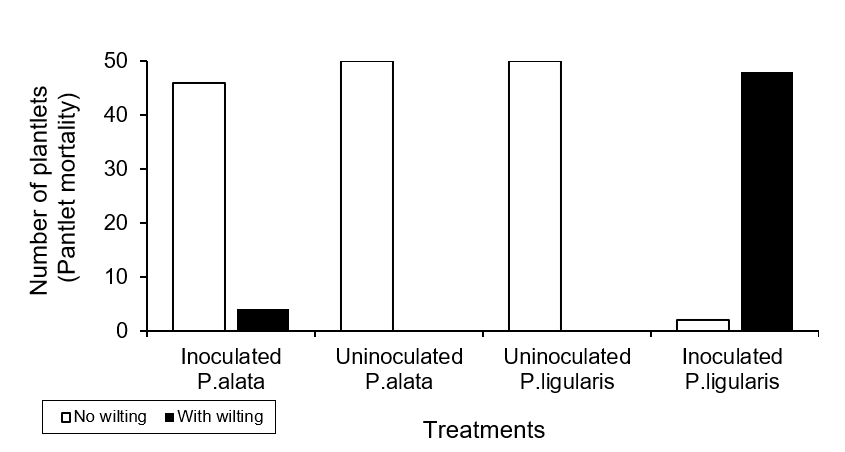
Regarding the uninoculated P. alata and P. ligularis plants, 100% survival was observed. These findings align with those of Osorio et al. (2020), who identified F. solani as a principal causal agent of wilting disease in P. ligularis. The high mortality observed in granadilla confirms its extreme susceptibility to the fungus. P. alata has been previously reported as a soil pathogen-tolerant species (Faleiro et al., 2008). In this study, 80% of P. alata plants survived, indicating partial tolerance. The variability in response may be attributed to the genetic diversity within the species, as Forero et al. (2015) reported differential responses to Fusarium among P. alata populations, attributable to its outcrossing nature. This explains why some individuals are susceptible while others exhibit resistance.
Graft compatibility was evaluated based on graft take rate and early plant development (Table 1). The cleft grafting technique achieved a significantly higher take rate (92%) compared with the splice graft (84%) (t-test, p < 0.05). 60 days after grafting; however, no significant differences were detected in plant height, number of leaves or stem diameter between the two techniques. These results agree with those reported by Cuya and Escobedo (2018) for granadilla grafts onto P. edulis f. flavicarpa, where a successful graft union did not necessarily lead to early differences in scion vigor.
| Type of graft | Grafting performance (%) | Total plant length (cm) | Number of leaves | Stem diameter (mm) |
|---|---|---|---|---|
| Splice | 84 | 16 | 6 | 4.1 |
| Cleft | 92 * | 15.7 | 6 | 4.1 |
Comparable patterns were observed by Espinal et al. (2023). They reported that while initial graft takes and early growth responses were similar across several Passiflora combinations, physiological compatibility and long-term field performance varied substantially among rootstocks. Specifically, seedlings grafted onto P. alata and P. maliformis exhibited higher survival rates and more uniform growth after field establishment compared with those on P. foetida or P. semaphytfolia. These findings highlight that early nursery indicators such as take rate and stem growth, though useful for evaluating grafting technique efficiency may not fully predict long-term graft performance.
In the context of our results, the higher success rate obtained with the cleft graft suggests better cambial alignment and callus formation, likely to improved vascular continuity between scion and rootstock. However, consistent with Espinal et al. (2023), the absence of early morphological differences implies that physiological compatibility should be confirmed through extended field evaluation, including flowering onset, yield and potential incompatibility symptoms such as stem swelling or delayed leaf abscission. Overall, the combined evidence supports the view that both the choice of grafting technique and the selection of rootstock species are critical determinants of graft longevity and agronomic performance in Passiflora cultivation systems. These findings suggest that while cleft grafting enhances initial graft success, both techniques lead to comparable vegetative development once the graft has established. Schmildt et al. (2017) highlighted the importance of callus formation at the graft union as a determinant of initial compatibility, which may explain the difference in take rates between the two techniques.
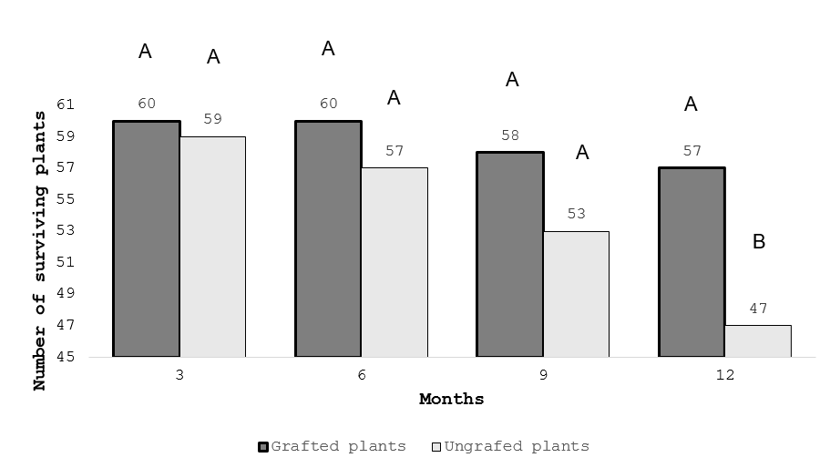
Cumulative plant survival was monitored for 12 months post-transplant (Figure 2). No significant differences were observed up to nine months. However, at 12 months, grafted plants had significantly higher survival (95%) compared to non-grafted plants (78.3%) (χ2, p = 0.016). This result suggests that tolerant rootstocks contribute to greater longevity in the field, likely due to improved root system resistance to soilborne pathogens.
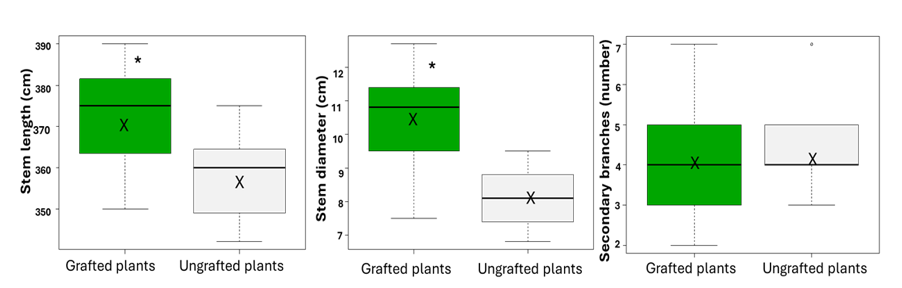
Regarding vegetative growth, grafted plants exhibited more robust development. At 15 months, the mean height and stem diameter of grafted plants (373.3 cm and 10.37 mm, respectively) were significantly greater than those of non-grafted plants (357 cm and 8.11 mm) (Figure 3). No significant differences were noted in the number of secondary branches.
Additionally, grafted plants flowered earlier, at an average of 210 days after planting, while non-grafted plants flowered at 375 days (Figure 4), a statistically significant difference (p < 0.05, t-test). This suggests that grafting considerably accelerates the onset of reproductive development.
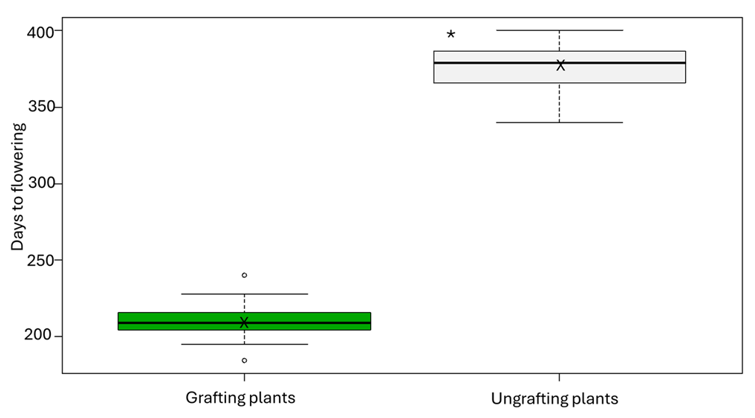
These findings confirm that grafting not only enhances disease tolerance but also promotes earlier reproductive maturity. The rootstock plays a central role in nutrient and water uptake, influencing scion growth and vigor (Hayat et al., 2023). This response may be mediated by molecular signals from the rootstock-such as phytohormones, mRNA, non-coding RNA, or proteins-that regulate physiological processes in the scion (Lu et al., 2020). Overall, these results support findings by Lima et al. (2017, 2021), who emphasized that rootstock selection should consider not only resistance but also positive effects on growth, yield, and precocity. Using P. alata as a rootstock proves to be a viable propagation strategy for P. ligularis, particularly in areas affected by F. solani. This approach aligns with modern fruit-growing practices, where grafting is used to overcome the genetic limitations of commercial cultivars (Adıgüzel et al., 2022, 2023; Dhurve et al., 2024).
This study demonstrates that Passiflora alata Curtis exhibits notable tolerance to Fusarium solani f. sp. passiflorae under greenhouse conditions, showing significantly lower incidence compared to Passiflora ligularis. Furthermore, granadilla plants grafted onto P. alata showed enhanced field performance, including higher survival rates, more vigorous vegetative growth, and earlier flowering compared to non-grafted plants. The cleft grafting technique proved to be more efficient in terms of initial graft success; however, both techniques supported comparable vegetative development once the graft was established.
These results support the use of P. alata as a rootstock in integrated management programs for wilting disease in granadilla. Grafting onto P. alata emerges as a promising agronomic strategy to mitigate the impact of soilborne pathogens, improve crop establishment, and shorten the juvenile phase, thereby contributing to the sustainability and productivity of granadilla cultivation in regions affected by F. solani.
The authors would like to thank Senainnova for co-funding the project 107643: ‘Scaling up the production of seedlings of Passifloraceae species on rootstocks tolerant to phytosanitary problems to promote the productivity, quality and useful life of crops’, the company Innmakers SAS, the association of fruit growers of Carmen de Viboral (Antioquia) and the research and development department of the Universidad Católica de Oriente.
Barbosa Santos, T.; Araujo, F. P.; Neto, A. F.; Freitas, S. T.; Souza- Araújo, J.; Oliveira, V. and Lima, M. S. 2021. Phytochemical compounds and antioxidant activity of the pulp of two brazilian passion fruit species: Passiflora cincinnata Mast. and Passiflora edulis Sims. International Journal of Fruit Science. 21(1):255-269.
CORNARE. 2012. Corporación Autónoma Regional de las Cuencas de los ríos Negro- Nare. Gobernación de Antioquia-Ministerio de Ambiente y Desarrollo Sostenible. Evaluación y zonificación de riesgos por avenida torrencial, inundación y movimiento en masa y dimensionamiento de procesos erosivos en el municipio de San Vicente Ferrer. Videográficas LTDA, Colombia. http://www.cornare.gov.co/GestionRiesgo/SAN-VICENTE/Documento-San-Vicente.pdf.
Osorio, J. A. C.; Martínez, E. P. L.; Hio, J. C.; Aguirre, J. E. R.; Vergara, J. A. A.; Luque, N. Y. S.; Rojas, E. D. Z. y Cruz, G. N. 2020. Caracterización sanitaria de los cultivos de granadilla, gulupa y maracuyá en Colombia, con especial referencia a la secadera causada por Fusarium solani f. sp. Passiflorae. Primera Ed. Vol. 1. Mosquera, Colombia: Agrosavia. Hilos Tensados. 41-66 pp. Doi: https://doi.org/10.21930/agrosavia.investigation.7403381.