elocation-id: e3903
Honeybees (Apis mellifera L.) are the most efficient pollinators in cultivated and wild plants, playing an essential role in agricultural production and ecosystem conservation. This research aimed to evaluate the effect of the distance of Apis mellifera L. hives in pollination with honeybees on the quantity and quality of the fruits of the Mexican lime [Citrus aurantifolia (Christm.) Swingle] from March to July 2022, at the Villa Chica farm of the SiCar Farms company, located in the municipality of Tecomán, Colima, Mexico, with an area of 3.75 ha, where eight honeybee colonies were installed; 36 trees were selected and divided into four treatments that consisted of different ranges of distance from the location of the bee colonies and a control group that was isolated: T1 (0-100 m), T2 (101-200 m), T3 (201-300 m), T4 (randomly selected trees excluding pollinators). Treatments T1 and T2 presented a positive effect on the variables of fruit set percentage, fruit weight, polar diameter, juice weight, and number of seeds, compared to the other treatments, so it is recommended to place hives uniformly in the Mexican lime crops at distances not greater than 200 m between them in order to improve pollination activity and obtain fruits in greater quantity and better quality.
Apis mellifera, Citrus aurantifolia, cuajado de frutos
The Mexican lime is native to the tropical and subtropical regions of Asia and Southeast Asia, including India and China. This crop was introduced in North Africa, Europe, and around the world (Narang et al., 2016). Currently, Mexico ranks second in terms of production volume. After Michoacán, Colima ranks second in national production with 298 808.73 t with a value of 4 274 390.60 thousand pesos (SIAP, 2024).
Insect pollination benefits the yields of 75% of plant species worldwide and insects are responsible for 35% of the total production harvest. On the other hand, honeybees are the insects that provide the most pollination services in agriculture (Siopa et al., 2024). These bees are commonly used in crop pollination since the continuous process of providing food to the brood demands a constant collection of floral resources, such as nectar and pollen (Dos-Santos et al., 2009; Fonseca et al., 2019).
Authors such as (Klein et al., 2007; Petersen et al., 2013) mention that honeybees play an important role in pollination. However, more knowledge is needed about this activity under specific conditions (Khan et al., 2012; Baena-Diaz et al., 2022). Specifically, in the western region of Mexico, the effect of Apis mellifera L. on the pollination of Mexican lime is unknown, so this research assessed the effect of the distance of Apis mellifera L. hives on variables related to the quantity and quality of Mexican lime fruits [Citrus aurantifolia (Christm.) Swingle].
This research was conducted from March to July 2022 at the Villa Chica farm, owned by the SiCar Farms company, located in the municipality of Tecomán, Colima, Mexico, at coordinates 18° 50’ 31” north latitude and 103° 49’ 31” west longitude (Google Earth, 2024) with dimensions of 125 m wide by 300 m long (3.75 ha), with an approximate population of 416 lime trees per hectare, average annual temperature of 26 °C, and an annual rainfall of 750 mm. The analysis of the physicochemical characteristics of the Mexican lime fruits was carried out in the laboratory of the company Citrojugo, SA de CV, located at Pípila 545, La Palmita, in the same municipality.
The experimental design was completely randomized, with four treatments observed weekly during the phenological cycle from flowering to fruit formation. As experimental units, 36 Mexican lime trees were used; they were approximately 4.5 years old, had similar characteristics in size and appearance, and were subjected to the same agronomic management (nutrition, health control, and irrigation). On this farm, a week before the anthesis of the Mexican lime flowers, eight A. mellifera L. colonies were placed; they contained six brood frames and four food frames (three for honey and one for pollen) with an approximate population of 40 000 worker bees each; they were placed at the northern end of the cultivation area in a straight line at a distance of 15 m between them.
The treatments were different ranges of distances between the hives and the trees chosen to make the observations and record variables. For treatments T1, T2 and T3, 10 trees (n= 10) were used, whereas the control group (T4) comprised six trees (n= 6). These trees were identified by a ribbon attached to the stem of a different color for each of the treatments, as described in Table 1.
The Mexican lime trees were isolated by placing cages made of a metal structure covered with polypropylene mesh (2.5 x 2.5 m); this excluded the trees from the visit of pollinators, leaving the flowers exposed to self-pollination.
From each selected tree, four clusters of flower buds were chosen, facing the cardinal points (north, south, east, and west), each with similar characteristics (4 to 6 buds per cluster and at an average height of 1 m from the ground), and they were identified with labels (treatment number, tree number and cardinal point).
The NIF was quantified manually three weeks after the bee hives were placed.
The PSF was recorded two months after the initial flowers were counted. To determine this percentage, the following formula was used: PSF *100/PIF, where the percentage of set fruits was multiplied by 100 divided by the percentage of initial flowers.
To determine this variable, the fruits were monitored weekly from 8:00 to 12:00 h, and a count was carried out of the days from the time the flowers opened (anthesis) until the fruit achieved the physical characteristics for harvest (32 mm equatorial diameter), which was measured with a digital vernier (UNIT Electronics, BEF-YB001, China) according to the specifications in Table 2.
The PFS was obtained with the formula: Number of harvested fruits/number of initial flowers*100, where the number of fruits set is divided by the number of initial flowers multiplied by 100. Subsequently, the fruits were placed in bags duly labeled for the evaluation of laboratory variables.
The weight (g) was determined using an analytical balance (A&D Company LTD, model GX-124A, Japan), and the size (mm) was obtained by measuring the polar and equatorial diameters with a digital vernier (UNIT Electronics, BEF-YB001, China) (Citrojugo, 2022).
The limes were cut with a stainless steel knife along the equatorial diameter, and then the seeds were manually extracted and counted.
The thickness was determined in millimeters (mm) with a digital vernier (UNIT Electronics, BEF-YB001, China).
The juice was extracted with a juicer and collected in a beaker placed on an analytical balance (A&D Company LTD, model GX-124A, Japan), and then the weight of the juice was recorded in grams.
It was determined with a digital refractometer (Atago, model RX-7000α, Japan), which was calibrated with distilled water before starting each test. A sample of lime juice (5 ml) was collected with a sterile syringe, and after a few seconds, the result of the percentage of °Brix was displayed on the screen.
A total of 3 g of juice was taken from each sample, weighed on an analytical balance (A&D Company LTD, model GX-124A, Japan), and placed in a labeled beaker for each treatment. Twenty-five milliliters of tri-distilled water were added and stirred on a magnetic plate (D Lab, model M57-H550-5, China) and five drops of phenolphthalein were added to the sample while stirring. Subsequently, by the titration method, 2 N NaOH was added with an automatic burette (Marienfeld, Schilling model, Germany) until it turned completely magenta (Citrojugo, 2022).
Acidity was determined with the following formula: (a) (N)(meq) x 100/m). Where: a= volume of 2 N NaOH spent (ml); N= NaOH normality; m= sample mass (g); meq= milliequivalents of anhydrous citric acid (g meq).
The data were subjected to an analysis of variance and a comparison of means using Tukey’s test (p = 0.05) in the SAS statistical package (Statistical Analysis System, 2002).
The results of the initial flowers, the set fruits, the percentage of fruit set, and the percentage of harvested fruits can be seen in Table 3.
There were no statistical differences in the NIF values from the treatments evaluated. Nevertheless, for the number of set fruits, T1 (8.8) and T2 (9.2) were higher and statistically different from T4 (2.5). Table 3 shows that, in PFS and PHF, T2 had the best results.
Mexican lime fruits exhibited a better effect on the variables studied when the trees were pollinated by honeybees at the closest distances to the colonies, showing efficient foraging behavior (Vásquez et al., 2006; Carrera et al., 2008; Castañeda et al., 2012). Regarding the number of flowers that developed into fruit (percentage of fruit set) and were harvested, T2 had the highest numerical values, which indicates that this distance range (101-200 m) may be the optimal one where bees express their greatest effectiveness; these results coincide with those of Malerbo-Souza et al. (2004), reported in a study of Citrus sinensis (L.) Osbeck, where fruit production was 35.3% higher in flowers visited by bees.
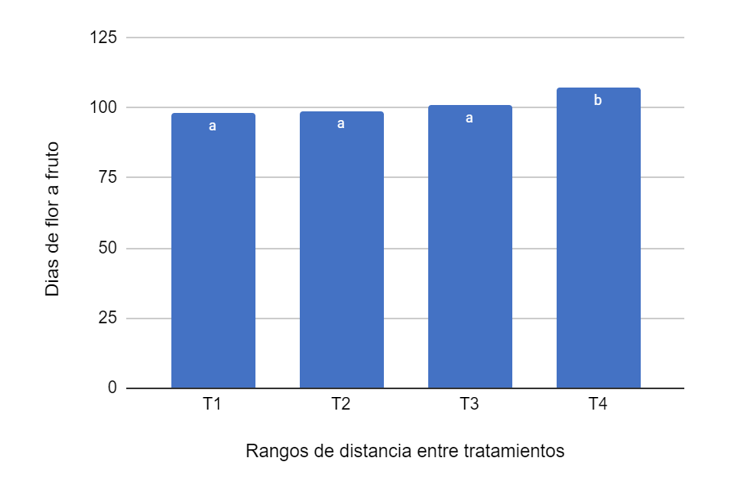
In a study by Vásquez et al. (2021), they established 1.6 hives ha-1 in orange crops, which resulted in a 26% increase in the number of oranges per tree against a 17% increase when using a density of 0.5 hives ha-1. As for the days required for the flowers to become harvest fruits, the results were similar across the three treatments (T1, T2, T3), with an average of 98, 99 and 101 days, respectively. In this sense, the control group (T4) differed statistically, taking 107 days from flower to fruit (Figure 1).
The average results of the variables of diameters, fruit weight, peel thickness, number of seeds, and juice weight are detailed in Table 4.
The results of the polar diameter showed similarity between T1 and T2, indicating that the flowers of the Mexican lime crop, when pollinated by bees, produce fruits that present a morphology close to a sphere. For the equatorial diameter, T1 had a result of 38.1 mm, differing statistically from T2 and T4. Regarding fruit diameters, it was observed that the trees that were closest to the colonies obtained the best results, demonstrating the influence of the pollinating activity of A. mellifera L.
In a study by Sagwe et al. (2023), where they carried out an experiment in 36 avocado orchards, of which 18 were supplemented with honeybee hives and the remaining 18 were control orchards, they evaluated fruit weight, seed weight, and oil and carbohydrate content of the fruits, and obtained that supplementation with bees on farms improved fruit weight and seed weight of avocado by 18% and increased oil content by 3.6%. In relation to weight, T1 and T2 had the best results, showing statistically significant differences compared with the other treatments.
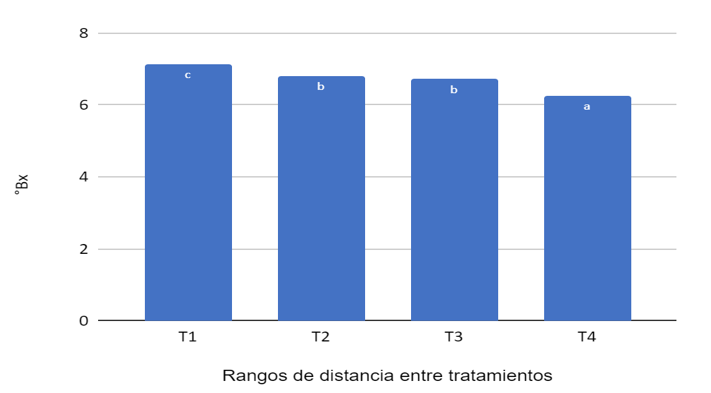
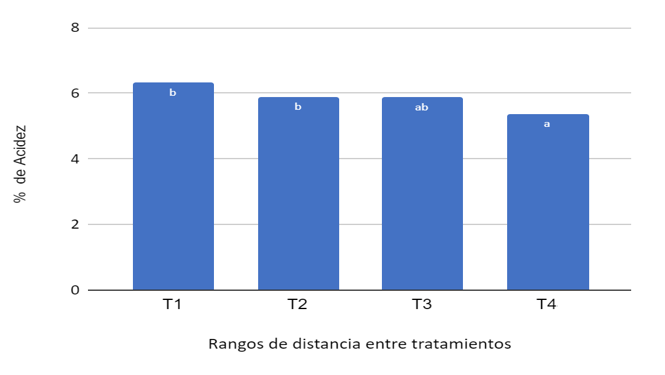
The number of seeds was higher in the fruits closest to the colony (T1 and T2). In terms of juice weight and peel thickness, it was found that T1 fruits had the most significant data, demonstrating that the fruits in this treatment were thicker and juicier. The results of the chemical variables of °Brix and acidity can be seen in Figures 2 and 3, respectively.
Regarding the °Brix, treatments 2 and 3 are similar. However, T1 and T2 benefited from pollinator activity, as they present 7.14 and 6.81 °Brix, respectively, compared to T3 and T4, which were lower. In terms of the acidity variable, the values among treatments T1, T2, and T3 were similar (6.32, 5.9 and 5.87, respectively), but they differed from T4, whose value was 5.37.
In the variables of fruit and juice weight, peel thickness, number of seeds, °Brix, and percentage of acidity, T1 and T2 obtained the best results compared to the other treatments, which allows us to infer two things; first, to corroborate the benefit in pollination of honeybees in lime flowers and second, the importance that bee colonies be placed within a distance range of 0-200 m, situations that, in various pollination studies, have demonstrated the efficiency of honeybees in the pollination of citrus crops (Ballesteros et al., 2011; Castañeda et al., 2012).
In the study by Castañeda et al. (2012), they evaluated directed pollination with A. mellifera L. on the quantity and quality of orange (Citrus sinensis) fruits at different distances. As a result, they obtained that fruit weight and volume were 7.2% and 13.2% higher, respectively, at a distance less than 200 m, whereas peel weight was lower, and the fruits were wide and long with a higher percentage of °Brix.
Vásquez et al. (2006) evaluated the pollinating effect of honeybees in strawberry commercial crops with three treatments (without exclusion, total exclusion and partial exclusion of bees) and found that the number of fruits was 60% higher in the treatment where bees had free access to the flowers. These results are similar to those obtained in this research regarding PHF in free-pollinated treatments (T1, T2 and T3).
Interiano et al. (2014) evaluated the effect of pollination of A. mellifera and Chrysoperla carnea on strawberry crops. The treatments used were self-pollination and open pollination. Among the results obtained for the quality values of the fruits from honeybees, the fruits were heavier, longer, and more homogeneous than those from the other C. carnea treatments; the fruits pollinated by the bees exhibited a positive effect on the production, coinciding with the results of the present research.
On the other hand, Mexican lime flowers are hermaphroditic (self-pollinating); the results of this work show that the presence of bees in the crop leads to greater production and improves fruit quality. This statement is supported by comparing trees that were excluded from visits by bees and other pollinators, where the results indicate that self-pollination is not enough. The pollinating importance of bees in self-pollinating crops has been reliably demonstrated in many research papers (Sanford et al., 1992; Santos et al., 2013; Interiano et al., 2015; Sajjad et al., 2023). Pesante (2010) notes that more effective pollination in shrubs and trees through the visit of bees can result in an increase in fruits and seeds.
Pollination of the flowers of Citrus aurantifolia (Christm.) Swingle using A. mellifera L. located within a range of 0-200 m from the trees shows a 25.2% increase in the set of harvested fruits of Mexican lime compared to the control group.
It is recommended to place and distribute honeybee hives evenly in orchards at distances no greater than 200 m in this crop, as it generates positive effects on yield, production and quality (fruit weight, polar diameter, juice weight and number of seeds) of the fruits.
Siopa, C.; Carvalheiro, L. G.; Castro, H.; Loureiro, J. y Castro, S. 2024. Animal-pollinated crops and cultivars a quantitative assessment of pollinator dependence values and evaluation of methodological approaches. Journal of Applied Ecology. 61(6):1279-1288. https://doi.org/10.1111/1365-2664.14634.