La exportación de la guayaba de México en el mercado mundial
DOI:
https://doi.org/10.29312/remexca.v17i3.4076Palabras clave:
balanza comercial, exportaciones, guayaba, importaciones, producciónResumen
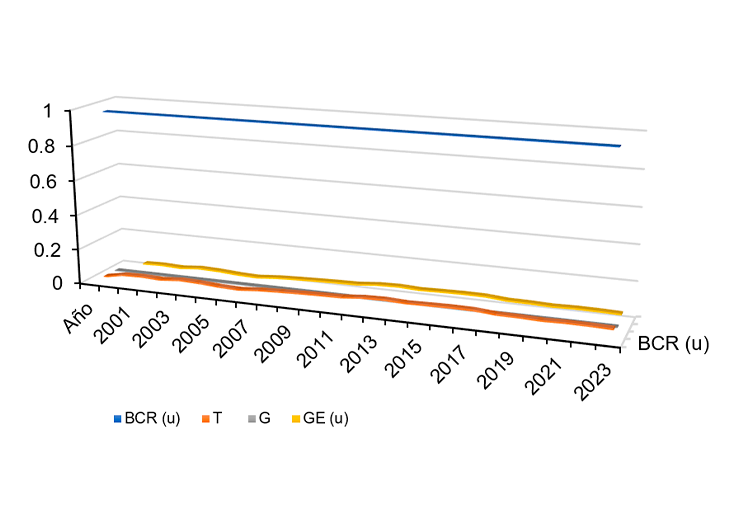
La guayaba es una fruta de alta aceptación a nivel mundial y en 2023 México se consolidó como el segundo exportador global, con un valor de 577 934.18 USD, lo que confirma su elevada competitividad internacional. El objetivo de la investigación consistió en analizar la competitividad de la guayaba mexicana en el comercio internacional, identificando su posición y formulando alternativas que fortalezcan su inserción en el comercio internacional. La investigación se desarrolló mediante el cálculo de tasas de crecimiento e índices de competitividad comercial para el periodo 2000-2023, utilizando datos de producción y comercio exterior. Los resultados mostraron que los indicadores fueron positivos: la balanza comercial se mantuvo en 1, lo que confirma que México es un exportador con ventajas competitivas; el indicador de trazabilidad fue de 0.34, evidenciando un exceso de oferta exportable; el coeficiente de dependencia comercial fue de 0, lo que refleja autosuficiencia alimentaria; y el grado de apertura exportadora alcanzó 0.035, señalando la existencia de excedentes exportables. En conjunto, estos resultados indican que la producción de guayaba en México se encuentra en expansión, con una marcada especialización exportadora y una posición competitiva sólida en el mercado internacional.
Descargas
Referencias
Avendaño, B. D. y Schwentesius, R. R. 2016. Competitividad y especialización del sector agroalimentario mexicano en el comercio internacional. Revista Mexicana de Agronegocios. 39(1):1029-1044.
Balassa, B. A. 1965. Trade liberalization and revealed comparative advantage. England. The Manchester School of Economic and Social Studies. 33(2):99-123. http://doi/10.1111/j.1467-9957.1965-tb00050.x. DOI: https://doi.org/10.1111/j.1467-9957.1965.tb00050.x
Banco Mundial. 2025. Global Economic Prospects: growth outlook and trade challenges.
Bustos, P. M. 2011. Trade liberalization, exportsters’dynamics and productivity growth. Jorunal of international Economics. 85(2):330-341. https://doi.org/10.1016/j.jinteco.2011.04.003.
Cruz, L. D. F.; Caamal, C. I.; Pat, F. V. G. y Reza, S. J. 2022. Competitividad de las exportaciones de aguacate Hass de México en el mercado mundial. Revista Mexicana de Ciencias Agrícolas. 13(2):355-362. https://doi.org/10.29312/remexca.v13i2.2885. DOI: https://doi.org/10.29312/remexca.v13i2.2885
Durán, L. J. E. y Álvarez, M. 2008. Indicadores de comercio exterior y política comercial: mediciones de posición y dinamismo comercial. (Documento de proyecto LC/W.217). Comisión Económica para América Latina y el Caribe (CEPAL). 1(1):1-45. https://repositorio.cepal.org/bitstream/handle/11362/3690/S2008794-es.pdf.
Espinosa, G. F. J. y Martínez, R. M. 2021. Innovaciones tecnológicas y su efecto en la competitividad del sector hortofrutícola en México. Revista Mexicana de Ciencias Agrícolas. 12(6):1023-1035.
FAO. 2023. Major Tropical Fruits. Market Review 2023. Organización de las Naciones Unidas para la Alimentación y la Agricultura (FAO). https://openknowledge.fao.org/items/60fb0b9e-f904-4690-8ccc-3539ca2cf2c3.
FAOSTAT. 2023. Food and Agriculture Organization of the United Nations: Statistical Database. Organización de las Naciones Unidas para la Alimentación y la Agricultura. https://www.fao.org/faostat/es/.
González, J. A. y Ramírez, M. P. 2023. Tendencias recientes en la exportación de frutas tropicales mexicanas. Revista Mexicana de Economía Agrícola y de los Recursos Naturales. 16(2):45-62. https://doi.org/10.22201/remea.2023.16.2.
Gutiérrez, M. D.; Guerrero, B. A. L.; Chávez, V. N. A.; Avelar, G. F. J. and Ornelas, G. I. G. 2023. Psidium guajava L.: from byproduct and use in traditional Mexican medicine to antimicrobial agent. Frontiers in Nutrition. 10(1):1108306. http:// doi.org/10.3389/fnut.2023.1108306. DOI: https://doi.org/10.3389/fnut.2023.1108306
Krugman, P. R.; Obstfeld, M. Melitz, M. J. 2018. Economía internacional: teoría y política 10ª Ed. Pearson Educación. 752-791 pp.
López, G. J. y Ramírez, M. A. (2021). Indicadores de eficiencia y productividad en sistemas agroindustriales mexicanos. Revista Mexicana de Economía Agrícola. 8(2):45-60.
Mendez, D. L. and Bacón, C. M. 2021. Innovación and market upgrading in global value chains: The case of horticultural exports. Global Food Security. 29(1):100535. https://doi.org/10.1016/j.gfs.2021.100535. DOI: https://doi.org/10.1016/j.gfs.2021.100535
Notteboom, T. E. and Rodriguez, J. P. 2020. The future of containerization: perspectives from maritime and inland freight distribution. Transport Reviews. 40(1):5-33. https://doi.org/10.1080/01441647.2019.1705604.
Pansara, T. D.; Ardeshna, N. J. and Vaghasiya, D. R. 2025. International trade of guava: An explorative study. International Journal of Statistics and Applied Matematics. 10(1):203-207.
Pariona, A. 2022. Guava (Psidium guajava L.) seed: A low volume, high value byproduct for human health and the food industry. Food Chemistry. https://doi.org/10.1016/j.foodchem.2022.133414. DOI: https://doi.org/10.1016/j.foodchem.2022.133414
Pat-Fernández, V. G.; Caamal- Cauich, I. Y Caamal-Pat, Z. H. 2014. Análisis de los indicadores de competitividad del comercio internacional de México. In anales de economía aplicada. Asociación Española de Economía Aplicada, ASEPELT. 75-87 pp.
Pat-Fernández, V. G.; Caamal-Cauich, I. y Caamal- Pat, Z. H. 2017. Comportamiento y competitividad del mango de México en el mercado mundial. In Ciencias Sociales Economía y Humanidades Handbook III. 1-16 pp.
Porter, M. E. 1990. The Competitive Advantage of Nations. Free Press. 1(1): 69-131. DOI: https://doi.org/10.1002/cir.3880010112
Quintero-Ramírez, J. M.; Omaña- Silvestre, J. M. y Ramírez- Padrón, L. C. 2020. Análisis de indicadores de ventajas comparativas reveladas: competitividad de las exportaciones de fresa (Fragaria spp.) mexicana. Revista de Desarrollo Económico. 7(24):13-19. DOI: https://doi.org/10.35429/JED.2020.24.7.13.19
Ramírez-Padrón, L. C.; Caamal-Cauich, I.; Pat-Fernández, V. G. y Martínez-Luis, D. 2016. Índices de competitividad de la fresa (Fragaria vesca L.) de México en el mercado mundial. Agroproductividad. 9(5):29-34.
Sangerman, J. D. M.; Larqué, S. B. S.; Navarro, B. A.; Rindermann, R. R. y Damian, H. M. A. 2013. Producción de guayaba (Psidium guajava L.) y su importancia socioeconómica en México. Revista de Ciencias Agrícolas. 4(7):1081-1093. https://www.scielo.org.mx/scielo.php?script=sci-arttext&pid=S200709342013000700009.
SIAP. 2023. Aumenta 8.2 por ciento la producción de guayaba en México en el último trienio. SAGARPA.
SIAP. 2023. Servicio de Información Agroalimentaria y Pesquera. Estadísticas de producción agrícola y pecuaria de México. Secretaría de Agricultura y Desarrollo Rural (SADER). https://www.gob.mx/siap.
SIAP. 2024. Servicio de Información Agroalimentaria y Pesquera Panorama agroalimentario 2018-2023. Guayaba. Secretaría de Agricultura y Desarrollo Rural. https://nube.agricultura.gob.mx/panorama-siap/2018-2024.pdf.
SIAP. 2024. Servicio de Información Agroalimentaria y Pesquera. Anuario estadístico de la producción agrícola 2000-2023: Guayaba (Psidium guajava L.). Secretaría de Agricultura y Desarrollo Rural. https://www.gob.mx/siap.
Suárez, T. J. R.; Hernández, A. C.; Domínguez, P. F. A. y Aceves, H. F. J. 2022. Characterization of guava grown in México. Revista Científica de Ciencias Agrícolas. 13(7):1233-1245. https://www.scielo.org.mx/scielo.php?pid=S200709342022000701233&script=sci-arttext. DOI: https://doi.org/10.29312/remexca.v13i7.3039
Vollrath, T. L. 1991. A theoretical evaluation of alternative trade intensity measures revealed comparative advantage. Weltwirtschaftliches Archiv. 127(2):265-280. http://doi.org/10.1007/BF02707986. DOI: https://doi.org/10.1007/BF02707986
Vorley, B. W.; Fearne, A. S. Ray, D. 2007. Regoverning markets: a place for small-scale producers in modern agrifood chains? International Institute for environment and development. 1(1):14:48. https://obnb.uk/p13634022-regoverning-markets-a-place-for-small-scale-producers-in-modern-agrifood-chains?utm-source=chatgpt.com.
Descargas
Publicado
Número
Sección
Licencia
Derechos de autor 2026 Revista Mexicana de Ciencias Agrícolas

Esta obra está bajo una licencia internacional Creative Commons Atribución-NoComercial 4.0.
Los autores(as) que publiquen en Revista Mexicana de Ciencias Agrícolas aceptan las siguientes condiciones:
De acuerdo con la legislación de derechos de autor, Revista Mexicana de Ciencias Agrícolas reconoce y respeta el derecho moral de los autores(as), así como la titularidad del derecho patrimonial, el cual será cedido a la revista para su difusión en acceso abierto.
Los autores(as) deben de pagar una cuota por recepción de artículos antes de pasar por dictamen editorial. En caso de que la colaboración sea aceptada, el autor debe de parar la traducción de su texto al inglés.
Todos los textos publicados por Revista Mexicana de Ciencias Agrícolas -sin excepción- se distribuyen amparados bajo la licencia Creative Commons 4.0 atribución-no comercial (CC BY-NC 4.0 internacional), que permite a terceros utilizar lo publicado siempre que mencionen la autoría del trabajo y a la primera publicación en esta revista.
Los autores/as pueden realizar otros acuerdos contractuales independientes y adicionales para la distribución no exclusiva de la versión del artículo publicado en Revista Mexicana de Ciencias Agrícolas (por ejemplo incluirlo en un repositorio institucional o darlo a conocer en otros medios en papel o electrónicos) siempre que indique clara y explícitamente que el trabajo se publicó por primera vez en Revista Mexicana de Ciencias Agrícolas.
Para todo lo anterior, los autores(as) deben remitir el formato de carta-cesión de la propiedad de los derechos de la primera publicación debidamente requisitado y firmado por los autores(as). Este formato debe ser remitido en archivo PDF al correo: revista_atm@yahoo.com.mx; revistaagricola@inifap.gob.mx.
Esta obra está bajo una licencia de Creative Commons Reconocimiento-No Comercial 4.0 Internacional.